

TL;DR:
- Maximum loss is the largest acceptable dollar amount a trader can lose before reinvesting or adjusting.
- Proper calculation of maximum loss involves entry price, stop-loss level, and position size before trading.
- Controlling maximum loss through discipline, stop-loss orders, and risk management strategies is essential for long-term trading success.
Most retail traders track their wins carefully but give far less attention to one number that determines whether they survive long enough to win again: maximum loss. This figure represents the largest amount a trader can lose on a single trade or over a defined period, and retail traders commonly misunderstand it, often failing to factor in all risk variables. Without a clear picture of maximum loss, position sizing becomes guesswork, leverage becomes a liability, and a single bad trade can wipe out weeks of gains. This guide breaks down what maximum loss really means, how to calculate it, and how to use it as a foundation for disciplined trading.
Table of Contents
- Defining maximum loss in trading
- Factors affecting maximum loss in day trading
- How to calculate your maximum loss before entering a trade
- Strategies to minimize maximum loss
- Why maximum loss is the starting point for successful trading
- Unlock your trading potential with expert risk management
- Frequently asked questions
Key Takeaways
| Point | Details |
|---|---|
| Maximum loss defined | Understanding how to calculate maximum loss is essential for every trade you make. |
| Risk factors matter | Position size, leverage, and stop-loss orders are key to controlling your losses. |
| Pre-trade calculation | Always determine your maximum loss before entering a position for smart risk management. |
| Minimizing loss | Disciplined strategies and trading rules help keep your losses within planned limits. |
| Risk-first mindset | Focusing on loss control is the foundation for sustainable trading success. |
Defining maximum loss in trading
Maximum loss in trading is the largest dollar amount a trader is willing or able to lose on a position, a session, or across a defined period. It is not simply the worst-case scenario in the abstract. It is a concrete, pre-calculated figure that every serious trader must establish before placing an order.
The core formula is straightforward:
Maximum Loss = (Entry Price – Stop Loss Level) x Position Size
For example, if you enter a trade at $100, place a stop loss at $97, and hold 500 units, your maximum loss is $1,500. That number is fixed before the trade opens, which is exactly the point.
It is important to distinguish between theoretical and realized maximum loss. Theoretical maximum loss is calculated before the trade. Realized maximum loss is what actually occurs, which can exceed the theoretical figure if slippage occurs during fast-moving markets or if a stop-loss order is not triggered at the intended price.
| Term | Definition |
|---|---|
| Theoretical maximum loss | Pre-calculated loss based on entry and stop-loss price |
| Realized maximum loss | Actual loss recorded after trade closure |
| Slippage | Difference between expected and actual execution price |
| Risk parameter | Predefined rule limiting total loss exposure |
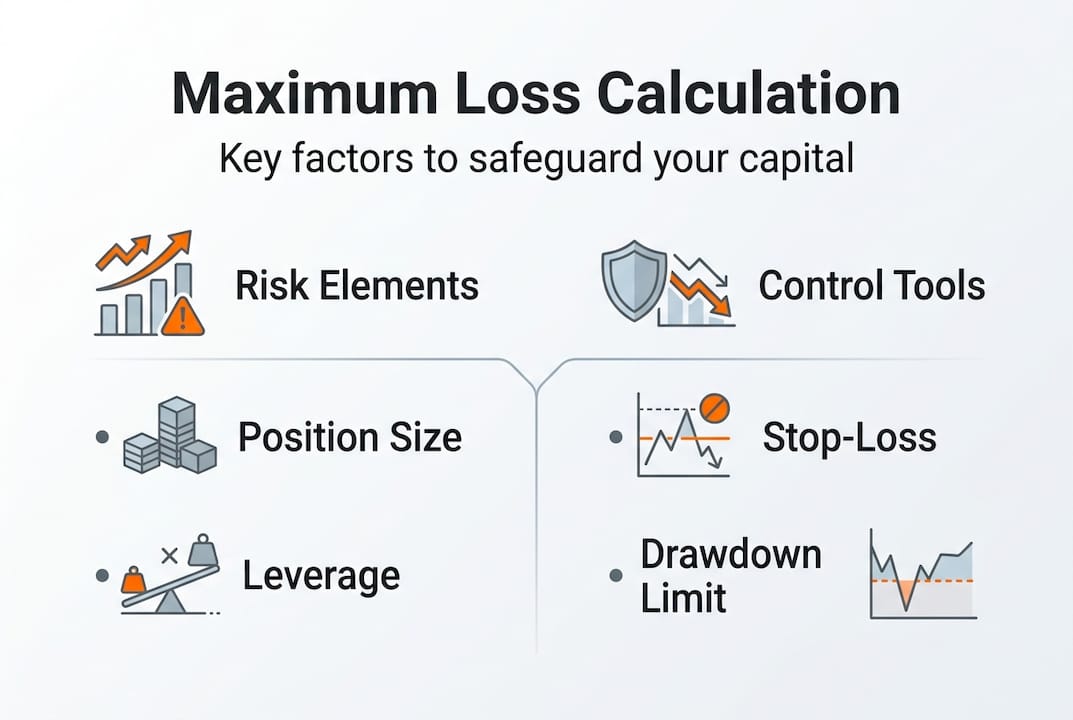
Key elements that define maximum loss include:
- Entry price: The price at which the position is opened
- Stop-loss level: The price at which the position is automatically closed to limit loss
- Position size: The number of units, lots, or contracts held
- Leverage ratio: The multiplier applied to your capital, which scales both gains and losses
Pro Tip: Always calculate your maximum loss in dollar terms, not just percentage terms. Percentages can obscure the real impact on your account balance, especially when trading with leverage.
Understanding crypto risk management rules and applying them consistently is what separates reactive traders from disciplined ones. Building a habit of pre-trade loss calculation is a core component of risk management for consistent profits.
Factors affecting maximum loss in day trading
With a clear definition in place, let’s explore the real-world factors that shape maximum loss in day trading. Several variables interact to determine how large your potential loss can grow, and each one requires deliberate management.
1. Position size
The larger your position, the greater your maximum loss at any given stop-loss distance. Doubling your position size doubles your dollar risk, even if nothing else changes. This is why position sizing is the first line of defense against outsized losses.
2. Leverage
Leverage allows you to control a large position with a small amount of capital. A 10:1 leverage ratio means a 1% move against you produces a 10% loss on your margin. Position sizing, leverage, and stop-loss orders are the most influential mechanisms for controlling maximum loss.
3. Stop-loss orders
A stop-loss order instructs your broker to close a position once it reaches a specified price. Without one, your maximum loss is theoretically unlimited on certain instruments. With one, your loss is capped, assuming no severe slippage.
4. Market volatility
Day trading involves intraday price swings that can be sharper and faster than those seen in swing trading. Higher volatility means wider stop-loss placement may be necessary, which directly increases maximum loss per trade.
| Factor | Day trading impact | Swing trading impact |
|---|---|---|
| Volatility | High, intraday spikes | Lower, multi-day trends |
| Stop-loss distance | Often tighter | Often wider |
| Leverage use | Typically higher | Typically lower |
| Maximum loss frequency | Higher (more trades) | Lower (fewer trades) |
“The traders who survive long-term are not those who avoid losses entirely. They are those who control how large each loss can become.”
Managing drawdown limits is especially critical in day trading because multiple small losses can compound quickly within a single session. Equally, emotional responses to losses, such as the impulse to avoid revenge trading, are among the most dangerous amplifiers of maximum loss.

How to calculate your maximum loss before entering a trade
Now that you know what factors are involved, let’s dig into how you can proactively calculate your maximum loss on any trade. Pre-trade calculation is not optional for serious traders. It is the standard.
Here is a step-by-step process:
- Identify your entry price. This is the price at which you plan to open the position.
- Set your stop-loss level. Determine the price at which the trade is clearly invalidated based on your strategy.
- Calculate the distance. Subtract the stop-loss level from the entry price (for long trades). This gives you the risk per unit.
- Determine your position size. Decide how many units or lots you will trade.
- Apply the formula. Multiply the risk per unit by position size to get your maximum loss in dollar terms.
- Compare to your account risk limit. Most professional risk frameworks recommend risking no more than 1-2% of account equity per trade.
Worked example:
- Entry price: $150
- Stop-loss level: $145
- Risk per unit: $5
- Position size: 200 units
- Maximum loss: $1,000
If your account balance is $50,000, this represents a 2% risk, which falls within standard professional parameters.
The best practice is to determine maximum loss on every trade before execution, using precise formulas and disciplined risk limits. Traders who skip this step often discover their actual risk exposure only after a loss has already occurred.
Pro Tip: Use a simple spreadsheet or a trading journal to log your pre-trade maximum loss calculation on every position. Over time, this builds pattern recognition around which setups carry the most risk.
Common mistakes to avoid include setting stop-losses based on round numbers rather than technical levels, ignoring the effect of leverage on dollar risk, and failing to adjust position size when volatility increases. Applying trading success factors consistently means treating pre-trade loss calculation as non-negotiable. Reviewing FX trading best practices can also help you refine how you set stop-loss levels across different market conditions.
Strategies to minimize maximum loss
Once you understand how to calculate maximum loss, it’s time to focus on proven ways to minimize your exposure and protect your trading capital. Calculation tells you what your risk is. Strategy determines whether you keep it under control.
Core strategies include:
- Strict stop-loss discipline: Place stop-loss orders on every trade, without exception. Moving a stop-loss further away from entry to avoid being stopped out is one of the most common and costly mistakes retail traders make.
- Fixed percentage risk per trade: Commit to risking no more than 1-2% of your account on any single trade. This prevents any one loss from significantly damaging your overall capital.
- Scaling position size to volatility: During high-volatility periods, reduce position size to maintain consistent dollar risk even as stop-loss distances widen.
- Avoiding overtrading: Taking too many trades in a session increases cumulative maximum loss exposure, even if each individual trade appears low-risk.
- Maintaining a risk/reward ratio of at least 1:2: This means your potential profit target is at least twice your maximum loss. Over time, this ratio supports positive expectancy.
Smart risk management strategies, like setting strict stop-loss levels and avoiding revenge trading, help traders minimize their maximum potential loss across sessions.
| Strategy | Risk reduction impact |
|---|---|
| Fixed stop-loss on every trade | Caps loss per position |
| 1-2% account risk rule | Limits session-level drawdown |
| Position size scaling | Maintains consistent dollar risk |
| 1:2 risk/reward minimum | Supports positive long-term expectancy |
| No revenge trading rule | Prevents compounding emotional losses |
Pro Tip: After any losing trade, wait at least 15 minutes before re-entering the market. This pause reduces the likelihood of emotional decision-making that leads to larger, unplanned losses.
Following structured trading rules and risk frameworks removes the guesswork from loss management. Traders who work to build discipline in trading consistently outperform those who rely on intuition alone.
Why maximum loss is the starting point for successful trading
Most retail traders set profit targets first and think about losses second. This is backwards. The traders who build lasting careers in the markets start with one question: how much can I lose on this trade? Everything else, entry timing, position size, leverage, follows from the answer.
Conventional trading content focuses heavily on setups, indicators, and profit potential. Very little attention goes to the structural role of maximum loss as a performance metric. Yet managing risk for consistent profits is what separates traders who grow their accounts from those who blow them up.
Seasoned traders understand that a risk-first mindset is not pessimistic. It is the only rational approach to a probabilistic environment. When you define your maximum loss before every trade, you remove uncertainty from the one variable you can actually control. Profits are never guaranteed. Losses, within defined limits, can be.
This shift in perspective is what makes the difference between traders who survive drawdowns and those who do not.
Unlock your trading potential with expert risk management
Applying maximum loss principles consistently is a skill that takes time, structure, and the right environment to develop. DayProp Funding provides exactly that.
Through structured evaluation programs, professional risk parameters, and scalable funding, DayProp gives disciplined traders the tools and capital to grow without putting personal funds at risk. Whether you want to compare trader funding models, sharpen your approach to manage risk for consistent profits, or simply take the next step in your trading career, explore DayProp Funding to see how structured prop trading can support your development.
Frequently asked questions
How do stop-loss orders limit maximum loss?
Stop-loss orders automatically close a trade at a predetermined price, ensuring losses stay within set limits and protecting your capital from uncontrolled drawdown.
What is the impact of leverage on maximum loss?
Leverage amplifies trading risk and can rapidly increase losses, making tight risk controls essential when trading on margin.
How can I calculate my maximum loss for a specific trade?
Multiply your position size by the difference between entry and stop-loss price. Formulas help traders estimate maximum loss for each position before the trade is placed.
What are the most effective ways to minimize maximum loss?
Discipline, strict stop-loss strategies, and avoiding emotional trading are key to keeping maximum loss consistently under control across sessions.
Why should I focus on maximum loss rather than just profits?
Risk control is central to trading success because consistently managing loss keeps your account intact and enables sustainable growth over time.
Recommended