

Many experienced retail traders suffer inconsistent results despite market knowledge because they ignore how regime shifts alter risk profiles. When volatility expands or liquidity thins, your edge changes completely. Trading rules provide the framework to adapt position sizing, stops, and risk budgets to these shifting conditions. Disciplined rule application reduces drawdowns, protects capital during uncertain periods, and dramatically increases your chances of securing proprietary funding. This guide explains why structured trading rules transform outcomes for FX, indices, and crypto traders seeking consistent profitability and funded accounts.
Table of Contents
- Understanding Market Regimes And Why Trading Rules Matter
- How Trading Rules Improve Risk Management And Protect Your Capital
- Common Pitfalls Traders Face Without Proper Rules And How To Avoid Them
- Implementing Trading Rules For Consistent Profits And Funding Success
- Enhance Your Trading With Dayprop Funding Programs
- FAQ
Key takeaways
| Point | Details |
|---|---|
| Regime mismatches cause losses | Trading the wrong regime turns normal variance into structural account damage |
| Risk budgets must adapt | Adjusting stops and size with volatility prevents oversized losses during uncertain periods |
| Rules improve profitability | Disciplined trading reduces drawdowns by 30-40% and increases profits by 20-30% |
| Consistency attracts funding | Structured rule application demonstrates the discipline prop firms seek in funded traders |
| Dynamic sizing protects capital | Static position sizing across changing conditions converts volatility into permanent damage |
Understanding market regimes and why trading rules matter
Market regimes define the behavioral environment your trades operate within. A trending regime rewards momentum strategies, while range-bound conditions punish breakout attempts. Volatility expansion periods demand tighter stops and smaller positions, yet many traders maintain identical setups across all three environments. This mismatch between strategy and regime context transforms statistical edge into consistent losses.
Trading the wrong regime leads to losses because the same setup behaves differently when volatility expands, when liquidity thins, or when macro drivers dominate. Your 2% risk per trade might work perfectly in stable trending markets but destroy your account during sudden regime shifts. Without formal rules recognizing these transitions, you’re essentially gambling that current conditions persist indefinitely.
Trading rules formalize your approach to regime recognition and adaptation. They specify when to trade momentum versus mean reversion, how to adjust position sizing as volatility changes, and which setups to avoid entirely during uncertain periods. This structure prevents the most expensive mistake traders make: applying yesterday’s winning strategy to today’s completely different market environment.
Consider these regime-specific adjustments your rules should address:
- Position sizing that scales inversely with volatility measurements
- Stop placement that widens during expansion phases to avoid premature exits
- Entry criteria that become more selective when market uncertainty rises
- Risk allocation that shifts toward lower-correlation instruments during stress periods
Pro Tip: Track which regime your primary markets occupy weekly. When you notice transitions from trending to ranging conditions, immediately reduce position sizes by 30-50% until the new regime stabilizes and you can validate your edge again.
“Market regimes change faster than most traders adjust their strategies. The gap between regime shift and strategy adaptation is where accounts die. Rules close that gap by forcing proactive rather than reactive adjustments.”
The fundamental principle underlying effective trading rules is that trading discipline requires recognizing when your edge exists and when it doesn’t. Most traders focus on finding perfect entries, but professionals focus on avoiding trades that lack statistical support in current conditions. Rules enforce this distinction automatically, removing emotional decision-making from regime assessment.
How trading rules improve risk management and protect your capital
Trading rules transform abstract risk concepts into concrete position limits and stop placement guidelines. Instead of deciding trade size based on conviction or recent results, rules dictate specific percentages tied to account equity and current volatility. This mechanical approach removes the psychological biases that cause traders to risk too much after wins or too little after losses.
Adjusting stops and position size based on measured volatility prevents the structural damage that ends trading careers. When the VIX spikes 40% or your currency pair’s ATR doubles, maintaining your standard 2% risk actually increases real exposure dramatically. Disciplined trading rules significantly improve risk management for retail traders in FX, indices, and crypto, leading to increased funding opportunities through measurable reduction in maximum drawdown periods.
Follow this sequence to implement volatility-adjusted risk management:
- Calculate your instrument’s 20-day average true range every week
- Establish your base risk per trade as 1-2% of account equity
- Scale position size inversely when ATR exceeds its 60-day average by more than 25%
- Widen stop distances proportionally to maintain the same risk percentage
- Reduce total portfolio heat when multiple positions show correlated volatility spikes
- Document every adjustment to build a performance database for rule refinement
Structured rules reduce drawdowns by 30-40% while increasing profitability by 20-30% because they prevent the catastrophic single trades that wipe out months of gains. You’re not optimizing for perfect trade selection. You’re optimizing to survive long enough that statistical edge compounds over hundreds of executions. Managing risk effectively means accepting smaller wins during volatile periods in exchange for avoiding the losses that end your trading career.
Pro Tip: Set a maximum portfolio heat limit of 6-8% across all open positions. When combined risk approaches this threshold, stop taking new trades regardless of setup quality. This single rule prevents the position clustering that turns normal drawdowns into account-ending events.
Risk budgets must contract when market uncertainty rises. During major economic announcements, geopolitical shocks, or liquidity crises, your effective edge shrinks even if your strategy remains technically sound. Rules formalize this relationship by reducing position sizes 25-50% when uncertainty indicators like the VIX exceed historical norms or when bid-ask spreads widen significantly.
“The difference between professional and amateur risk management isn’t sophistication. It’s consistency. Professionals apply the same rules every single trade, regardless of recent results or market excitement. Amateurs adjust rules to fit their current emotional state.”
Enforcing discipline through predetermined rules eliminates the emotional trading decisions that destroy accounts. You won’t convince yourself that this setup is special enough to risk 5% instead of your standard 2%. You won’t move your stop further away because you believe the market will reverse. The rules decide, removing your psychology from risk decisions entirely. This mechanical consistency is exactly what prop trading firms evaluate when assessing funding candidates.
Common pitfalls traders face without proper rules and how to avoid them
Static sizing and stop placement across changing market conditions represents the single most expensive mistake retail traders make. Keeping the same size and stop logic when the market changes converts normal variance into structural damage. Your account trends downward not because your strategy stopped working, but because you’re applying it in conditions where it has no edge.
Mistaking range-bound markets for trending conditions causes traders to chase breakouts that immediately reverse. Conversely, applying mean reversion strategies during strong trends results in catching falling knives repeatedly. Without rules that formally identify regime characteristics, you’ll consistently apply the wrong strategy type to current conditions. This mismatch doesn’t just reduce profitability; it creates systematic losses that compound over time.
Compare these approaches to the same volatile market environment:
| Approach | Position Sizing | Stop Placement | Outcome |
| — | — | — |
| No rules | Fixed 2% risk regardless of volatility | Static 50-pip stops | 35% drawdown as volatility spikes trigger stops |
| Adaptive rules | Scales to 1% when ATR exceeds average | Widens to 75 pips during expansion | 12% drawdown, maintains edge through volatility |
| Regime-aware rules | Reduces to 0.5% during uncertain periods | Pauses trading until regime stabilizes | 6% drawdown, preserves capital for high-edge setups |
Pro Tip: After every losing trade, verify whether you correctly identified the current regime before entry. If you traded a breakout during ranging conditions or faded a move during a strong trend, the problem isn’t your execution but your regime assessment. Adjust your identification rules, not your strategy.
The most dangerous pitfall is believing that perfect trade selection matters more than risk management. You’re not trying to find trades that never lose. You’re building a system that survives the inevitable losing streaks every strategy experiences. Trading rule transparency in your approach allows you to identify when losses result from bad luck versus structural problems in your regime identification or risk scaling.
Avoid these specific errors through formal rule implementation:
- Never risk more than 1% on any single trade during the first month after a regime change
- Immediately cut position sizes by 50% when your 10-trade win rate drops below your historical average
- Stop trading entirely when drawdown exceeds 8% until you identify the regime mismatch
- Require three confirming signals before entering trades during high-uncertainty periods
- Document every trade’s regime classification to build pattern recognition over time
You’re aiming to avoid the big losses that permanently damage accounts, not to achieve perfect accuracy. A trading system with 45% win rate and disciplined risk management outperforms a 65% win rate system with inconsistent position sizing. The difference lies entirely in how rules protect capital during inevitable losing periods and prevent emotional decisions from compounding losses.
Implementing trading rules for consistent profits and funding success
Creating effective trading rules starts with defining specific strategies for each market regime you’ll encounter. Your trending market rules should specify momentum indicators, breakout criteria, and trailing stop methodology. Range-bound rules need mean reversion signals, support and resistance identification, and profit-taking guidelines. Volatility expansion rules must include position size reduction triggers and conditions for pausing trading entirely.
Follow these steps to build a comprehensive rule framework:
- Identify the three primary regimes in your traded instruments using objective measurements
- Define entry criteria specific to each regime with exact indicator values and confirmations
- Establish position sizing formulas that adjust based on current volatility measurements
- Set stop placement rules that account for regime-specific price behavior
- Create profit-taking guidelines appropriate to expected move sizes in each regime
- Document maximum portfolio heat limits and correlation restrictions
- Specify conditions that pause trading until market clarity improves
Adjust risk tolerance and position size proactively as volatility measurements change, not reactively after losses occur. When your instrument’s ATR increases 30% above its average, reduce position sizes before taking the next trade. When uncertainty rises, your risk budget falls proportionally. This proactive adjustment prevents the drawdowns that reactive traders experience repeatedly.
Maintain detailed documentation of every trade decision and rule application. Record which regime you identified, what signals triggered your entry, how you calculated position size, and where you placed stops. This transparency serves two critical purposes: it allows you to refine rules based on actual performance data, and it demonstrates the discipline that prop firms require when evaluating traders for funding.
Consistent rule application attracts proprietary funding because it proves you can manage capital professionally. Prop firms don’t fund traders who show occasional brilliance mixed with emotional decisions. They fund traders who apply the same disciplined process every single trade, producing consistent risk-adjusted returns. Your rule documentation becomes your resume, demonstrating that you treat trading as a business rather than speculation.
Key elements your rule system must address:
- Maximum daily loss limits that force trading cessation before emotional decisions compound damage
- Minimum win rate thresholds that trigger strategy review when performance degrades
- Correlation limits preventing excessive exposure to single market moves
- Scaling rules that increase position sizes only after sustained profitability demonstrates edge
- Review schedules for updating rules based on changing market structure
Pro Tip: Start with overly conservative rules that feel restrictive. It’s far easier to gradually loosen profitable rules than to tighten rules after undisciplined trading damages your account. Most traders fail by starting too aggressive, not too cautious.
The path to consistent profitability and funding success requires treating your trading rules as non-negotiable rather than guidelines. Every discretionary override you permit creates an opportunity for emotional decisions to bypass your risk management. Professional risk management means following rules even when you’re convinced this particular trade deserves an exception. The moment you start making exceptions, you’ve abandoned the system that protects your capital.
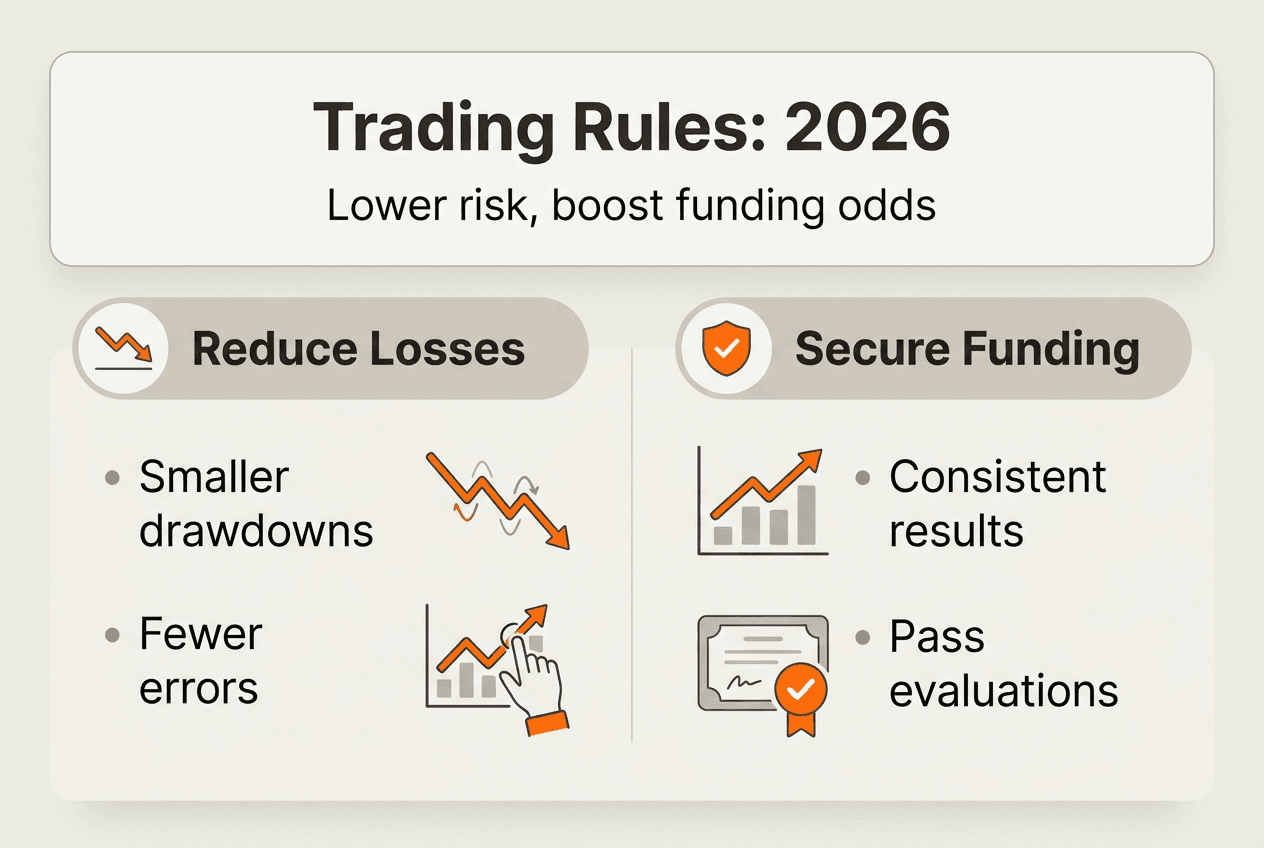
Setting clear trading objectives aligned with your rules creates measurable targets for evaluation. Instead of vague goals like “be profitable,” define specific metrics: maximum drawdown under 10%, win rate above 48%, average risk-reward ratio of 1:1.8, and monthly return between 3-6%. These concrete objectives let you assess whether your rules produce the consistency required for funding approval.
Enhance your trading with DayProp funding programs
Mastering trading rules positions you perfectly for proprietary funding opportunities that reward disciplined risk management. DayProp offers structured evaluation programs specifically designed to identify traders who demonstrate consistent rule application and professional capital management. Their transparent criteria align directly with the regime-aware, volatility-adjusted approach this guide teaches.

DayProp’s comprehensive evaluation guide walks you through exactly what funding firms assess and how to demonstrate the discipline they require. Their performance-based evaluation process focuses on risk-adjusted returns rather than absolute profit, rewarding traders who protect capital during volatile periods. Understanding why professional risk management matters transforms how you approach both evaluation and funded trading. The skills you develop implementing structured trading rules directly translate into meeting funding criteria and scaling your allocated capital over time.
FAQ
Why do trading rules reduce drawdowns?
Trading rules prevent oversized positions during volatile or uncertain market conditions by enforcing predetermined risk limits. They remove emotional decision-making that causes traders to increase exposure after wins or violate stop placement during losses. Rules ensure consistent position sizing relative to account equity and current volatility, preventing the catastrophic single trades that create deep drawdowns. By formalizing when to reduce risk and when to pause trading entirely, rules protect capital during the periods that destroy undisciplined accounts.
Can trading rules guarantee funding success?
Rules significantly increase funding eligibility by demonstrating the consistency and discipline proprietary firms require, but they don’t guarantee approval. Successful funding requires meeting specific evaluation metrics over sustained periods while managing drawdowns within firm limits. Rules eliminate the emotional mistakes and inconsistent risk management that cause most evaluation failures. Combined with genuine edge in your trading strategy, disciplined rule application gives you the best possible chance of securing and maintaining funded accounts. The difference between funded and unfunded traders is usually consistency, not occasional brilliance.
How often should I review and adapt my trading rules?
Review your trading rules after significant market regime changes, after drawdowns exceeding 5%, or quarterly at minimum. Major volatility shifts, changes in correlation patterns, or sustained performance degradation all signal potential needs for rule adjustment. However, distinguish between refining rules based on data versus abandoning them due to recent losses. Stay flexible enough to adapt rules when market structure genuinely changes, but disciplined enough to follow current rules until systematic review indicates needed modifications. Maintaining trading discipline means resisting the urge to constantly tweak rules after every losing trade.
What’s the minimum number of rules needed for effective trading?
You need rules covering five critical areas: regime identification criteria, position sizing formulas, stop placement methodology, maximum portfolio heat limits, and conditions for pausing trading. Start with one specific rule in each category rather than building elaborate systems. For example, reduce position size by 50% when ATR exceeds its 60-day average, place stops at 1.5x current ATR, and stop trading when daily loss reaches 2%. Simple rules consistently applied outperform complex systems inconsistently followed. Add refinements only after you’ve proven you can follow basic rules for at least three months without violations.
How do I know if my trading rules actually work?
Track these metrics over at least 100 trades: maximum drawdown depth and duration, win rate relative to historical average, average risk-reward ratio, and consistency of position sizing. Effective rules should reduce maximum drawdown compared to your pre-rule trading while maintaining or improving overall profitability. Your position sizes should show clear correlation with volatility measurements, and you should have zero instances of violating predetermined risk limits. If you’re still making discretionary overrides or emotional decisions, your rules aren’t working because you’re not following them. The effectiveness of rules depends entirely on consistent application, not theoretical soundness.
Recommended