
TL;DR:
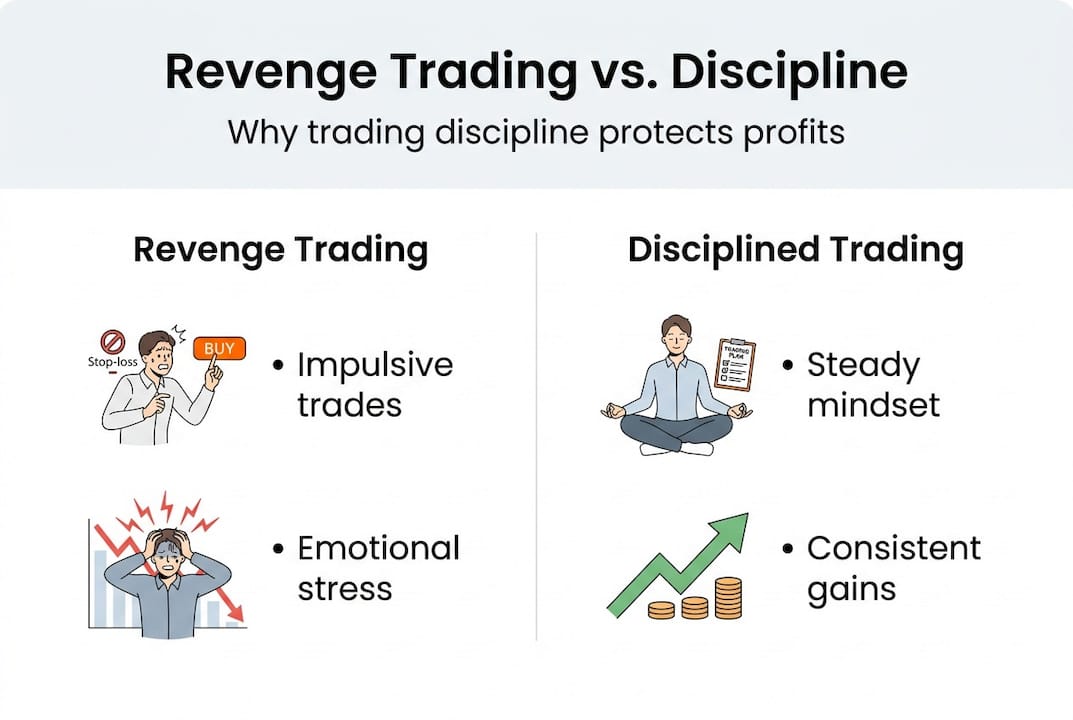
- Revenge trading is an impulsive attempt to recover losses driven by emotional triggers.
- It impairs rational decision-making, increases risk, and can erode trading accounts over time.
- Building structured routines and external accountability are key to breaking the revenge trading cycle.
Revenge trading is one of the most destructive patterns in retail FX, indices, and crypto markets, yet many traders mistake it for resilience. The idea that doubling down after a loss shows courage or market intelligence is a dangerous misconception. Research in behavioral finance consistently shows that loss aversion drives irrational risk, pushing traders toward decisions that feel justified in the moment but systematically erode capital over time. This article breaks down what revenge trading actually is, why it happens even to experienced traders, and how you can build practical systems to stop it before it stops your trading career.
Table of Contents
- What is revenge trading and why does it happen?
- The psychological trap: Urgency, ego, and impaired decision-making
- Why wins can be dangerous: False rewards and the gambler’s trap
- How to break the revenge trading cycle: Practical steps
- Perspective: What most traders get wrong about revenge trading
- Next steps: Build discipline with proven trading frameworks
- Frequently asked questions
Key Takeaways
| Point | Details |
|---|---|
| Revenge trading defined | It’s an emotional response to losses that leads traders to take impulsive, high-risk trades. |
| Psychology is central | Loss aversion, stress, and ego are major drivers behind the urge to chase losses. |
| Wins reinforce the cycle | Occasional victories in revenge trades make the habit much harder to break. |
| Break the cycle | Simple routines—like pausing, journaling, and debriefing—reduce impulsive mistakes. |
| Even pros are at risk | Skilled traders, not just beginners, experience the revenge trading trap. |
What is revenge trading and why does it happen?
Revenge trading refers to placing trades with the primary goal of recovering recent losses, rather than acting on a valid market signal or strategy. It is not a deliberate choice most of the time. It is a reactive state where emotion overrides analysis. In FX markets, this might look like doubling your position size after a losing EUR/USD trade. In crypto, it could mean chasing a Bitcoin move you missed by entering at a poor level with no clear stop.
The behavioral science behind this is well established. Kahneman and Tversky’s loss aversion principle explains that losses feel roughly twice as painful as equivalent gains feel rewarding. This asymmetry creates a strong psychological pull to “undo” a loss as quickly as possible. The result is urgency, and urgency is the enemy of disciplined trading.
Several emotional triggers fuel revenge trading:
- Anger at the market or at yourself for a poor decision
- Urgency to recover capital before the session ends
- Ego that refuses to accept being wrong
- Fear that the loss defines your ability as a trader
Importantly, revenge trading is not limited to beginners. Skilled traders with years of experience can fall into the same trap, especially after a streak of strong performance is suddenly interrupted. Overconfidence built during a winning run can make a single loss feel disproportionately threatening.
“Loss aversion and urgency work together to push traders toward impulsive decisions that feel rational but are driven entirely by emotional state rather than market logic.”
Understanding trading psychology basics is the first step toward recognizing these triggers before they translate into harmful trades. The pattern is predictable once you know what to look for.
The psychological trap: Urgency, ego, and impaired decision-making
Once a loss occurs, the brain enters a stress response. Cortisol, the primary stress hormone, rises sharply. Research confirms that cortisol spikes impair rational decision-making after a loss, reducing a trader’s ability to assess risk accurately and increasing appetite for high-variance bets. This is not a character flaw. It is biology working against your trading plan.
Ego compounds the problem. Many traders privately define their self-worth through their trading results. A loss is not just a financial setback; it feels like a personal failure. This triggers a need to prove competence immediately, which pushes traders toward larger, faster, and less-considered positions.
The table below illustrates how disciplined and revenge-driven traders respond differently to the same losing trade:
| Situation | Disciplined trader | Revenge-driven trader |
|---|---|---|
| Loss on EUR/USD | Reviews trade, notes error, waits for next setup | Immediately re-enters with larger size |
| Two consecutive losses | Steps back, checks daily drawdown limit | Increases risk to recover faster |
| End-of-session loss | Accepts result, logs trade in journal | Places late trade outside strategy |
| Losing streak | Reduces position size, reassesses edge | Switches instruments chasing momentum |
The contrast is clear. Discipline creates a buffer between stimulus and response. Revenge trading removes that buffer entirely.
Pro Tip: When you feel the urge to re-enter a trade immediately after a loss, set a physical timer for 10 minutes. Do not touch the platform until it goes off. This small pause interrupts the cortisol-driven impulse cycle and allows your prefrontal cortex, the rational part of your brain, to re-engage.
For traders building toward funded accounts, understanding this dynamic is essential. Reading a retail prop trading guide alongside studying capital allocation in trading gives you the structural knowledge to pair with psychological awareness. Prop trading evaluation essentials also reinforce why emotional discipline is weighted as heavily as raw performance.
Why wins can be dangerous: False rewards and the gambler’s trap
Here is the counterintuitive reality most traders never consider: winning a revenge trade is often worse than losing it. When an impulsive trade happens to recover your loss, your brain registers a reward. Dopamine is released. The behavior is reinforced. You have just trained yourself to repeat a destructive pattern.
This is exactly how occasional wins reinforce impulsive behavior, making revenge trading more likely in the future. The same mechanism drives gambling addiction. Variable reward schedules, where wins are unpredictable, are the most powerful form of behavioral conditioning known in psychology.
The following patterns signal that gambling psychology has entered your trading:
- Increasing position size after a loss without a strategy-based reason
- Trading instruments you do not normally follow because they are “moving”
- Ignoring your pre-set stop loss after entry
- Feeling relief rather than satisfaction after a recovery trade
- Justifying poor setups because “I need to make this back”
The data below compares outcomes across 20-trade streaks for disciplined versus revenge-driven approaches:
| Metric | Disciplined trader (20 trades) | Revenge trader (20 trades) |
|---|---|---|
| Average win rate | 52% | 48% |
| Average risk per trade | 1% of account | 2.8% of account |
| Largest single drawdown | 4% | 18% |
| Account growth | +8% | -22% |
| Emotional consistency | High | Low |
The numbers reveal something critical. The revenge trader may win nearly as often, but the risk profile destroys the account over time. Consistency in risk management, not win rate alone, determines long-term profitability.

Focusing on building trading discipline is the structural antidote to this trap. The goal is not to eliminate losses. It is to ensure no single emotional decision can undo weeks of disciplined work.
How to break the revenge trading cycle: Practical steps
Recognizing the pattern is necessary, but recognition alone does not stop it. You need a repeatable system. Research confirms that structure can interrupt the loss-to-impulse cycle, and the most effective systems are simple enough to follow under emotional stress.
Here is a four-step framework to apply after any significant loss:
- Detect: Identify the emotional state immediately after the loss. Ask yourself: “Am I thinking about the next trade or about recovering this loss?” The answer tells you everything.
- Disrupt: Step away from the platform. Close the charts. A minimum 15-minute break is non-negotiable. Physical movement, such as a short walk, accelerates the reset.
- Document: Open your trading journal and write down what happened. Note the entry, the reason, the outcome, and your emotional state. This converts a reactive moment into a learning event.
- Debrief: Before re-entering the market, review your trading plan. Confirm that any new trade idea meets your pre-defined criteria. If it does not, it does not get placed.
Pro Tip: Keep a pre-trade checklist as a separate document from your journal. Before every trade, check off: valid setup, correct position size, stop loss defined, and emotional state neutral. If any box is unchecked, the trade does not happen.
Daily routines matter as much as post-loss protocols. Starting each session with a brief review of your rules and recent trades keeps your decision-making anchored to strategy rather than emotion. Traders who work toward mastering trading discipline report that consistent pre-session preparation significantly reduces impulsive behavior during live market hours.
The goal of these steps is not perfection. It is to create enough friction between a loss and the next trade that your rational mind has time to re-engage.
Perspective: What most traders get wrong about revenge trading
Most articles on revenge trading treat it as an education problem. The assumption is that if traders simply understand the psychology, they will stop doing it. That assumption is incorrect, and it keeps traders stuck.
At DayProp, we see this pattern regularly in evaluation data. Traders who fail challenges often know exactly what revenge trading is. They can define it, explain the psychology, and identify it in others. What they cannot do is interrupt it in themselves under real financial pressure.
The real issue is not ignorance. It is accountability infrastructure. Traders who improve are those who build external systems that make impulsive behavior structurally harder to execute. Rules like daily loss limits, mandatory breaks after consecutive losses, and position size caps work because they remove the decision from the emotional moment entirely.
The uncomfortable truth is that the “I know better this time” mindset is the most dangerous version of revenge trading. It is not driven by inexperience. It is driven by overconfidence in one’s ability to override emotion on demand. Real progress comes from treating losses as data points rather than debts. Exploring pathways to consistent growth starts with accepting that structure, not willpower, is what sustains a trading career.
Next steps: Build discipline with proven trading frameworks
Understanding revenge trading is valuable. Acting on that understanding is what separates funded traders from those who repeatedly reset their accounts. DayProp’s resources are built specifically for traders who want to move from reactive to structured.
Explore the trading evaluation guide to understand exactly what disciplined performance looks like in a funded context. Review crypto risk management tips to apply structured risk rules to volatile markets. And if you are weighing your options, compare funding models to find the evaluation structure that fits your trading style. Discipline is the product. Funding is the reward.
Frequently asked questions
What is revenge trading?
Revenge trading means placing impulsive trades to quickly recover losses, usually after a losing streak. It is driven by loss aversion and a psychological need to recover capital fast rather than by valid market signals.
Why is revenge trading dangerous?
It impairs rational decision-making and typically leads to greater losses and lasting emotional stress. A cortisol spike after losses reduces risk assessment accuracy and increases the likelihood of oversized, poorly timed positions.
How can I avoid revenge trading?
Pause after a loss, use a trading journal to document emotional states, and follow a defined risk-management routine. Structured routines interrupt the loss-to-impulse cycle before it leads to a damaging trade.
Does revenge trading only affect beginners?
No. Experienced traders are also susceptible to revenge trading, particularly those who have built overconfidence through a strong winning streak that is suddenly interrupted by a significant loss.
Recommended
- Avoid gambling in trading: build discipline for lasting success – DayProp Funding
- What is trading discipline? Master consistent profits in 2026 – DayProp Funding
- Why use trading rules: improve risk and gain funding in 2026 – DayProp Funding
- Trading Accounts: Building Discipline and Profitability – DayProp Funding