

Most retail traders burn through their capital within months, not because they lack skill, but because they fail to implement disciplined growth strategies. The path from struggling with small accounts to sustainable capital growth demands systematic risk management, strategic funding partnerships, and patient compounding. This guide reveals proven steps to grow your trading capital without blowing up your account.
Table of Contents
- Prerequisites: What You Need Before Growing Trading Capital
- Step 1: Adopt Disciplined Risk Management Practices
- Step 2: Leverage Proprietary Trading Firms For Funding
- Step 3: Scale Your Capital With Systematic Reinvestment
- Common Mistakes And Troubleshooting
- Expected Outcomes And Realistic Growth Benchmarks
- Explore Professional Funding Solutions To Accelerate Growth
- Frequently Asked Questions
Key Takeaways
| Point | Details |
|---|---|
| Risk management is foundational | Limit risk to 1-2% per trade to survive market volatility and compound gains steadily |
| Prop firms provide capital access | Pass evaluations to trade firm capital without personal financial risk |
| Systematic reinvestment compounds growth | Reinvest 50-75% of profits using tiered scaling to grow capital predictably |
| Avoid overtrading and stop-loss violations | These mistakes cause 70% of account failures in retail trading |
| Target 2-5% monthly returns | Realistic, sustainable growth beats aggressive gambling approaches |
Prerequisites: What You Need Before Growing Trading Capital
Before attempting to grow your trading capital, you need a solid foundation to prevent unnecessary losses. Jumping into growth strategies without these essentials is like building a house on sand.
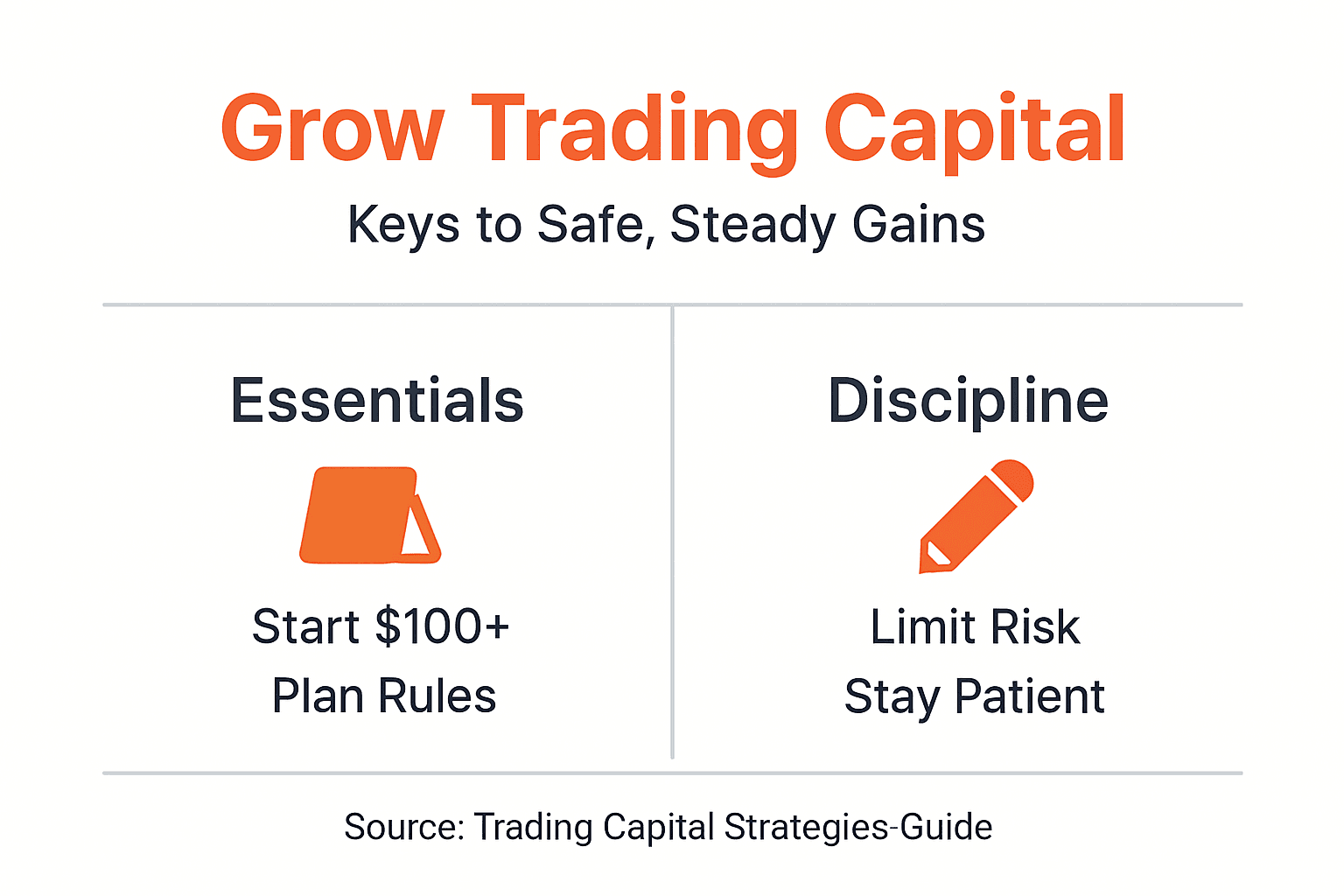
You need minimum starting capital, ideally above $100, to reduce the emotional pressure that comes with tiny accounts. Starting trading with undercapitalized accounts (below $100) significantly increases risk of emotional decision making and failure to survive market volatility. Small balances magnify the psychological impact of each loss, leading to revenge trading and poor decisions.
A well defined trading plan acts as your roadmap. This plan must include your risk limits, entry and exit rules, position sizing formulas, and specific market conditions you’ll trade. Without written rules, you’re gambling, not trading.
You also need access to reliable trading platforms with proper risk monitoring tools. Your platform should allow you to set automatic stop losses, track your risk percentage in real time, and provide stable execution during volatile periods.
Finally, cultivate a disciplined mindset through basic trading education. Understanding market dynamics, price action, and risk principles forms the foundation for sustainable growth. Study successful traders, practice on demo accounts, and build confidence before risking real money.
Pro Tip: Write down your trading rules and review them before every trading session to maintain discipline.
Step 1: Adopt Disciplined Risk Management Practices
Risk management separates traders who survive long enough to profit from those who blow up their accounts. Every trade you take should protect your capital first, seek profit second.
Risk only 1-2% of your capital per trade consistently. If you have a $5,000 account, risk $50 to $100 maximum per trade. This approach ensures that even a string of 10 consecutive losses won’t destroy your account. Maintain risk per trade between 1-2% of capital and adhere to risk to reward ratios of at least 1:2 to control drawdowns effectively.

Use risk to reward ratios of 1:2 or greater to maximize profit potential. This means if you risk $50, you should target at least $100 in profit. Over time, you can lose more trades than you win and still come out profitable with proper ratios.
Strictly set and enforce stop loss orders to limit downside on every position. Place your stop loss before entering the trade, not after the market moves against you. Never move a stop loss further away to give a losing trade more room.
Avoid increasing risk impulsively after losses. Many traders double their position size after a loss, hoping to recover quickly. This revenge trading mentality destroys accounts faster than anything else. Stick to your predetermined risk percentage regardless of recent results.
For additional risk management insights, focus on developing a systematic approach that removes emotion from position sizing decisions.
Pro Tip: Calculate your position size before entering any trade using the formula: (Account Size × Risk %) ÷ Stop Loss Distance = Position Size.
Step 2: Leverage Proprietary Trading Firms for Funding
Once you’ve mastered risk management with your own capital, proprietary trading firms offer a path to trade significantly larger accounts without risking personal funds. These firms provide capital to traders who can demonstrate consistent profitability and disciplined risk management.
Prop firms fund your trading account with capital ranging from $10,000 to $200,000 or more. You trade this capital under the firm’s risk parameters, keeping a significant portion of the profits you generate. This model lets skilled traders scale their income without needing years to build personal capital.
You must pass rigorous evaluation focusing on risk discipline and profitability. Prop firms provide trading capital without personal funds but require passing risk management and consistency evaluations with profit shares averaging around 50%. Most evaluations require you to hit a profit target while staying within maximum daily and total drawdown limits.
Profit sharing typically splits approximately 50/50 between you and the firm, though some platforms offer up to 80% profit splits. The firm absorbs all losses, while you receive regular payouts based on your trading performance. This arrangement aligns incentives and rewards disciplined trading behavior.
Strict drawdown and risk limits enforce discipline throughout your funded trading career. These rules prevent the reckless behavior that destroys retail accounts, creating a professional trading environment that encourages long term thinking.
Comparison of Prop Firm Models:
| Feature | Traditional Evaluation | Fast Track Model | Instant Funding |
|---|---|---|---|
| Evaluation Period | 30-60 days | 7-14 days | None |
| Upfront Cost | $100-$300 | $300-$500 | $500-$1000 |
| Profit Split | 50-80% | 50-70% | 40-60% |
| Best For | Patient traders | Experienced traders | Proven track record |
Review this detailed prop firm evaluation guide to understand exactly what firms look for in funded traders.
Pro Tip: Focus on consistency over home runs during evaluations. Firms reward steady daily profits far more than sporadic large wins.
Step 3: Scale Your Capital with Systematic Reinvestment
After securing funding or building your personal account, systematic profit reinvestment accelerates your capital growth through compounding. The key is scaling position size proportionally as your account grows, not based on emotional impulses.
Follow this tiered scaling approach:
-
Establish your baseline: Start with your standard position size based on 1-2% risk. For a $10,000 account, this might be 0.5 to 1 standard lot depending on your stop loss distance.
-
Set growth milestones: Decide in advance when you’ll increase position size. Common thresholds are every 10-20% account growth. If you start at $10,000, plan to increase size at $11,000, $12,000, and so on.
-
Reinvest 50-75% of trading profits: Reinvest 50-75% of profits systematically and scale position sizes in tiers to prevent emotional scaling and avoid large drawdowns. Withdraw the remaining 25-50% to secure gains and maintain motivation.
-
Recalculate position size at each milestone: When you hit $11,000, recalculate your position size using the same 1-2% risk formula. This ensures your risk stays proportional to your growing account.
-
Document every scaling decision: Keep a journal noting when and why you increased position size. This accountability prevents impulsive increases driven by overconfidence after winning streaks.
Avoid impulsive increases in risk or position size between your predetermined milestones. The temptation to “push harder” after a good week destroys more traders than losing streaks. Stick to your scaling plan religiously.
Monitor emotional discipline closely while scaling. Larger position sizes magnify both profits and losses, which can trigger emotional reactions you didn’t experience with smaller trades. If you notice anxiety or excitement affecting your decisions, scale back temporarily.
Explore more scaling trading capital tips and review scaling strategy steps to refine your approach as your account grows.
Pro Tip: Never increase position size after a winning streak. Only scale up when you reach predetermined account balance milestones, regardless of recent performance.
Common Mistakes and Troubleshooting
Even disciplined traders fall into predictable traps when growing capital. Recognizing these mistakes early and implementing fixes prevents catastrophic losses.
Overtrading leads to emotional burnout and erodes your edge through poor trade selection. Overtrading, ignoring stop losses, and impulsive position size increases cause 70% of failures in small accounts but can be mitigated with discipline. Limit yourself to a maximum number of trades per day based on your strategy. If your system generates 2-3 quality setups daily, don’t force 10 trades just to stay busy.
Ignoring stop losses causes large drawdowns that can take months to recover. Every trade needs a predetermined exit point that protects your capital. If you find yourself moving stops or hoping a losing trade will turn around, you’re gambling. Enforce stop loss discipline by treating every stop hit as a successful execution of your risk management plan.
Impulsive position increases magnify risk beyond your system’s design. Doubling your position size because you feel confident about a trade introduces enormous risk that wasn’t part of your plan. Use tiered scaling based on account growth, never on conviction about individual trades.
Regularly review and adjust your trading plan to improve performance. Schedule weekly reviews examining your trade execution, emotional state, and adherence to rules. Monthly reviews should analyze your edge, win rate, and whether your strategy still fits current market conditions.
If you notice declining performance, return to demo trading or reduce position size until you identify the problem. Many issues stem from overconfidence after success or fear after drawdowns, both of which distort decision making.
For additional perspective on trader common mistakes and how to avoid them, study the patterns that derail even experienced traders.
Expected Outcomes and Realistic Growth Benchmarks
Setting realistic expectations prevents frustration and helps you stay committed to disciplined growth strategies. Understanding achievable benchmarks keeps you focused on sustainable progress rather than chasing unrealistic returns.
Sustainable growth targets are 2-5% monthly profit when trading with proper risk management. Aim for consistent monthly returns of 2-5%, maintain drawdowns under 10%, and expect to scale capital 2-5 times within 6-12 months with discipline. These returns compound impressively over time without exposing you to blowup risk.
Small accounts require patience and discipline to scale. A $5,000 account growing at 3% monthly reaches approximately $7,150 after 12 months. While this seems modest, combining this growth with profit withdrawals and potential prop firm funding creates significant income streams.
Passing prop firm evaluations validates consistent performance and opens access to much larger capital. Once funded, your earning potential multiplies since you’re trading $25,000 to $100,000 accounts while risking none of your personal funds. Most traders can pass evaluations within 2-4 attempts once they’ve developed genuine edge.
Maintain maximum drawdown below 10% to survive volatile markets. Even the best traders experience losing periods. Keeping drawdowns small ensures you can recover quickly and continue compounding your capital. A 10% drawdown requires an 11% gain to break even, while a 50% drawdown needs a 100% gain.
Realistic Growth Timeline:
| Starting Capital | Monthly Return | 6 Month Balance | 12 Month Balance | Risk Level |
|---|---|---|---|---|
| $5,000 | 3% | $5,970 | $7,130 | Conservative |
| $5,000 | 5% | $6,700 | $8,980 | Moderate |
| $10,000 | 3% | $11,940 | $14,260 | Conservative |
| $10,000 | 5% | $13,400 | $17,960 | Moderate |
For more insights on realistic growth benchmarks and how discipline impacts profitability, review the performance metrics of consistently profitable traders.
Explore Professional Funding Solutions to Accelerate Growth
Growing your trading capital becomes exponentially easier when you leverage professional proprietary funding that provides significant capital without personal financial risk. Instead of slowly building a small account, you can demonstrate your skills through structured evaluations and gain access to institutional-level funding.
Professional prop firm funding offers scalable capital that multiplies your earning potential while the firm absorbs all trading losses. You focus purely on executing your strategy within defined risk parameters, receiving regular payouts based on your performance.
Comprehensive guides walk you through the performance-based trading evaluation process, helping you understand exactly what evaluators look for and how to demonstrate consistency. Following proven evaluation strategies found in our secure prop funding guide significantly increases your pass rate.
Developing the essential trading skills for funded traders ensures you not only pass evaluations but thrive with larger capital. These skills include advanced risk management, emotional control under pressure, and systematic trade execution that prop firms reward with higher profit splits and account scaling opportunities.
Frequently Asked Questions
How much capital is ideal to start growing trading capital?
Start with at least $500 to $1,000 for meaningful growth without excessive emotional pressure from tiny positions. Accounts below $100 magnify the psychological impact of each trade, leading to poor decisions and revenge trading. Larger starting balances let you implement proper position sizing and risk management while surviving normal market volatility.
What is the safest risk percentage per trade?
Risk 1-2% of your total account balance per trade to ensure survival through inevitable losing streaks. This percentage means even 10 consecutive losses only reduce your account by 10-20%, allowing plenty of room for recovery. Never risk more than 2% on a single trade regardless of conviction, as larger risks compound quickly during drawdowns and can destroy accounts.
Can I grow my capital quickly with high leverage?
High leverage creates the illusion of fast growth but dramatically increases blowup risk and typically destroys accounts within weeks. Sustainable capital growth comes from consistent small wins that compound over time, not from gambling with oversized positions. Professional traders and prop firms avoid high leverage specifically because it prevents the disciplined, long term approach necessary for reliable income.
How do prop firms help with growing trading capital?
Prop firms provide substantial trading capital after you pass their evaluation, letting you earn significant income without risking personal funds. You keep 50-80% of profits while the firm absorbs all losses, creating asymmetric risk that favors the trader. This model lets skilled traders with limited personal capital access six figure accounts and scale their income based purely on performance.
What monthly returns should I realistically expect?
Target 2-5% monthly returns for sustainable, long term capital growth that compounds reliably without excessive risk. These returns may seem modest but represent 24-60% annually, far exceeding most investment benchmarks. Higher returns typically require proportionally higher risk that leads to eventual account destruction, while conservative returns with strict risk management create consistent income and career longevity.
Recommended