

TL;DR:
- Many traders mistakenly believe increasing trade size alone leads to account growth, but true scalability depends on structured risk management and disciplined rule adherence. Proper scaling involves incremental position increases based on proven edge, liquidity, and risk parameters, while scaling out locks in profits and reduces emotional stress. Successful long-term growth requires treating scalability as a strict system, maintaining discipline through psychological readiness and systematic rules, rather than relying on impulsive size jumps.
Most retail traders assume that growing a trading account is simply a matter of increasing position size. Take bigger trades, make more money. That logic sounds intuitive but it is one of the most damaging misconceptions in active trading. True trade scalability is a structured process built on risk management, disciplined rule adherence, and gradual, performance-driven capital growth. In this article, you will learn exactly what trade scalability means, how scaling in and out works in practice, and how to apply these principles across FX, indices, and crypto markets to build a trading career that lasts.
Table of Contents
- What is trade scalability?
- How scaling in and out works
- Applying trade scalability in FX, indices, and crypto
- Common pitfalls when scaling trades
- The overlooked truth about trade scalability
- Unlock your growth with scalable trading solutions
- Frequently asked questions
Key Takeaways
| Point | Details |
|---|---|
| Scalability defined | Trade scalability is the structured ability to grow position size or capital without increasing risk disproportionately. |
| Scaling mechanics matter | Using scaling in and out techniques helps manage risk, entries, and targets more effectively than simple size increases. |
| Market quality is crucial | Low-slippage, liquid markets are essential for scalability to work in practice. |
| Discipline trumps size | A rule-based, disciplined mindset is necessary to scale successfully, not just access to larger capital. |
| Scalability enables growth | Adopting scalable practices creates a pathway from retail accounts to funded, professional trading. |
What is trade scalability?
Trade scalability is the ability to increase position size, trade frequency, or capital allocation over time without negatively impacting risk parameters or overall performance. It is not about simply adding zeros to your lot size. It is about growing exposure in proportion to demonstrated edge, available liquidity, and your current risk framework.
This concept matters enormously for both retail trading basics and funded traders. For retail traders, scalability is the pathway from a small personal account to a professionally managed, growing book. For traders pursuing prop funding, scalability is the mechanism that unlocks access to higher capital tiers, professional trading conditions, and performance-based income. Without a scalable approach, a trader’s results plateau or deteriorate as exposure increases.
Scalability IS:
- Adjusting position size incrementally based on account growth and confirmed edge
- Adapting trade structure to available market liquidity and execution quality
- Following a rule-based framework that governs when and how size increases
- Using volatility-adjusted sizing tools like Average True Range (ATR) to keep risk consistent
- Scaling out of winning positions to lock in profits while letting a portion run
Scalability IS NOT:
- Arbitrarily doubling or tripling position size after a winning streak
- Averaging down into losing trades to lower your break-even point
- Ignoring slippage and transaction costs as account size grows
- Treating a larger funded account the same way as a small personal account
- Conflating high leverage with scalable growth
Risk-adjusted growth via gradual exposure adjustments is the core of scalability for retail and funded traders operating in liquid markets like FX, indices, and crypto without market impact.
Understanding this distinction is the foundation. Once you accept that scalability is a system rather than an impulse, every subsequent decision about trade management becomes clearer and more structured.
How scaling in and out works
With the basics established, it is crucial to understand the practical mechanics at work. How do traders actually scale in and out, and what does the evidence show about real performance impact?
Scaling in: step-by-step process
Scaling in involves entering positions in tranches, for example a 25/50/25 split, to reduce initial risk, improve average entry price, and confirm your thesis before full commitment. Volatility-based sizing tools like ATR are used to calibrate each tranche. Here is a practical sequential walkthrough:
- Identify your setup and define maximum risk. Before placing any order, determine the total position size you would accept at full commitment, then express it as a percentage of account equity, typically 0.5% to 1%.
- Enter the first tranche at the primary signal level. This is usually 25% to 33% of the total intended position. Your initial risk is limited, and you are testing whether the market confirms your thesis.
- Wait for price to move in your favor and confirm the directional bias. This could be a break of a key level, a volume confirmation, or a secondary technical trigger. Do not add to the position if price moves against you immediately.
- Add the second tranche at the confirmation level. This represents 50% of the total intended size. Adjust your stop loss to account for the blended average entry and keep total risk within your pre-defined limit.
- Enter the final tranche only if the trade is progressing cleanly. This remaining 25% is added at a third confirmation point. At this stage, the position is fully sized and the trade management phase begins.
Scaling out: step-by-step process
Scaling out locks partial profits at defined targets, for example 50% at 1R, 25% at 2R, and trailing the remainder, which reduces variance and emotional pressure but may cap upside in strong trending conditions. Here is the process:
- Set your first profit target at 1R (equal to the amount risked). When price reaches this level, close 50% of the position. This locks in realized profit and removes emotional pressure from the trade.
- Set the second target at 2R. Close an additional 25% of the original position here. Move your stop loss on the remaining 25% to break-even or better.
- Trail the stop on the final portion. Use an ATR-based trailing stop or a key structural level below price. Let this runner capture any extended trend move without risking profits already secured.
Pro Tip: Always backtest your scaling methodology with realistic slippage and transaction costs included. A scaling strategy that looks profitable in clean data may underperform significantly once commissions and execution spreads are factored in across hundreds of trades.
Performance comparison: scaling in vs. scaling out
| Factor | Scaling in | Scaling out |
|---|---|---|
| Primary benefit | Reduces initial risk | Locks in partial profits early |
| Effect on entries | Improves average entry price | No impact on entries |
| Effect on drawdown | Reduces maximum drawdown | Reduces equity curve volatility |
| Psychological benefit | Smaller initial commitment | Removes pressure on full exits |
| Trade-off | Misses full move if thesis confirms immediately | May cap upside in strong trends |
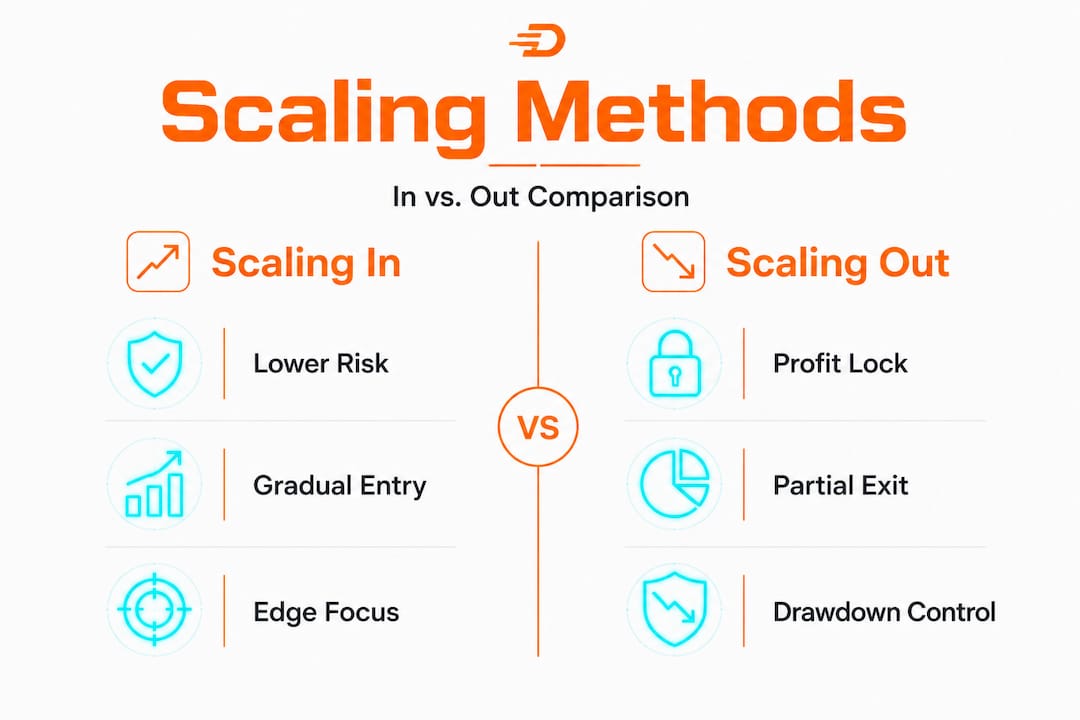
The data behind these mechanics is compelling. In a 24-month FX scalp strategy tested across 5,120 trades, scaling in raised expectancy from 0.03R to 0.045R per trade, improved win rate from 42% to 48%, reduced maximum drawdown from 12% to 7%, and added only 0.6 pips of average slippage per trade. Those numbers represent a meaningful, measurable performance uplift achieved through structure alone. No new edge was introduced. The same strategy became more robust simply by applying disciplined scaling mechanics, and understanding managing risk with scaling is precisely what separates consistent performers from inconsistent ones.
Applying trade scalability in FX, indices, and crypto
Once you understand how scaling mechanics work, the next step is putting these concepts into action across today’s most active trading markets. Not every market is equally suited for scalable strategies, and the execution environment matters as much as the strategy itself.

Scalability requires low-slippage conditions, fast and reliable order execution, and sufficient market depth to absorb incremental position additions without significant market impact. Major FX pairs like EUR/USD, GBP/USD, and USD/JPY consistently meet these requirements. Leading equity indices such as the S&P 500, NASDAQ 100, and DAX offer comparable liquidity during core trading sessions. In crypto, scalability requires low slippage markets, and assets like Bitcoin and Ethereum on major exchanges provide the depth needed, though spreads widen significantly during off-hours.
Rules for scalable execution across all markets:
- Never average down into a losing position. Adding size to a trade moving against you is not scaling, it is compounding a mistake.
- Define maximum total position size before entering the first tranche. The total risk across all tranches must not exceed your pre-defined per-trade limit.
- Increase position size in fixed increments, never arbitrary jumps. A common framework is 25% account allocation growth per performance milestone.
- Align your scaling plan with the liquidity profile of your market and your specific timeframe. Scalping in illiquid crypto markets requires tighter increment rules than swing trading major FX pairs.
- Document every scaling decision in a trade journal. Data on your own execution is irreplaceable for refining your process.
Following best FX trading practices and considering retail funding challenges are equally important when building a scalable framework.
Capital tier examples in prop and retail accounts
| Account type | Starting capital | Scaling trigger | Maximum capital access |
|---|---|---|---|
| Retail personal account | $5,000 | 10% net growth per quarter | Self-funded, no external cap |
| Prop evaluation account | $25,000 | Pass challenge phases | Up to $300,000 |
| Prop funded (scaled tier) | $100,000 | 20% profit over 4 months | Up to $5,000,000 |
| Institutional prop allocation | $500,000 | Consistent risk-adjusted returns | No fixed ceiling |
Prop firm scaling plans that increase capital based on consistent profits over defined periods create a structured performance pathway. Scalability in this context amplifies discipline because every rule violation carries consequences, and that accountability is actually what makes the model work for long-term growth.
Pro Tip: Align your scaling plan precisely with your demonstrated trading edge and the specific timeframe you trade. A swing trader operating on the 4-hour chart needs a fundamentally different scaling framework than a scalper working on the 1-minute chart. Review scaling tips for consistent growth to find frameworks suited to your style.
Common pitfalls when scaling trades
With best practices in mind, it is equally important to acknowledge common traps that can derail even knowledgeable traders aiming for scalability. These are not theoretical risks. They appear regularly in real trading accounts.
-
Chasing position size after a winning streak. A series of winning trades creates confidence that can quickly become overconfidence. Increasing size significantly after a good run means the next drawdown, which is statistically inevitable, hits your account at maximum exposure. Risk per trade must be governed by rules, not by recent emotions.
-
Neglecting to scale risk alongside size. Many traders increase position size but forget to adjust their stop loss distances proportionally. Keeping a tight stop on a larger position does not reduce risk if the market’s natural volatility requires a wider stop. Use ATR to keep risk consistent across different position sizes.
-
Ignoring liquidity constraints. A position size that works perfectly in EUR/USD on the 1-hour chart may experience significant slippage in a lower-liquidity crypto pair or during off-hours. Disciplined rules, slippage awareness, and proper backtesting are critical to real scalability in both personal and prop-funded models.
-
Averaging down into losing trades. This is one of the most common and most destructive behaviors in trading. It disguises risk accumulation as trade management. When a thesis is wrong, the correct action is to exit and reassess, not to add size in the hope of recovering from an initial loss.
-
Backtesting without realistic costs. A scalable system must be validated with commissions, spreads, and expected slippage included. Strategies that appear highly profitable in theoretical testing often lose their edge once real-world execution friction is applied. This is especially true for high-frequency approaches where transaction costs compound rapidly. Understanding the types of proprietary trading models helps traders choose environments where these costs are better controlled.
Pro Tip: Review your equity curve each month and flag any periods where scaling decisions coincided with elevated drawdown. If increases in position size consistently precede drawdown periods, your scaling triggers need to be recalibrated. Preserving your equity curve during the growth phase is more important than maximizing short-term returns.
The overlooked truth about trade scalability
After working through mechanics and common mistakes, it is worth stepping back to consider what scalability actually means at a deeper level for a trading career. Most traders who study scaling focus almost entirely on the technical side: lot sizing formulas, ATR multipliers, profit targets, and backtesting results. That knowledge matters. But the technical side is only half the equation.
The traders who consistently scale successfully share one defining characteristic: they treat their scaling framework as non-negotiable. Not as a guideline. Not as a target. As a hard rule that governs every single trade, regardless of how compelling a setup looks or how much confidence they feel in any given moment. Emotional pressure is highest precisely when rules are most at risk of being broken.
Consider the trader who has passed an evaluation phase and is now managing institutional capital for the first time. The mechanics of the strategy have not changed. The edge is the same. But the psychological weight of larger numbers, combined with the accountability of an external performance review, creates conditions where discipline either holds or breaks. The traders who scale successfully in this environment do so because their rule adherence was already habitual before the capital increased. They built the behavior first and let the capital follow.
Most traders approach this in reverse. They increase capital first, then try to develop discipline under pressure. That sequence rarely produces sustainable results. Scalable funding insights confirm that the traders who grow capital most reliably are those who already have systematic rule-following embedded in their process before they ever touch a larger account.
The transition from chasing quick gains to methodically scaling a rule-based system is not a technique upgrade. It is a mindset transformation that precedes every durable trading career.
Scalability, properly understood, is a measure of how well your process can absorb growth without breaking. That is about psychology and systems, not just position sizing arithmetic.
Unlock your growth with scalable trading solutions
Scalable trading is not reserved for institutional desks. With the right framework, any disciplined trader can pursue structured, performance-driven capital growth in FX, indices, and crypto.
DayProp provides the infrastructure that makes scalability real. From detailed scalable funding guides and practical account scaling tips to a transparent trading evaluation guide that connects skilled traders with institutional-level capital, every resource is built for traders who are serious about long-term growth. If you trade with discipline and follow a structured process, DayProp’s evaluation platform is designed to recognize that and reward it with expanding capital access.
Frequently asked questions
How is trade scalability different from simply increasing position size?
Trade scalability increases exposure in a structured, risk-adjusted way based on confirmed edge and performance milestones, rather than through arbitrary size jumps. Risk-adjusted growth via gradual exposure adjustments is what separates true scalability from reckless leverage.
Why do so many traders fail to scale successfully?
Most scaling failures come from emotional decision-making, breaking disciplined rules, or underestimating the impact of liquidity constraints. Disciplined rules, slippage awareness, and proper backtesting are critical for both personal and prop-funded models to scale sustainably.
What markets are best suited for trade scalability?
Liquid markets with tight spreads and deep order books offer the best execution conditions for scalable strategies. Prop firm scaling plans increasing capital based on consistent profits are most effective in FX majors, leading equity indices, and large-cap crypto assets.
Can trade scalability improve risk management?
Yes. Scaling in and out structures how you enter and exit positions, directly reducing drawdown and emotional pressure throughout the trade. Entering positions in tranches reduces initial risk and allows confirmation of your trade thesis before full capital commitment.
Recommended
- Trading account scaling tips for consistent growth in 2026 – DayProp Funding
- Why trade multiple instruments for funding in 2026 – DayProp Funding
- Essential trading success factors for consistent profits – DayProp Funding
- Trading Account Growth: Pathways to Consistent Gains – DayProp Funding
- Navigating the Shifting Sands: Crypto Exchange Security in 2026 | Crypto Watchdog