

TL;DR:
- % of retail traders lose money due to gambling-like behaviors. Discipline, rules, and risk management differentiate trading from gambling. Platform design and psychology significantly influence impulsive, risky trading actions.
Most retail traders believe their losses come from bad analysis or bad luck. The reality is more uncomfortable: 80% of retail traders lose not because markets are impossible, but because they approach trading the same way a gambler approaches a casino. The line between speculating with a plan and betting on hope is thin, and most traders cross it without noticing. This guide breaks down the psychological traps, platform designs, and behavioral patterns that turn trading into gambling, and shows you exactly how disciplined trading looks different in practice.
Table of Contents
- Why ‘trading’ so often turns into gambling for retail traders
- The psychology behind gambling behaviors in trading
- How gamified trading platforms and apps amplify gambling risks
- What separates disciplined trading from gambling: Rules, edge, and risk management
- Why most advice on ‘avoiding gambling’ misses the real challenge
- Ready to escape gambling and trade with discipline?
- Frequently asked questions
Key Takeaways
| Point | Details |
|---|---|
| Trading vs gambling | Without discipline, trading becomes gambling and most lose money. |
| Role of psychology | Cognitive biases drive impulsive decisions that sabotage profits. |
| Platform risks | Gamified apps increase the odds of problematic gambling-like trading. |
| Path to discipline | Structured rules, edge, and risk management are vital to avoid gambling behaviors. |
| Practical next steps | Apply routines and checklists to build discipline for lasting trading success. |
Why ‘trading’ so often turns into gambling for retail traders
With the confusion between trading and gambling so prevalent, it is crucial to examine how undisciplined retail trading mimics gambling’s risky patterns.
At a surface level, trading and investing vs. gambling share structural similarities: both involve risk, uncertain outcomes, and the real possibility of losing money. The critical difference is that disciplined trading relies on a statistical edge, a repeatable process, and defined risk parameters. Gambling relies on chance. When traders abandon process and chase outcomes, they erase that difference entirely.
The numbers are stark. Up to 97% of persistent day traders lose money over time. That is not a market problem. That is a behavior problem. Understanding retail trading explained helps clarify why so many participants enter markets without the structural foundation needed to survive long term.
Here are the most common gambling-like behaviors seen in retail trading:
- Revenge trading: Immediately re-entering a position after a loss to recover funds, driven by emotion rather than setup quality
- Overleveraging: Using position sizes far beyond what a sound risk model supports, amplifying both gains and losses
- Chasing losses: Increasing trade frequency or size after a losing streak in an attempt to break even quickly
- Ignoring stop-losses: Holding losing trades open in the hope the market will reverse, rather than cutting losses at a predefined level
- Random entry: Taking trades based on gut feeling, tips, or social media hype with no defined criteria
- Outcome-focused thinking: Judging each trade as a win or loss rather than evaluating whether the process was sound
“The difference between a trader and a gambler is not the market they operate in. It is whether they have a repeatable, rules-based process with a genuine edge.”
Without edge and process, every trade is essentially a bet. The market does not reward effort or intention. It rewards consistency and sound execution. Recognizing these gambling-like behaviors in your own trading is the first step toward correcting them.
The psychology behind gambling behaviors in trading
While structural similarities blur the line, it is the mind that makes the biggest difference. Trader psychology is where most people start gambling without realizing it.
Cognitive biases like overconfidence, FOMO, and loss aversion are the primary psychological forces that push traders toward gambling behaviors. These are not character flaws. They are predictable, well-documented mental shortcuts that every human brain uses. In trading, they become liabilities.
Here are the five most damaging biases in trading:
- Overconfidence bias: Traders overestimate their ability to predict market direction, leading to oversized positions and insufficient preparation for adverse moves.
- FOMO (fear of missing out): Seeing a fast-moving market triggers impulsive entries without proper analysis, often at the worst possible price.
- Loss aversion: The psychological pain of a loss is roughly twice as powerful as the pleasure of an equivalent gain. This causes traders to hold losing positions too long and cut winning ones too early.
- Disposition effect: A direct result of loss aversion. Traders sell winners quickly to lock in gains and hold losers hoping for a reversal, which is the opposite of sound risk management.
- Confirmation bias: Traders seek out information that supports their existing position and ignore data that contradicts it, leading to poor decision-making under pressure.
These biases do not operate independently. They compound. A trader who enters a position due to FOMO is already emotionally invested. When the trade goes against them, loss aversion kicks in. They hold. The loss grows. Confirmation bias finds reasons to stay in. The result is a blown account, not bad luck.
“Discipline is not a personality trait. It is a system. Without a system, even the most intelligent trader will eventually act like a gambler.”
Understanding trading psychology essentials is not optional for serious traders. Recognizing your personal triggers is the foundation of behavioral control.
Pro Tip: Keep a trading journal that records not just your entries and exits, but the emotional state you were in before each trade. Patterns in your psychology become visible quickly, and visibility is the first step toward change.
How gamified trading platforms and apps amplify gambling risks
Psychology is not shaped in a vacuum. Trading platforms are deliberately designed to take advantage of these vulnerabilities.

Gamification refers to the use of game-design elements in non-game contexts. In trading apps, this means confetti animations on trades, leaderboards, streak counters, and push notifications that create urgency. These features trigger dopamine responses and encourage frequent, impulsive trading. The more you trade, the more revenue the platform generates through spreads and commissions.
The Financial Conduct Authority (FCA) studied this directly. High DEP (digital engagement practice) users suffer more large losses and trade more frequently than low DEP users. The data is clear: platform design influences behavior in measurable, harmful ways.
Common app features that promote gambling-like trading include:
- Push notifications alerting you to price movements in assets you hold
- Streak rewards for trading on consecutive days
- Leaderboards showing top performers to trigger competitive behavior
- Confetti or celebration animations after any trade, win or lose
- One-tap trading that removes friction and encourages impulsive action
- Social feeds showing other users’ trades and profits
Here is how platform design affects trader outcomes:
| Feature | Low gamification platform | High gamification platform |
|---|---|---|
| Average trade frequency | Lower, more selective | Higher, often impulsive |
| Average position size | Consistent with plan | Frequently oversized |
| Loss frequency | Lower over time | Higher, with larger drawdowns |
| Emotional engagement | Analytical | Reactive and competitive |
| Long-term account survival | More likely | Less likely |
Recognizing platform manipulation is the first step to reclaiming discipline. If your trading app feels exciting, that is a warning sign, not a feature.
What separates disciplined trading from gambling: Rules, edge, and risk management
Having seen the risks, let’s break down exactly what separates successful, disciplined traders from those who helplessly gamble.
Three concepts form the foundation of disciplined trading. Edge is a statistical advantage that, applied consistently over many trades, produces a positive expected outcome. Rules are predefined criteria for entries, exits, position sizing, and maximum daily loss. Risk management is the systematic application of those rules to protect capital across all market conditions.
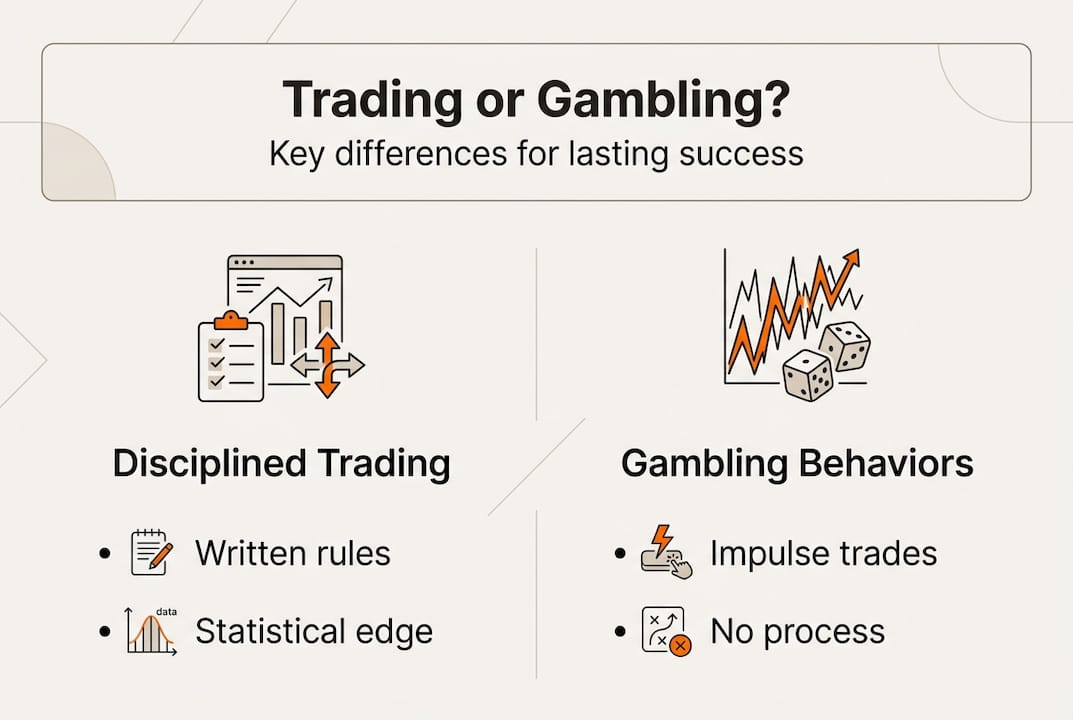
Edge and strict risk management are what formally separate trading from gambling. Without them, you are simply speculating on direction with no structural advantage.
| Behavior | Disciplined trader | Gambler |
|---|---|---|
| Entry criteria | Defined, rules-based | Impulsive or emotional |
| Position sizing | Fixed percentage of capital | Based on conviction or mood |
| Stop-loss use | Always predefined | Rarely used or moved |
| Response to losses | Follows plan, reduces size | Revenge trades, increases size |
| Trade journal | Maintained consistently | Absent or inconsistent |
| Goal | Consistent process | Quick profit |
To build a disciplined framework, follow these steps:
- Define your edge: Backtest your strategy across at least 100 trades to confirm it has a positive expectancy before trading live capital.
- Write a trading plan: Document your entry rules, exit rules, position sizing formula, and maximum daily drawdown limit in writing.
- Set hard risk limits: Risk no more than 1 to 2 percent of your account on any single trade. Review risk management strategies to build a model that fits your style.
- Review benefits of trading rules: Rules remove emotion from execution. They are not restrictions. They are protection.
- Track trading habits for consistency: Consistency in behavior precedes consistency in results.
Pro Tip: Use a pre-trade checklist before every entry. Ask yourself: Does this trade meet all my criteria? If the answer is no to even one item, skip the trade. Discipline is built one skipped trade at a time.
Why most advice on ‘avoiding gambling’ misses the real challenge
With all the frameworks explained, let us address the deeper reason why most advice on avoiding gambling often fails in practice.
Most traders already know the theory. They know they should not revenge trade. They know overleveraging is dangerous. They know they need a plan. The problem is not knowledge. It is execution under pressure.
Discipline is not built by reading articles. It is forged through routines, repeated daily, until sound behavior becomes automatic. The traders who consistently avoid gambling do not rely on willpower in the moment. They reduce friction for good habits and increase friction for bad ones. Written checklists, hard stop-loss orders, and position size calculators are not optional extras. They are structural defenses.
The uncomfortable truth is that most traders want to avoid the slow, boring work of building a process. They want a shortcut to the results. That desire is itself a gambling mindset. Accepting that progress is slow, that losses are part of the process, and that consistency matters more than any single trade is what separates professionals from participants.
Explore prop trading insights to see how funded traders approach discipline as a long-term investment, not a temporary fix.
Ready to escape gambling and trade with discipline?
Now that you have seen what genuinely separates trading from gambling, here is how you can put that knowledge into action.
DayProp is built specifically for traders who want to move beyond gambling behaviors and operate with institutional-level discipline. Our structured evaluation process rewards consistency, risk management, and repeatable edge, not luck or oversized bets. You can compare trading funding models to find the structure that fits your approach, or review the types of trading challenges designed to sharpen your discipline under real conditions. When you are ready to trade with a framework that rewards skill over speculation, explore DayProp Funding and take the next step toward funded, disciplined trading.
Frequently asked questions
What are the main signs you are gambling instead of trading?
If you trade impulsively, increase position sizes after losses, or rely on hope instead of a plan, you are likely gambling. Cognitive biases and lack of a plan are the primary drivers of gambling behavior in retail trading.
How do trading platforms encourage gambling behaviors?
Features like streak tracking, digital rewards, and push notifications promote impulsive, risky behavior similar to casino apps. DEP apps with gamification are directly linked to higher losses and more problematic trading patterns.
Is all trading gambling?
No. Trading with a defined edge, written rules, and consistent risk management is fundamentally different from gambling. Edge and risk management are the structural elements that separate the two, while random, emotional trading removes that distinction.
Why do most retail traders lose money?
Most retail traders lose because they rely on undisciplined, gambling-like behaviors rather than structured processes. 74 to 97% of retail traders lose money over time, primarily due to poor process and emotional decision-making rather than market conditions.
Recommended
- What is trading discipline? Master consistent profits in 2026 – DayProp Funding
- FX Trading Discipline Process: 5 Steps to Funding Success – DayProp Funding
- How to manage risk in trading for consistent profits 2026 – DayProp Funding
- What is trading psychology: master discipline and consistency – DayProp Funding