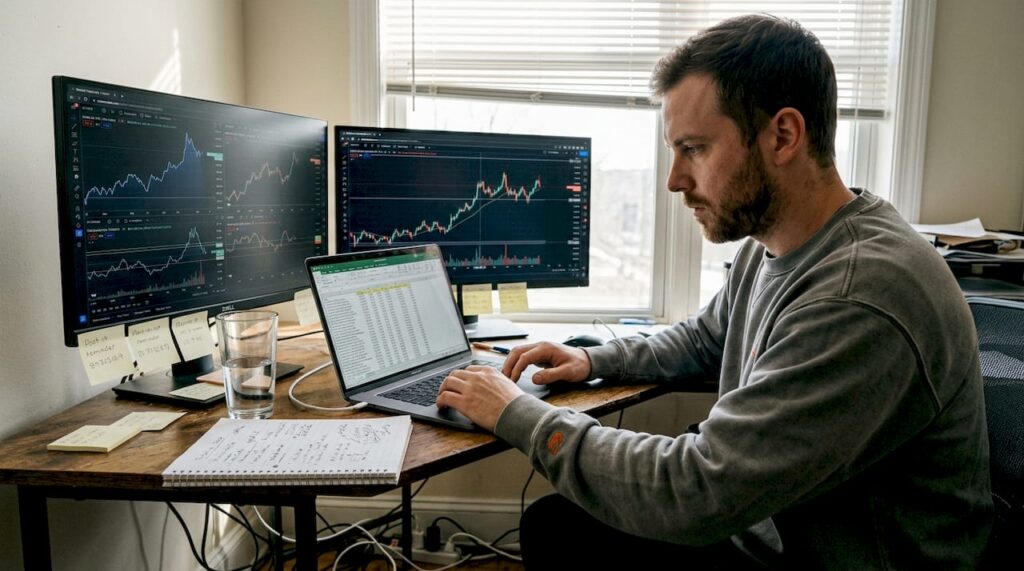

Poor risk management causes most traders to lose consistently, yet effective risk control is the proven path to capital preservation and reliable trading results. This guide delivers expert-backed strategies for disciplined risk management across FX, indices, and crypto markets in 2026. You will learn practical frameworks from position sizing to stop-loss execution that separate consistently profitable traders from those who fail. Master these techniques to trade with confidence and protect your capital.
Table of Contents
- Understanding The Importance Of Disciplined Risk Management
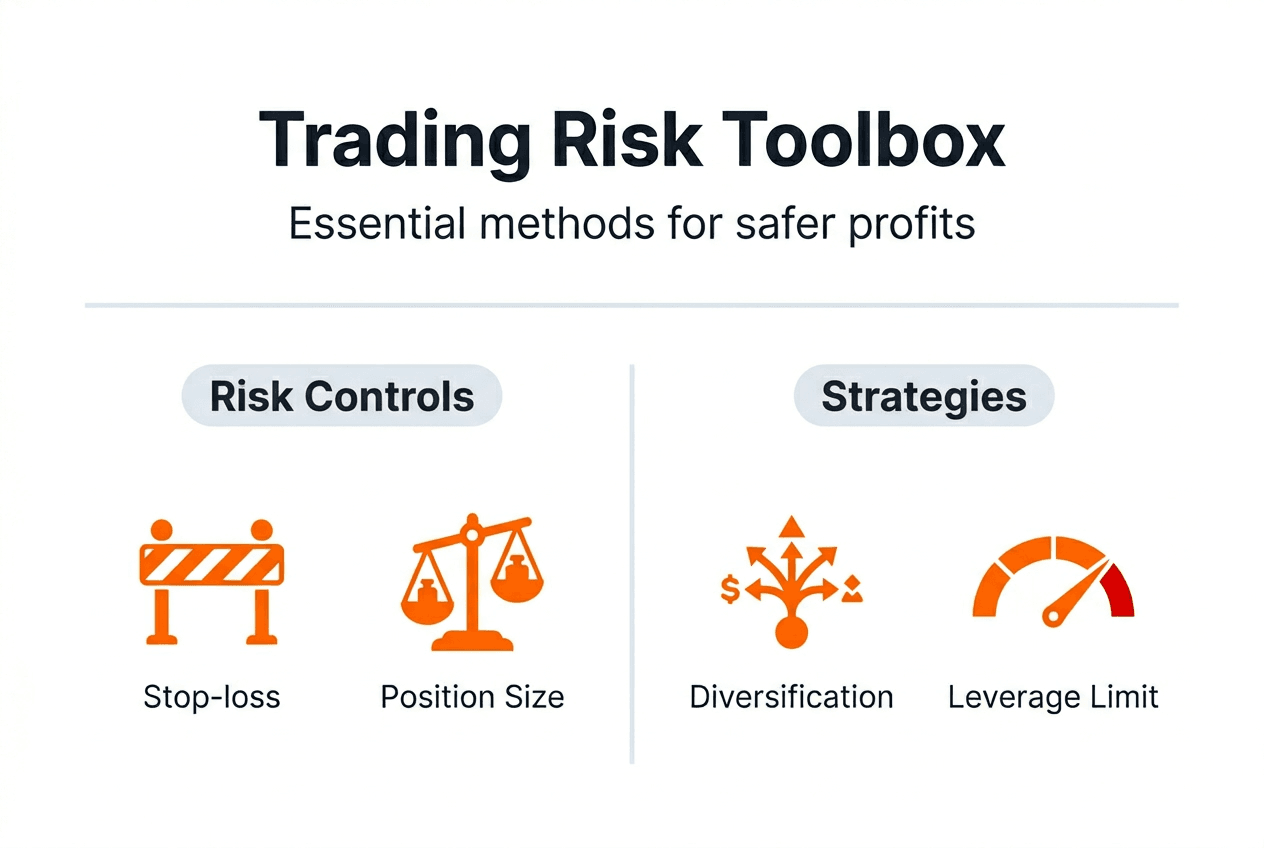
- Preparing Your Trading Toolbox: Diversification, Position Sizing, And Leverage Control
- Executing Risk Control: Stop-Losses, Risk-Reward Ratios, And Trading Journals
- Verifying And Adapting Your Risk Management Through Testing And Monitoring
- Boost Your Risk Management Skills With Dayprop Funding
- Frequently Asked Questions
Key takeaways
| Point | Details |
|---|---|
| Discipline beats intelligence | Disciplined risk management separates successful crypto traders from unsuccessful ones. |
| Strategic diversification works | Core-Satellite models with Bitcoin as the foundation reduce portfolio volatility significantly. |
| Position sizing protects capital | Fixed percentage allocation per trade reduces risk of ruin by 50%. |
| Leverage requires caution | Experts recommend 5-10x maximum leverage to avoid catastrophic losses like recent $22M liquidations. |
| Testing validates strategies | Backtesting and forward testing identify strategy weaknesses before risking real capital. |
Understanding the importance of disciplined risk management
Disciplined risk management is the primary differentiator between successful and unsuccessful crypto traders. Your trading strategy matters less than your ability to control losses and preserve capital over time. Most retail traders focus obsessively on entry signals while ignoring the risk controls that determine long-term survival.
Emotions like overconfidence and fear of missing out destroy even experienced traders. You see a setup that looks perfect, ignore your position sizing rules, and suddenly a 3% account drawdown becomes 15%. Effective prop trading risk management focuses on keeping emotions neutral and controlling risks through predetermined rules. This approach prevents impulsive decisions during market volatility.
Prop trading firms emphasize capital preservation via strict drawdown limits and risk parameters. These rules force traders to develop discipline before accessing larger capital. You cannot override risk controls with gut feelings or revenge trades. The system protects you from yourself.
Developing this discipline requires deliberate practice. Maintain a detailed trading journal documenting every trade decision, risk parameter, and emotional state. Review your journal weekly to identify patterns where emotions compromised your risk management. Learn why traders need professional risk management to build sustainable trading careers.
Building trading habits for consistent profits starts with these core practices:
- Never risk more than 1-2% of your account on a single trade
- Set stop losses before entering any position
- Review your risk controls daily before market open
- Document every trade with clear risk justification
- Accept losses as part of the process, not personal failures
Pro Tip: Loss control beats profit chasing every time. Traders who survive five years focus on not losing rather than maximizing gains. This mindset shift enables longevity in volatile markets where most participants fail within 12 months.
Preparing your trading toolbox: diversification, position sizing, and leverage control
Strategic preparation separates disciplined traders from gamblers. You need specific frameworks for diversification, position sizing, and leverage management before placing your first trade. These tools protect your capital during inevitable drawdowns and market shocks.
Strategic diversification with Core-Satellite models improves portfolio resilience significantly. Allocate 60-70% to core holdings like Bitcoin that provide stability during market crashes. Use the remaining 30-40% for satellite positions in altcoins, indices, or FX pairs that offer higher growth potential. This balance captures upside while limiting catastrophic portfolio losses.
Position sizing based on fixed account percentages is your primary defense against ruin. Fixed percentage allocation reduces risk of ruin by 50% compared to arbitrary position sizes. Calculate your position size using this formula: Position Size = (Account Balance × Risk Percentage) / (Entry Price – Stop Loss Price). Never exceed 2% account risk per trade regardless of conviction level.

Leverage amplifies both gains and losses exponentially. Experts recommend 5-10x maximum leverage with automated stop-losses to mitigate catastrophic risk. The recent $22M ETH liquidation case study demonstrates how overleveraging destroys accounts instantly during flash crashes. Most profitable traders use 3-5x leverage consistently rather than swinging between 1x and 50x based on confidence.
This table compares risk profiles across position sizing and leverage combinations:
| Position Size | Leverage | Max Loss Per Trade | Account Ruin Risk |
|---|---|---|---|
| 1% account | 5x | 5% | Very Low |
| 2% account | 10x | 20% | Moderate |
| 5% account | 20x | 100% | Extreme |
Automated stop-loss orders protect against unexpected market moves when you cannot monitor positions. Set stops immediately after entry, never adjust them wider, and accept the loss when triggered. Manual stop management invites emotional override during volatile periods.
Learn how to grow trading capital and avoid failure by maintaining strict position sizing discipline. Understand why long-term growth is key to building sustainable trading income rather than boom-bust cycles.
Pro Tip: Risk the same percentage on every trade regardless of setup quality. This removes the bias where you oversize “sure things” that inevitably fail. Consistency in position sizing creates predictable risk exposure across your portfolio.
Executing risk control: stop-losses, risk-reward ratios, and trading journals
Execution separates theoretical knowledge from practical results. You need specific techniques for setting stops, calculating risk-reward ratios, and documenting trades to control risk on every position. These tactical skills determine whether your preparation translates to consistent profits.
Stop-loss orders reduce losses by 30-40% compared to positions without predetermined exits. Set stops at logical technical levels like support zones, swing lows, or volatility-based distances. Never place stops at round numbers where liquidity hunters target retail orders. Use actual market structure to define your maximum acceptable loss.
Risk-reward ratios of 1:2 or higher improve long-term profitability even with 40% win rates. Calculate reward potential before entering: if your stop is 50 pips away, your target should be 100+ pips minimum. Reject setups where favorable risk-reward is impossible regardless of technical appeal. This single filter eliminates most marginal trades.
Expert traders document every trade to learn and refine their risk management continuously. Your journal should capture entry reasoning, position size calculation, stop placement logic, emotional state, and outcome analysis. Review weekly to identify patterns where risk controls failed or emotions compromised decisions.
This comparison shows performance impact of risk-reward discipline:
| Risk-Reward Ratio | Win Rate Needed | Expected Value |
|---|---|---|
| 1:1 | 50% | Break Even |
| 1:2 | 34% | Profitable |
| 1:3 | 26% | Highly Profitable |
Top techniques for effective stop and risk-reward management:
- Calculate stop distance before entry, then determine position size
- Use ATR (Average True Range) to set volatility-adjusted stops
- Place stops beyond recent swing highs/lows, not at obvious levels
- Measure reward potential to nearest resistance before taking trades
- Accept that some stops will trigger due to noise, this is normal
Discover what real trading skill means for achieving 60% less risk and 25% higher returns. Master the performance-based evaluation process that funds disciplined traders. Learn how to set trading objectives that support consistent risk management.
Pro Tip: Never move your stop loss further from entry. This single rule prevents the catastrophic “give it more room” mistake that turns controlled losses into account-destroying disasters. Accept the initial stop or close the trade.
Verifying and adapting your risk management through testing and monitoring
Verification transforms theoretical risk plans into proven systems. You must test your strategies on historical data and live markets before committing significant capital. This process reveals hidden vulnerabilities that destroy untested approaches during real market stress.
Backtesting and forward testing increase strategy success probability by identifying weaknesses and validating risk assumptions. Backtest on 3-5 years of historical data across different market conditions. Look specifically for maximum drawdown periods to understand worst-case scenarios. If backtest drawdowns exceed your psychological tolerance, adjust position sizing or strategy parameters before live trading.
Forward testing in live markets with small capital validates backtest results without material risk. Trade your system with 10-20% of intended capital for 50-100 trades minimum. This sample size reveals whether backtest performance was curve-fitted or genuinely robust. Most strategies fail forward testing because historical optimization creates false confidence.
Regular monitoring identifies when market conditions change and risk parameters need adjustment. Review your maximum drawdown, win rate, and average risk-reward monthly. When metrics deviate significantly from historical norms, reduce position sizes or pause trading until you understand the change. Risk management requires adaptation based on evolving market and personal factors.
Risk management is not a one-time setup but a continuous skill that keeps traders funded and consistent through all market conditions. The traders who survive and thrive treat risk control as their primary edge.
Ongoing evaluation process for risk management:
- Backtest strategy on historical data covering bull, bear, and sideways markets
- Document maximum drawdown, average win/loss, and risk-reward achieved
- Forward test with small capital for minimum 50 trades to validate results
- Monitor monthly performance metrics against historical expectations
- Adjust position sizing down by 50% when drawdown exceeds historical maximum
- Review and update risk parameters quarterly as markets and personal skills evolve
Explore the complete trading evaluation guide to secure prop funding with proven risk management. Compare different trader funding models to find your best fit in 2026.
Pro Tip: Track your emotional state during testing phases. If you feel anxious watching small forward test positions, you will panic with full capital deployed. Use testing to calibrate position sizes that let you sleep comfortably regardless of market action.
Boost your risk management skills with DayProp funding
Mastering risk management opens doors to professional funding opportunities. DayProp provides structured evaluation programs designed to identify traders with genuine risk discipline and consistent execution skills. You can demonstrate your edge in real market conditions without risking personal capital.
Our performance-based evaluation process rewards traders who prioritize capital preservation and systematic risk control. You will learn the exact parameters and risk rules that professional traders use daily. Access comprehensive guides covering the complete evaluation process to secure prop funding faster. Develop the essential trading skills that separate funded traders from those who struggle. DayProp focuses on education and long-term trader development, not gambling behavior or unrealistic promises.
Frequently asked questions
What is risk management in trading and why is it important?
Risk management in trading means controlling potential losses through position sizing, stop-losses, and diversification to protect your capital. It is crucial because preserving capital during losing periods determines whether you survive long enough to capture profitable opportunities. Most traders fail due to poor risk control, not bad strategy.
How much leverage is safe for retail traders in 2026?
Safe leverage for retail traders ranges from 5x to 10x maximum, with most profitable traders using 3-5x consistently. Higher leverage amplifies losses exponentially, as demonstrated by recent case studies showing $22M liquidations from overleveraging in crypto markets. Always use automated stop-losses when trading with any leverage.
What are the best practices for setting stop-loss orders?
Set stop-loss orders at logical technical levels like support zones or swing lows, not round numbers where liquidity hunters target orders. Use automated stops placed immediately after entry and never widen them to “give trades more room.” Review stop performance regularly in your trading journal to identify patterns where stops are too tight or too wide.
How can diversification reduce trading risks in crypto and other markets?
Diversification reduces risk by holding assets with different correlation patterns, so losses in one position do not destroy your entire portfolio. Effective strategies use Core-Satellite models with stable assets like Bitcoin (60-70%) providing downside protection and smaller satellite positions (30-40%) in altcoins or other markets offering growth potential. Balance quality over quantity, as holding 50 random coins provides no real diversification benefit.
Recommended
- Why traders need professional risk management in 2026 – DayProp Funding
- 7 Trading Habits for Consistent Profits in FX and Crypto – DayProp Funding
- Prop Trading Risk Tips: 3% Drawdown Limits for 2026 – DayProp Funding
- Indices Trading Strategy Steps for Consistent Funding – DayProp Funding
- Master Risk Management In Automated Trading MT4 MT5
- Pasos para empezar en trading 2026: Guía con 60% más éxito