

TL;DR:
- Professional traders operate under strict rules for risk, entry, and exit to maintain discipline.
- Consistent risk management and pre-trade planning are crucial for long-term trading success.
- Journaling and regular reviews reinforce discipline and help identify rule deviations and emotional triggers.
Essential professional trading rules to boost discipline
Trading without structured rules is one of the fastest ways to destroy capital. Retail traders in FX, indices, and crypto markets frequently underestimate how much their own behavior drives losses, not market conditions. Studies consistently show that the majority of retail traders lose money, and a core reason is the absence of a professional rule framework. This guide covers the mindset, risk controls, pre-trade preparation, and review cycles that distinguish disciplined traders from those who treat markets like a casino. By the end, you will have a practical roadmap for implementing and sustaining professional-grade trading rules.
Table of Contents
- Professional trading mindset: What sets pros apart
- Core risk management rules every trader must adopt
- Pre-trade planning and suitability checks
- Ongoing rule verification and accountability
- Our hard-won lessons: Why most traders fail to follow rules consistently
- Take your trading to the next level with professional support
- Frequently asked questions
Key Takeaways
| Point | Details |
|---|---|
| Adopt the one-percent rule | Never risk more than 1% of your capital per trade to manage losses and protect your account. |
| Always plan pre-trade | Set clear objectives and ensure each trade fits your risk tolerance before you execute. |
| Journal and review regularly | Document your trades and analyze your results to improve discipline and performance. |
| Rules apply across all markets | Whether trading FX, indices, or crypto, professional rules keep you disciplined and reduce risk. |
Professional trading mindset: What sets pros apart
The term “trading like a pro” gets used loosely, but it has a precise meaning. Professional traders operate within a defined rule system that governs every decision: what to trade, when to trade, how much to risk, and when to exit. Rules are not optional guidelines; they are the operating system for every trade. When a rule says no, that means no, regardless of how strong the setup looks or how excited you feel.
Psychological discipline is where most retail traders struggle. The market creates constant pressure: prices move fast, opportunities appear and disappear, and losses sting. Without rules, your brain defaults to emotional responses. You cut winning trades too early because you fear giving back gains. You hold losing trades too long because you refuse to accept you were wrong. Both behaviors systematically erode capital over time.
Here is a direct comparison of professional habits versus common retail mistakes:
| Behavior | Professional trader | Typical retail trader |
|---|---|---|
| Risk per trade | Capped at 1% of capital | Inconsistent, often 5%+ |
| Stop-loss usage | Set before entry, always | Skipped or moved mid-trade |
| Trade journaling | Every trade recorded | Rarely or never done |
| Emotional response to loss | Rule-based review | Revenge trading |
| Strategy changes | Data-driven, periodic | After every losing streak |
The most common bad habits among retail traders include overtrading, increasing position size after losses to recover quickly, ignoring stop-losses after price moves close to them, and switching strategies without adequate testing. Each of these habits is a direct consequence of operating without a ruleset.
A professional ruleset creates consistency by removing decision fatigue. When the rules handle the hard decisions, your job is simply to execute. The trading success factors that separate long-term profitable traders from the rest are almost always rule-based and behavioral, not about finding a secret indicator or signal. Consistency in applying a defined process, even an imperfect one, outperforms brilliant but erratic decision-making over any meaningful sample of trades.
Pro Tip: Write your rules down and keep them visible at your trading station. Physical reminders reduce the chance of overriding your own ruleset in the heat of a trade.
Professional traders also treat each trade as one in a series of hundreds. A single outcome, win or loss, carries almost no information on its own. What matters is the statistical result of applying the same rules repeatedly. This probabilistic mindset is what allows pros to take a loss without panic and stay disciplined through drawdown periods.
Core risk management rules every trader must adopt
Risk management is not a preference. It is the foundation of longevity in any market. Without it, even a trader with a genuinely profitable strategy will eventually blow an account during a bad streak. The rules below are non-negotiable for anyone serious about trading professionally.
The one-percent rule is the starting point. As a standard professional approach, you cap risk at 1% of your total trading capital per trade, using stop-losses and position sizing so the maximum loss is known before you enter. On a $10,000 account, that means a maximum loss of $100 per trade. It sounds conservative, but it means you can absorb 20 consecutive losing trades and still have 80% of your capital intact. That kind of resilience is what keeps you in the game long enough for your edge to pay off.
Here is a practical risk sizing table for different account sizes:
| Account size | 1% risk per trade | 2% risk per trade |
|---|---|---|
| $5,000 | $50 | $100 |
| $10,000 | $100 | $200 |
| $25,000 | $250 | $500 |
| $50,000 | $500 | $1,000 |
For managing trading risk effectively, follow these steps in order:
- Define your stop-loss level based on technical structure, not on how much you want to risk.
- Calculate the distance in pips or points from your entry to your stop-loss.
- Determine position size so that the distance multiplied by size equals your maximum dollar risk.
- Set your take-profit level based on a reward-to-risk ratio of at least 1.5:1 before entering.
- Place both orders simultaneously when you enter the trade, then do not move them.
The capital allocation guide from DayProp expands on how to scale these principles across different account structures and funding stages.
Common mistakes in risk management include using a fixed dollar stop rather than a technically derived one, which forces poor position sizing. Another frequent error is widening stop-losses after price moves against you, converting a controlled loss into a catastrophic one. Traders also underestimate correlation risk: holding three positions in currency pairs that all move with the dollar means your actual exposure is far higher than your per-trade risk suggests.
Pro Tip: Calculate your position size before every trade using a dedicated calculator or a spreadsheet. Never estimate it mentally under pressure.

Understanding why use trading rules goes beyond just protecting capital. Structured rules also make it possible to qualify for external funding, because prop trading firms evaluate trader behavior against exact risk parameters. Consistent rule compliance is the ticket to scaling beyond your own capital.
Pre-trade planning and suitability checks
With risk rules established, the next critical layer is pre-trade preparation. Most retail traders skip or rush this step, jumping straight from “I see a setup” to placing an order. Professionals treat every trade as a business decision requiring verification before execution.
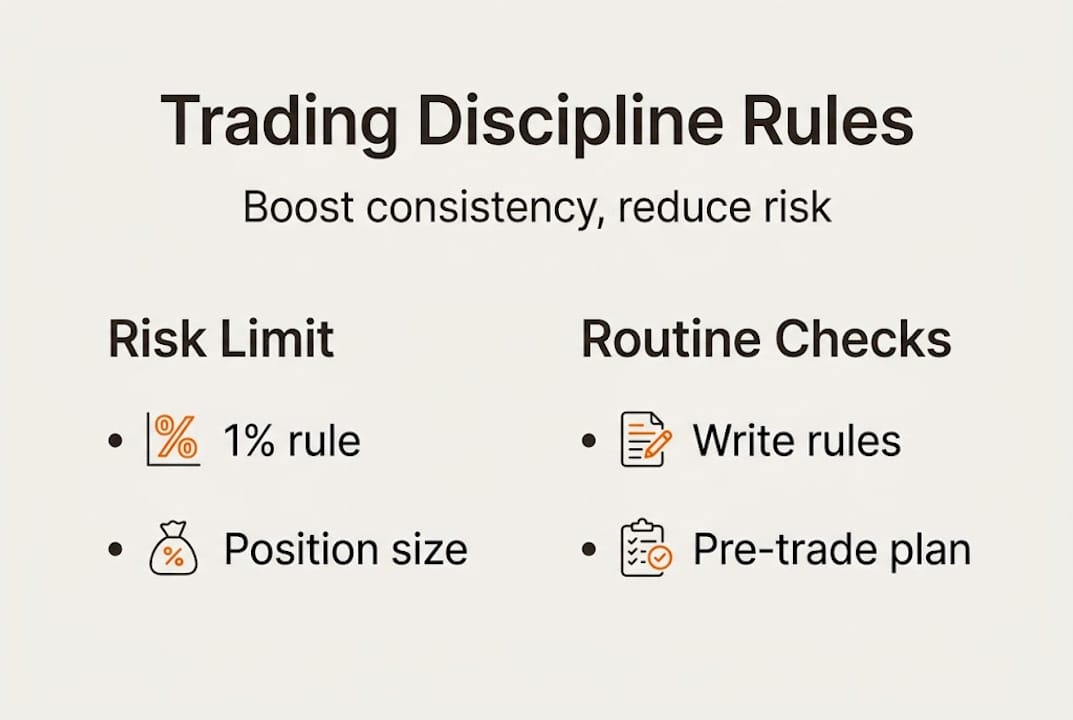
Pre-trade planning answers four questions: Does this trade fit my strategy? Is the risk-to-reward acceptable? Is market context supportive? And does this trade suit my current account state? These are not abstract questions. They have concrete, checkable answers that take two to five minutes to verify.
A practical pre-trade checklist includes:
- Strategy alignment: The setup must match a defined entry pattern from your trading plan, not a gut feeling.
- Risk-to-reward ratio: Minimum 1.5:1. If you cannot identify a logical take-profit at that ratio, pass on the trade.
- Market session: Confirm the asset is in its optimal liquidity window. Trading EUR/USD during Asian session hours carries different spread and volatility conditions than the London or New York overlap.
- News and event check: Identify any scheduled economic releases within the next 30 minutes that could invalidate your stop-loss before price reaches it.
- Account drawdown status: If you are in a drawdown, does this trade’s risk bring you close to your maximum daily or weekly loss limit?
- Setting trading objectives: Are your daily and weekly targets still realistic, or are you trading to recover losses?
The regulatory side of the industry reinforces why suitability checks matter. MiCA suitability guidelines from ESMA require crypto-asset service providers to collect information on a client’s knowledge, experience, financial situation, and risk tolerance before providing advice or managing portfolios. While these rules apply to licensed firms, the underlying principle applies equally to individual traders: never commit capital to a position without first confirming it fits your risk profile and objectives.
“Assessing suitability before making recommendations is not a bureaucratic formality. It is a recognition that capital should only be deployed where it has a justified reason to be.”
The account scaling tips available from DayProp connect directly to this principle: traders who maintain rigorous pre-trade habits demonstrate the consistency that justifies moving to larger account sizes. Skipping suitability checks is a visible flaw in performance data.
Pre-trade planning also reduces the psychological burden during a trade. When you enter with a clear plan, including your entry, stop, and target, you do not need to make decisions while price is moving. That clarity is one of the defining traits of professional execution.
Ongoing rule verification and accountability
Once preparation and suitability checks become routine, effective traders build a third layer: ongoing review and accountability. Rules written and never reviewed become outdated or are gradually abandoned under pressure. Review cycles close that gap.
The most effective accountability tool is a trade journal. Every trade should be logged with the following information:
- Date, time, asset, and direction of the trade.
- Entry price, stop-loss, and take-profit levels.
- Position size and dollar risk.
- The specific rule or setup that triggered the entry.
- Outcome: profit or loss in both dollar amount and percentage of account.
- A brief post-trade note on whether you followed your rules and why.
This data becomes the foundation for weekly and monthly reviews. During a review cycle, look for:
- Trades where you deviated from your rules and why.
- Asset classes or sessions where your win rate consistently underperforms.
- Risk-to-reward patterns: are you achieving the ratios you plan for, or are you exiting early?
- Emotional triggers: did losses cluster around specific news events or market conditions?
“Accountability without data is just intention. The journal converts intention into a trackable process.”
The MiCA framework emphasis on periodic statements for clients reinforces the value of regular performance reviews. The principle is the same for individual traders: periodic structured review, not ad hoc reflection, is what drives improvement.
Knowing when to adjust your rules is equally important. Signs that your ruleset may need revision include a statistically significant drop in win rate over 50 or more trades, consistent overperformance or underperformance in specific sessions, or market structure changes that make your entry patterns less reliable. Rule changes should be deliberate and tested, not reactive.
Signs you should not change your rules include a short losing streak of fewer than 10 trades, discomfort with drawdown that is still within your defined limits, or external pressure from other traders using different approaches. The DayProp blog covers market-specific rule adjustments, and the crypto risk rules guide addresses how to adapt your framework for the additional volatility and regulatory considerations of the crypto market.
Accountability also works externally. Sharing your journal with a trading partner or community, even selectively, creates social reinforcement for rule compliance. The act of knowing someone else will see your trade log reduces impulsive deviations significantly.
Our hard-won lessons: Why most traders fail to follow rules consistently
The gap between knowing the rules and following them is where most traders lose real money. It is not ignorance that causes failures. Every experienced trader understands the one-percent rule, journaling, and pre-trade checks. The failure happens in real-time, under pressure, when an emotional response overrides a logical one.
Overconfidence is the most underrated risk. After a winning streak, traders routinely increase position size, skip confirmation steps, or enter setups that barely meet their criteria. The market does not reward recent success; it rewards consistent process. A five-trade winning streak carries exactly zero predictive information about the sixth trade.
FOMO, the fear of missing out, is the second consistent saboteur. A trade moves without you, you feel the pull to chase it, and your carefully written entry rule gets rationalized away. The professional response is to document the missed trade in your journal and move on. The retail response is to enter late and usually lose.
Addressing overcoming trading challenges requires recognizing that discipline is not a personality trait you either have or lack. It is a system you build and protect. Treat your rule deviations as data, not as moral failures. Each breach tells you something about the specific trigger that bypassed your process. Fix the system, not just your attitude.
The mindset shift that actually works: stop measuring success by whether you made money today and start measuring it by whether you followed your rules. A losing trade executed perfectly is a better performance than a winning trade entered on impulse. Over hundreds of trades, process adherence is what produces results.
Take your trading to the next level with professional support
Mastering professional trading rules puts you in a position to do more than protect your own capital. It qualifies you to access institutional-level funding through structured evaluation programs.
DayProp’s performance-based evaluation is built around the exact principles covered in this guide: disciplined risk management, consistent execution, and rule-based trading behavior. Traders who demonstrate these qualities through the evaluation process gain access to funded accounts without risking personal capital. Explore the available funding model options to find the structure that fits your trading style, and review the funding benefits that come with joining a platform built for serious, rule-following traders. Your edge deserves capital behind it.
Frequently asked questions
What is the one-percent rule in trading?
The one-percent rule means never risking more than 1% of your total capital on any single trade, so a $10,000 account limits each trade’s loss to $100. As Investopedia confirms, risk is controlled through stop-loss and position sizing set before entry.
How does pre-trade suitability check help retail traders?
A suitability check confirms your trade matches your risk tolerance, strategy, and current account state before you commit capital. ESMA’s MiCA suitability requirements show that assessing financial situation and objectives before acting is a recognized industry standard, not just a personal preference.
Why do professional traders journal their trades?
Journaling creates a performance record that reveals patterns, rule violations, and emotional triggers that are invisible without data. It converts vague impressions about performance into specific, actionable information.
Are trading rules different for FX, indices, and crypto?
The core risk management and discipline principles apply across all three markets, but crypto carries additional regulatory considerations under frameworks like MiCA guidelines and higher volatility that require tighter position sizing and more frequent suitability reviews.
What is the biggest mistake new traders make with rules?
Most new traders either skip setting clear rules entirely or abandon them after their first significant loss, defaulting to emotional decision-making at exactly the moment structured thinking matters most.
Recommended
- FX Trading Discipline Process: 5 Steps to Funding Success – DayProp Funding
- Why use trading rules: improve risk and gain funding in 2026 – DayProp Funding
- Avoid gambling in trading: build discipline for lasting success – DayProp Funding
- 7 Trading Habits for Consistent Profits in FX and Crypto – DayProp Funding