

Most aspiring FX traders fail funding evaluations not because they lack technical skill or market knowledge, but because they cannot maintain consistent discipline under pressure. A single impulsive trade, an emotional reaction to a loss, or a deviation from risk parameters can disqualify an otherwise capable trader from funding opportunities. Building a structured trading discipline process transforms these behavioral weaknesses into measurable strengths. This guide provides a step-by-step framework for preparing, executing, and verifying your discipline routines to qualify for professional capital.
Table of Contents
- Understanding discipline in FX trading
- Essential requirements for a disciplined trading process
- Step-by-step: Building your FX trading discipline process
- Avoiding common mistakes and troubleshooting discipline lapses
- Measuring discipline and tracking your progress
- Take your trading discipline to the next level with DayProp Funding
- Frequently asked questions
Key Takeaways
| Point | Details |
|---|---|
| Discipline is fundamental | Developing consistent trading habits is critical to passing funding evaluations and sustaining long-term success. |
| Structure leads to results | A well-defined trading process reduces emotional errors and keeps you on track under pressure. |
| Measure improvement | Using journals and regular self-assessment helps traders spot discipline gaps and improve steadily. |
| Avoid common pitfalls | Recognize and address discipline-breaking behaviors early to minimize their impact on performance and evaluation chances. |
Understanding discipline in FX trading
Discipline in FX trading means consistently following your trading plan and risk parameters regardless of emotional state or recent outcomes. It is not a personality trait you either possess or lack. Discipline is a trainable process built through deliberate practice and systematic routines. Trading psychology and mindset impact discipline and consistency, making it essential to understand the behavioral foundations of rule-based trading.
For aspiring retail traders seeking funding, discipline matters more than profit in evaluation contexts. Proprietary trading firms assess whether you can follow rules under stress, manage risk consistently, and avoid the behavioral patterns that destroy accounts. A trader who generates modest returns while adhering strictly to parameters demonstrates more funding potential than one who achieves higher profits through rule violations.
“Discipline separates traders who receive funding from those who remain stuck in evaluation cycles. Firms fund the process, not the outcome.”
Common discipline pitfalls include:
- Revenge trading after losses, attempting to recover capital through impulsive positions
- Overleveraging beyond plan parameters when a setup appears attractive
- Adjusting stop losses mid-trade to avoid taking planned losses
- Trading outside documented setups based on gut feelings or market noise
- Skipping journaling after losing days to avoid confronting mistakes
Recognizing these patterns is the first step toward building a trading discipline process that eliminates them systematically.
Essential requirements for a disciplined trading process
Before implementing daily discipline routines, you need foundational elements in place. These requirements create the structure that makes consistent execution possible.
Core elements:
- Written trading plan specifying entry criteria, exit rules, and position sizing formulas
- Daily execution checklist to verify pre-trade, during-trade, and post-trade discipline steps
- Risk parameters defining maximum loss per trade, daily loss limits, and position size caps
- Trading journal for logging every trade with setup type, execution quality, and emotional state
Supporting psychology:
- Patience to wait for plan-compliant setups rather than forcing trades
- Detachment from outcomes to evaluate trades by process quality, not profit
- Acceptance of losses as normal business expenses within a probabilistic edge
Hardware and software:
- Charting platform with technical indicators matching your plan
- Alert system for price levels and setup notifications
- Journaling application or spreadsheet for performance tracking
- Timer or scheduling tool for discipline check intervals
Structured process and risk management are key to consistent trading profits. The table below outlines essential tools and their discipline functions:
| Tool Category | Specific Tool | Discipline Function |
|---|---|---|
| Planning | Written trading plan | Defines rule set for all decisions |
| Execution | Pre-trade checklist | Prevents impulsive entries |
| Risk Control | Position size calculator | Enforces consistent risk per trade |
| Review | Trading journal | Tracks adherence and identifies patterns |
| Accountability | Community or mentor | Provides external feedback loop |
Pro Tip: Start with small position sizes during the discipline-building phase. Lower financial stress makes it easier to follow rules consistently while you develop the habit patterns that will scale to larger accounts.
Once these requirements are in place, you can implement the daily discipline process that transforms intentions into consistent actions.
Step-by-step: Building your FX trading discipline process
A functional discipline process breaks trading into discrete phases with specific behavioral checkpoints. This framework provides structure for daily execution.
1. Pre-market preparation
Before the trading session begins, complete these discipline steps:
- Review your trading plan to refresh entry criteria and risk parameters
- Set maximum loss limits for the day in your platform
- Calculate position sizes for potential setups based on account balance
- Identify key price levels and mark them on your charts
- Set alerts for plan-compliant setup conditions
- Document your mental state and any factors that might affect discipline
This preparation phase creates a buffer between you and the market. It shifts decision-making from reactive to proactive, reducing the likelihood of emotional trades.
2. Trade execution discipline
During active trading hours, follow only setups that match your documented plan criteria. Use this execution checklist before every entry:
- Does this setup match a defined pattern in my plan?
- Is my position size calculated according to my risk formula?
- Have I placed my stop loss at the planned technical level?
- Am I entering because of plan criteria or emotional impulse?
- Have I documented this trade in my journal before execution?
If any answer is no, do not take the trade. A disciplined approach boosts performance and reduces risk by eliminating trades that fall outside your tested edge.
3. Real-time discipline monitoring
Set a timer to review your discipline status every 60-90 minutes during the session. Ask:
- Am I following my plan or making adjustments based on recent results?
- Have I taken any trades outside my documented setups?
- Am I respecting my stop losses or considering moving them?
- Is my emotional state affecting my decision quality?
If you identify discipline drift, step away from the platform for 15 minutes. Physical separation from the trading environment interrupts behavioral momentum and allows rational assessment.

4. Post-trade journaling and review
After each trade and at session end, log complete trade data:
- Setup type and entry reasoning
- Execution quality relative to plan
- Exit reasoning and whether stop or target was hit
- Emotional state during the trade
- Discipline score: Did you follow all plan rules?
Review this data weekly to identify patterns. Are you more disciplined in morning sessions? Do you break rules after consecutive losses? This analysis reveals specific behavioral triggers to address.
Pro Tip: Find an accountability partner or join a trading community focused on process improvement. External feedback helps you spot discipline lapses you might rationalize or overlook.
The comparison below shows how daily and weekly discipline reviews serve different functions:
| Review Type | Frequency | Primary Focus | Key Questions |
|---|---|---|---|
| Daily Review | End of each session | Immediate execution quality | Did I follow my plan today? What specific rules did I break? |
| Weekly Review | End of trading week | Pattern identification | What conditions trigger discipline lapses? Are my rules realistic? |
This structured approach to trading rules and risk management creates a feedback loop that strengthens discipline over time.
Avoiding common mistakes and troubleshooting discipline lapses
Even with a solid process, traders encounter behavioral traps that undermine discipline. Recognizing these patterns early allows for quick correction.
Frequent discipline-breaking mistakes:
- Revenge trading: Taking impulsive positions immediately after a loss to recover capital
- Overleveraging: Increasing position size beyond plan parameters when a setup appears attractive
- Stop loss adjustment: Moving stops further away mid-trade to avoid taking a planned loss
- Plan deviation: Taking trades that do not match documented setup criteria
- Journaling avoidance: Skipping post-trade documentation after losing days
Behavioral warning signs:
You are likely experiencing discipline drift if you:
- Rationalize trades that do not match your plan criteria
- Feel urgency to enter positions without completing your checklist
- Skip journaling entries or delay documentation
- Adjust risk parameters mid-session based on recent results
- Trade during times outside your planned schedule
“The moment you start negotiating with your trading rules is the moment discipline fails. Rules exist precisely for the situations where you want to break them.”
How to reset after a discipline failure:
When you break your discipline process, take these recovery steps:
- Immediate cessation: Stop trading as soon as you recognize the violation
- Documentation: Write a detailed account of what happened and why
- Pattern analysis: Review your journal for similar past incidents
- Cooling period: Take at least 24 hours away from live trading
- Plan adjustment: Determine if your rules need modification or if execution was the issue
- Gradual return: Resume with minimum position sizes until discipline is re-established
Schedule a formal review day after any significant discipline lapse. Returning to the market too quickly often leads to repeated mistakes. Trading challenges require specific discipline protocols, and understanding your personal failure patterns is essential for long-term success.
Measuring discipline and tracking your progress
Objective measurement transforms discipline from a vague concept into quantifiable data. This allows you to track improvement and identify specific areas needing attention.
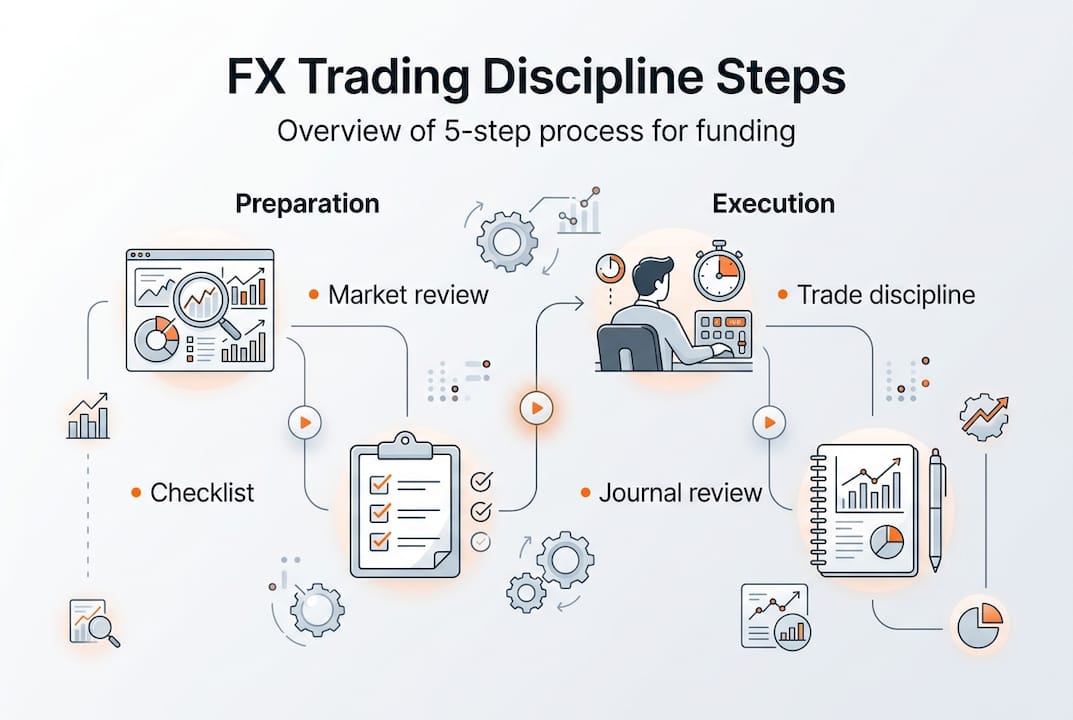
Quantitative discipline metrics
Calculate these metrics from your trading journal:
- Plan adherence rate: Percentage of trades matching documented setup criteria
- Risk compliance rate: Percentage of trades using correct position sizing
- Stop loss respect rate: Percentage of trades exited at planned stop levels
- Journaling completion rate: Percentage of trades fully documented
- Impulse trade frequency: Number of trades taken outside planned schedule or criteria
Track these metrics weekly. A trader with 95% plan adherence and 60% profitability demonstrates better funding potential than one with 70% adherence and 80% profitability. Consistency in process predicts long-term performance more reliably than short-term profit.
Journal data analysis
Review your journal monthly to identify patterns:
- Which session times show highest discipline scores?
- Do discipline lapses cluster after winning or losing streaks?
- Are certain setup types associated with more rule violations?
- Does your discipline deteriorate as the week progresses?
This analysis reveals specific conditions where your discipline process needs reinforcement. You might discover you trade more impulsively in afternoon sessions, suggesting a need for stricter pre-trade checklists during those hours.
External feedback and benchmarking
Seek objective assessment from:
- Trading mentors who can review your journal entries
- Community groups focused on process improvement
- Performance analytics platforms that compare your metrics to peer averages
Statistic callout: Proprietary trading firms report that traders maintaining 90%+ plan adherence rates pass funding evaluations at 3x the rate of those with lower consistency metrics, regardless of absolute profit levels.
Ongoing tracking helps traders sustain discipline and prepare for funding. The measurement process itself reinforces discipline by making behavioral patterns visible and creating accountability through data.
Take your trading discipline to the next level with DayProp Funding
Implementing a structured discipline process prepares you for the real-world conditions of professional trading evaluations. The behavioral skills you develop through systematic preparation, execution monitoring, and performance tracking directly translate to success in funding challenges.
DayProp Funding provides evaluation programs designed to identify traders who demonstrate consistent discipline and risk management. Our challenges reward process quality over short-term profit, aligning with the discipline-first approach outlined in this guide. Traders who master the five-step discipline framework position themselves for evaluation success and long-term capital growth.
Explore our comprehensive resources to continue your development. Our performance evaluation process guide details exactly what evaluators assess during funding challenges. The prop funding guide provides strategies for navigating evaluation requirements. Compare different capital allocation approaches in our trader funding models analysis to find the structure that matches your discipline strengths.
Discipline is not a fixed trait. It is a skill you build through deliberate practice and systematic process. The framework in this guide provides the structure to develop that skill and demonstrate it under evaluation conditions.
Frequently asked questions
What is the most important part of a trading discipline process?
Consistently following your trading plan and established risk parameters is the single most important aspect of trading discipline. All other elements support this core behavior.
How can I recover from a discipline lapse after a losing streak?
Take a trading break, review your journal to identify what triggered the lapse, and reset your mindset before returning. Never try to earn losses back with impulse trades.
What tools are recommended for tracking trading discipline?
Use a trading journal, daily checklists, and performance analytics platforms to objectively measure your adherence to plan. Spreadsheets work well for custom metric tracking.
Why is discipline emphasized more than profit in funding evaluations?
Prop firms value rule-based discipline over short-term profit because following rules signals long-term potential and reduces risk. Consistent process predicts sustainable performance.
How long does it take to build strong trading discipline?
Most traders need 3-6 months of deliberate practice with a structured discipline process to achieve 90%+ plan adherence rates. The timeline varies based on trading frequency and commitment to systematic review.
Recommended