

Most retail traders chase fast account doubling only to blow up within months. The harsh truth: rapid doubling attempts correlate with 70-90% failure rates in retail trading. Trading objectives are specific, structured goals that guide every trade decision and risk parameter, enabling discipline and sustainable growth in FX, indices, and crypto markets.
Table of Contents
- Introduction To Trading Objectives In Retail Trading
- Why Clear Trading Objectives Matter: The Reality Check
- Framework For Setting Effective Trading Objectives
- Common Misconceptions About Trading Objectives
- Market-Specific Considerations In Trading Objectives
- Psychological Impact Of Trading Objectives
- Linking Trading Objectives To Funded Account Growth
- How DayProp Funding Supports Your Trading Objectives
- Frequently Asked Questions
Key takeaways
| Point | Details |
|---|---|
| Clear objectives enhance discipline | Measurable trading objectives improve risk control and decision-making consistency across all markets. |
| High failure rates stem from poor goal-setting | 70-90% of retail traders fail due to vague goals and impulsive trading behavior. |
| SMART goals improve performance | Structured goal frameworks tailored to market conditions increase consistency and capital growth. |
| Market-specific adaptation is critical | Objectives must reflect volatility differences between FX, indices, and crypto for effective risk management. |
| Strong objectives reduce emotional trading | Clear goals decrease anxiety and impulsive decisions, supporting long-term profitability. |
Introduction to trading objectives in retail trading
Trading objectives are specific, measurable goals that define your risk tolerance, profit targets, and trade criteria for every position you take. They transform vague intentions like “make money” into concrete benchmarks such as “risk 1% per trade to target 2% returns with a maximum 5% monthly drawdown.” Without these anchors, traders drift into inconsistent decisions driven by emotion rather than strategy.
Why do trading objectives matter so much? They create a framework that aligns your trading strategy with your personal risk capacity and performance expectations. Instead of reacting to market noise, you execute trades based on predetermined rules that match your capital and psychological tolerance. This consistency separates disciplined traders from gamblers.
Retail traders face distinct challenges that make objectives even more critical:
- Limited capital makes every loss more impactful, requiring strict risk controls
- Psychological pressure from personal funds on the line increases emotional decision-making
- Access to high leverage in FX and crypto amplifies both gains and catastrophic losses
- 24/7 crypto markets and volatile price swings demand adaptive yet firm objectives
Objectives bridge the gap between your trading plan and execution. They answer questions before you enter a position: How much am I willing to lose? What return justifies this risk? When do I exit regardless of outcome? This clarity prevents the common trap of moving stop losses or holding losers too long, behaviors that destroy accounts.
For retail traders in FX, indices, and crypto, objectives also account for market-specific factors like liquidity differences, trading hours, and volatility patterns. A well-structured objective adapts to these realities while maintaining core principles of capital preservation and consistent growth. Resources like the DayProp blog offer practical insights into building these frameworks for real-world trading conditions.
Why clear trading objectives matter: the reality check
The statistics are brutal. 70-90% of retail FX traders lose money largely due to poor goal-setting and inadequate risk management. This isn’t about lacking technical skills or chart reading ability. Most failing traders can spot patterns and execute trades mechanically. The problem lies deeper: they trade without clear, measurable objectives that define success and protect capital.
Many retail traders fixate on technical signals while ignoring the strategic foundation that makes those signals profitable. You might have a winning pattern that works 60% of the time, but without defined risk limits and profit targets, random execution will still drain your account. One oversized loss can erase weeks of disciplined gains. One emotional revenge trade can trigger a spiral of poor decisions.
“Trading without objectives is like driving without a destination. You might move fast, but you’ll never know if you’re headed toward success or off a cliff.”
The reality extends beyond individual trades. Market complexity involves:
- Psychological pressure that intensifies without predefined exit rules
- Volatility spikes that punish traders who lack adaptive risk parameters
- Drawdown periods that test discipline when objectives aren’t clearly tied to long-term strategy
- Leverage that magnifies both wins and losses, requiring precise position sizing
Without clear objectives, risk management becomes reactive instead of proactive. You’re guessing at position sizes rather than calculating them based on account percentage rules. You’re hoping a losing trade reverses rather than cutting losses at a predetermined point. This approach guarantees inconsistency and eventual capital erosion.
Structured goals provide measurable progress markers that reduce emotional decision-making. When you know your weekly drawdown limit is 3% and you hit 2.5%, the objective tells you to reduce position sizes or step away, not double down to recover. This mechanical adherence to rules, enabled by clear objectives, is what separates funded traders from those who blow accounts. Learn how building discipline in trading accounts transforms performance through objective-based execution.
Framework for setting effective trading objectives
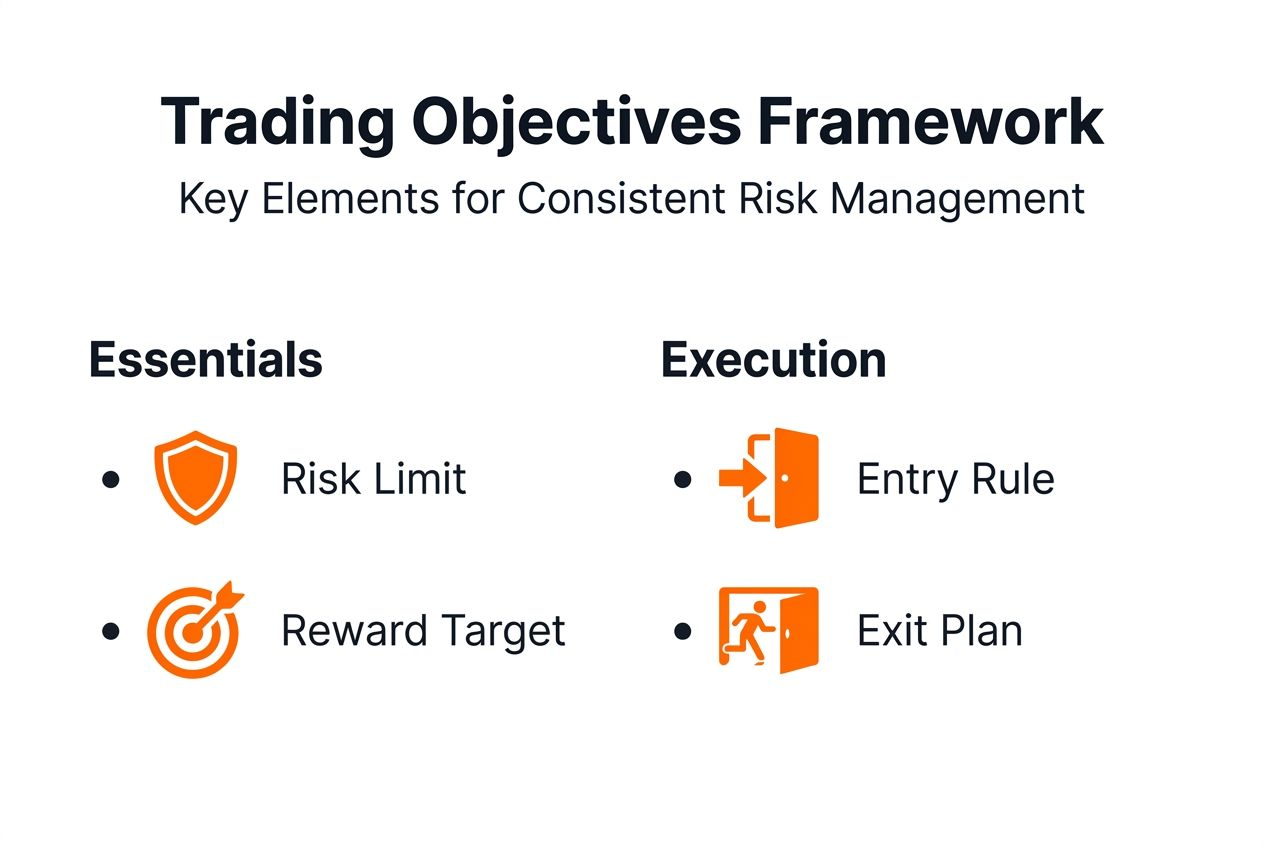
Creating effective trading objectives requires a systematic approach that transforms vague aspirations into concrete, actionable targets. Follow this five-step framework tailored for retail traders in FX, indices, and crypto markets.
Step 1: Assess your risk tolerance and available capital
Start by determining how much capital you can allocate to trading without affecting essential expenses. Calculate the maximum dollar amount you’re comfortable losing in a single trade and over a month. For most retail traders, risking more than 1-2% per trade or 5-10% monthly drawdown leads to psychological stress and poor decisions. Your objectives must fit within these personal boundaries.
Step 2: Set SMART goals
Apply the SMART framework to create specific, measurable, achievable, relevant, and time-bound objectives. Research shows using SMART goals improves achievement rates by up to 50% in trading contexts. Instead of “grow my account,” define “achieve 8% monthly returns while maintaining a maximum 5% drawdown over the next quarter.” This precision eliminates ambiguity and creates clear success metrics.
Step 3: Incorporate risk-to-reward ratios
Every trade should target at least a 1:2 risk-to-reward ratio, meaning you aim to make twice what you risk. If you risk $50, target $100 profit minimum. This mathematical edge allows you to be profitable even with a 40% win rate. Calculate your ratios before entering positions and reject trades that don’t meet your minimum threshold.

Step 4: Define clear entry, exit, and stop-loss rules
Document specific criteria for every trade component. Entry rules might include “RSI below 30 with bullish divergence on 4-hour chart.” Exit rules could specify “take profit at 2% gain or when RSI reaches 70.” Stop-loss placement should be technical, like “20 pips below recent swing low,” not arbitrary. These rules remove emotion from execution.
Step 5: Review and adjust based on performance data
Schedule monthly reviews of your trading journal to analyze whether objectives align with results. If your win rate is 55% but you’re losing money, your risk-to-reward ratio needs adjustment. If drawdowns consistently exceed limits, tighten position sizing. Objectives should evolve as you gather performance data and market conditions shift.
| Objective Element | Example Specification | Purpose |
|---|---|---|
| Daily risk limit | Maximum 0.5% account risk per trade | Prevents catastrophic single-trade losses |
| Weekly target | 2-3% account growth | Provides short-term measurable milestone |
| Monthly drawdown cap | Maximum 8% total decline | Triggers strategy pause and review |
| Win rate goal | Maintain 50%+ winning trades | Ensures strategy viability with risk ratios |
Pro Tip: Start with conservative objectives for the first three months. Many traders set aggressive targets and face psychological pressure that leads to overtrading. Build confidence with achievable goals, then scale as your consistency proves sustainable.
For traders pursuing funded opportunities, align your objectives with evaluation criteria from platforms offering performance-based trading evaluation processes. Understanding these benchmarks helps you structure goals that simultaneously build skills and meet funding requirements. Reference this SMART goal methodology checklist to ensure your objectives cover all essential elements. Additionally, explore the trading evaluation guide for prop funding to see how structured objectives translate to funded account success.
Common misconceptions about trading objectives
Retail traders often operate under false beliefs that sabotage their success before they even begin. Understanding these myths helps you set realistic, effective objectives that align with market realities.
Myth: Fast account doubling is achievable and sustainable
Many traders believe they can double accounts in weeks or months through aggressive trading. The data tells a different story. Rapid attempts to double accounts lead to excessive risk-taking and dramatically higher failure rates. Professional traders target 5-15% monthly returns consistently, not 100% moonshots. The math of compounding makes modest, steady gains far more powerful than boom-bust cycles that inevitably bust.
Myth: You can trade profitably without defined goals
Some traders claim intuition or “feel” guides their best trades, suggesting goals restrict natural talent. Reality contradicts this. Trading without objectives means you can’t measure progress, identify what works, or replicate success. You might hit a lucky streak, but without goals anchoring your decisions, you’ll give those gains back during inevitable drawdown periods. Goals don’t limit talent; they provide the structure that lets skill compound.
“The market rewards patience and punishes greed. Objectives that reflect this truth survive. Those that don’t, disappear with the accounts that hold them.”
Myth: High-risk trades accelerate wealth building
The belief that bigger risks equal bigger rewards dominates retail trading psychology. While leverage amplifies gains, it destroys accounts far more often. Consider this:
- Risking 10% per trade requires just 10 consecutive losses to zero your account
- Risking 1% per trade allows 100 consecutive losses before elimination
- Most traders don’t have 100 bad trades in a row, but many have 10 during learning phases
Sustainable growth comes from risk limits that protect capital during learning curves and market volatility. High-risk trading isn’t bold; it’s mathematical suicide.
Myth: Trading objectives should remain static
Some traders set goals once and never adjust them, believing consistency means rigidity. Markets evolve. Your skill improves. Capital grows. Objectives must adapt while maintaining core risk management principles. A trader with $5,000 and one with $50,000 need different absolute dollar targets even if percentage goals align. Quarterly reviews and adjustments based on performance data keep objectives relevant and achievable.
Market-specific considerations in trading objectives
Different markets demand different objective frameworks. FX, indices, and crypto each present unique volatility profiles, liquidity characteristics, and operational patterns that must shape your goals and risk parameters.
FX markets: lower volatility, higher liquidity
Forex typically offers the tightest spreads and deepest liquidity among retail markets. Major pairs like EUR/USD move in smaller percentage increments compared to crypto, allowing tighter stop losses relative to targets. Your objectives here can focus on higher trade frequency with smaller per-trade risk. Daily volatility usually sits below 1% for majors, so expecting 5% daily returns signals unrealistic objectives that will push you toward overleverage.
Indices markets: session-based volatility
Stock indices like S&P 500 or NASDAQ 100 show distinct volatility patterns tied to trading sessions. Objectives must account for this:
- Pre-market and opening hours bring higher volatility requiring wider stops
- Mid-day sessions often consolidate, favoring range-bound strategies
- Closing hours see increased volume and breakout potential
Your risk limits might tighten during low-volatility periods and relax slightly during known high-volatility windows, always within your overall drawdown caps. Unlike 24/7 markets, indices force discipline by limiting trading hours, which can actually support better objective adherence.
Crypto markets: extreme volatility, continuous operation
Cryptocurrency trading operates 24/7 with volatility that can exceed 10% daily moves on major assets like Bitcoin. This environment demands stricter risk controls and more flexible profit targets. Consider these adaptations:
- Reduce position sizes compared to FX trades (risk 0.5% vs 1% in forex)
- Set wider percentage-based stops to avoid getting shaken out by normal noise
- Use time-based exits in addition to price targets, as crypto can consolidate for days
- Implement daily trading hour limits to prevent burnout from constant market access
| Market Type | Typical Daily Volatility | Recommended Max Risk Per Trade | Stop-Loss Considerations |
|---|---|---|---|
| FX Majors | 0.5-1.0% | 1-2% of account | Tight stops work; 20-30 pips typical |
| Stock Indices | 0.8-1.5% | 1-1.5% of account | Session-dependent; wider at open/close |
| Crypto | 3-10%+ | 0.5-1% of account | Wide stops needed; percentage-based |
Understanding these market differences prevents the common mistake of applying identical objectives across all assets. A strategy that works in FX with 1% stops might blow your account in crypto with the same parameters. Adapt your goals to match the environment while maintaining your core risk management philosophy. Resources on trading habits in FX and crypto provide additional insights into tailoring objectives for these distinct market conditions.
Psychological impact of trading objectives
Trading psychology often determines success more than technical analysis or market knowledge. Clear, well-structured objectives directly address the psychological pitfalls that destroy accounts and trading careers.
Reducing decision anxiety and emotional trading
When every trade requires real-time decision-making without guidelines, anxiety spikes. Should you exit now or wait? Is this dip a buying opportunity or the start of a collapse? Objectives eliminate this mental strain by providing predetermined answers. You know your stop loss, target, and maximum daily loss before opening positions. This clarity lets you execute mechanically, reducing the emotional weight of each decision.
Building confidence through structure and focus
Traders with clear objectives report higher confidence levels because they can measure progress objectively. Instead of feeling like you’re guessing, you’re following a tested plan with defined success metrics. Even losing trades feel manageable when they fit within expected risk parameters. This confidence compounds over time, making it easier to take valid setups without hesitation or fear.
Key psychological benefits of structured objectives include:
- Decreased impulsive trading driven by FOMO or revenge mentality
- Lower stress from knowing exactly when to stop trading for the day or week
- Improved sleep quality when you’re not worried about undefined risks overnight
- Greater resilience during drawdowns because you anticipated them in your objectives
Pro Tip: Write your objectives on a card and place it where you can see it while trading. Physical reminders combat the psychological tendency to abandon plans during emotional moments. Reviewing objectives before each trading session reinforces discipline and keeps long-term goals front of mind.
Supporting sustained capital growth through discipline
Psychological discipline creates the consistency required for compounding returns. When objectives keep you from overleveraging during winning streaks or revenge trading during losses, your equity curve smooths out. This steadier growth, even if slower than you initially hoped, builds the psychological momentum that keeps you trading through inevitable rough patches.
Traders who internalize their objectives transform them from external rules into automatic behaviors. This psychological shift from “I should follow my plan” to “This is how I trade” marks the transition from struggling beginner to consistently profitable trader. Learn more about developing this disciplined approach to trading growth through objective-focused psychology.
Linking trading objectives to funded account growth
Structured trading objectives directly translate to success in proprietary trading evaluations and funded account programs. The connection isn’t coincidental; these programs explicitly reward the discipline and risk management that clear objectives create.
Objectives enforce evaluation rule compliance
Funded trading challenges have specific rules around maximum daily losses, total drawdowns, and minimum trading days. These aren’t arbitrary; they mirror professional risk management standards. When your personal trading objectives already incorporate similar limits, meeting funded program requirements becomes natural rather than restrictive. You’re simply executing your normal disciplined approach under evaluation conditions.
Data shows discipline doubles success rates
Case studies reveal that discipline and risk adherence double the chance of advancing in funded trading challenges compared to discretionary trading without clear objectives. The reason is straightforward: evaluation programs eliminate traders who take excessive risks or trade emotionally, exactly the behaviors that objectives prevent. Traders who’ve already built objective-based habits pass evaluations at dramatically higher rates.
Managing drawdowns enables capital scaling
Funded programs often offer account scaling when traders demonstrate consistent profitability within risk parameters. Clear objectives that cap drawdowns at 5-8% monthly position you for these scaling opportunities. You prove you can manage $10,000 without excessive risk, earning the right to manage $25,000, then $50,000, then more. Without objectives limiting losses, you’ll never demonstrate the control required for capital increases.
Practical applications for funded trading objectives:
- Align daily loss limits with evaluation maximum daily drawdown rules
- Set profit targets that achieve evaluation goals within required trading days
- Build consistency metrics that demonstrate edge over minimum evaluation periods
- Document every trade to show decision-making process follows defined criteria
Many traders approaching funded evaluations realize their existing objectives need refinement to match institutional expectations. This recognition drives improvement in risk management and strategic thinking that benefits all trading, not just evaluations. Resources focused on helping traders grow trading capital with smart goals provide frameworks specifically designed for funded program success.
The essential skills for funded traders all connect back to objective-based trading: risk management, emotional control, strategic planning, and performance analysis. Mastering these skills through structured objectives creates a foundation for consistent trading account growth strategies that work in both personal and funded trading contexts.
How DayProp funding supports your trading objectives
DayProp’s evaluation platform is built around the same principle that drives successful trading: structured objectives create consistent results. Their funded programs provide traders with the capital to apply disciplined strategies without personal financial risk, while their educational resources help you develop and refine the objectives that make you evaluation-ready.
DayProp’s performance-based trading evaluation process aligns directly with objective-focused trading. Their challenge rules around maximum drawdowns, profit targets, and trading day requirements mirror the structure that professional traders use daily. When you build personal objectives that incorporate these standards, you’re simultaneously preparing for funded success and developing sustainable trading habits.
Their comprehensive prop trading risk tips for 2026 guide traders through setting appropriate risk parameters that protect capital while pursuing growth. These aren’t theoretical concepts; they’re practical frameworks used by traders managing institutional capital. Applying these principles to your objective-setting process increases both evaluation pass rates and long-term profitability.
The DayProp funded trading platform offers evaluation structures that reward exactly what clear objectives create: consistency, discipline, and risk-aware execution. Whether you’re developing your first structured trading plan or refining an existing approach, their resources provide the benchmarks and best practices that turn vague trading goals into funded account success.
Frequently asked questions
What are trading objectives and why are they important?
Trading objectives are specific, measurable goals that define your risk tolerance, profit targets, position sizing rules, and trade execution criteria. They’re important because they transform vague intentions into concrete benchmarks that guide every trading decision. Without clear objectives, traders drift into emotional, inconsistent execution that typically results in capital loss. Objectives create the discipline and structure necessary for long-term profitability.
How do trading objectives reduce emotional trading and improve discipline?
Clear objectives provide predetermined answers to questions that otherwise trigger emotional responses during live trading. When you know your exact stop loss, profit target, and maximum daily risk before entering a position, you eliminate real-time decision anxiety that leads to impulsive changes. This structure reduces the psychological weight of each trade and prevents revenge trading after losses or overconfidence after wins.
What is the best way to tailor trading objectives for crypto compared to FX or indices?
Crypto objectives should incorporate tighter risk limits per trade, typically 0.5-1% versus 1-2% in FX, due to higher volatility and larger price swings. You’ll need wider percentage-based stops to avoid getting shaken out by normal crypto noise. Consider implementing daily trading hour limits since crypto’s 24/7 operation can lead to overtrading and burnout. Adjust profit targets to reflect crypto’s potential for larger moves while maintaining strict drawdown caps.
How often should traders review and adjust their trading objectives?
Traders should conduct formal objective reviews monthly or quarterly, depending on trading frequency and capital size. These reviews should analyze whether current objectives align with actual performance data, market conditions, and personal circumstances. Make adjustments when your win rate, average win/loss ratio, or account size changes significantly. However, avoid changing core risk management principles during emotional periods or short-term drawdowns.
Recommended