

TL;DR:
- Most retail FX traders fail due to poor risk management and over-leverage.
- Discipline, proper position sizing, and trading higher timeframes improve longevity.
- Accessing prop firm funding offers scalable capital without risking personal savings.
Between 70 and 90 percent of retail FX traders lose money consistently, with most estimates settling around 71 to 80 percent. That is not a warning to scare you away from trading. It is a benchmark to beat. The difference between traders who survive and those who blow their accounts usually comes down to a handful of repeatable practices, not market secrets or special indicators. This article covers what those practices actually look like: how to manage risk with precision, how to build discipline into your trading setup, how to access prop firm capital without risking your own savings, and how to measure your performance honestly over time.
Table of Contents
- Why most retail traders fail and how to flip the odds
- Risk management: The non-negotiable rules for staying in the game
- Tactics for discipline: Timeframes, diversification, and broker choice
- Accessing capital safely: Prop firm funding and evaluation challenges
- Execution edge: Match strategy to market and measure results honestly
- Perspective: The hard truths and overlooked edges in retail FX
- Next steps: Secure your growth and reduce risk with expert guidance
- Frequently asked questions
Key Takeaways
| Point | Details |
|---|---|
| Most traders lose money | Focus on defensive strategies to avoid joining the majority who don’t profit. |
| Risk small, trade smart | Risking just 1-2% per trade and using stops helps protect your trading capital. |
| Prop firms reduce personal risk | Trading with a prop firm’s capital allows you to scale without risking your own savings. |
| Discipline beats prediction | Strict execution and honest review matter more than trying to constantly predict market moves. |
Why most retail traders fail and how to flip the odds
The statistics are stark. Only 3 to 8 percent of retail traders remain profitable over a three-year period. Most quit within the first year. The reasons are consistent: excessive leverage, no defined risk controls, and chasing unrealistic monthly returns that no institutional desk would ever target.
Retail traders also face structural disadvantages that institutions do not. You are trading CFDs (contracts for difference) with spreads, overnight fees, and slippage working against you. Institutions access raw interbank pricing, execute in size, and have full visibility into order flow. Understanding this gap is the first step toward operating more defensively. For a deeper look at how the other side operates, reviewing institutional trading conditions gives useful context.
Here is what consistently separates losing traders from those who last:
- Leverage misuse. Using 50:1 or 100:1 leverage on small accounts turns minor adverse moves into account-ending losses.
- No predefined exit rules. Entering trades without stop-loss or take-profit levels leads to emotional decision-making.
- Chasing returns. Targeting 20 to 30 percent monthly returns forces over-trading and excessive risk.
- Ignoring the cost structure. Spreads, commissions, and swap fees erode profitability faster than most new traders expect.
“The market does not care about your account balance. It rewards process, not ambition.”
The mindset shift required is significant. Treat trading as a structured business with defined risk budgets, not a vehicle for fast wealth. Understanding what retail trading actually involves at a structural level helps set realistic expectations from the start.
Risk management: The non-negotiable rules for staying in the game
With a defensive mindset in place, the next step is to master risk. This is where most traders either build a durable foundation or continue repeating the same costly mistakes.

The core principle is straightforward: risk only 1 to 2 percent of your account balance on any single trade using proper position sizing. On a $10,000 account, that means a maximum loss of $100 to $200 per trade. This cap prevents any single bad trade from doing serious damage to your overall capital.
Here is a step-by-step framework for applying risk management consistently:
- Define your stop-loss before entry. Determine the price level where your trade idea is proven wrong, then set your stop there.
- Calculate position size from the stop distance. Use a position sizing calculator to determine lot size based on your risk amount and stop distance.
- Set a take-profit at a minimum 1:2 risk/reward ratio. If you risk 50 pips, target at least 100 pips. This means you can be wrong more than half the time and still profit.
- Never move a stop-loss to avoid a loss. Widening stops mid-trade invalidates your original analysis and increases actual risk.
- Avoid raising leverage after a losing streak. Over-leverage to recover losses is one of the most common causes of full account drawdown.
“Drawdowns are part of trading. Catastrophic drawdowns are a choice.”
Pro Tip: Use a free online risk calculator before every trade. Input your account size, risk percentage, stop distance in pips, and currency pair. Never estimate position size manually.
Applying these rules consistently is what separates traders who achieve consistent trading profits from those who rely on luck. For traders operating in crypto or multi-asset environments, the same risk management rules apply across markets. And for those serious about scaling, studying professional risk management frameworks provides a clear benchmark.
Tactics for discipline: Timeframes, diversification, and broker choice
Effective risk management sets the stage, but discipline in your trading setup is equally vital. How you structure your trading environment has a direct impact on your results.
One of the most overlooked improvements a retail trader can make is shifting to higher timeframes like H4 and daily, and selecting regulated brokers with transparent execution. Lower timeframes amplify noise, increase transaction costs, and encourage impulsive decisions.
Pro Tip: Avoid scalping retail CFDs. The combination of spreads, slippage, and swap fees makes it extremely difficult to generate net positive results at high frequency on a retail account.
Here is a practical comparison of trading setups by timeframe and approach:
| Factor | Lower timeframes (M1, M5) | Higher timeframes (H4, Daily, Weekly) |
|---|---|---|
| Signal noise | Very high | Low to moderate |
| Transaction costs | High (more trades) | Lower (fewer trades) |
| Emotional pressure | Intense | Manageable |
| Strategy suitability | Scalping (high risk) | Swing and position trading |
| Recommended for retail | No | Yes |
For diversification, focus on major currency pairs (EUR/USD, GBP/USD, USD/JPY) where liquidity is highest and spreads are tightest. Avoid spreading attention across too many instruments at once. Trading five correlated pairs simultaneously does not reduce risk. It multiplies it.
Key broker selection criteria:
- Regulatory status. Choose brokers regulated by FCA, ASIC, or CySEC.
- Execution transparency. Look for ECN or STP execution with disclosed pricing.
- Swap and spread disclosure. Understand the full cost structure before opening an account.
For traders exploring how institutional trading conditions differ from retail setups, or looking for a practical guide for retail traders, those resources provide useful structural context.
Accessing capital safely: Prop firm funding and evaluation challenges
Once your trading plan is robust, there is a safe way to scale up: prop firm funding. Proprietary trading firms provide capital to traders who pass a structured evaluation, allowing you to trade larger accounts without putting your personal savings at risk.
The model works as follows. You pay a one-time challenge fee, trade a demo account under defined rules (maximum drawdown, profit target, minimum trading days), and if you pass, you receive a funded account. Top firms offer accounts up to $400,000 with profit splits ranging from 80 to 95 percent. The5ers, for example, has distributed over $43 million in payouts to funded traders.
Here is how leading prop firms compare:
| Firm | Max funding | Profit split | Key rule focus | Track record |
|---|---|---|---|---|
| The5ers | Up to $4M (scaling) | 80 to 100% | Consistency, low drawdown | Established, $43M+ paid |
| FTMO | Up to $200,000 | 80 to 90% | Two-phase challenge | Well-known, widely reviewed |
| MyForexFunds | Up to $300,000 | 75 to 85% | Rapid challenge format | Mixed recent reviews |
Key criteria when selecting a prop firm:
- Longevity. Prefer firms with a multi-year track record and verified payout history.
- Rule clarity. Rules on drawdown, lot size, and trading hours must be transparent and fixed.
- Scaling potential. Look for firms that grow your account based on performance, not just initial funding.
- Avoid new, unproven firms. The prop firm space has seen several closures. Stick to established names.
For a detailed breakdown, reviewing prop firm rules explained helps you evaluate what each firm actually requires. The prop trading guide covers the full path from evaluation to funded status, and understanding funded trader strategies prepares you for what comes after passing.
Execution edge: Match strategy to market and measure results honestly
With capital and rules in place, your success now depends on testing, reflection, and adapting to market realities. No single strategy works for every trader or every market condition.
The three primary retail strategy types are trend following, mean reversion, and range trading. Trend and mean reversion strategies have meaningfully different win rate profiles and drawdown characteristics. Before committing real capital, run any strategy through a demo phase using at least 100 sample trades.
Key execution habits that separate consistent traders from inconsistent ones:
- Backtest before live trading. Use historical data to validate your setup across different market conditions.
- Run a demo phase. Confirm that your live execution matches your backtest results before scaling.
- Track every trade in a journal. Record entry, exit, rationale, and outcome. Review weekly.
- Accept realistic win rates. Research shows that even with machine learning models, FX markets are increasingly efficient, and traders need win rates above 55 percent just to break even after costs.
- Focus on process metrics, not daily P&L. Measure adherence to your rules, not just your account balance.
Pro Tip: Keep a trade journal with a simple scoring system. Rate each trade on rule adherence (1 to 5) regardless of outcome. A losing trade executed correctly is a better result than a winning trade taken impulsively.
Long-term consistency comes from repeating a sound process, not from finding a new indicator or strategy every month. The traders who last are those who refine what works and eliminate what does not, based on actual data.
Perspective: The hard truths and overlooked edges in retail FX
Most traders who struggle are not failing because they lack access to good strategies. They fail because they underestimate how much discipline the execution actually requires. The FX market does not reward intelligence or effort in isolation. It rewards behavioral consistency under pressure.
The persistent myth in retail trading is that there is a strategy secret waiting to be discovered. In reality, the edge most traders are missing is not a new indicator or a proprietary signal. It is the willingness to apply known rules without exception, review losses without rationalization, and say no to over-leverage when the temptation to recover losses is highest.
Huge losses are rarely caused by bad strategies. They are caused by abandoning good strategies at the worst possible moment. The traders who survive long enough to benefit from funding opportunities for retail traders are those who treated every losing period as a process test, not a signal to change everything.
Retail trading is, at its core, a test of discipline. Not prediction.
Next steps: Secure your growth and reduce risk with expert guidance
Knowledge of best practices is the foundation, but applying them in a structured, funded environment is where real progress happens. If you are ready to move beyond theory, the next step is to explore your options for evaluation and funded trading.
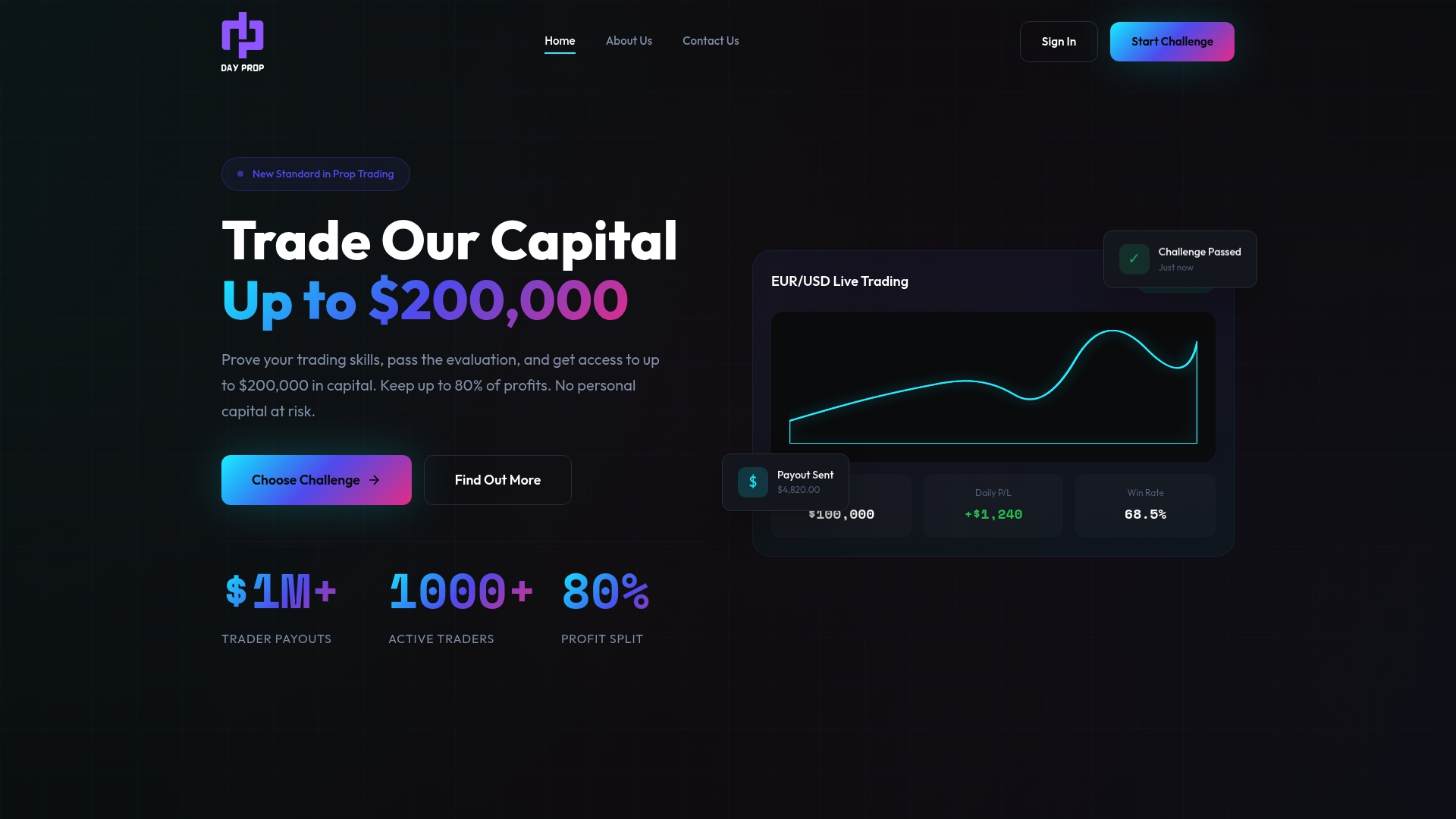
Start by reviewing funding model comparisons to understand which structure fits your trading style and risk tolerance. If you are preparing for an evaluation, the evaluation guide for prop funding walks you through exactly what to expect and how to prepare. DayProp provides structured challenges built around professional risk parameters, transparent rules, and performance-based scaling, giving disciplined traders a clear path to institutional-level capital without personal capital risk.
Frequently asked questions
How much should I risk per FX trade?
Most experts recommend risking only 1 to 2 percent of your account balance on any single trade to avoid large drawdowns. This cap ensures no single loss can significantly damage your overall capital base.
What’s the best way to get funded as a retail FX trader?
Enroll in a reputable prop firm challenge with clear rules and a proven track record. Firms like The5ers offer retail traders access to large capital accounts with competitive profit splits and structured scaling plans.
Are demo accounts useful for FX trading practice?
Yes, demo accounts are essential for validating strategies before risking real capital. Testing strategies in demo first helps you build confidence and identify weaknesses in your approach without financial consequence.
Is a high win rate all you need to succeed in FX trading?
No. Research confirms that traders need win rates above 55 percent just to break even after costs, and managing risk and drawdown is often more decisive than win rate alone.
Why should I avoid scalping as a retail FX trader?
Because of high transaction costs and slippage, scalping retail CFDs is rarely profitable compared to swing trading on higher timeframes where cost impact per trade is proportionally lower.
Recommended