

Many traders believe aggressive risk accelerates wealth, but limiting risk to 1-2% per trade is what separates consistent winners from account blowouts. Ignoring professional risk limits leads to emotional decisions, revenge trading, and total capital loss. This guide explains why professional risk management is essential for consistent trading performance and securing funding.
Table of Contents
- Introduction To Professional Risk Management
- Core Principles Of Professional Risk Management
- Understanding Risk-Reward Relationship And Its Impact
- Psychological Benefits And Discipline Through Risk Management
- Common Misconceptions About Risk And Their Corrections
- Why Professional Risk Management Is Critical For Securing Funding
- Unique Risk Challenges In Crypto Trading
- Implementing Professional Risk Management: Step-By-Step Framework
- Conclusion: From Risk Management To Consistent Funding And Growth
- Explore DayProp Funding Solutions To Apply Professional Risk Management
Key takeaways
| Point | Details |
|---|---|
| Capital preservation | Professional risk management preserves capital by enforcing 1-2% risk per trade, ensuring survival through losing streaks. |
| Risk-reward priority | Risk-reward ratio drives profitability more effectively than win rate alone, with minimum 1:2 targets recommended. |
| Emotional control | Disciplined risk controls reduce impulsive trading and support consistent performance under market stress. |
| Funding requirement | Prop firms require strict adherence to risk limits for evaluation success and account scaling. |
| Crypto adaptation | Higher crypto volatility demands tighter stop losses and smaller position sizes compared to forex. |
Introduction to professional risk management
Professional risk management is a structured process that protects trading capital through quantitative rules and disciplined loss control. Amateur traders often make emotional decisions, risk large portions of capital, and chase losses without clear exit strategies. Professional traders, by contrast, use predefined risk percentages, systematic stop losses, and position sizing formulas to ensure survival and consistency.
Capital preservation is the foundation of long-term trading success. Without protecting your account from catastrophic losses, even the best strategy eventually fails. Professional traders understand that staying in the game matters more than hitting home runs.
Common amateur pitfalls include:
- Ignoring stop losses and hoping losing trades reverse
- Risking 5-10% or more per trade, leading to rapid account depletion
- Trading emotionally after losses, compounding mistakes
- Failing to calculate position size based on risk tolerance
- Over-leveraging accounts beyond sustainable limits
Professional risk management sets the stage for consistent, fundable performance. Traders who master essential trading skills for funded traders prioritize risk control as their competitive edge. By adopting systematic risk rules, you shift from gambling to professional trading, positioning yourself for institutional funding and sustainable growth.
Core principles of professional risk management
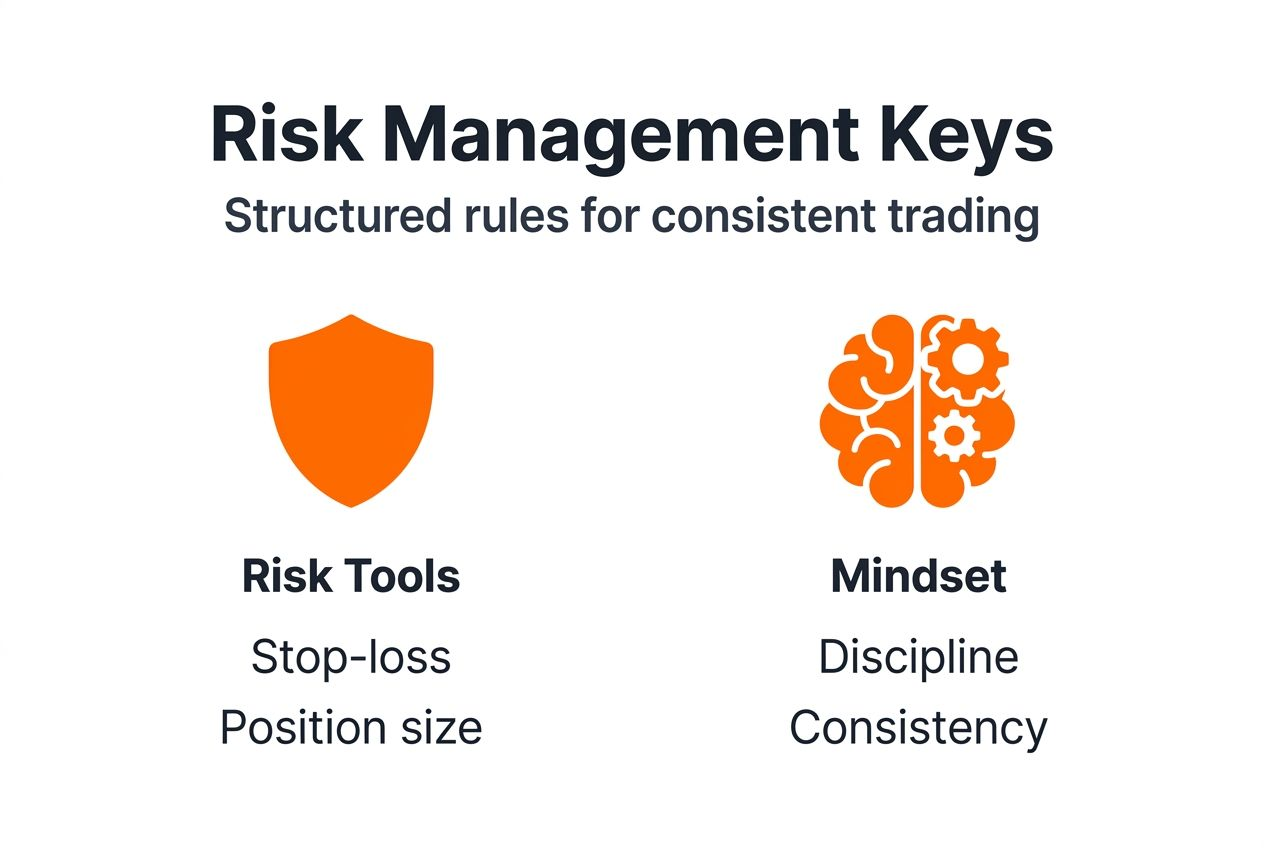
Professional traders limit risk to 1-2% of their trading capital per trade to survive inevitable losing streaks. This industry standard ensures that even ten consecutive losses only reduce your account by 10-20%, leaving ample capital to recover. Without this discipline, three bad trades at 10% risk each could wipe out 30% of your account, creating psychological pressure and forcing desperate decisions.
Stop-loss orders automatically close losing trades at predetermined price levels, protecting you from rapid market volatility and emotional errors. You set your stop loss before entering a trade based on technical levels or volatility measures, removing the temptation to hold losing positions too long. This automation is critical during high-impact news events or sudden market moves.

Position sizing translates your risk percentage into actual trade size. The formula is simple: Position Size = (Account Size × Risk %) / (Entry Price – Stop Loss Price). For example, with a $10,000 account, 1% risk ($100), entering at $50 with a stop at $49, you can buy 100 shares. This calculation ensures you never risk more than your predetermined limit regardless of trade setup.
| Account Size | Risk % | Max Loss Per Trade |
|---|---|---|
| $5,000 | 1% | $50 |
| $10,000 | 1% | $100 |
| $25,000 | 2% | $500 |
| $50,000 | 1% | $500 |
Pro Tip: Set stop losses using recent support and resistance levels or Average True Range (ATR) multiples to align risk control with actual market volatility. This approach places stops where markets naturally reverse, improving your win rate while maintaining strict risk limits.
Understanding prop trading risk tips and drawdown limits helps you meet evaluation standards and scale funded accounts. Professional risk management is not optional; it’s the foundation of every successful trading career.
Understanding risk-reward relationship and its impact
Win rate alone does not determine profitability. A trader winning 60% of trades can lose money if winners are small and losers are large. Conversely, a trader must pair win rate with a favorable risk-reward ratio, such as 1:2 or 1:3, to achieve consistent gains even with a 40% win rate.
Risk-reward ratio compares the potential reward of a trade to the potential loss. A 1:2 ratio means you risk $100 to make $200. A 1:3 ratio risks $100 to make $300. The higher your risk-reward ratio, the fewer winning trades you need to stay profitable.
| Scenario | Win Rate | Risk-Reward | Outcome |
|---|---|---|---|
| Trader A | 60% | 1:1 | Breakeven or small loss after costs |
| Trader B | 40% | 1:3 | Strong profit despite lower win rate |
Calculating risk-reward is straightforward. If you enter at $100, set a stop loss at $98 (risking $2), and target $106 (gaining $6), your risk-reward ratio is 1:3. Before entering any trade, verify your target reward is at least double your risk.
Focusing on risk-reward improves consistency and profitable growth over time. You stop chasing every setup and instead select trades with favorable odds. This discipline protects capital and compounds gains faster.
Practical tips to optimize risk-reward:
- Only take trades offering minimum 1:2 risk-reward ratio
- Identify clear support and resistance levels before entry
- Adjust targets based on market volatility and structure
- Avoid trades where stop loss placement requires poor risk-reward
- Use trailing stops to lock in profits as trades move favorably
Adopting this mindset transforms trading from a high-stress gamble into a calculated process. You learn to grow trading capital with risk control by prioritizing quality setups over trade frequency.
Psychological benefits and discipline through risk management
Clear risk rules reduce impulsive and revenge trading by removing decision-making under emotional pressure. When you know your maximum loss before entering, you accept outcomes calmly. This pre-commitment prevents the common trap of doubling down after losses or exiting winners too early out of fear.
Implementing daily risk limits beyond per-trade risk control acts as a circuit breaker to prevent large drawdowns and emotional breakdowns. For example, setting a 3% daily max loss limit forces you to stop trading after hitting that threshold, protecting you from spiraling losses driven by frustration or desperation.
Psychological resilience grows when you accept controlled losses as part of the process. Professional traders view losses as business expenses, not personal failures. This mental shift reduces emotional overwhelm and keeps you focused on long-term performance rather than single-trade outcomes.
Benefits of journaling and routine adherence:
- Track emotional triggers that lead to risk breaches
- Identify patterns in decision-making under stress
- Reinforce positive behaviors through consistent review
- Build confidence by documenting adherence to rules
- Improve self-awareness and accountability over time
Pro Tip: Use a trading journal to record not just trade details but your emotional state before, during, and after each trade. Review weekly to spot emotional triggers that cause you to break risk rules, then adjust your controls or take breaks when those triggers appear.
Discipline becomes automatic when risk management is systematic. You develop habits that support long-term growth and discipline, transforming trading from an emotional rollercoaster into a professional practice.
Common misconceptions about risk and their corrections
Myth 1: Taking higher risk per trade accelerates wealth growth. Reality: Increased risk per trade exponentially raises the probability of account blowout. A single bad streak at 10% risk per trade can destroy your account, while 1-2% risk ensures survival and compounding over time.
Myth 2: Stop losses limit profits by cutting trades that would have reversed. Reality: Stop losses are necessary protective tools preventing catastrophic losses. While occasional trades reverse after stops, the majority of stopped trades continue losing, and the protection stops provide far outweighs missed reversals.
Myth 3: Risk management reduces trading opportunities by being too conservative. Reality: Disciplined risk actually enables more consistent trading because you preserve capital to take quality setups. Aggressive risk forces you to sit out after losses, while controlled risk keeps you in the game.
Ignoring risk controls leads to emotional errors and account ruin. Traders without predefined risk rules make reactive decisions under stress, compounding losses through revenge trading and poor entries. Professional risk management removes emotion from the equation.
Common myths and corrections:
- Myth: Risk limits are for beginners. Correction: Even elite institutional traders enforce strict risk limits.
- Myth: Stop losses get hunted by brokers. Correction: Market volatility, not manipulation, triggers most stops.
- Myth: You need high risk to make meaningful returns. Correction: Compounding small, consistent gains beats occasional big wins.
- Myth: Risk management is too complex. Correction: Basic rules like 1% risk per trade are simple and effective.
Understanding prop trading risk myths and facts helps you adopt professional standards and avoid common traps. The path to consistent trading runs through disciplined risk control, not aggressive speculation.
Why professional risk management is critical for securing funding
Prop firms evaluate traders based on consistent adherence to risk rules, as it correlates strongly with long-term profitability. Evaluation challenges typically require traders to risk no more than 1-2% per trade and limit daily losses to 3-5% of account size. Breaching these limits results in immediate disqualification, regardless of overall profitability.
Traders who strictly control risk achieve higher funding success rates and scale faster. Prop firms know that disciplined traders who protect capital during drawdowns ultimately generate consistent returns. Conversely, traders who hit profit targets through high-risk trades rarely pass evaluations or maintain funded accounts long-term.
The direct correlation between risk adherence and funding success is clear. Prop firms prioritize traders who demonstrate the ability to follow rules, manage emotions, and preserve capital. These qualities predict sustainable performance far better than short-term profit spikes.
Practical funding-related risk rules traders must meet:
- Maximum 1-2% risk per trade to protect capital
- Daily max loss limits, typically 3-5% of starting balance
- No martingale or grid strategies that violate risk parameters
- Consistent position sizing across all trades
- Stop loss placement on every trade before execution
Professional risk management is mandatory for funded trading career progression. Understanding the trading evaluation guide for funding and prop trading risk limits for funding positions you to pass evaluations and scale accounts successfully. The performance-based trading evaluation guide further details how firms assess risk discipline throughout the funding process.
Unique risk challenges in crypto trading
Crypto markets exhibit higher volatility than forex, making professional risk management even more critical to control large swings and preserve capital. Bitcoin and altcoins routinely experience 10-20% intraday moves, compared to typical forex pairs moving 0.5-1% daily. This volatility amplifies both profit potential and loss risk.
Tighter stop losses and smaller position sizes are needed to manage crypto’s rapid moves. A stop loss that works for EUR/USD may be too wide for Bitcoin, allowing excessive loss before triggering. Crypto traders often use 0.5-1% risk per trade instead of the standard 1-2% to account for this volatility.
Capital preservation tactics unique to crypto include scaling risk adjustments dynamically based on market conditions. During high volatility periods, professional traders reduce position sizes further or increase stop loss tightness. This flexibility prevents getting stopped out by normal crypto fluctuations while still protecting capital from true reversals.
Risk adaptation techniques for crypto:
- Use volatility-based stops like ATR multiples instead of fixed pip distances
- Reduce leverage significantly compared to forex standards
- Scale into positions gradually rather than entering full size immediately
- Set tighter trailing stops to protect profits during rapid reversals
- Avoid trading during extreme volatility events unless you have clear edge
Understanding trading skills for crypto risk challenges helps you adapt professional risk management to digital asset markets. Crypto offers tremendous opportunity, but only traders who respect its unique volatility profile survive long-term.
Implementing professional risk management: step-by-step framework
-
Calculate acceptable risk per trade (1-2% of equity). Determine your account size and multiply by 0.01 or 0.02. This becomes your maximum dollar loss per trade. For a $10,000 account, 1% risk equals $100 maximum loss per trade.
-
Determine stop-loss levels based on market volatility and support/resistance. Analyze the chart to identify where your trade idea is invalidated. Use technical levels, ATR, or recent swing points. Your stop loss should reflect where the market proves your analysis wrong.
-
Calculate position size using risk tolerance and stop-loss distance. Divide your max dollar risk by the distance from entry to stop loss. If risking $100 with a $1 stop distance, your position size is 100 units. This ensures you never exceed your predetermined risk.
-
Set daily and weekly max loss limits to halt trading after drawdowns. Common limits are 3-5% daily and 10% weekly. When hit, stop trading immediately. This circuit breaker prevents emotional spirals and gives you time to review what went wrong.
-
Monitor and journal trades to track risk adherence and emotional triggers. Record every trade with entry, exit, stop loss, position size, and your emotional state. Review weekly to identify patterns where you break rules or experience psychological pressure.
Continuous review and adjustment as experience grows is essential. Risk management is not static. As your account grows, recalculate position sizes. As you improve, you might tighten risk further or adjust based on strategy performance. The performance-based trading evaluation process emphasizes this iterative improvement.
Explore additional trading risk management steps and the long-term trading growth framework to refine your approach. Professional risk management becomes second nature through consistent application and honest self-assessment.
Conclusion: from risk management to consistent funding and growth
Professional risk management is the foundational edge separating consistent winners from failed accounts. It transforms trader behavior by enforcing discipline, controlling emotions, and protecting capital through structured rules. Traders who adopt these principles demonstrate the consistency and resilience that prop firms seek.
Improvements in discipline, emotional resilience, and consistency compound over time. You develop confidence knowing your risk is controlled regardless of market conditions. This mental clarity allows you to focus on strategy execution rather than worrying about catastrophic losses.
Adopting professional risk controls is the direct path to securing funding and growing trading capital sustainably. Whether trading forex, indices, or crypto, disciplined risk management proves your ability to handle institutional capital responsibly. Mastering trading account growth with discipline positions you for long-term success in funded trading.
Explore DayProp funding solutions to apply professional risk management
Ready to put your professional risk management skills to work? DayProp’s structured trading evaluation guide for funding helps disciplined traders secure funding and scale their accounts. Our performance-based trading evaluation guide rewards consistency, risk control, and real trading edge.
Explore DayProp’s funding challenges and resources at DayProp to convert your disciplined trading into institutional capital. We provide transparent rules, professional risk parameters, and fast-track payout models designed for traders who prioritize capital preservation and long-term growth.
FAQ
What is professional risk management in trading?
Professional risk management is the disciplined approach to limiting losses using predefined rules like fixed risk percentages and stop losses to protect trading capital. It’s essential for forex and crypto traders seeking consistent performance and funding success.
How does risk management influence prop trading funding success?
Traders must strictly follow risk limits like 1-2% per trade to pass evaluations and avoid disqualification, making risk management critical to securing funding. Prop firms prioritize traders who demonstrate consistent risk discipline over those chasing profits recklessly. Learn more through our prop trading evaluation guide.
What are common mistakes traders make with risk management?
Ignoring stop losses, risking more than 2% per trade, and failing to set daily loss limits are frequent mistakes leading to emotional trading and account blowouts. Avoid these by following strict, automated risk rules. Review common risk mistakes in prop trading for detailed guidance.
How is crypto trading risk management different from forex?
Crypto markets show greater volatility and require tighter stop losses, smaller position sizes, and dynamic risk adjustments unlike typical forex standards. Professional crypto traders often use 0.5-1% risk per trade instead of 1-2% to account for rapid price swings.
What steps can I take to implement professional risk management?
Calculate risk limits at 1-2% per trade, set stop losses based on volatility and technical levels, position size accordingly, establish daily loss limits, and track adherence through journaling. Follow the detailed steps to implement risk management for a complete framework.
Recommended