
Proprietary trading rules often feel like unnecessary barriers that limit your freedom to trade. Many retail traders assume these firm-enforced guidelines exist solely to restrict their strategies or create obstacles to funding. The reality is the opposite. Proprietary trading firms use rules to control risk and promote consistent trader performance, creating frameworks that actually enhance your ability to manage capital effectively. This guide clarifies how proprietary trading rules work across FX, indices, and crypto markets, showing you exactly how to apply them to improve your skills, secure funding, and build a sustainable trading career.
Table of Contents
- Key takeaways
- What are proprietary trading rules and why do they matter?
- Core proprietary trading rules for FX, indices, and crypto explained
- How proprietary trading rules shape risk management and trader behavior
- Applying proprietary trading rules to secure funding and grow as a trader
- Explore DayProp’s proprietary trading funding solutions
- Frequently asked questions
Key Takeaways
| Point | Details |
|---|---|
| Discipline through rules | Proprietary trading guidelines protect capital and promote consistent performance, not to restrict traders. |
| Drawdown and sizing | Understanding maximum drawdown and position sizing is essential to stay within firm limits and manage risk. |
| Cross asset rules | Rules vary by FX, indices, and crypto but share core risk controls like drawdown limits and leverage caps. |
| Path to funding | Following the rules increases the odds of securing prop funding and building a sustainable trading career. |
What are proprietary trading rules and why do they matter?
Proprietary trading rules are firm-enforced guidelines that govern how you execute trades, manage risk, and interact with capital provided by the trading firm. These aren’t arbitrary restrictions designed to frustrate traders. They serve specific objectives: protecting firm capital, ensuring consistent profitability, and identifying traders who can perform under real-world institutional conditions.
Firms implement rules because they’re investing their capital in your trading ability. Every dollar you lose comes from their balance sheet until you prove you can generate consistent returns. Rules create a testing environment that mirrors professional trading desks, where risk management isn’t optional.
Common proprietary trading rules include maximum daily loss limits (typically 3-5% of account balance), overall drawdown thresholds (usually 6-10%), position sizing requirements, and instrument restrictions. Some firms prohibit trading during major news events or limit the number of open positions you can hold simultaneously. Others specify minimum holding periods to discourage scalping or set maximum leverage ratios to control exposure.
For traders, these guidelines provide unexpected benefits beyond capital protection. Rules force you to develop discipline, eliminate revenge trading, and focus on quality setups rather than quantity. You learn to calculate position sizes precisely, respect stop losses religiously, and manage emotions when approaching daily limits. This structured approach separates successful funded traders from those who blow accounts chasing losses.
Pro Tip: Treat rules as trading tools that reveal weaknesses in your strategy and psychology. If you consistently hit daily loss limits, your risk-reward ratios or win rate need improvement. If drawdown rules feel restrictive, you’re likely overleveraging or taking too many correlated positions.
Understanding why use trading rules shifts your perspective from viewing them as obstacles to recognizing them as frameworks that accelerate skill development. Firms that enforce strict rules aren’t trying to make evaluation harder. They’re filtering for traders who can handle institutional capital responsibly, which directly increases your long-term earning potential once funded.
Core proprietary trading rules for FX, indices, and crypto explained
Proprietary trading rules vary significantly across asset classes because each market presents unique risk characteristics. FX markets offer high liquidity and lower volatility compared to crypto, while indices fall somewhere between. Firms tailor their guidelines to account for these differences, though certain core principles remain universal.
The most critical rule across all instruments is the maximum drawdown limit. Most prop firms enforce maximum drawdown and stop loss rules differently depending on the market traded. FX accounts typically allow 8-10% total drawdown because currency pairs move in smaller increments. Indices might permit 6-8% given their moderate volatility. Crypto accounts often face stricter 5-6% limits due to extreme price swings that can wipe out accounts in hours.
Daily loss limits function similarly but reset each trading session. These prevent catastrophic single-day losses that could compromise your entire evaluation. FX traders might get 3-5% daily loss allowance, indices traders 3-4%, and crypto traders 2-3%. The tighter crypto restriction reflects how quickly Bitcoin or Ethereum can move 10-15% on breaking news.

| Rule Type | FX Markets | Indices | Crypto |
|---|---|---|---|
| Max Drawdown | 8-10% | 6-8% | 5-6% |
| Daily Loss Limit | 3-5% | 3-4% | 2-3% |
| Max Open Positions | 5-10 | 3-5 | 2-4 |
| Leverage Cap | 1:100 | 1:50 | 1:20 |
| News Trading | Often allowed | Restricted during releases | Highly restricted |
Position sizing rules control how much capital you risk per trade. Most firms cap individual positions at 1-2% of account value for FX, 2-3% for indices, and 3-5% for crypto (where larger moves justify bigger position risk). Maximum open positions typically range from 5-10 for FX (allowing diversification across pairs), 3-5 for indices, and 2-4 for crypto to prevent overexposure.
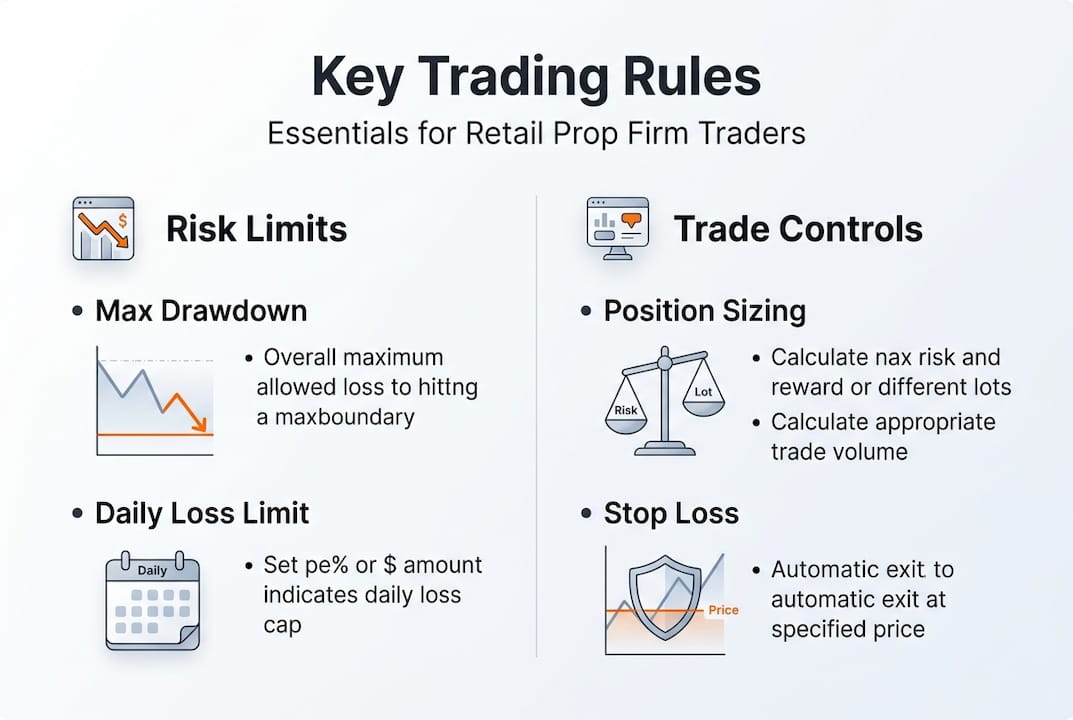
Stop loss mandates require you to set protective stops on every position. Some firms enforce maximum stop distances (like 50 pips for EUR/USD or 100 points for S&P 500) to prevent unrealistic risk-reward setups. Others simply require proof of stop placement without dictating distance.
Additional stipulations include trading hour restrictions (some firms prohibit overnight holding), news event blackouts (no trading 15 minutes before/after major releases), and instrument eligibility lists. You might have access to 40 FX pairs, 10 major indices, and 5 crypto assets, with exotic or illiquid instruments excluded entirely.
Traders must adapt their techniques within these boundaries. Scalpers might struggle with minimum holding periods. Swing traders need strategies that respect daily loss limits even when positions move against them overnight. Understanding proprietary trading models helps you select firms whose rules align with your natural trading style, reducing friction between your approach and their requirements.
How proprietary trading rules shape risk management and trader behavior
Proprietary trading rules fundamentally restructure how you approach every trading decision by embedding professional risk management into your daily routine. These guidelines don’t just limit losses. They rewire the psychological patterns that cause retail traders to fail, replacing emotional reactions with systematic responses.
Risk management principles enforced by trading rules center on capital preservation, position sizing discipline, and loss acceptance. When you know a 3% daily loss triggers account restrictions, you calculate exact position sizes before entering trades. You measure stop distances in dollar risk rather than arbitrary pip counts. You close losing positions at predetermined levels instead of hoping for reversals. This mechanical approach removes the cognitive burden of deciding “how much is too much” in the heat of trading.
Professional risk management supported by firm rules helps traders avoid large losses and maintain consistent profits, creating behavioral patterns that persist even after you secure funding. The key impacts on trader behavior include:
-
Discipline becomes automatic rather than aspirational. Daily loss limits force you to stop trading after bad sessions instead of revenge trading to recover losses. You develop the habit of walking away, which protects capital and mental clarity.
-
Emotion control improves through external accountability. Knowing the firm monitors your compliance creates a psychological barrier against impulsive decisions. You pause before doubling position sizes or abandoning your trading plan.
-
Strategic patience replaces urgency. When rules limit your daily trades or require minimum holding periods, you wait for A+ setups rather than forcing mediocre entries. Quality over quantity becomes operational reality, not just trading wisdom.
-
Consistency emerges from repetition within boundaries. Following the same risk parameters daily creates muscle memory. Your brain stops debating “should I risk 1% or 3% on this trade” and defaults to your proven system.
-
Accountability shifts from internal promises to external measurement. You can’t lie to yourself about risk when the platform automatically closes positions at drawdown thresholds. Performance data becomes objective feedback rather than subjective interpretation.
“The best traders I’ve funded don’t fight the rules. They internalize them until risk management becomes reflexive. That’s when they stop being retail traders and start thinking like institutional professionals.” — Senior Risk Manager, Multi-Asset Prop Firm
Pro Tip: Monitor your drawdown percentage after every trade, not just at day’s end. Set alerts at 50% and 75% of your daily limit so you have clear warning signals before hitting restrictions. This proactive tracking lets you adjust position sizing or stop trading before forced limits kick in, maintaining control over your decisions.
The behavioral transformation happens gradually. Initially, rules feel constraining. You’ll want to take that fifth position even though your limit is four, or hold through news despite blackout periods. As you adapt, you notice fewer emotional decisions, smaller losing streaks, and more consistent equity curves. Understanding how to manage risk trading consistent profits becomes second nature when firm rules provide the structure your discipline builds upon.
Applying proprietary trading rules to secure funding and grow as a trader
Securing proprietary trading funding requires demonstrating that you can operate profitably within firm rules, not despite them. Evaluation challenges specifically test your ability to generate returns while respecting risk parameters, making rule compliance the primary filter between retail traders and funded professionals.
Firms evaluate rule compliance through automated monitoring systems that track every metric in real time. Your daily loss percentage, maximum drawdown, position sizes, holding periods, and trading hours all feed into algorithms that flag violations instantly. Understanding and complying with prop trading rules increases your chance of passing evaluations and gaining capital funding because firms prioritize consistent rule followers over high-profit rule breakers.
Integrating rules into daily practice requires systematic preparation:
- Calculate your maximum position size before market open based on account balance and risk percentage. Update this number weekly as your balance changes during evaluation.
- Set platform alerts at 50%, 75%, and 90% of daily loss limits so you receive warnings before hitting hard stops.
- Create a pre-trade checklist that includes rule verification: position size within limits, stop loss placed, drawdown room available, instrument allowed, time restrictions clear.
- Review compliance metrics daily alongside profit/loss. Track how close you came to limits even on winning days to identify risk creep.
- Develop contingency plans for approaching limits: reduce position sizes by 50% at 75% of daily loss, stop trading entirely at 90%, never trade on tilt after hitting limits.
| Evaluation Criteria | Typical Threshold | Rule Emphasis |
|---|---|---|
| Profit Target | 8-10% account growth | Secondary to risk management |
| Maximum Drawdown | 6-10% depending on instrument | Primary filter, instant fail if breached |
| Daily Loss Limit | 3-5% depending on instrument | Critical, multiple violations = failure |
| Minimum Trading Days | 10-15 days | Ensures consistency over luck |
| Profit Consistency | No single day > 50% of total profit | Tests sustainable edge vs. gambling |
Skill development linked with rule adherence centers on three areas. First, patience improves because you can’t force trades when approaching daily limits. You learn to wait for setups that justify the risk rather than trading out of boredom. Second, risk control becomes precise as you calculate exact position sizes that keep you within boundaries. Third, strategy refinement accelerates when you analyze which setups consistently work within your constraints versus which push you toward limits.
The critical mindset shift treats rules as frameworks that reveal your trading edge rather than restrictions that hide it. If your strategy requires 10% daily drawdown room to be profitable, it’s not a viable professional approach. If you need to hold 15 positions simultaneously to diversify risk, you’re likely overtrading. Rules expose these flaws early, before you risk real capital or firm funding.
Exploring resources like the trading evaluation guide secure prop funding provides step-by-step frameworks for passing challenges. Comparing different firms through guides that compare trader funding models helps you match your trading style with compatible rule sets. Developing essential trading skills within rule boundaries accelerates your path from evaluation to funded status.
Long-term growth as a funded trader depends on internalizing rules until they become automatic. The traders who scale to six-figure accounts aren’t those who barely stay within limits. They’re the ones who operate comfortably at 60-70% of maximum risk parameters, leaving margin for error and unexpected volatility. This conservative approach within firm guidelines demonstrates the professional mindset that earns account scaling, profit splits, and career longevity in proprietary trading.
Explore DayProp’s proprietary trading funding solutions
Ready to apply your understanding of proprietary trading rules in a real evaluation environment? DayProp offers structured funding challenges designed for retail traders serious about transitioning to professional capital management. Our transparent rule sets across FX, indices, and crypto let you demonstrate your edge while building the discipline firms demand.
Our performance-based trading evaluation process guide walks you through exactly what metrics we measure, how compliance is tracked, and what separates passing traders from those who need more preparation. Whether you’re new to prop trading or comparing firms, our trading evaluation guide secure prop funding provides the frameworks you need to succeed. Explore how to compare trader funding models and find the evaluation structure that matches your trading style and risk tolerance.
Frequently asked questions
What are proprietary trading rules?
Proprietary trading rules are firm-enforced guidelines that govern risk management, position sizing, and trading behavior when using company capital. These rules exist to protect firm assets while identifying traders who can generate consistent profits under professional conditions. Key rules include maximum drawdown limits, daily loss caps, and position size restrictions.
How do drawdown limits affect my trading strategy?
Drawdown limits cap your maximum cumulative loss to protect both firm capital and your evaluation status. You must adjust position sizes smaller and set tighter stop losses to ensure no single trade or series of losses breaches your threshold. Understanding prop trading risk tips drawdown limits helps you structure strategies that stay comfortably within boundaries. Most professionals operate at 60-70% of maximum drawdown to leave room for volatility.
Can I trade multiple instruments under proprietary trading rules?
Most proprietary firms allow trading across multiple instruments like FX pairs, indices, and crypto, but each asset class has specific rules reflecting its volatility and liquidity. Diversifying across instruments can actually reduce overall portfolio risk and improve funding prospects by demonstrating versatility. Learn more about why trade multiple instruments to leverage this strategic advantage during evaluations.
How can I improve compliance with proprietary trading rules?
Create detailed trading plans that explicitly incorporate firm rules into your decision-making process. Use trade journaling to track how close you come to limits daily, identifying patterns before they become violations. Regular performance reviews help you adjust strategies proactively rather than reactively. Setting alerts at 75% of daily loss limits gives you warning to reduce risk or stop trading before hitting hard restrictions. Discover how to set trading objectives consistent risk management that align with proprietary firm expectations.
Recommended
- Types of proprietary trading models for retail traders in 2026 – DayProp Funding
- Why use trading rules: improve risk and gain funding in 2026 – DayProp Funding
- Trading Rule Transparency Boosts Funded Success 25% – DayProp Funding
- Why fund retail traders: benefits and challenges 2026 – DayProp Funding