

Retail traders often struggle to access institutional capital and maintain the discipline required for consistent profitability. Without structured evaluation frameworks, many talented traders never realize their full potential or secure the funding they deserve. This comprehensive guide walks you through the proprietary trading evaluation process for 2026, covering preparation strategies, execution steps, and scaling techniques that transform retail traders into funded professionals capable of managing significant capital with confidence and precision.
Table of Contents
- Understanding Proprietary Trading And Funding Evaluation
- Preparing For The Prop Trading Evaluation Process
- Step-By-Step Execution Of The Trading Evaluation
- Verifying Success And Scaling Your Proprietary Trading Account
- Unlock Your Trading Potential With Dayprop Funding
- Frequently Asked Questions About Proprietary Trading And Funding In 2026
Key takeaways
| Point | Details |
|---|---|
| Understand proprietary trading models | Proprietary trading connects retail traders with institutional capital through performance-based evaluations in FX, indices, and crypto markets. |
| Master essential preparation steps | Develop core trading skills, professional risk management, and strict rule adherence before attempting any evaluation challenge. |
| Execute evaluations systematically | Follow structured phases from demo challenge through verification to funded account with clear profit targets and risk limits. |
| Scale accounts with discipline | Apply methodical scaling strategies that prioritize risk controls and sustainable growth over aggressive capital expansion. |
| Maintain long-term consistency | Track daily metrics, journal trades, and reinforce professional habits that support career advancement in proprietary trading. |
Understanding proprietary trading and funding evaluation
Proprietary trading allows retail traders to access institutional capital without risking personal funds. In this model, prop firms provide capital to traders who demonstrate consistent profitability and disciplined risk management through structured evaluations. You trade the firm’s money, keep a percentage of profits, and avoid the stress of funding your own account with savings or loans.
For 2026, popular proprietary trading models for retail traders include evaluation challenges, funding grants, and profit splits. Evaluation challenges require you to meet specific profit targets while respecting strict drawdown limits over a set period. Funding grants offer immediate capital access based on your track record or application. Profit splits determine how earnings are divided between you and the firm, typically ranging from 70/30 to 90/10 in your favor.
The trading evaluation process serves as your gateway to funding. Firms use these assessments to filter out gamblers and identify traders with genuine edge. You’ll need to prove you can generate returns consistently without violating risk parameters. This approach protects both parties: firms avoid funding reckless traders, and you gain access to capital that would take years to accumulate independently.
Retail traders in 2026 focus primarily on three market categories:
- Foreign exchange pairs offering high liquidity and tight spreads for technical strategies
- Stock indices providing exposure to broader market movements with manageable volatility
- Cryptocurrency markets delivering 24/7 trading opportunities and emerging trend patterns
Each market demands specific skills and risk approaches. FX requires understanding macroeconomic drivers and central bank policies. Indices respond to sector rotations and institutional flows. Crypto demands heightened risk awareness due to extreme volatility and sentiment shifts. Your choice depends on your analytical strengths, preferred timeframes, and risk tolerance.
Preparing for the prop trading evaluation process
Successful evaluation starts long before you register for a challenge. You need a foundation of essential trading skills that separate professionals from amateurs. Technical analysis allows you to identify high-probability setups using price action, indicators, and chart patterns. Execution discipline ensures you follow your plan without emotional interference. Position sizing protects your account from single-trade disasters.

Professional risk management forms the backbone of every funded trader’s approach. Essential trading skills and professional risk management are critical to pass evaluations and obtain funding. You must calculate risk per trade as a percentage of account equity, typically 1% to 2% maximum. This means a $100,000 account risks $1,000 to $2,000 per position. Losing streaks become manageable rather than catastrophic when you control position size.
Drawdown limits represent the maximum loss allowed before evaluation failure. Most firms enforce daily and total drawdown thresholds. Daily limits might restrict losses to 3% of starting balance in a single session. Total drawdown caps cumulative losses at 6% to 10% throughout the evaluation. Violating either threshold results in immediate disqualification. Understanding drawdown limits tips helps you structure trades that respect these boundaries.
Adopting trading rules for funding transforms inconsistent results into repeatable performance. Professional trading rules improve risk control and increase chances of funding success. Your ruleset should cover entry conditions, stop loss placement, profit targets, maximum daily trades, and prohibited trading times. Write these rules down and review them before every session. Consistency emerges from repetition, not inspiration.
Key preparation elements include:
- Developing a proven trading strategy with positive expectancy over 100+ trades
- Backtesting your approach across different market conditions and timeframes
- Practicing emotional control through meditation, journaling, or mental rehearsal techniques
- Building a trading routine that includes pre-market analysis and post-trade reviews
Pro Tip: Simulate evaluations under real conditions by trading a demo account with the exact rules, timeframes, and pressure you’ll face during the actual challenge. This builds muscle memory and reveals weaknesses before money is on the line.
Step-by-step execution of the trading evaluation
The performance-based evaluation process typically unfolds in three distinct phases, each with specific requirements. Performance-based evaluations involve stages with profit targets, risk limits, and consistency requirements. Understanding these stages helps you allocate mental energy appropriately and avoid rushing through critical checkpoints.
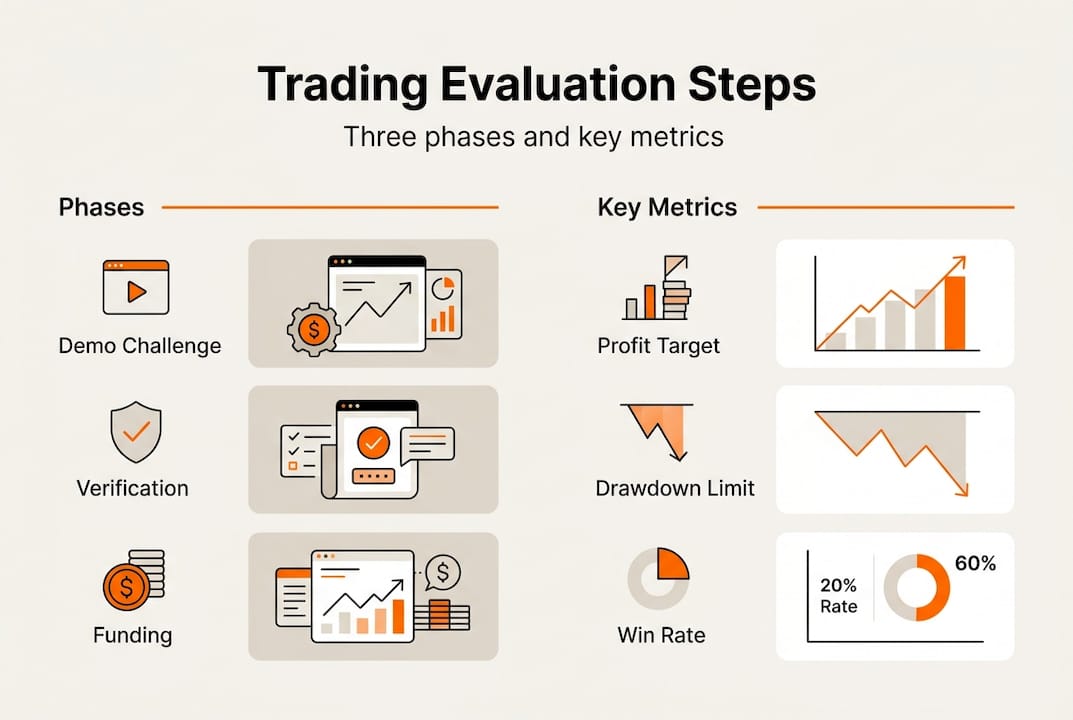
Phase one is the demo challenge where you prove basic profitability. You receive a simulated account with virtual capital, often $25,000 to $100,000. Your objective is reaching a profit target, usually 8% to 10% of starting balance, while respecting drawdown limits. Most traders complete this phase in two to four weeks, though some finish in days if they catch favorable market conditions.
Phase two involves verification, where firms confirm your results weren’t luck. You trade another demo account with similar or slightly reduced profit targets, typically 5% to 8%. This stage filters out traders who got lucky in phase one but lack consistent methodology. Verification usually requires at least five to ten trading days to demonstrate repeatability.
Phase three grants you a funded account with real capital. You keep a percentage of profits, often 80% initially, with potential increases to 90% after proving consistency. Risk limits remain strict, but you’re now generating actual income. Some firms require minimum trading days per month to maintain active status.
| Evaluation Phase | Profit Target | Max Daily Drawdown | Max Total Drawdown | Typical Duration |
|---|---|---|---|---|
| Demo Challenge | 8% to 10% | 3% to 5% | 6% to 10% | 2 to 4 weeks |
| Verification | 5% to 8% | 3% to 5% | 6% to 10% | 1 to 2 weeks |
| Funded Account | Ongoing | 3% to 5% | 6% to 10% | Indefinite |
Consistency metrics matter as much as profit totals. Firms analyze your average win rate, risk-reward ratios, and trading frequency. A trader who makes 10% through ten consistent trades looks better than someone who made 10% through one lucky position. Avoid overtrading to inflate activity or gambling on high-risk setups to hit targets faster.
Rules adherence is monitored through automated systems. Violations like trading during news events, holding positions overnight when prohibited, or exceeding position size limits trigger immediate disqualification. Read the specific rules for your chosen firm carefully, as requirements vary significantly across providers.
Pro Tip: Track metrics daily using a spreadsheet that calculates your current drawdown, remaining profit needed, and average risk per trade. This visibility prevents emotional decisions and helps you adjust position sizing as you approach targets or limits.
Verifying success and scaling your proprietary trading account
Verification extends beyond passing initial evaluations. Once funded, firms continuously monitor your performance to ensure you maintain professional standards. They track consistency metrics like maximum consecutive losses, average trade duration, and adherence to risk parameters. Falling below minimum activity requirements or violating rules can result in account termination even after funding.
Scaling strategies determine how quickly you grow your trading capital. Account scaling tips emphasize gradual increases that match your skill development. Scaling trading accounts methodically with risk controls leads to more sustainable growth. Two primary approaches exist: scaling risk percentage or scaling absolute capital.
Scaling risk percentage means increasing your risk per trade as your account grows. If you risk 1% on a $50,000 account, you risk $500 per trade. When your account reaches $100,000, that 1% becomes $1,000. This approach automatically compounds gains without requiring conscious adjustments. However, it also compounds losses during drawdowns.
Scaling absolute capital involves requesting larger funded accounts after demonstrating consistency. You might start with $50,000, then request $100,000 after six months of profitable trading. Your risk per trade increases proportionally, but you maintain the same percentage-based approach. This method provides psychological comfort since you’re not constantly adjusting position sizes.
| Scaling Method | Starting Capital | Risk Per Trade | After 20% Growth | New Risk Per Trade | Pros | Cons |
|---|---|---|---|---|---|---|
| Risk Percentage | $50,000 | $500 (1%) | $60,000 | $600 (1%) | Automatic compounding | Larger losses during drawdowns |
| Absolute Capital | $50,000 | $500 (1%) | Request $100,000 | $1,000 (1%) | Psychological stability | Requires firm approval |
Best practices for long-term account growth include:
- Setting monthly profit goals that align with your historical win rate and average trade size
- Withdrawing a portion of profits regularly to secure earnings and reduce performance pressure
- Reviewing trades weekly to identify patterns in both winning and losing positions
- Adjusting strategies when market conditions shift rather than forcing outdated approaches
Mindset and discipline separate traders who scale successfully from those who blow accounts. You must view trading as a business with operating costs, profit margins, and growth targets. Emotional attachment to individual trades destroys objectivity. Treat each position as one data point in a larger statistical sample. Your edge emerges over hundreds of trades, not from any single outcome.
Sustainable profits require accepting that losing streaks are inevitable. Professional traders experience win rates between 40% and 60%, meaning four to six losing trades out of every ten. Your risk-reward ratios must compensate for this reality. A 50% win rate with 2:1 risk-reward generates consistent profits over time. Chasing 80% win rates often leads to holding losers too long or cutting winners too early.
Unlock your trading potential with DayProp Funding
DayProp specializes in performance-based evaluations that identify disciplined traders ready for institutional capital. We offer multiple funding models tailored for retail traders in FX, indices, and crypto markets. Our transparent rules, fast-track verification, and competitive profit splits create an environment where skill translates directly into income. Whether you’re starting your first evaluation or scaling an existing funded account, our platform provides the structure and support you need. Explore our comprehensive trading evaluation guide to understand each phase in detail.
Compare different trader funding models to find the approach that matches your trading style and risk tolerance. Our team of experienced market professionals built DayProp to emphasize education, discipline, and long-term trader development rather than short-term speculation. Join traders who have transformed their retail experience into professional careers through our DayProp funding platform and discover how structured evaluations can accelerate your path to consistent profitability.
Frequently asked questions about proprietary trading and funding in 2026
What markets can retail prop traders trade in 2026?
Retail prop traders in 2026 primarily focus on foreign exchange pairs, stock indices, and cryptocurrency markets. Most proprietary firms offer access to major FX pairs like EUR/USD and GBP/USD, popular indices such as S&P 500 and NASDAQ 100, and leading cryptocurrencies including Bitcoin and Ethereum. Market availability varies by firm, so verify specific instruments before starting an evaluation.
How long does the typical trading evaluation process take?
The typical evaluation process takes four to eight weeks from start to funded account. The demo challenge phase usually requires two to four weeks, followed by one to two weeks for verification. Some traders complete both phases faster if they achieve profit targets quickly while maintaining strict risk management. However, rushing through evaluations often leads to rule violations and disqualification.
What happens if I fail the evaluation?
Failing an evaluation means you don’t receive funding for that specific attempt. Most firms allow you to purchase another evaluation and try again immediately. Some traders fail multiple times before passing, using each attempt as a learning experience. Review your trading journal to identify mistakes, adjust your strategy, and ensure you understand all rules before retrying.
Can I trade multiple instruments in evaluations?
Yes, most proprietary firms allow trading multiple instruments during evaluations. You can trade FX pairs, indices, and crypto simultaneously if your strategy covers multiple markets. However, spreading attention across too many instruments often reduces focus and increases mistakes. Stick to two or three markets where you have proven edge and deep understanding.
How do I manage risk once funded?
Manage risk in funded accounts using the same strict parameters that got you funded. Continue risking 1% to 2% per trade, respect daily and total drawdown limits, and follow your established trading rules. Many funded traders reduce risk slightly during their first month to build confidence and establish a profit cushion. Consistency matters more than aggressive profit-seeking in funded environments.
Recommended