

TL;DR:
- Most retail traders fail to outperform the market due to overconfidence and high trading costs.
- Consistent long-term success relies on disciplined risk management, process adherence, and realistic expectations.
- Market randomness limits the impact of technical skill; genuine edge requires systematic execution and control.
Most retail traders believe their results come down to skill. They study charts, refine strategies, and track their performance with conviction. Yet the data tells a different story. Across FX, indices, and crypto markets, consistent outperformance is statistically rare, and the line between a skilled trader and a lucky one is far thinner than most people admit. Understanding this distinction is not about discouraging ambition. It is about building a realistic foundation for long-term improvement. This article examines what research says about trader performance, what genuine skill looks like, and how you can shift from relying on chance to developing a repeatable, disciplined edge.
Table of Contents
- Why do so many traders underperform? The data behind the debate
- Is consistent trading success really skill or just a lucky streak?
- What can actually be trained as ‘skill’ in trading?
- Market realities: Why most retail trading strategies falter long term
- The hard truth: What most trading education still gets wrong
- Level up your trading journey with the right support
- Frequently asked questions
Key Takeaways
| Point | Details |
|---|---|
| Skill is rare | Data shows very few retail traders beat the market with skill over time. |
| Luck dominates short term | Most short-run wins are explained by luck, not repeatable trading skill. |
| Discipline reduces luck’s impact | Focusing on risk management and consistency helps offset randomness. |
| Most strategies fail long term | Without strict rules and cost control, most retail strategies underperform after fees. |
| True skill can be trained | Key trading skills like risk control and discipline can be learned and applied with effort. |
Why do so many traders underperform? The data behind the debate
The numbers on retail trader performance are sobering. Studies consistently show that the majority of active traders fail to beat passive benchmarks, and the gap is not small. The classic study by Barber and Odean found that active retail traders underperform the market by 6.5% annually, with the highest-turnover traders returning just 11.4% compared to the market’s 17.9%. The culprit is overconfidence driving excessive trading, which amplifies transaction costs and erodes returns.
The pattern repeats across asset classes. In FX and crypto markets, high-frequency retail participation often generates more broker revenue than trader profit. When you factor in spreads, commissions, and overnight financing costs, the math works against active trading from the start.
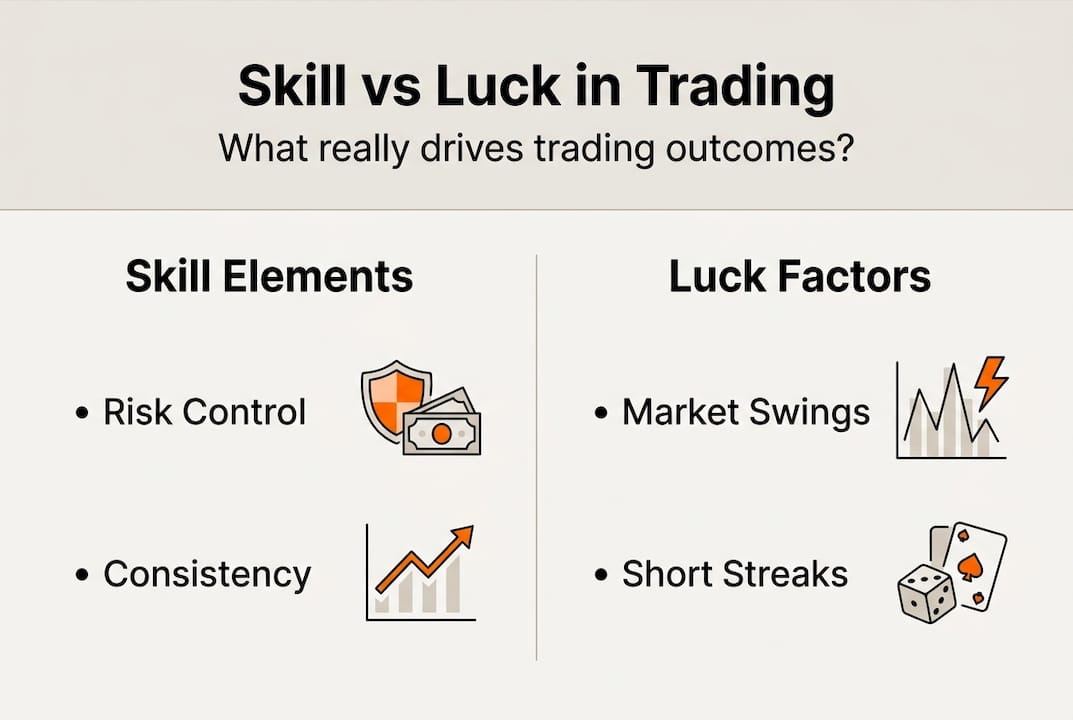
| Trader group | Annual return | Market benchmark |
|---|---|---|
| Lowest turnover quintile | ~17.5% | ~17.9% |
| Highest turnover quintile | 11.4% | 17.9% |
| Average active retail trader | ~11.4% | ~17.9% |
The behavioral side of underperformance is equally important. Overconfidence leads traders to believe their pattern recognition is superior to what the data supports. They trade more, take larger positions, and ignore base rates. The result is a portfolio that looks active but performs passively at best.
“No retail strategy maintains a win rate above 55% over 12 months. After costs, win rates converge to 50%, matching a random distribution.”
This is not a minor statistical footnote. It means that for most traders, outcomes over a 12-month period are statistically indistinguishable from a coin flip after costs are applied. Understanding real trading skill impact requires separating genuine edge from noise, and the importance of long-term growth becomes clear when you see how compounding losses from overtrading destroys accounts over time.
Is consistent trading success really skill or just a lucky streak?
With the statistical picture in mind, how do we tell actual skill from simple good fortune? The challenge is that luck and skill produce identical short-term outcomes. A trader who doubles their account in three months may be skilled, or they may have taken concentrated positions during a trending market. Without a large sample of trades across varied conditions, it is nearly impossible to tell.
A truly skilled trader demonstrates consistency across market regimes, not just during favorable conditions. They maintain a defined risk-to-reward ratio, follow a documented process, and show drawdown control even during losing periods. A lucky trader, by contrast, often has an irregular trade history, outsized wins relative to their system, and no clear explanation for why specific trades were taken.

| Characteristic | Skilled trader | Lucky trader |
|---|---|---|
| Win rate over 12 months | Stable, 50-55% | Volatile, spikes then falls |
| Drawdown behavior | Controlled, within plan | Irregular, often large |
| Trade rationale | Documented, rule-based | Intuitive, inconsistent |
| Performance across conditions | Consistent in trends and ranges | Strong only in trending markets |
| Response to losing streaks | Disciplined, no revenge trading | Emotional, position sizing changes |
Several signals suggest luck rather than skill is at work. Watch for these patterns in your own account or when evaluating others:
- A high win rate that appears suddenly without a change in strategy
- Position sizes that increase after winning streaks
- No documented trade plan or post-trade review process
- Strong performance in one market type but not others
- Inability to explain the logic behind profitable trades
Pro Tip: Pull your last 50 trades and calculate your win rate, average risk-to-reward, and maximum drawdown. If your results cannot be explained by a repeatable process, luck is likely a significant factor. Explore trading psychology insights to understand how cognitive bias shapes your perception of your own performance. You can also find practical trading skill development ideas to build a more systematic approach.
Research confirms that win rates converge toward 50% after costs for most retail traders, which means sustained outperformance requires a genuine, measurable edge, not just favorable market conditions.
What can actually be trained as ‘skill’ in trading?
So, if luck dominates the short run, what elements can you as a trader actually improve through deliberate practice? The answer is specific and bounded. Skill in trading is not about predicting price movements with precision. It is about managing the variables you can control.
Here are the core trainable skills that separate disciplined traders from gamblers:
- Risk management: Defining maximum loss per trade, per day, and per week before entering any position. This is the single most trainable and impactful skill in trading.
- System adherence: Following a documented trading plan without deviation, even during drawdowns. Consistency in execution reduces variance over time.
- Trade selection discipline: Passing on setups that do not meet your criteria, even when the market feels compelling. Fewer, higher-quality trades outperform high-frequency speculation.
- Performance review: Analyzing closed trades systematically to identify patterns in both wins and losses. Skill improves through structured feedback, not just experience.
- Emotional regulation: Recognizing when psychological states like fear or overconfidence are influencing decisions and stepping back from the screen when necessary.
Pro Tip: Treat every trading week as a data collection exercise, not a profit target. Review your trades every Friday with one question: did I follow my process? Profit or loss is secondary to process quality in early skill development.
The limits of skill matter here. Even a well-trained trader cannot eliminate market randomness. Excessive trading driven by overconfidence remains the leading cause of underperformance, which means the first skill to develop is knowing when not to trade. Review the essential trading skills required for funded traders and study the performance trading process to understand how professional evaluation frameworks define and measure real skill.
Market realities: Why most retail trading strategies falter long term
Understanding what is and is not skill is crucial, but surviving long term demands facing the market’s hardest truths. Most retail trading strategies do not fail because of bad ideas. They fail because of execution costs, psychological drift, and the relentless randomness of short-term price action.
“FCA data from 2023 shows that 65 to 70% of retail traders lose money. Most strategies that appear profitable on paper lose after real-world costs are applied.”
The math is straightforward. A strategy with a 52% win rate and a 1:1 risk-to-reward ratio looks profitable in a backtest. Add a 0.5-pip spread, overnight swap costs, and slippage on entries and exits, and that edge disappears. This is why cost reduction is not optional for serious traders. It is a core performance variable.
Here are the most actionable adjustments retail traders can make to improve long-term survival rates:
- Reduce trade frequency: More trades mean more costs. A selective, rule-based approach reduces friction and preserves edge.
- Use rule-based entries and exits: Discretionary decisions under pressure are where strategies break down. Documented rules remove emotion from execution.
- Review strategy performance quarterly: Markets change. A strategy that worked in a trending environment may fail in a ranging one. Regular review prevents strategy decay.
- Minimize leverage exposure: High leverage amplifies both wins and losses, but the psychological effect of large drawdowns causes more damage than the financial loss alone.
- Account for all costs: Include spreads, commissions, swap rates, and slippage in every backtest and forward test.
Effective risk reduction for currencies requires the same systematic thinking applied in institutional settings. Understanding trading rules for risk and studying trading models for retail gives you a clearer picture of how professional frameworks approach the problem of long-term strategy sustainability.
The hard truth: What most trading education still gets wrong
Conventional trading education focuses heavily on setups, indicators, and pattern recognition. It sells the idea that with enough study, a retail trader can learn to read the market and generate consistent profits. The evidence does not support this framing.
The uncomfortable reality is that skill gives you an edge at the margins, not a guaranteed path to outperformance. Markets are partially random, and no amount of technical mastery eliminates that randomness. What separates long-term survivors from short-term speculators is not superior pattern recognition. It is discipline in trading, rigorous risk controls, and the humility to accept that any single trade outcome tells you almost nothing about your ability.
Most retail traders overestimate how quickly skill compounds. They expect six months of study to produce consistent results. In reality, building a statistically meaningful track record takes hundreds of trades across multiple market conditions. The practical takeaway is this: treat trading as probability management, not personal genius. Your job is to execute a process with positive expected value over a large sample, not to be right on any individual trade. That mindset shift is more valuable than any indicator or strategy upgrade.
Level up your trading journey with the right support
Understanding the balance between skill and luck is the first step. Putting that understanding into practice requires structure, accountability, and access to the right resources.
DayProp offers a performance-based evaluation process designed to identify traders who demonstrate real discipline and risk management, not just short-term wins. Whether you are assessing your current approach or preparing for funded trading, the path forward starts with honest self-evaluation. Compare funding models to find the structure that fits your trading style, use the secured prop funding guide to understand what evaluators actually look for, and review the performance evaluation process to see how disciplined traders get funded.
Frequently asked questions
Can trading skill really overcome luck in the long run?
For most retail traders, skill adds a marginal advantage, but long-term results still largely match random outcomes after costs. Win rates converge to 50% after costs for most retail participants, making genuine edge difficult to sustain.
What are the top signs a trader is just lucky?
Short-term winning streaks, high risk concentration, and erratic position sizing often signal luck rather than a repeatable skill set. Consistent performance across varied market conditions is the clearest indicator of genuine edge.
How can retail traders increase their odds of success?
Focusing on risk control, process discipline, and reducing transaction costs gives traders their best advantage over randomness. Excessive trading driven by overconfidence remains the primary cause of underperformance, so trading less and more selectively is often the highest-impact change.
Why do most retail strategies fail over time?
High transaction costs, psychological bias, and market randomness cause most retail trading strategies to underperform over the long term. FCA data shows that 65 to 70% of retail traders lose money, with most paper-profitable strategies failing once real costs are applied.
Recommended
- What Is Real Trading Skill? 60% Less Risk, 25% Higher Returns – DayProp Funding
- What is trading discipline? Master consistent profits in 2026 – DayProp Funding
- How to manage risk in trading for consistent profits 2026 – DayProp Funding
- What is trading psychology: master discipline and consistency – DayProp Funding
- Trade Smarter with AI | Simple Trading Journal by TradeWise
- Trading strategijų žingsniai: kaip pasiekti gerų rezultatų