

TL;DR:
- Only 1.6% of day traders are profitable annually, with most losing money long-term.
- Retail trading involves personal accounts accessing markets like FX, indices, stocks, and crypto with high leverage.
- Success depends on discipline, risk management, consistent process, and emotional control over strategies.
Only 1.6% of day traders are profitable on a yearly basis, and 97% lose money over the long term. Those numbers are striking, but they are not a reason to walk away from trading. They are a reason to understand it properly. Retail trading is widely misunderstood, often reduced to stock-picking apps or crypto speculation, when in reality it covers a structured world of FX pairs, indices, and derivatives accessible to any individual with a brokerage account. This guide breaks down what retail trading actually is, how it works, where most traders go wrong, and what separates the small percentage that sustains profitability from the rest.
Table of Contents
- Defining retail trading: Who, what, and where
- How retail trading works: Methods, tools, and strategies
- Retail vs institutional: Key differences and why they matter
- The hurdles: Risks, pitfalls, and what separates successful retail traders
- Why trading ‘edge’ is about discipline and process, not secret strategies
- Take your trading to the next level with structured funding opportunities
- Frequently asked questions
Key Takeaways
| Point | Details |
|---|---|
| Retail traders defined | A retail trader is an individual trading their own money on public platforms rather than large institutional funds. |
| Most use high leverage | Many retail traders access high leverage, especially in forex and crypto, but this increases both risk and opportunity. |
| Success requires more than strategy | Only a disciplined process with strong risk management sets successful retail traders apart from the majority who lose money. |
| Structured funding bridges the gap | Skillful retail traders can now access funding and professionalize their trading through evaluations and prop firm opportunities. |
Defining retail trading: Who, what, and where
The term “retail trader” applies to a broad group of market participants. According to the standard industry definition, retail trading refers to individual non-professional investors who buy and sell securities, currencies, indices, or cryptocurrencies for their own personal accounts using brokerage platforms. The key word is personal. Retail traders are not managing client funds or acting on behalf of an institution. They are operating independently, with their own capital, and accepting full personal risk.
Retail traders access a wide range of markets. The most common include:
- Foreign exchange (FX): Currency pairs like EUR/USD or GBP/JPY traded through retail FX brokers
- Stock indices: Products like the S&P 500 or NASDAQ 100, accessed via CFDs, futures, or ETFs
- Cryptocurrencies: Bitcoin, Ethereum, and altcoins traded on spot or derivatives exchanges
- Individual equities: Shares of publicly listed companies bought through brokerage accounts
The platforms retail traders use vary by market. Retail traders access markets via online brokers or apps like Robinhood, MetaTrader for FX, or crypto exchanges like Coinbase, often with access to high leverage. In FX, leverage ratios for retail accounts can reach 30:1 or higher depending on jurisdiction, which amplifies both gains and losses significantly.
Here is a quick overview of how retail market access compares across asset classes:
| Asset class | Common platforms | Typical leverage | Primary analysis style |
|---|---|---|---|
| FX | MetaTrader 4/5, cTrader | Up to 30:1 (regulated) | Technical |
| Indices | MT5, broker CFD platforms | Up to 20:1 | Technical/macro |
| Crypto | Binance, Coinbase, Bybit | Up to 10:1 (varies) | Technical/sentiment |
| Equities | Robinhood, IBKR, eToro | Up to 4:1 (US margin) | Fundamental/technical |
One important distinction is what retail trading is not. It is not proprietary trading, where firms deploy firm capital through professional traders. Understanding that gap matters, because it opens the door to structures like prop trading that allow skilled retail traders to access institutional-level capital without the institutional barriers.
“Retail traders are not a monolith. They range from part-time hobbyists to near-professional independent operators. The defining characteristic is personal account ownership, not skill level.”
How retail trading works: Methods, tools, and strategies
Now that you know who retail traders are and the assets they trade, let’s get practical with the methods and tools that drive their trading.
Setting up a retail trading account is straightforward. Most brokers require identity verification, a minimum deposit, and a platform download or web login. From there, traders select their instruments and execute orders. The real complexity lies in the methodology behind those trades.
Common methodologies include day trading, scalping, and swing trading, each with a distinct time horizon and risk profile. Here is how they break down:
- Day trading: All positions opened and closed within a single session. No overnight exposure. Requires active monitoring and fast decision-making.
- Scalping: Very short-term trades, often lasting seconds to minutes. High trade frequency, small profit targets per trade. Demands tight spreads and fast execution.
- Swing trading: Positions held for days to weeks, capturing medium-term price moves. Less time-intensive but requires patience and macro awareness.
Most retail traders rely heavily on technical analysis, using price charts, indicators like RSI and MACD, and pattern recognition to identify entries and exits. Fundamental analysis, which involves evaluating economic data, earnings reports, or central bank policy, plays a secondary role for most retail participants, though it becomes more relevant in index and FX trading.
The tools most commonly used include:
- MetaTrader 4 and 5: Industry standard for FX and CFD trading
- TradingView: Popular charting platform used across all asset classes
- Broker dashboards: Built-in order management and risk tools
- Economic calendars: For tracking high-impact data releases
In FX, a retail trader might enter a long EUR/USD position based on a breakout above a key resistance level. In crypto, they might trade BTC/USD perpetuals on a derivatives exchange. In indices, a CFD on the S&P 500 allows directional bets without owning the underlying. Mastering the trading challenges specific to each market is essential before scaling capital.

Pro Tip: Before committing real capital, use a demo account for at least 30 days. Track not just your win rate but your average risk-to-reward ratio. That ratio tells you more about your edge than any single winning trade.
Strong crypto risk management practices are especially critical given the volatility and 24/7 nature of digital asset markets.
Retail vs institutional: Key differences and why they matter
While retail traders operate alongside giants, their experience differs dramatically. Understanding those differences is not just academic. It shapes how you position yourself and what realistic expectations look like.
Retail traders differ from institutions in several fundamental ways: smaller capital bases, a stronger reliance on technical rather than fundamental analysis, higher leverage but worse execution quality, and emotional decision-making versus systematic processes. Retail traders account for roughly 10% of daily US stock volume, a meaningful but minority share.
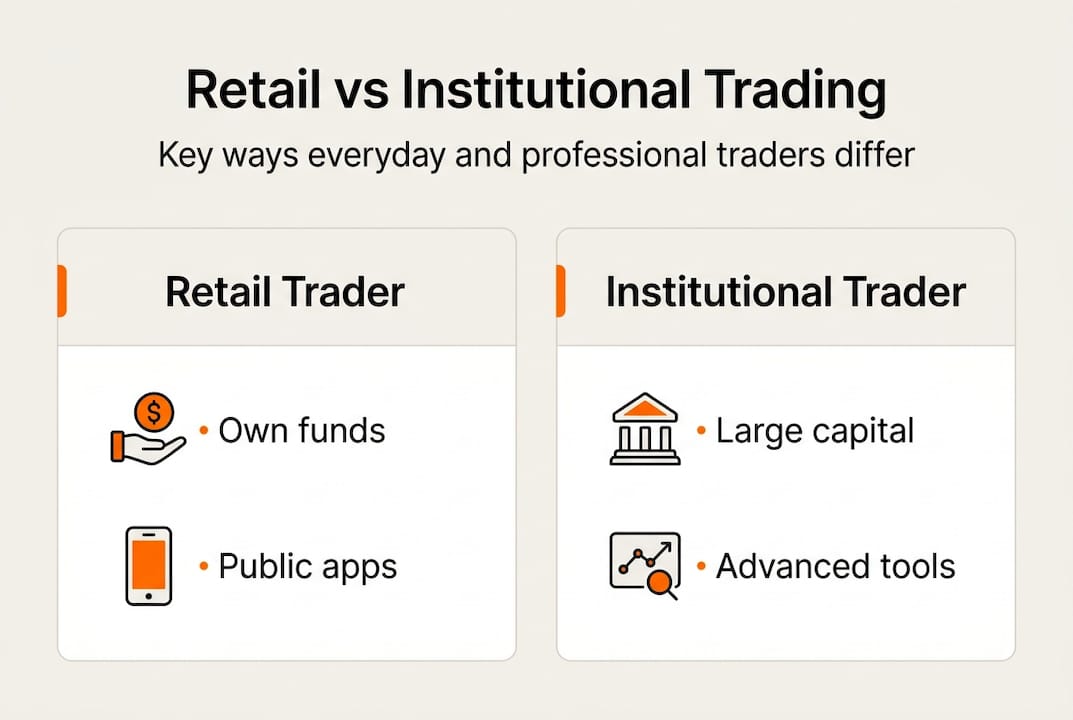
| Factor | Retail trader | Institutional trader |
|---|---|---|
| Capital | Personal funds, limited | Billions under management |
| Execution | Retail spreads, slippage | Direct market access, lower cost |
| Leverage | High (regulated limits) | Lower, but larger absolute size |
| Analysis | Primarily technical | Fundamental, quantitative, macro |
| Decision process | Often emotional | Systematic, rules-based |
| Market information | Public data only | Research teams, proprietary data |
Retail traders do hold some genuine advantages. They are agile. A retail trader can enter and exit a position in seconds without moving the market. Institutions managing billions cannot do that. Retail traders also have the freedom to trade across multiple markets and strategies without the regulatory constraints that govern fund managers.
However, retail traders face structural disadvantages in fees, information access, and execution. Institutions dominate volume and liquidity. Despite this, retail participation has surged in recent years, with data showing that approximately 15% of traders made their first-ever trade in 2020 alone, reflecting a major democratization of market access.
Proprietary trading firms occupy an interesting middle ground. They offer skilled retail traders access to institutional-level capital and infrastructure in exchange for demonstrated performance. Understanding the benefits of funding retail traders and the various proprietary trading models available can help you identify the most viable path forward.
“The gap between retail and institutional is not just about money. It is about process, infrastructure, and information. Bridging that gap requires more than capital. It requires behavioral discipline.”
The hurdles: Risks, pitfalls, and what separates successful retail traders
With these structural differences in mind, it is important to face the hard data on retail trader performance and the lessons hidden within.
The statistics are stark. Only 1.6% of day traders are profitable on a yearly basis. Approximately 97% lose money over the long term, and 80% quit within two years. In retail FX and CFD markets, around 75% of accounts lose money. These figures are not anomalies. They reflect consistent, documented patterns across markets and time periods.
The most common causes of retail trading failure include:
- Overtrading: Taking too many positions, often driven by boredom or the need to recover losses quickly
- Poor position sizing: Risking too much capital on a single trade, eliminating the buffer needed to survive drawdowns
- Emotional bias: Letting fear or greed override a pre-defined plan, leading to early exits or holding losing trades too long
- Lack of a structured process: Trading without defined entry criteria, exit rules, or risk parameters
- Ignoring transaction costs: Spreads, commissions, and swap fees erode returns faster than most new traders expect
What separates the profitable minority? Consistency in process, not brilliance in strategy. Successful retail traders typically follow strict risk limits, use realistic position sizing (often risking no more than 1% to 2% of capital per trade), and maintain detailed trading journals to identify behavioral patterns.
Pro Tip: If you cannot explain your reason for entering a trade in one sentence before you place it, you are not ready to place it. Clarity of rationale is a proxy for discipline.
Structured retail trading challenges provide an external framework that forces traders to operate within defined risk parameters, which is exactly the environment where discipline is built. A well-designed trading challenge guide can accelerate that development significantly.
Why trading ‘edge’ is about discipline and process, not secret strategies
The sobering statistics on retail trading are not meant to discourage. They reveal a truth that gets missed in the constant pursuit of new strategies: most traders fail not because they lack a system, but because they cannot execute a system consistently.
The pursuit of “edge” in retail trading is almost always framed as a tactical problem. Traders look for better indicators, new chart patterns, or underexplored markets. But the evidence points elsewhere. The traders who sustain profitability over time are not the most clever. They are the most disciplined. They follow rules when it is uncomfortable. They size down when uncertain. They do not deviate from process because of a single bad day.
Emotional triggers, the fear of missing a move, the urge to recover a loss immediately, are the actual reasons most new traders quit. Not bad strategies. Understanding skill versus luck in trading is a critical reframe. Skill in trading is largely behavioral, not analytical.
For traders who want to become fundable, this distinction matters enormously. Prop firms evaluate process, consistency, and risk management, not raw returns. Building those habits now, before seeking institutional capital, is the most direct path to long-term viability.
Take your trading to the next level with structured funding opportunities
Understanding retail trading is the foundation, but applying that knowledge in a structured environment is where real development happens. Structured trading challenges provide the discipline framework that most retail traders never build on their own.
At DayProp, we design evaluation programs that reward consistency, risk management, and genuine trading skill. Whether you are working through an evaluation guide for prop funding or comparing trader funding models to find the right fit, our platform gives you the tools and capital access to trade at a professional level. Explore our trading challenge programs and take the next step toward funded trading without risking your own capital.
Frequently asked questions
What is the difference between a retail trader and an institutional trader?
Retail traders invest their own money using public platforms, while institutional traders manage large capital pools on behalf of organizations with better execution, lower fees, and direct market access.
Why do most retail traders lose money?
Most retail traders lose money due to poor risk management, overtrading, and emotional decision-making. 97% lose long-term, with 75% of FX and CFD accounts ending in a net loss.
What types of assets do retail traders typically trade?
Retail traders most often trade forex pairs, indices, stocks, and cryptocurrencies. They access these markets through online brokerage platforms and exchanges designed for individual account holders.
How can a retail trader become consistently profitable?
Consistent profitability comes from discipline, defined risk limits, and realistic position sizing. Traders who follow structured risk management practices and maintain a clear process significantly improve their long-term odds.
Recommended
- Types of trading challenges every retail trader should master – DayProp Funding
- What is prop trading? Complete guide for retail traders – DayProp Funding
- Trader skill vs luck: What really drives trading success – DayProp Funding
- Why fund retail traders: benefits and challenges 2026 – DayProp Funding