
TL;DR:
- Institutional trading conditions include direct market access, advanced algorithms, and real-time risk controls.
- Retail traders can adopt tools like DMA, volume indicators, and strategic order types to improve execution.
- Large institutional advantages like dark pools and lower fees are offset by constraints like market impact and slower decision processes.
Institutional trading conditions shape how the world’s largest market participants execute trades, manage risk, and access liquidity. Most retail traders operate without ever seeing the infrastructure that powers hedge funds, banks, and asset managers. Understanding what institutional trading conditions actually involve gives you a clearer picture of why execution quality, pricing, and risk controls differ so dramatically between professional and retail environments. This guide breaks down the mechanics, highlights the key differences, and offers practical steps to help you bring institutional-grade thinking into your own trading approach.
Table of Contents
- What are institutional trading conditions?
- Core mechanics: Execution, risk checks, and post-trade processes
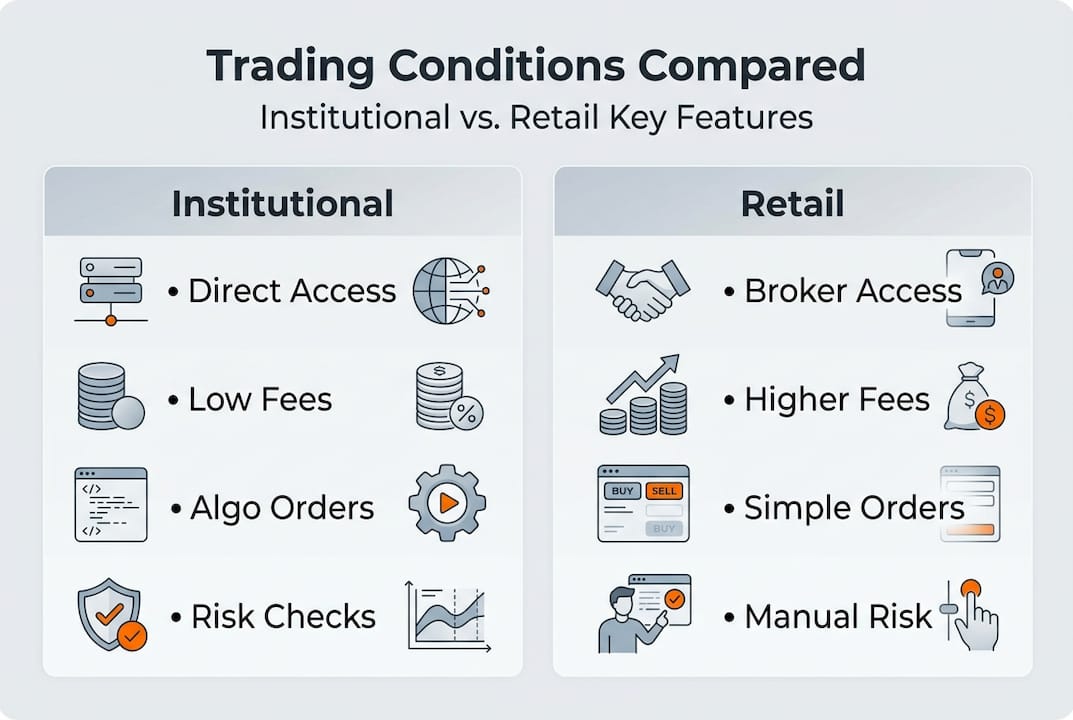
- Institutional vs. retail trading: Key differences
- How retail traders can bridge the gap
- What most traders miss about institutional trading conditions
- Ready to approach the markets like a pro?
- Frequently asked questions
Key Takeaways
| Point | Details |
|---|---|
| Institutional edge | Institutions use advanced tech, market access, and data for cost-effective trading. |
| Retail limitations | Retail traders face higher costs, restricted tools, and greater market impact. |
| Bridging the gap | Retail traders can adopt parts of the institutional playbook using DMA brokers and disciplined strategies. |
| Actionable steps | Focus on execution quality, risk controls, and a professional mindset to level up trading. |
What are institutional trading conditions?
Institutional trading conditions refer to the specialized environment, infrastructure, and execution methodologies available to large financial institutions. These include hedge funds, investment banks, pension funds, and asset managers. The contrast with standard retail trading is significant, and understanding it starts with knowing what tools and systems institutions actually use.
At the core, institutional trading is built on speed, precision, and scale. Institutions don’t place orders the way retail traders do. They use sophisticated systems that automate execution, monitor risk in real time, and analyze every trade after it closes. Understanding trading rules and risk is foundational to appreciating why these systems exist.
Institutional trading conditions encompass the specialized trading environment, infrastructure, access, and execution methodologies available to large financial institutions, contrasting sharply with retail trading environments in almost every measurable dimension.
Here are the key features that define institutional trading conditions:
- Direct Market Access (DMA): Institutions route orders directly to exchanges, bypassing intermediaries and reducing latency.
- Algorithmic execution: Automated systems handle order placement, timing, and size based on pre-set parameters.
- Pre-trade risk checks: Systems validate each order against exposure limits before it reaches the market.
- Proprietary data feeds: Institutions access real-time, granular market data unavailable to most retail platforms.
- Post-trade analytics: Every trade is reviewed using Transaction Cost Analysis (TCA) to measure execution quality.
These features, as outlined in algo execution mechanics, form the backbone of how institutions interact with markets. The result is a trading environment optimized for efficiency, scale, and risk control. Retail traders working with standard broker platforms simply don’t have access to most of these tools by default. Understanding real trading conditions is the first step toward closing that gap.
Core mechanics: Execution, risk checks, and post-trade processes
Now that you know what defines these conditions, let’s look at the mechanics that power institutional trading from start to finish.
Institutional trade workflow follows a structured sequence:
- Pre-trade analysis: The desk evaluates market conditions, liquidity, and expected cost before placing any order.
- Order construction: Large orders are broken into smaller pieces to minimize market impact.
- Algorithmic execution: Automated strategies handle the actual order flow based on timing and price targets.
- Real-time risk monitoring: Systems track exposure, position limits, and volatility throughout execution.
- Post-trade TCA: Every execution is benchmarked against market prices to measure performance and identify inefficiencies.
The three most common execution algorithms are VWAP, TWAP, and POV. VWAP (Volume Weighted Average Price) spreads orders across the trading day in proportion to historical volume patterns. TWAP (Time Weighted Average Price) distributes orders evenly over a set time window. POV (Percentage of Volume) ties order flow to real-time market volume, keeping the institution’s footprint proportional to overall activity. These core execution mechanics reduce slippage and prevent large orders from moving the market against the institution.
Pro Tip: Even as a retail trader, you can apply VWAP logic to your entries. Avoiding trades during low-volume periods and targeting entries near VWAP levels can meaningfully improve your average fill price over time.
| Mechanic | Institutional trading | Retail trading |
|---|---|---|
| Order execution | DMA with algo routing | Market/limit orders via broker |
| Risk controls | Automated pre-trade checks | Manual or basic platform limits |
| Data access | Proprietary real-time feeds | Delayed or standard broker data |
| Post-trade review | Full TCA benchmarking | Minimal or no analysis |
| Order sizing | Algorithmic slicing | Manual position sizing |
Applying risk management rules consistently is the retail equivalent of institutional pre-trade checks. Tracking your drawdown limits and following a capital allocation guide brings discipline that mirrors institutional practice.
Institutional vs. retail trading: Key differences
Understanding institutional mechanics sets the stage for a direct comparison with what retail traders actually experience.
| Factor | Institutional trading | Retail trading |
|---|---|---|
| Market access | Dark pools, ECNs, direct exchange | Retail broker routing |
| Leverage | Lower, risk-adjusted | Higher, often excessive |
| Fees and spreads | Volume-based discounts, tight spreads | Wider spreads, higher commissions |
| Order flow | Internalized or routed for best price | Often internalized by broker |
| Execution tools | Full algo suite | Basic order types |
Institutions benefit from lower fees via volume, tighter spreads negotiated directly with liquidity providers, and access to prime brokerage services. Retail traders face wider spreads and higher slippage, particularly during volatile periods.

One of the most striking institutional advantages is dark pool access. Approximately 40% of US equity volume occurs off-exchange in dark pools, where institutions trade large blocks without revealing their intentions to the broader market. This dramatically reduces market impact.
Key impacts on retail traders include:
- Higher slippage: Retail orders are smaller but still subject to spread costs and broker routing decisions.
- Limited price discovery: Without dark pool access, retail traders only see part of the full order flow picture.
- Order flow disadvantage: Retail orders are frequently internalized, meaning they never reach the open market.
Despite these disadvantages, retail traders can still find their edge. Smaller position sizes mean you can enter and exit markets without moving prices. Exploring trading challenges for retail traders and understanding the benefits and challenges of funded trading can help you identify where your natural advantages actually lie.
How retail traders can bridge the gap
Now that the gap is clear, here’s how you can adapt elements of the institutional trading playbook to your own practice.
- Use DMA-capable brokers: Select brokers that offer direct market access or ECN routing to get closer to institutional execution quality.
- Learn institutional indicators: VWAP, volume profiles, and liquidity zones are tools institutions use daily. Adding them to your analysis sharpens your market reads.
- Apply order types strategically: Limit orders, stop-limits, and iceberg orders reduce slippage and give you more control over execution.
- Track your execution quality: Keep a trading journal that records entry price versus intended price. This is your personal version of TCA.
- Study liquidity zones: Institutions accumulate and distribute positions at specific price levels. Recognizing these areas helps you trade with, rather than against, institutional flow.
Retail traders can bridge the gap by focusing on execution quality, understanding liquidity dynamics, and adopting tools like VWAP for better entry timing.
Pro Tip: Avoid high leverage. Institutions use lower leverage precisely because it reduces risk of forced liquidation. Matching that discipline is one of the most impactful changes you can make as a retail trader.
Mindset also matters. Institutional traders think in terms of process, not outcome. They evaluate whether their execution followed the plan, not just whether the trade was profitable. Applying risk management for consistent profits and understanding proprietary trading rules helps build the same process-driven approach.
What most traders miss about institutional trading conditions
Most retail traders assume institutional trading is simply better in every way. That assumption deserves scrutiny.
Institutional trading comes with significant constraints. Large position sizes create market impact, meaning institutions often struggle to enter or exit positions without moving prices against themselves. They also face regulatory reporting requirements, internal compliance layers, and committee-driven decision-making that slows execution. A nimble retail trader can act on a setup in seconds. An institution may take days to build a position.
As noted by research on institutional vs retail dynamics, institutions don’t always outperform, and retail agility can be a genuine edge in niche or less liquid markets. The myth of institutional infallibility is just that: a myth.
The real opportunity for retail traders is not to copy institutions but to borrow their discipline. Use their frameworks for risk control, execution analysis, and position sizing while keeping the flexibility that comes with smaller capital. Exploring retail trading challenges through a structured evaluation process is one practical way to build that discipline in a professional context.
Blending institutional mechanics with retail flexibility is where genuine edge lives.
Ready to approach the markets like a pro?
You now understand the mechanics that separate institutional trading from retail, and more importantly, you know which elements you can realistically adopt. The next step is putting that knowledge into a structured environment where discipline is tested and rewarded.
DayProp offers a structured evaluation process designed to simulate professional trading conditions for retail traders. From the funded account workflow to clearly defined risk parameters, DayProp gives you the framework to trade with institutional discipline without needing institutional capital. Explore the available trading challenges and take a concrete step toward closing the gap between where you trade now and where you want to be.
Frequently asked questions
What are the main benefits of institutional trading conditions?
Institutions enjoy direct market access, lower fees, advanced execution algorithms, and robust pre-trade and post-trade risk controls that are largely unavailable to standard retail traders.
Can retail traders access any institutional trading tools?
Some retail brokers offer limited DMA and basic algorithmic order types, but access to dark pools and custom TCA remains largely restricted to institutional participants.
Why are institutional fees and spreads lower than retail?
Institutions trade at high volumes, which gives them volume-based fee discounts and the ability to negotiate tighter spreads directly with exchanges and prime liquidity providers.
What is the significance of dark pools in institutional trading?
Dark pools allow institutions to execute large block trades without revealing order size to the market, and approximately 40% of US equity volume occurs off-exchange through these venues, significantly reducing market impact.
Recommended
- Understand real trading conditions: trade like a pro – DayProp Funding
- Structured trading challenge: Step-by-step guide to funding – DayProp Funding
- Types of trading challenges every retail trader should master – DayProp Funding
- Why fund retail traders: benefits and challenges 2026 – DayProp Funding
- Trading System Installation Guide: Set Up Automated Trading 2026