

Most retail traders discover a frustrating gap between demo performance and live results only after real money is on the line. Studies show that 70-90% of retail traders lose money over the long term, and a significant driver is the failure to account for real trading conditions before going live. Real trading conditions refer to the actual market environment you operate in, including spreads, slippage, liquidity constraints, and psychological pressure. For traders pursuing funded opportunities in FX, indices, and crypto, understanding these dynamics is not optional. It is the foundation on which consistent performance and capital access are built.
Table of Contents
- What are real trading conditions?
- Essential components of real trading conditions
- The realities of trading outcomes: statistics and what they mean
- How to adapt: practical steps for mastering real trading conditions
- Why most guides get real trading conditions wrong
- Get started with real trading and funding opportunities
- Frequently asked questions
Key Takeaways
| Point | Details |
|---|---|
| Live trading is different | Real trading conditions expose you to slippage, wider spreads, and emotional pressure not found in demo trading. |
| Most retail traders lose | Empirical studies show up to 90% of retail traders underperform in real markets without proper adaptation. |
| Success comes from adaptation | Traders who thrive build habits like risk management and journaling to overcome real market challenges. |
| Set realistic goals | Aim for consistent 2-5% monthly returns by compounding small edges and adjusting to true market dynamics. |
What are real trading conditions?
Real trading conditions describe the full environment a trader encounters when entering, managing, and exiting live positions. Unlike demo accounts, which typically offer instant fills, fixed spreads, and zero emotional stakes, live markets introduce friction at every step. That friction is not noise. It is the actual cost of doing business.
For FX traders, real conditions include variable spreads that widen during major news events, partial fills on large orders, and execution delays measured in milliseconds that can shift entry prices meaningfully. For indices traders, gap risk around market open and close adds another layer. Crypto markets carry their own distinct set of challenges. Crypto slippage ranges from 0.05-0.47% on a $10,000 BTC/USDT order due to fragmented liquidity, thin order book depth outside peak hours, and volatility that can widen spreads by 2-5x within seconds.
Here is a direct comparison of demo versus live trading conditions across key factors:
| Factor | Demo account | Live account |
|---|---|---|
| Spreads | Fixed, often tight | Variable, widens in volatility |
| Slippage | Minimal or none | Present, especially in crypto |
| Order execution | Instant fills | Delays during news or low liquidity |
| Emotional pressure | None | High, especially with real capital |
| Liquidity | Simulated | Real, varies by time and market |
The core elements that define real trading conditions include:
- Spreads: The difference between bid and ask prices, which directly reduces profit on every trade
- Slippage: The gap between your intended entry price and the actual fill price
- Order execution speed: Delays that affect entries and exits, particularly during volatile sessions
- Liquidity: The availability of counterparties at your desired price, which varies by market and session
- Psychological pressure: The cognitive and emotional load of managing real capital at risk
“The difference between a good demo trader and a consistently profitable live trader often comes down to how well they have prepared for the friction that real markets introduce.”
Exploring real trading challenges across different market structures helps traders build the awareness needed to navigate these conditions. For those active in digital assets, understanding crypto risk management is especially critical given the unique volatility profile of that market.
Essential components of real trading conditions
With the core definition established, it is crucial to look closer at the specific ingredients that make trading conditions real and how they play out in different markets.
Spreads are the first cost every trader pays. Variable spreads, common in FX and crypto, expand during high-impact news releases or periods of low liquidity. A spread that sits at 0.5 pips during the London session can jump to 3 pips around a Federal Reserve announcement. That shift can turn a calculated entry into an immediate loss.
Slippage is particularly damaging in crypto. Slippage on BTC/USDT orders can reach 0.47% due to fragmented exchange liquidity and thin depth outside peak trading windows. In FX, slippage is generally lower but still present during major data releases. A trader using a 20-pip stop-loss who experiences 3 pips of slippage on entry and 2 pips on exit has effectively reduced their risk-reward ratio without realizing it.

The table below shows how these components differ across markets:
| Component | FX | Indices | Crypto |
|---|---|---|---|
| Typical spread | 0.5-2 pips | 0.5-1 point | 0.1-0.5% |
| Slippage risk | Low to moderate | Moderate | High |
| Liquidity depth | Deep | Moderate | Fragmented |
| Trading hours | 24/5 | Session-based | 24/7 |
The five key components that shape real trading outcomes are:
- Variable spreads that respond to volatility and session timing
- Slippage driven by order size, liquidity, and market conditions
- Execution delays that affect timing-sensitive strategies
- Liquidity constraints that limit trade size and increase cost at off-peak hours
- Psychological stress that increases error rates under real capital risk
Applying structured trading rules for risk helps traders account for these variables systematically. Sound capital allocation in trading ensures that slippage and spread costs do not erode position sizing logic.
Pro Tip: Always factor in at least 1-2 pips or 0.1-0.2% of expected slippage when backtesting a strategy. If your edge disappears after adding realistic execution costs, the strategy needs refinement before going live.
The realities of trading outcomes: statistics and what they mean
Understanding the mechanics only goes so far. Empirical data reveals what actual trading outcomes look like in live environments, and the numbers are stark.
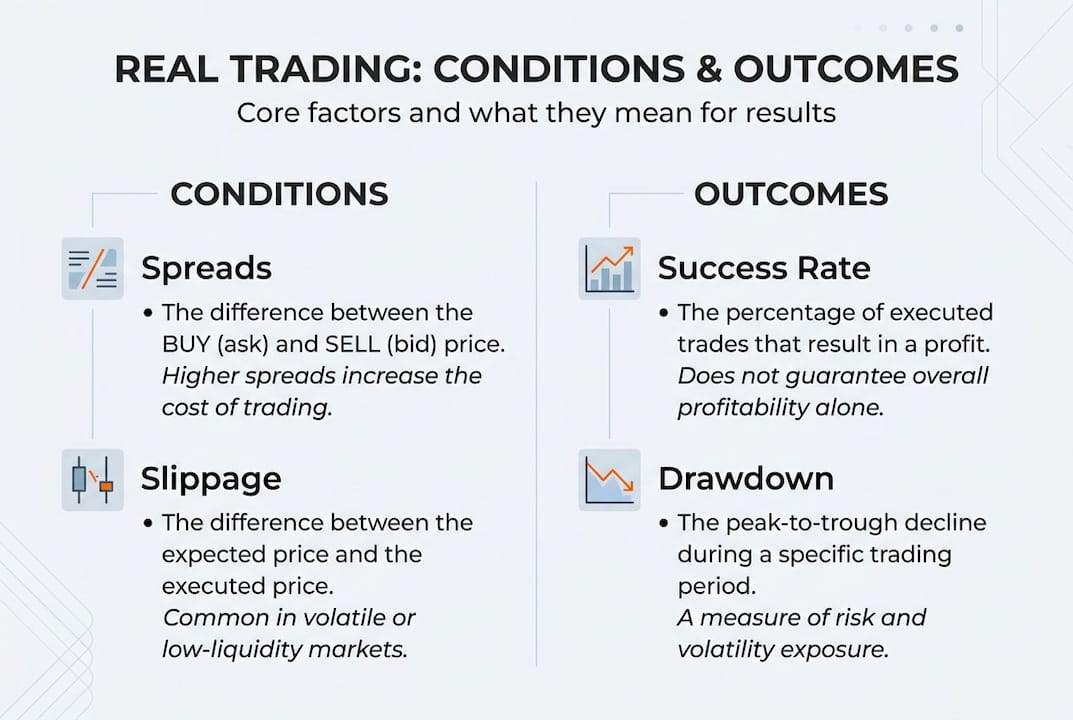
70-90% of retail FX and crypto traders lose money over the long term. The average day trader returns negative 36% annually after fees. Within six months, 93% of new traders have lost their initial capital. In 2026, crypto slippage alone cost traders an estimated $2.7 billion in 2024, a figure that reflects how much friction compounds across millions of trades.
These statistics are not meant to discourage. They are meant to recalibrate expectations. The majority of traders who fail do so not because markets are rigged, but because they underestimate the real cost of execution, overestimate their edge, and set return targets that are not grounded in market reality.
Here is what realistic performance benchmarking looks like:
- Monthly return target: Consistent traders aim for 2-5% per month, not 20-30%
- Drawdown tolerance: Staying within 5-10% maximum drawdown preserves capital and access to funding
- Win rate reality: A 45-55% win rate with a positive risk-reward ratio is a sustainable edge
- Fee and spread impact: Transaction costs can reduce gross returns by 20-40% depending on frequency
- Compounding over time: A 3% monthly return compounds to over 42% annually without excessive risk
Pro Tip: Set your performance benchmark before you start trading, not after. If your target is 5% per month, calculate how many trades at what average risk-reward ratio are needed to reach it. That clarity prevents overtrading.
Understanding realistic trader outcomes helps frame what funded trading programs actually reward. Exploring different trader funding models shows how performance-based capital access aligns with these realistic benchmarks.
How to adapt: practical steps for mastering real trading conditions
Acknowledging these sobering statistics, here is how you can proactively meet the challenge of real market conditions and improve your probability of long-term success.
Success in live trading depends on compounding small edges consistently: limiting risk to 1-2% per trade, journaling every decision, and avoiding overtrading are the habits that separate funded traders from the 80-90% who fail. These are not abstract principles. They are the practical behaviors that protect capital across hundreds of trades.
Key habits for adapting to real trading conditions:
- Risk framework: Never risk more than 1-2% of total capital on a single trade, regardless of conviction
- Trade journaling: Record entry rationale, exit outcome, and emotional state for every trade to identify patterns
- Avoid overtrading: More trades do not mean more profit. Frequency increases exposure to spread and slippage costs
- Simulated testing first: Validate any new strategy in a structured evaluation environment before committing live capital
- Realistic compounding: Target 2-5% monthly returns and let compounding do the work over time
- Use available tools: Risk calculators, position sizing models, and evaluation platforms reduce guesswork
The step-by-step approach to building real-market readiness:
- Define your maximum risk per trade and per day before opening the platform
- Backtest your strategy with realistic spread and slippage assumptions included
- Run the strategy in a structured evaluation environment to observe behavior under simulated pressure
- Transition to small live positions to experience real execution dynamics
- Review your journal weekly to identify where real conditions diverged from your plan
Learning to manage risk for consistent profits is the most direct path to passing evaluations and retaining funded capital. For crypto traders specifically, applying dedicated crypto risk strategies addresses the unique slippage and volatility profile of digital asset markets.
Why most guides get real trading conditions wrong
Most trading education presents risk management as a clean, controllable process. Set your stop-loss, define your risk-reward, follow the plan. What these guides consistently omit is the reality of execution under pressure, where slippage moves your stop, a fill comes in late, and the emotional weight of a losing streak distorts your next decision.
The popular focus on perfect setups ignores the fact that even a technically sound trade can be degraded by 0.3% slippage, a two-second execution delay, or a spread that doubled during the entry window. These are not edge cases. They are routine in live markets.
At DayProp, the view is that true trading edge is built through discipline under uncertainty, not through optimizing for ideal conditions that rarely exist. Traders who journal consistently, adapt their behavior based on real data, and approach realistic trading challenges with structured habits outperform those chasing perfect strategies. Applying using trading rules as a behavioral framework, rather than a rigid checklist, is what creates durable performance in real markets.
Get started with real trading and funding opportunities
Ready to put your knowledge to work under real market conditions? DayProp provides the structured environment to test and prove your edge before accessing institutional-level capital.
Start by reviewing the funding model comparison to identify which evaluation structure fits your trading style and risk profile. Then work through the evaluation process guide to understand exactly what consistent performance looks like in a funded context. If you are ready to take the first step toward prop funding, the trading evaluation guide outlines everything you need to secure capital access based on real trading skill, not luck.
Frequently asked questions
What does ‘real trading conditions’ mean?
Real trading conditions are the actual market environment traders face, including spreads, slippage, order execution speed, and emotional stress. In crypto, for example, slippage on a $10k order can reach 0.47% due to fragmented liquidity and thin depth outside peak hours.
How do live market conditions differ from trading on demo?
Live conditions involve real capital risk, actual slippage, widened spreads during volatility, and psychological pressure that demo accounts do not replicate. These factors directly affect execution quality and overall profitability.
What are realistic profit targets for retail traders?
Experienced traders generally aim for consistent 2-5% monthly returns under real trading conditions, allowing compounding to build account size without taking on excessive drawdown risk.
Why do most retail traders lose money in real markets?
70-90% of retail traders lose long-term due to volatility, slippage, execution costs, and emotional decision-making under pressure. The average day trader returns negative 36% annually after fees, with 93% losing their initial capital within six months.
Recommended