

TL;DR:
- Indices trading is complex because exposure occurs through derivatives, each introducing unique risks requiring careful evaluation. Effective assessment combines macroeconomic analysis, constituent weighting, volatility metrics, and options Greeks to monitor performance and manage risk continuously. Professional funding evaluations emphasize disciplined risk controls, consistent behavior, and thorough process documentation, rather than just profit results.
Indices trading is more complex than it appears at first glance. Understanding what is indices trading evaluation matters because most retail traders approach indices without a structured method to measure performance, control risk, or meet the requirements that professional prop funding programs demand. An index like the S&P 500 cannot be purchased directly. All exposure flows through derivative instruments such as futures, options, and CFDs, each introducing its own layer of risk that must be evaluated carefully before any capital is committed.
Table of Contents
- Key takeaways
- What indices are and how traders access them
- How to evaluate indices trading strategies and performance
- Practical methods for evaluating indices trading performance
- Indices evaluation and professional capital access
- My perspective on indices trading evaluation
- Take your indices evaluation further with Dayprop
- FAQ
Key takeaways
| Point | Details |
|---|---|
| Indices are not directly tradable | All index exposure requires derivatives or ETFs, adding leverage and counterparty risk to manage. |
| Evaluation is multi-dimensional | Effective indices trading evaluation covers market structure, risk metrics, volatility, and constituent analysis. |
| Greeks matter in options evaluation | Delta, Gamma, Theta, Vega, and Rho must be monitored together to accurately assess index options risk. |
| Prop funding has defined benchmarks | Meeting professional capital criteria requires disciplined drawdown control and consistent performance records. |
| Continuous monitoring is non-negotiable | Evaluating indices trading performance is an ongoing process, not a one-time review before entering a trade. |
What indices are and how traders access them
Before discussing evaluation methods, the mechanics of index construction deserve attention. An index is a statistical measure that tracks the collective price performance of a defined group of stocks. It is not a security. It is a score. This distinction shapes everything about how evaluation works.
The most widely followed indices in global markets include:
- S&P 500: Tracks 500 large-cap U.S. companies using a market-capitalization weighting method
- Dow Jones Industrial Average: Covers 30 blue-chip U.S. stocks and uses a price-weighted calculation
- NASDAQ 100: Focuses on the 100 largest non-financial companies listed on the NASDAQ exchange
- FTSE 100: Tracks the 100 largest companies by market capitalization on the London Stock Exchange
The weighting method an index uses has direct consequences for trading behavior. In a market-cap weighted index, a small number of companies can drive a disproportionate share of index movement. When Apple, Microsoft, or Nvidia shift significantly, the S&P 500 moves with them. Traders who ignore this concentration risk during evaluation are working with an incomplete picture.
Since the index itself is not tradable, exposure comes through four primary instruments:
| Instrument | How it works | Key consideration |
|---|---|---|
| ETFs | Funds that replicate index composition | Liquid, lower leverage, expense ratios apply |
| Futures | Standardized contracts on index value | High leverage, require margin management |
| Options | Contracts granting rights to buy or sell | Complex risk profile, time decay applies |
| CFDs | Agreements on price difference with a broker | Flexible sizing, carry overnight costs |
Each instrument carries its own risk profile. Evaluation must account for which instrument a trader uses, because the same index position behaves differently depending on the vehicle.
How to evaluate indices trading strategies and performance
Understanding indices markets at a structural level is only the starting point. Effective evaluation requires analyzing multiple layers of market information simultaneously.
Macroeconomic and market structure drivers
Index prices respond to interest rate decisions, earnings cycles, inflation data, and geopolitical events. A trader evaluating indices trading strategies without accounting for these drivers is assessing performance in a vacuum. Central bank policy shifts alone can reprice entire markets within hours.
Index composition and weighting analysis
Because certain sectors or individual stocks carry outsized weight, monitoring heavily weighted constituents is a standard part of professional evaluation. Periodic rebalancing events also matter. When a stock is added to a major index, institutional funds must buy it, often creating short-term price movement that informed traders can anticipate.

Volatility metrics and term structure
Volatility evaluation goes well beyond checking a single number. The VIX term structure reveals whether the market is pricing near-term fear versus longer-term uncertainty. When short-dated volatility spikes above long-dated levels, the structure inverts, signaling stress. Traders who rely on volatility ETFs for hedging face additional decay costs of 4 to 9% monthly due to contango rolling, making index puts a structurally sounder hedging approach.
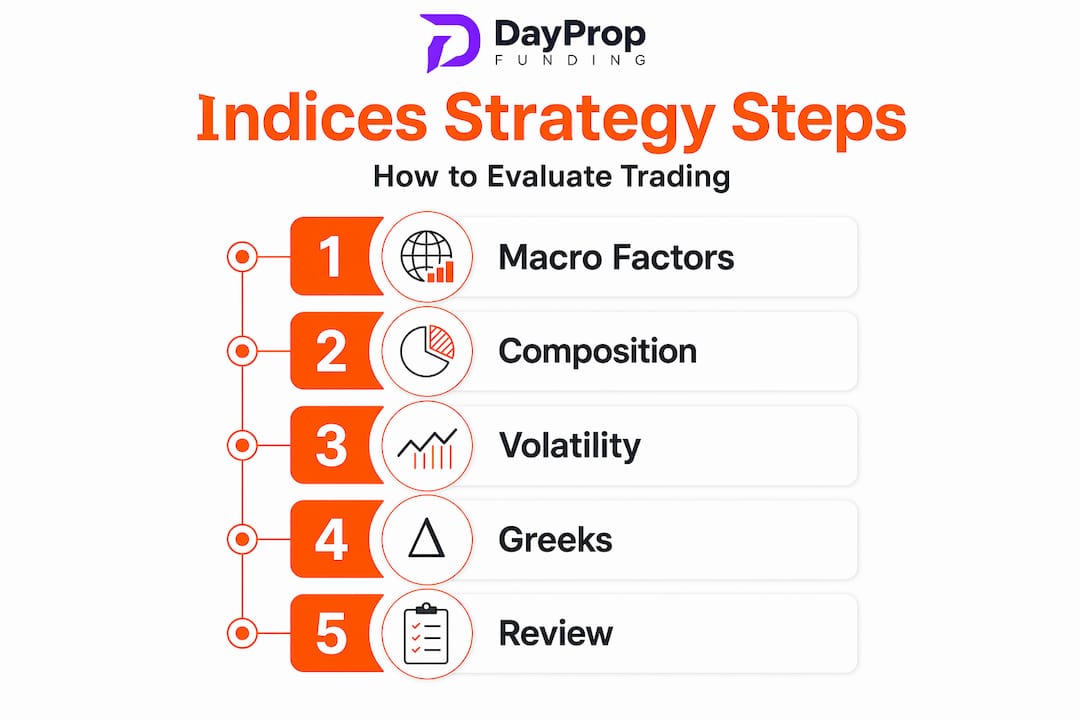
The five primary Greeks in index options evaluation
When trading index options, the five Greeks quantify sensitivity across multiple dimensions:
- Delta: Measures how much the option price moves per unit change in the index
- Gamma: Tracks how quickly Delta itself changes as the index moves
- Theta: Calculates the rate at which an option loses value as time passes
- Vega: Reflects sensitivity to changes in implied volatility
- Rho: Measures sensitivity to interest rate changes
Managing all Greeks simultaneously is necessary because price, time, and volatility change at the same time in live markets. Relying on one Greek while ignoring others produces incomplete and often misleading risk assessments.
Pro Tip: Near expiration, Gamma and Theta interact intensely. Positions that seemed stable can shift dramatically in a short period, requiring frequent rebalancing to maintain the risk profile you intended.
Practical methods for evaluating indices trading performance
Evaluation frameworks become useful only when applied consistently. The following methods give traders a structured approach to analyzing their indices trading performance on an ongoing basis.
-
Analyze market internals and breadth indicators. Advance-decline lines, new highs versus new lows, and percentage of stocks above key moving averages all measure the underlying health of an index move. Divergences between breadth and price often signal reversals before the index chart shows them.
-
Evaluate leverage impact with precision. High leverage in index derivatives amplifies both gains and drawdowns. Evaluation must include a leverage-adjusted view of performance. A 5% gain on a 10x leveraged position is a 0.5% move on capital. Understanding the relationship between notional exposure and actual capital at risk prevents dangerous misreading of results.
-
Use quantitative tools for tracking and hedging. Advanced risk forecasting methods, including saddlepoint approximations for Gamma hedging, allow traders to manage portfolio Greeks more efficiently than manual recalculation. Even simpler tools like position-level P&L tracking and drawdown logs provide data that manual review alone cannot match. Consistent performance monitoring is what separates disciplined traders from those who react only when things go wrong.
-
Review historical volatility and inter-index correlations. The S&P 500 and NASDAQ 100 often move together, but their correlation breaks during sector-specific events. Tracking realized versus implied volatility across multiple indices helps identify mispriced risk and refine position sizing.
-
Commit to continuous monitoring and disciplined execution. Evaluation is not a pre-trade checklist. It is an ongoing discipline. Logging trades with entry context, market conditions, and outcome data creates the feedback loop that transforms consistent analysis into improved strategy.
Pro Tip: Build a weekly review process that covers three areas: what the market did, what your strategy said to do, and what you actually did. Gaps between the second and third categories are where the most useful lessons live.
Indices evaluation and professional capital access
Understanding indices trading evaluation connects directly to how prop funding programs assess trader readiness. When a trader applies for a funded account, the evaluation phase is designed to measure far more than raw profitability.
The benefits of indices trading in an evaluation context include built-in diversification, defined trading hours, and high liquidity, all of which make performance data easier to interpret objectively. Prop firms can see whether a trader’s results reflect skill or luck more clearly in indices than in lower-liquidity instruments.
The benchmarks that professional evaluations typically apply include:
- Maximum drawdown limits: Often set between 5% and 10% of account value, requiring disciplined stop placement on every trade
- Daily loss caps: Protecting against single-session blowups that disqualify otherwise strong performers
- Profit targets: Usually set at 8% to 10% of starting balance over the evaluation period
- Consistency rules: Some programs require that no single trade account for more than a defined percentage of total profits
Traders who fail evaluations most often do so not from lack of skill, but from failing to contextualize market conditions before executing. They take positions without considering broader risk, misread leverage, or ignore drawdown rules during losing streaks.
Mastering evaluation frameworks and indices trading strategies gives traders a structural advantage. They enter evaluations knowing how to document their process, control risk within predefined limits, and present a performance record that reflects genuine trading discipline.
My perspective on indices trading evaluation
I have seen traders with genuinely good market instincts fail evaluation after evaluation for a single reason. They treat evaluation as a performance. They trade cleanly, avoid mistakes, and hit targets. But when asked to explain their process, they cannot articulate why they entered a trade, what they expected the index to do, or how they managed risk relative to their exposure.
Professional evaluators and prop firms are not just looking at your profit line. They are looking at whether your behavior under pressure matches the behavior of a trader who can scale capital without blowing it up. That distinction matters more than most traders realize.
What I have learned is that thorough indices trading evaluation is the single best preparation tool available. When you analyze your trades consistently, you build a record that shows not only results but also process. That record is what funds traders and keeps them funded.
The traders who treat evaluation as a discipline, rather than a test to pass, consistently outperform those who treat it as a temporary constraint. Apply the same rigor to evaluating your indices trading that you would want a fund manager applying to their portfolio. That standard, held consistently, is what actually builds a career in trading.
— Nikola
Take your indices evaluation further with Dayprop
Dayprop is built specifically for traders who want to move from retail accounts to professional capital without compromising their trading process. The platform provides structured trading challenges with transparent risk parameters, realistic drawdown limits, and fast-track payout models designed for traders who demonstrate real skill in FX, indices, and crypto markets.
If you are working to pass a trading evaluation or understand what professional programs require, the performance-based evaluation guide at Dayprop walks through the full process step by step. For traders who have struggled with evaluations before, the evaluation failure analysis identifies the most common breakdown points and how to address them. Dayprop also provides a risk management framework aligned with the exact parameters professional evaluators use when reviewing indices trading performance.
FAQ
What is indices trading evaluation?
Indices trading evaluation is the process of analyzing a trader’s performance across indices markets using criteria such as drawdown control, consistency, risk management, and strategy execution. In prop funding contexts, evaluation determines whether a trader qualifies for professional capital access.
Can you buy an index directly?
No. Indices are statistical measures and cannot be purchased directly. Traders gain index exposure through derivative instruments including futures, options, CFDs, and ETFs, each carrying distinct risk characteristics.
Why do the Greeks matter in indices options evaluation?
The five Greeks, Delta, Gamma, Theta, Vega, and Rho, quantify how an index option’s value responds to changes in price, time, volatility, and interest rates. Evaluating all Greeks together is necessary because these factors shift simultaneously during live trading.
What metrics do prop firms use to evaluate indices traders?
Prop firms typically assess maximum drawdown, daily loss limits, profit targets, and trade consistency. Traders who demonstrate disciplined risk controls and repeatable execution across indices markets are most likely to pass funded account evaluations.
How do market breadth indicators improve indices trading evaluation?
Market breadth indicators measure participation across an index by tracking advance-decline ratios and the percentage of stocks moving with the trend. Divergences between breadth and index price can identify weakening trends before price confirms the reversal, improving evaluation accuracy.
Recommended