

Many capable traders fail prop firm challenges not because their strategy is flawed, but because their workflow breaks down under pressure. A funded trading account workflow is a repeatable system that guides you from signup to funded status with minimal errors and emotional interference. Studies show that most failed challenges could have been avoided with better preparation and rule adherence. This guide walks you through every phase of that process, from pre-challenge setup to post-challenge documentation, so you can approach each evaluation with clarity and confidence.
Table of Contents
- What is a funded trading account workflow?
- What you need before you start: tools, requirements, and preparation
- The three-phase funded trading account workflow explained
- Risk management rules every funded trader must follow
- Common mistakes and how to troubleshoot your workflow
- How to verify and document your funded trading account workflow for ongoing success
- Take your funded trading success further with DayProp
- Frequently asked questions
Key Takeaways
| Point | Details |
|---|---|
| Follow a three-phase system | Buffer, survive, then execute to minimize mistakes and maximize challenge success. |
| Risk management is critical | Limiting each trade to 0.5–1% risk protects against disqualification. |
| Always simulate first | Practice using the program’s rules with demo or paper trading before going live. |
| Document everything | Keep thorough records to analyze results and improve your trading workflow. |
What is a funded trading account workflow?
A funded trading account workflow is a structured, repeatable process that takes you from the moment you register for a prop firm challenge to the point where you receive capital allocation. It is not just a checklist. It is a system designed to minimize emotional decisions and procedural errors at every stage.
For most prop firms, the workflow follows a clear sequence. You start with an introduction to prop trading rules and platform setup, move through one or two evaluation phases, and then transition into a funded account. Each stage has specific performance targets and risk boundaries you must respect.
The workflow consists of critical steps: initial rules review, simulation practice, structured challenge phases, and consistent risk management. Skipping any one of these steps increases the probability of disqualification significantly.
A funded trading account workflow is not about trading perfectly. It is about trading within a defined system consistently enough to demonstrate edge and discipline to the evaluating firm.
- Rules review: Read every rule before placing a single trade
- Simulation practice: Test your approach under challenge conditions
- Challenge execution: Apply your strategy within the defined risk parameters
- Funded transition: Maintain the same discipline once capital is allocated
What you need before you start: tools, requirements, and preparation
Understanding the workflow is only step one. Before your first live challenge, you need to gather the right tools, set up your accounts, and run through a mental checklist that confirms you are ready to operate within the firm’s rule set.

Simulating real trading conditions using the challenge’s exact rules before risking capital is one of the most overlooked steps. Paper trading practice under the specific drawdown limits and profit targets of your chosen firm gives you a realistic preview of how your strategy performs under those constraints.
Here is what you need before starting any funded challenge:
- A verified brokerage or prop firm account with platform access
- A trading journal or log to record every position and decision
- A clear understanding of the firm’s daily drawdown, maximum drawdown, and profit target rules
- A tested strategy with defined entry, exit, and position sizing rules
- A schedule that accounts for news events and restricted trading windows
For structured challenge guidance and risk management basics, reviewing these resources before your challenge begins will sharpen your preparation significantly.
| Tool | Purpose | Priority |
|---|---|---|
| Trading journal | Log trades, emotions, and decisions | High |
| Demo account | Simulate challenge conditions | High |
| Economic calendar | Avoid high-impact news events | Medium |
| Position size calculator | Enforce risk per trade limits | High |
| Rule sheet printout | Quick reference during sessions | Medium |
Pro Tip: Set up your journal before day one of the challenge. Log not just your trades but your reasoning for each entry. Reviewing this data after each session reveals patterns that raw P&L numbers never will.
The three-phase funded trading account workflow explained
With tools prepped, let’s look at the mechanics of the three-phase workflow that forms the backbone of funded account success. A 3-phase system covering buffer creation, survival, and execution gives traders a structured path through the evaluation without relying on luck or aggressive risk-taking.
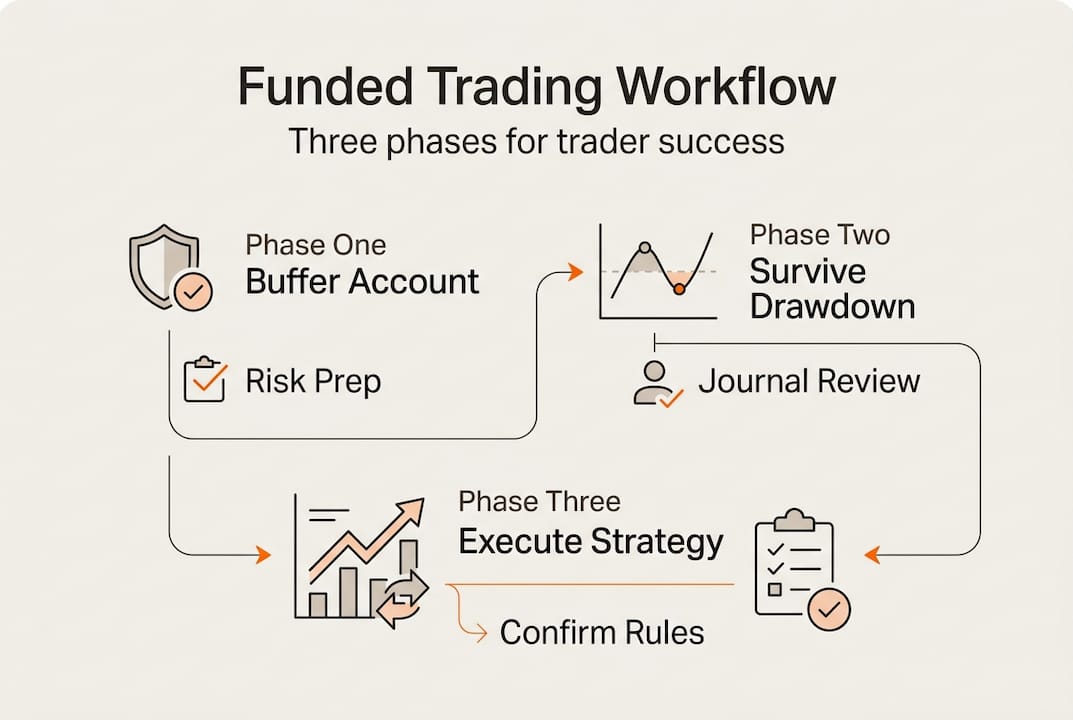
| Phase | Priority | Key Actions |
|---|---|---|
| Phase 1: Buffer | Build early cushion | Trade conservatively, target small consistent gains |
| Phase 2: Survival | Protect your buffer | Reduce size, avoid news, minimize mistakes |
| Phase 3: Execution | Hit profit target | Apply full strategy with confidence and discipline |
Here is how each phase works in practice:
- Phase 1 (Days 1 to 5): Build your buffer. Trade at reduced position sizes and focus on capturing small, consistent gains. The goal is to create a cushion above your starting equity without approaching the drawdown limit. Review step-by-step challenge process resources to calibrate your targets.
- Phase 2 (Days 6 to 10): Survive. Once you have a buffer, your job is to protect it. Reduce position sizes further if needed, avoid trading around major news events, and focus on not giving back gains. Emotional discipline is the primary skill here.
- Phase 3 (Days 11 onward): Execute. With a buffer in place and your drawdown protected, you can apply your primary strategy at normal position sizes. This is where scaling tips during challenges become relevant as you push toward the profit target.
For additional context on market analysis strategies that support each phase, reviewing current frameworks helps you adapt your approach to live conditions.
Pro Tip: Before transitioning from Phase 2 to Phase 3, pause for one full trading session. Review your journal, confirm your buffer is intact, and verify that your strategy is performing as expected. Rushing the transition is one of the most common causes of late-stage disqualification.
Risk management rules every funded trader must follow
Mastering workflow phases demands discipline. Strict risk rules keep you in the game and on track for funding. The data is clear: most disqualifications result from breaking simple risk limits, not from poor strategy.
Here are the non-negotiable risk rules for funded account challenges:
- Risk 0.5 to 1% per trade. This is the standard guideline. Risking more than 1% per position accelerates the path to disqualification when a losing streak hits.
- Respect daily drawdown limits. Most firms set a daily loss limit between 4% and 5%. Hitting this limit on any single day ends your session and can end your challenge.
- Avoid trading major news events unless your strategy is specifically designed for high-volatility conditions and the firm permits it.
- Never average down on losing positions. This is one of the fastest ways to breach a drawdown limit.
- Log every trade before and after execution to maintain accountability.
For deeper guidance on drawdown limits and capital allocation strategies, these resources provide firm-specific frameworks. Practicing within simulation before live trading reinforces these habits before real capital is at stake. You can also review scaling your trading account to understand how risk rules evolve as your account grows.
Safety alert: Overtrading is the silent disqualifier. Many traders breach drawdown limits not from one large loss but from a series of small, impulsive trades taken outside their defined setup criteria. If you have hit your daily target or your daily loss threshold, stop trading immediately.
Common mistakes and how to troubleshoot your workflow
Even disciplined traders hit snags. The missteps that derail funded workflows are predictable, and most of them are avoidable with the right preparation. Most failed challenges could be avoided with better rule preparation and risk practice.
The three most common mistakes are:
- Ignoring the rule set. Traders often skim the rules and miss critical restrictions around news trading, weekend holding, or lot size limits. Fix this by printing the full rule sheet and reviewing it before every session.
- Overtrading. Taking too many positions, especially during slow market conditions, leads to unnecessary losses. Fix this by setting a maximum daily trade count and stopping when you reach it.
- Poor log keeping. Without a detailed journal, you cannot identify what is working or what caused a loss. Fix this by logging every trade immediately after execution, including your reasoning and emotional state.
For troubleshooting specific issues, review evaluation rule sets to confirm you understand the firm’s requirements. If drawdown is the recurring problem, drawdown troubleshooting resources provide targeted solutions. Backtesting your approach before the challenge also reduces the likelihood of strategy-related errors during live evaluation.
Pro Tip: Before starting any new phase of your challenge, pause and review your journal from the previous phase. Identify one specific behavior to improve and one behavior to reinforce. This two-minute review prevents the same mistakes from compounding across phases.
How to verify and document your funded trading account workflow for ongoing success
Fixing errors is part of growth. The final step is making sure what works is tracked and repeatable for future funded rounds. Using journals to capture what works during challenge phases creates a foundation for repeatable improvement.
Here is how to set up a documentation system that supports long-term funded account success:
- Create a daily trade log. Record entry price, exit price, position size, risk amount, and outcome for every trade.
- Add a session notes column. After each session, write two to three sentences about what went well and what you would change.
- Conduct a phase-end audit. At the end of each workflow phase, review all trades and identify patterns in your wins and losses.
- Compare results against the rule set. Confirm that every trade complied with the firm’s requirements. Flag any violations and note how to prevent them.
- Archive each challenge cycle. Store your logs from every challenge attempt. Over time, this archive becomes your most valuable performance resource.
| Log category | What to track | Success metric |
|---|---|---|
| Trade entries | Price, size, direction | Compliance with setup criteria |
| Risk per trade | Dollar amount and percentage | Stays within 0.5 to 1% |
| Daily P&L | Gross and net result | No daily limit breaches |
| Rule compliance | Any violations noted | Zero violations per phase |
| Emotional state | Confidence, stress, impulsivity | Consistent and neutral |
For guidance on tracking payouts and performance once you reach funded status, and for support on the transition from sim to live trading, these resources extend your documentation practice into the funded phase itself.
Take your funded trading success further with DayProp
With your workflow mapped out, the next step is finding a funding partner whose structure supports every phase of your process. DayProp is built specifically for disciplined retail traders in FX, indices, and crypto markets who want transparent rules, professional risk parameters, and a clear path to capital.

DayProp’s step-by-step evaluation process aligns directly with the three-phase workflow covered in this guide, giving you a structured environment to demonstrate your edge. You can also compare funding models to find the challenge structure that fits your trading style and risk tolerance. Whether you are preparing for your first evaluation or scaling after a successful funded round, DayProp Funding provides the tools and framework serious traders need to grow without risking personal capital.
Frequently asked questions
What is the main reason traders fail funded account challenges?
Most disqualifications come from breaking core risk rules, particularly exceeding daily or overall drawdown limits rather than from strategy failure.
How many steps are in a typical funded account workflow?
A quality workflow follows three main stages: buffer creation, survival, and execution, each with distinct priorities and risk parameters.
Should I start live trading right after buying a challenge?
No. You should always simulate within the challenge’s exact rules before committing real capital to the evaluation.
What is a safe risk per position for funded accounts?
Most experts recommend limiting each trade to 0.5 to 1 percent of the account balance to stay within safe drawdown boundaries throughout the challenge.
Recommended
- Indices Trading Strategy Steps for Consistent Funding – DayProp Funding
- Structured trading challenge: Step-by-step guide to funding – DayProp Funding
- Trading Account Growth: Pathways to Consistent Gains – DayProp Funding
- 6 Essential Trading Skills Every Funded Trader Needs – DayProp Funding
- Master Trading Success: Strategies & Tools 2026 – My Framer Site