

Chasing wild monthly returns can feel tempting when trading FX, indices, or crypto, but those who succeed know real progress comes from measurable compounding and disciplined execution. Consistent account growth sets disciplined traders apart from the crowd endlessly searching for quick wins. This article dispels common misconceptions, breaks down account types and growth paths, and shares professional methods that transform speculative trading into a sustainable profession.
Table of Contents
- Defining Trading Account Growth And Misconceptions
- Types Of Trading Accounts And Growth Pathways
- Structured Scaling And Performance-Based Funding
- Risk Management For Sustainable Account Growth
- Avoiding Common Mistakes And Gambling Behaviors
Key Takeaways
| Point | Details |
|---|---|
| Trading Account Growth | Growth is about consistent, measured increases through disciplined trading and risk management, not unrealistic returns. |
| Common Misconceptions | Many traders mistakenly believe that larger positions or perfect win rates lead to faster growth; instead, proper position sizing and strategy yield better results. |
| Account Structure Impact | The type of trading account significantly influences growth potential and risk management strategies, with each offering different advantages. |
| Risk Management Importance | Effective risk management is vital for sustaining account growth, focusing on limiting losses to allow for compounding gains over time. |
Defining Trading Account Growth and Misconceptions
Trading account growth means consistent, measurable increases in your trading capital over time through profitable trades and disciplined risk management. It’s not a sprint toward unrealistic returns, but a structured path built on edge, consistency, and rule-based execution.
Most retail traders misunderstand what real account growth looks like. They chase 50% monthly returns when 8-12% monthly gains compound into extraordinary wealth over 12-24 months. The math works in your favor once you stop fighting it.
The Real Definition
True account growth happens when you:
- Execute trades aligned with a documented edge
- Maintain strict position sizing and risk parameters
- Track win rates, risk-to-reward ratios, and profit factors
- Compound gains systematically across multiple trading cycles
It’s measurable progress, not gambling luck. You can replicate your results month after month because they come from process, not chance.
Common Misconceptions
Research on retail investor behaviour reveals widespread misunderstandings about active trading and its impact on account growth. Here are the biggest myths traders believe:
Myth 1: Bigger positions = Faster growth
Actually, position sizing determines survival. A trader risking 5% per trade typically wipes out before their edge compounds. A trader risking 1-2% per trade stays in the game long enough to profit from their edge.
Myth 2: You need perfect win rates
Winning 45% of trades while maintaining a 3:1 reward-to-risk ratio generates profits. A 70% win rate with breakeven trades generates nothing. The math changes everything.
Myth 3: More trading = More growth
High-frequency trading increases costs, slippage, and emotional decisions. Trading your edge when it appears—even if that’s just 3-4 times weekly—compounds faster than random noise.
Myth 4: Indicators predict price movement
Indicators are lagging reflections of price action, not crystal balls. Real account growth comes from understanding market structure, support/resistance, and developing the trading habits that match your methodology.
The difference between account growth and account destruction is often a single parameter: position sizing discipline.
Misunderstandings destroy accounts faster than market volatility ever could. When you redefine growth as steady compounding through documented edges, trading shifts from speculation to profession.
Pro tip: Calculate your actual win rate and risk-to-reward ratio across your last 50 trades before adjusting position size—data beats intuition every single time.
Types of Trading Accounts and Growth Pathways
Not all trading accounts are created equal. The account structure you choose determines your leverage capacity, risk parameters, and potential growth trajectory. Different account types unlock different strategies—and some accelerate growth far more effectively than others.
Your account type is foundational. It shapes what you can trade, how much capital you can control, and the rules governing your positions. Understanding these distinctions separates traders who scale from those who plateau.
Account Structure Matters
Different trading account types directly influence growth through leverage, risk management, and trading behavior. Each structure creates distinct advantages and constraints:
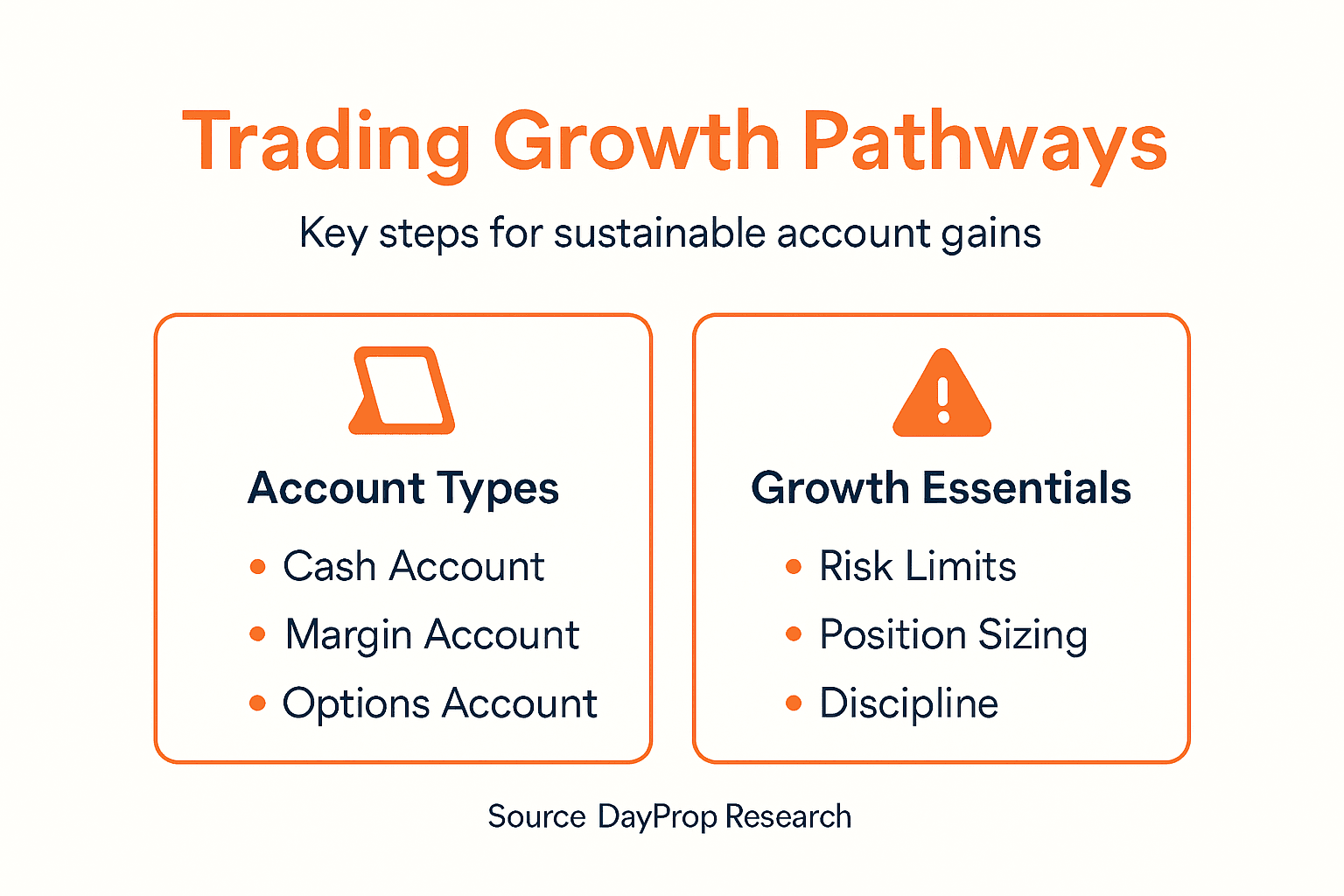
Cash Accounts
You trade only with capital you deposit. No leverage, no borrowing. Growth is linear—1x your deposited capital.
Margin Accounts
You borrow capital from your broker to control larger positions. Leverage amplifies both gains and losses. A 2:1 margin account lets you control double your deposited capital, but drawdown risk increases proportionally.

Options Accounts
These unlock derivatives trading where capital efficiency matters most. You control large underlying positions with minimal capital outlay. Risk requires stricter discipline.
Here’s a comparison of trading account types and the growth pathways each supports:
| Account Type | Leverage Availability | Suitable Strategy | Growth Potential |
|---|---|---|---|
| Cash Account | No leverage | Position trading, longer holds | Linear, steady growth |
| Margin Account | Broker-provided (e.g. 2:1) | Swing trading, larger trades | Accelerated with risk |
| Options Account | Highly capital efficient | Derivatives, hedging, spreads | High if managed well |
Growth Pathways by Account Type
Each account type supports different growth strategies:
- Cash accounts suit position traders holding 5-20 day trades, compounding steady 2-3% monthly gains
- Margin accounts enable swing traders capturing 3-5 day trends while managing leverage-based risk
- Options accounts allow capital-efficient strategies where 5% account risk controls 20-30% underlying exposure
The optimal pathway depends on your edge. If you trade 4-hour indices breakouts, margin accounts with 1.5:1 leverage compound faster than cash. If you trade weekly forex structure, cash accounts prevent over-leveraging and preserve capital.
Account type determines your growth ceiling. Mismatched account structure kills even traders with documented edges.
Disciplined traders match account structure to their methodology. A swing trader on a cash account manually limits position sizing. The same trader on a properly leveraged margin account compounds 3-4x faster while maintaining identical risk metrics.
Structured trading account discipline ensures growth pathways remain sustainable. You need parameters that enforce your edge rather than fight it.
Pro tip: Start with a cash account if your win rate is below 55%, then graduate to leverage only after demonstrating consistent profitability across 100+ trades.
Structured Scaling and Performance-Based Funding
Structured scaling ties capital increases directly to your trading performance. You don’t get more money because time passed—you get it because you proved profitability under defined rules.
This approach aligns trader incentives with actual results. Performance-based systems reward consistency and penalize recklessness far more effectively than traditional account structures.
How Performance-Based Funding Works
Performance measurement systems tie capital allocation directly to quantifiable output metrics. In trading, this means your next funding tier depends on hitting specific benchmarks:
- Minimum monthly profitability targets
- Maximum drawdown thresholds
- Consistency across consecutive months
- Win rate or risk-adjusted return requirements
You control the variables that unlock capital. Hit the metrics, unlock more funding. Miss them, prove you’re not ready yet.
The Scaling Mechanism
Structured scaling typically follows this progression:
- Evaluation Phase – Prove your edge on $10,000-$25,000 under strict rules
- Tier 1 Funding – Graduate to $50,000-$100,000 after consistent monthly gains
- Tier 2 Funding – Access $100,000-$250,000 by maintaining profitability across 3-6 months
- Tier 3+ Funding – Unlock $250,000+ through demonstrated long-term consistency
Each tier requires maintaining previous metrics while adding new complexity. This builds traders progressively rather than exposing them to capital they can’t handle.
Why This Model Matters
Traditional brokers give you fixed leverage regardless of results. Structured scaling gives you leverage you’ve earned.
This distinction changes behavior. When your next $100,000 depends on a 6-month track record, you stop taking 5% losses per trade. You stop revenge trading after a bad day. You follow rules because the alternative—losing your growth pathway—matters more than the next trade.
Performance-based funding turns traders from speculators into professionals. The system enforces discipline through opportunity cost.
You’re competing against objective metrics, not market noise. Miss targets two months running, you reset. But hit them consistently, and capital compounds exponentially.
Pro tip: Before committing to evaluation, document exactly which metrics you need to hit and reverse-engineer your position sizing to match—this prevents surprises when monthly results arrive.
Risk Management for Sustainable Account Growth
Risk management isn’t about avoiding losses—it’s about controlling them so your account survives long enough to compound gains. Without it, even profitable traders blow up accounts.
Sustainable growth requires intentional risk architecture. You build rules that protect capital during drawdowns and preserve compounding power when markets turn hostile.
The Foundation: Position Sizing
Position size determines survival. Risk too much per trade, and a normal 5-trade losing streak destroys months of gains.
Effective risk management practices contribute directly to sustainable financial performance and long-term account resilience. Professional traders use these core principles:
- Risk 1-2% of account per trade maximum
- Never exceed 5% total risk across all open positions
- Scale position size down during drawdown periods
- Increase size only after recovering to equity peaks
This sounds conservative. It’s actually aggressive—you’re compounding reliably instead of gambling.
Drawdown Management
Drawdowns are inevitable. How you respond determines whether they become recovery periods or account death.
Set maximum drawdown limits:
- Hit 10% drawdown: reduce position size to 50% normal
- Hit 15% drawdown: close all positions, reassess your edge
- Hit 20% drawdown: your system failed; stop trading until you understand why
These aren’t arbitrary. They protect you from compounding losses into account destruction. A 20% drawdown requires 25% gains to recover. A 50% drawdown requires 100% gains. The math favors stopping early.
This table summarizes key risk management actions and their impacts on account survival:
| Action | When to Use | Intended Effect |
|---|---|---|
| Reduce position size by 50% | 10% drawdown | Slow further losses |
| Close all trades, reassess system | 15% drawdown | Halt and diagnose issues |
| Cease trading, review thoroughly | 20% drawdown | Prevent account blowup |
Continuous Risk Assessment
Risk parameters shift as markets evolve. Bitcoin’s volatility in 2023 differs from 2024. Indices behave differently in trending versus choppy markets.
Review your risk framework monthly:
- Did your actual drawdowns match expected levels?
- Are position sizes appropriate for current volatility?
- Did your stop-loss placements make sense in hindsight?
- Are correlations between your trades changing?
Sustainable growth comes from managing risk, not predicting price. Control what you control: position size, stops, and capital preservation.
Traders who survive decades do one thing consistently—they never let a single trade or losing streak threaten account survival. They think in terms of 100-trade sequences, not individual fills.
Pro tip: Calculate your historical maximum drawdown from 100+ trades, then set your 20% stop-loss limit at half that figure—this prevents black swan events from destroying accounts while you learn.
Avoiding Common Mistakes and Gambling Behaviors
The line between trading and gambling blurs when emotion replaces process. A gambler chases losses with bigger bets. A trader following rules cuts losses and moves forward. Understanding this distinction saves accounts.
Most traders fail not from bad luck, but from repeating behaviors that guarantee failure. These patterns are recognizable. Once you see them, you can eliminate them.
Cognitive Distortions That Destroy Accounts
Cognitive distortions like overconfidence fuel excessive trading and risky decisions that resemble gambling. These mental traps feel logical in the moment:
Overconfidence Bias
You win three trades, suddenly you’re certain the next five will win. You increase position size based on confidence, not edge. Markets humble overconfident traders quickly.
Recency Bias
Last week’s losing streak convinces you that your system is broken. You abandon it right before it enters a winning period. Recency bias kills discipline.
Loss Aversion
You hold losing positions hoping they’ll reverse, turning small losses into account-destroying drawdowns. You cut winners too early to lock in gains. This backwards behavior compounds losses.
Gambling Behaviors in Trading
At-risk traders exhibit gambling-like behaviors including chasing quick gains and emotional decision-making. Recognize these warning signs:
- Trading when markets are closed (wanting action constantly)
- Increasing position size after losses (revenge trading)
- Taking trades outside your documented edge
- Checking positions every 5 minutes (anxiety-driven)
- Trading on news or tips instead of technical setup
These behaviors feel productive. They’re actually account destruction in motion.
The Kill Switch: Automated Rules
Willpower fails. Rules work. Build safeguards that prevent emotional decisions:
- Set daily loss limits: if hit, trading stops
- Use alerts instead of watching charts
- Document every trade reason before entering
- Review weekly trades against your criteria
- Track emotion levels—if angry or euphoric, don’t trade
The traders who scale to $500K+ accounts share one trait: they’ve eliminated discretion from their worst decisions. Rules replace emotions.
You can’t trust yourself in the heat of the moment. Structure the market so impulses can’t trigger reckless actions. Discipline compounds faster than intelligence.
Pro tip: Write down three gambling-like behaviors you’ve exhibited, then create one specific rule to prevent each—review these rules before every trading session.
Unlock Consistent Trading Account Growth with DayProp
The article highlights a critical challenge traders face: transforming trading account growth from guesswork and risky gambles into steady, measurable progress through disciplined risk management and performance-based scaling. If you are striving to master position sizing, maintain your edge, and escape common misconceptions about growth and leverage, you need a platform designed to support your trading journey with real-world conditions and transparent rules.
At DayProp, we bridge the gap between retail trading ambitions and institutional-level capital by offering structured evaluation and funding programs focused on consistent gains, risk control, and professional discipline. Explore our Uncategorized – DayProp Funding category to learn how you can start demonstrating your trading edge under strict risk parameters. Don’t wait to compound your success—visit DayProp now and take the first step in scaling your trading account the right way.
Frequently Asked Questions
What is trading account growth?
Trading account growth refers to consistent increases in your trading capital over time through profitable trades and disciplined risk management, not unrealistic returns.
How can I measure my trading account growth?
You can measure your trading account growth by tracking win rates, risk-to-reward ratios, and profit factors, while also maintaining systematic compounding of your gains.
What are the common misconceptions about trading account growth?
Common misconceptions include the belief that bigger positions lead to faster growth, that you need perfect win rates, and that more frequent trading results in more growth. In reality, disciplined risk management and alignment with a documented edge are crucial.
How does account type affect trading growth?
Different account types, such as cash accounts, margin accounts, and options accounts, influence your leverage capacity and risk parameters, ultimately shaping your growth trajectory in trading.
Recommended
- Trading Accounts: Building Discipline and Profitability – DayProp Funding
- Indices Trading Strategy Steps for Consistent Funding – DayProp Funding
- Blog – DayProp Funding
- 7 Trading Habits for Consistent Profits in FX and Crypto – DayProp Funding
- Metas financieras SMART: Impulsa tu estabilidad en México