

Active retail traders know that the right trading account is the difference between simply participating and executing a winning strategy in fast-moving markets. With rapid price swings in FX and crypto, the structure of your trading account directly impacts your ability to manage risk and maintain consistency. In this guide, you’ll discover how a trading account built for speed and discipline offers the tools and controls essential for sustainable profitability amid global market volatility.
Table of Contents
- Trading Accounts Defined for Active Traders
- Types of Trading Accounts and Their Uses
- Setting Up and Managing Your Account
- Risk Management and Compliance Essentials
- Common Pitfalls and Smart Strategies
Key Takeaways
| Point | Details |
|---|---|
| Importance of Account Type | Selecting the right trading account can significantly impact your trading performance and risk management. Professionals should choose accounts that align with their trading strategies and risk tolerance. |
| Discipline through Structure | Well-structured accounts with defined risk limits enforce disciplined trading behavior, preventing emotional decision-making. Implement these structures to improve consistency in trade execution. |
| Risk Management is Essential | Effective risk management strategies, such as stop-loss orders and position sizing, are critical to preserving capital and ensuring long-term profitability. Avoid ignoring these fundamentals. |
| Avoiding Common Pitfalls | Recognizing and addressing common trading mistakes, such as emotional decision-making and overtrading, can enhance a trader’s success. A solid trading plan helps mitigate these risks. |
Trading Accounts Defined for Active Traders
A trading account is a specialized account designed for buying and selling financial assets with frequency and speed. Unlike traditional investment accounts, these accounts prioritize rapid execution and flexible access to multiple asset classes.
Active traders depend on these accounts to maintain consistent market presence. Whether you trade FX, indices, or crypto, your account structure directly impacts your ability to execute strategy effectively.
What Makes Trading Accounts Different
Trading accounts serve a distinct purpose compared to standard brokerage accounts. The key differences include:
- Higher transaction frequency: Designed for multiple trades daily, not long-term holding
- Faster execution: Electronic access replaces traditional floor trading limitations
- Capital requirements: Often require minimum balances to maintain account privileges
- Regulatory oversight: Subject to rules like FINRA’s pattern day trader regulations that protect traders from excessive risk exposure
- Advanced features: Access to real-time data, margin facilities, and specialized order types
Active traders need accounts built for their operational reality, not designed for passive investors holding positions for months.
Professional vs. Retail Trading Accounts
Not all trading accounts function identically. Professional trading accounts offer experienced traders enhanced capabilities—higher leverage, broader instrument access, and reduced protective restrictions.
Professional accounts require specific eligibility criteria:
- Demonstrated trading experience and market knowledge
- Substantial trading activity history
- Significant capital commitment and portfolio value
- Understanding of leverage risks and advanced strategies
Retail accounts, by contrast, impose stricter protections. They limit leverage, restrict certain instruments, and require simpler risk disclosures.
Your account classification determines what you can trade, how much leverage you can access, and what regulatory protections apply.
Why Account Structure Matters for Discipline
Your trading account isn’t just a portal to markets—it’s a framework that either enables or restricts your trading behavior. Accounts with clear risk parameters, position limits, and drawdown rules force discipline into your operations.
Structured accounts prevent the common trap of overleveraging on a single position. They enforce position sizing rules automatically rather than relying on willpower alone.
A properly configured trading account with explicit risk limits removes emotional decision-making from position sizing and leverage management.
DayProp’s evaluation accounts exemplify this principle. They set defined drawdown limits, daily loss stops, and position sizing constraints that traders must respect. This structure trains the discipline required for profitable trading.

Without these guardrails, retail traders often violate their own risk rules when momentum feels strong or losses mount.
The Path Forward
Your trading account choice affects profitability more than you might realize. Accounts designed for active traders give you the tools, speed, and structure needed for consistent results.
Pro tip: When evaluating accounts, prioritize risk control features over leverage availability—accounts that enforce your discipline through built-in rules will generate better long-term returns than accounts offering unlimited risk exposure.
Types of Trading Accounts and Their Uses
Trading accounts come in different configurations, each suited to specific trading styles and risk tolerances. Understanding the distinctions helps you select an account that matches your operational needs and capital constraints.
Your account type directly affects what you can trade, how much leverage you access, and what happens when losses mount. The wrong choice limits your opportunities; the right one amplifies your edge.
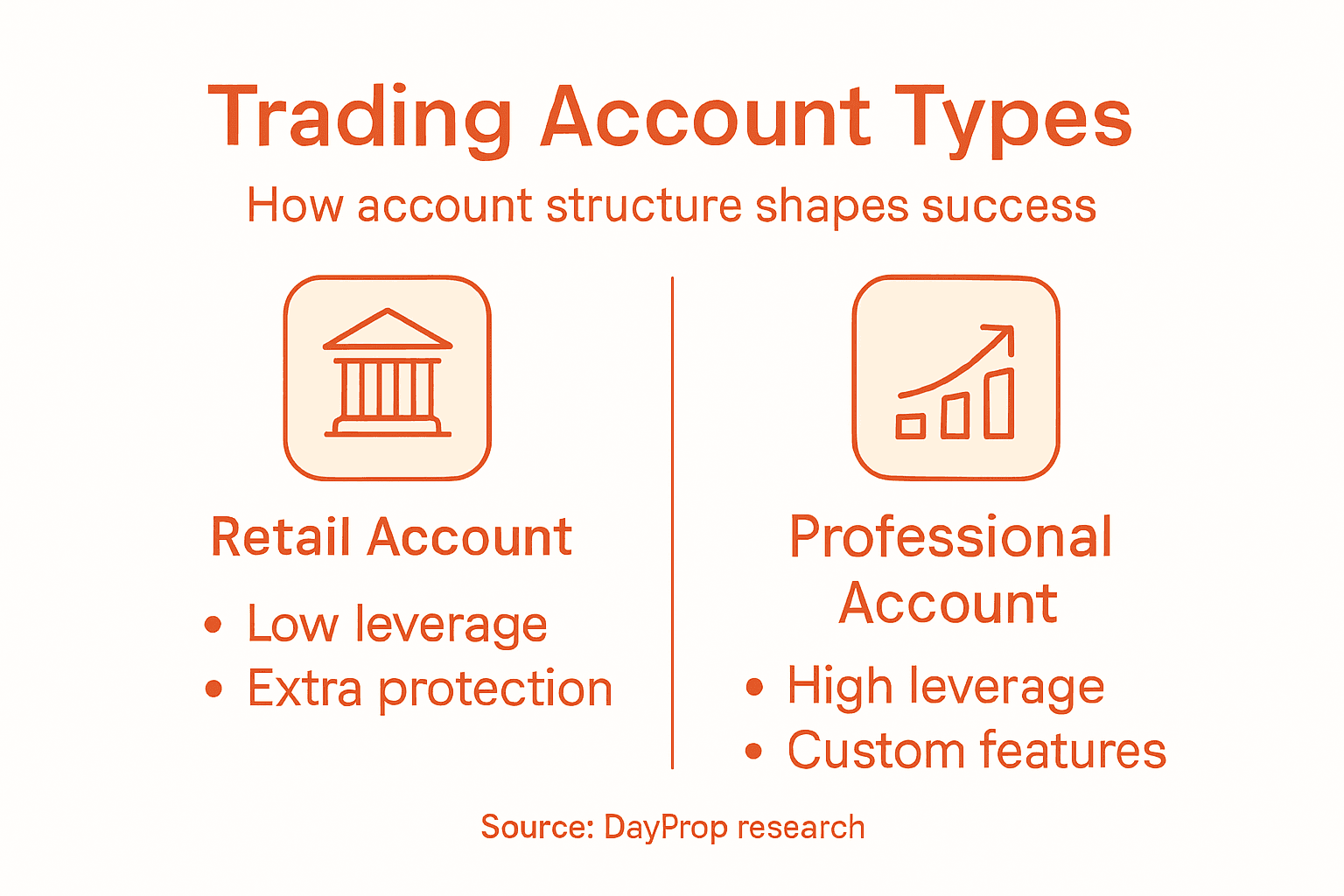
Here is a comparison of key trading account types and their ideal users:
| Account Type | Best For | Main Advantage | Main Limitation |
|---|---|---|---|
| Retail Account | Beginner traders | Strong regulatory safeguards | Lower leverage, limited products |
| Professional Account | Experienced traders | Higher leverage access | Requires proof of experience |
| Evaluation Account | Developing discipline | Built-in risk controls | Simulated capital, limited withdrawal |
| Margin Account | Active, risk-tolerant | Increased buying power | Greater risk of losses |
Cash Accounts vs. Margin Accounts
The foundational split in trading accounts separates those using your own capital from those allowing borrowed funds. These two categories define your entire trading framework.
Cash accounts require you to pay the full purchase price upfront with no borrowing allowed. You trade only with capital you possess, which means:
- Lower risk exposure and simpler account management
- No margin calls or forced liquidations
- Slower capital deployment since funds settle before reuse
- Ideal for traders building discipline with limited capital
Margin accounts permit you to borrow funds from your broker to increase purchasing power. Margin accounts increase potential returns but also risks, including margin calls when equity declines.
Margin trading amplifies both wins and losses. A 2% favorable move becomes 5% profit with 2.5:1 leverage. But a 2% loss becomes 5% loss equally fast.
Choosing between cash and margin accounts depends on your risk tolerance, trading style, and capital base—not on leverage availability alone.
Specialized Account Types
Beyond the cash-versus-margin distinction, several types of trading accounts support different trading strategies:
- Day trading accounts: Regulated accounts with minimum capital requirements and pattern day trader rules protecting against excessive risk
- Options trading accounts: Require approval and experience verification; support multi-leg strategies and complex positions
- Futures accounts: Designed for derivatives trading with distinct margin calculations and settlement processes
- Evaluation accounts: Structured accounts with defined drawdown limits and position sizing rules that enforce discipline
Each account type comes with regulatory oversight tailored to its complexity level and risk profile.
Matching Account Type to Your Trading Strategy
Your trading strategy should determine your account selection, not the reverse. Day traders need accounts with fast execution and intraday settlement. Options traders require approval for spreads and naked positions. Long-term position traders can operate effectively in basic cash accounts.
The alignment matters more than account features. A cash account with clear risk rules beats a margin account with unlimited leverage if you lack discipline.
Pro tip: Start with a cash account to build position sizing discipline, then graduate to margin or specialized accounts only after proving consistent profitability for at least three months.
Setting Up and Managing Your Account
Opening a trading account requires deliberate steps and careful broker selection. The process matters because poor execution early creates friction and cost throughout your trading career.
Account setup extends beyond funding. It includes platform familiarization, tool configuration, and establishing the operational systems that support consistent execution.
Selecting Your Broker and Opening an Account
Your broker choice determines execution quality, platform reliability, and available features. Not all brokers serve active traders equally.
The account application process follows a predictable sequence:
- Research and select a regulated broker matching your trading needs
- Complete the account application with personal and financial information
- Submit identity verification documents and proof of address
- Fund your account with initial capital
- Verify platform access and complete setup
This sequence matters. Rushing through broker selection to fund faster costs more than the time saved.
Regulated brokers protect your capital through segregated accounts and regulatory oversight—never compromise on broker credibility for faster onboarding.
Verify that your chosen broker serves your specific asset classes. A crypto-focused broker might lack FX depth. An FX specialist might not support indices. Match the platform to your actual trading plan.
Platform Setup and Configuration
Opening and managing a trading account effectively requires understanding your platform’s tools before risking capital. Most traders skip this step and pay for it immediately.
Configuration priorities:
- Chart setup: Configure timeframes, indicators, and layouts matching your analysis style
- Alert systems: Set price alerts and volume triggers for watchlist instruments
- Order types: Understand stop-loss, limit orders, and advanced execution options
- Risk tools: Enable position sizing calculators and account balance displays
- Data feeds: Verify real-time data quality for your trading instruments
Spend time here. Platform familiarity during demo trading prevents costly execution errors during live trading.
Operational Account Management
Once funded and configured, account management becomes ongoing discipline. This means reviewing performance regularly, adapting strategies alongside market conditions, and practicing consistent risk management.
Daily management includes:
- Monitoring open positions and account equity
- Recording trade outcomes in your journal
- Reviewing stop-loss and limit order placement
- Tracking cumulative daily losses against your limits
Monthly management involves analyzing performance data, identifying patterns in profitable trades, and adjusting position sizing based on recent volatility.
Without structured review, you miss the feedback loops that separate profitable traders from account-drainers.
Pro tip: Create a pre-market checklist covering account balance verification, platform connectivity, watchlist confirmation, and risk parameters before placing your first trade each day.
Risk Management and Compliance Essentials
Risk management and compliance form the foundation of sustainable trading. Without them, you’re gambling with account destruction and regulatory consequences.
These aren’t optional. They’re the systems that keep your capital intact and your trading activities legal.
Understanding Risk Management in Trading
Risk management means identifying threats to your capital and implementing controls that prevent catastrophic losses. It’s the difference between a bad month and permanent account liquidation.
Trading risk management involves strategies such as setting stop-loss orders, limiting position sizes, managing leverage, and maintaining adequate capital reserves. These aren’t theoretical—they’re operational requirements.
Core risk management components include:
- Stop-loss orders: Automatic exits at predetermined loss levels, removing emotion from losing positions
- Position sizing: Limiting each trade to a small percentage of account equity, typically 1-3%
- Leverage management: Using appropriate margin ratios based on your account size and volatility tolerance
- Capital reserves: Maintaining cash buffers above minimum account requirements
- Diversification: Spreading risk across multiple positions rather than concentrating capital
Without position sizing discipline, a single bad trade wipes out months of gains. Stop-losses protect you from catastrophic moves while you sleep.
This table summarizes practical risk management tools and their impacts on long-term trading performance:
| Risk Tool | Core Purpose | Benefit for Trader |
|---|---|---|
| Stop-Loss Orders | Control loss on each trade | Limits downside risk |
| Position Sizing | Set max exposure per trade | Prevents single trade wipeout |
| Leverage Cap | Limit margin usage | Reduces risk of liquidation |
| Daily Loss Limit | Halt after daily max loss | Preserves trading capital |
Effective risk management prevents catastrophic losses, maintains discipline, and enables long-term profitability by avoiding account destruction.
Compliance and Regulatory Standards
Compliance means adhering to regulatory standards governing your trading activities. This prevents fraud, insider trading, and manipulative practices that destroy market integrity.
Your broker enforces compliance through:
- Know-Your-Customer (KYC) verification documenting your identity and financial situation
- Anti-Money Laundering (AML) monitoring tracking fund sources and transaction patterns
- Trade reporting requirements submitting execution data to regulatory authorities
- Account segregation protecting customer funds from broker insolvency
Regulatory bodies like FINRA and the SEC establish rules protecting market participants. Compliance isn’t bureaucratic burden—it’s protection against fraud and market manipulation.
Building Your Risk Framework
Risk management and compliance create a secure trading environment by identifying, assessing, and mitigating trading risks systematically. Good governance structures support both.
Your personal framework should include:
- Daily loss limits—maximum acceptable loss before stopping trading
- Weekly equity targets—minimum balance preservation before withdrawal
- Position limit rules—maximum number of simultaneous open positions
- Leverage caps—maximum acceptable margin ratio for your account
- Review cycles—weekly performance analysis and strategy adjustments
Write these rules down. Post them where you trade. Follow them mechanically even when profits feel certain.
Pro tip: Implement your risk rules in your trading account’s settings first—use position size calculators, drawdown alerts, and daily loss stops to enforce discipline electronically rather than relying on willpower alone.
Common Pitfalls and Smart Strategies
Most traders fail not because markets are unpredictable, but because they repeat the same mistakes. Understanding these pitfalls separates those who survive from those who blow up accounts.
The good news: these errors are preventable through awareness and systematic execution.
The Emotional Trading Trap
Emotional decisions driven by fear and greed destroy trading accounts faster than any market move. Fear makes you exit winners too early; greed makes you hold losers hoping for reversals.
When your position moves against you, panic sets in. Instead of following your plan, you either exit at the worst possible moment or freeze, hoping the loss reverses. When profits come, euphoria clouds judgment, pushing you to overtrade or increase leverage dangerously.
These emotional responses are neurological, not rational. Your brain’s survival instinct triggers fight-or-flight responses that sabotage disciplined trading.
Maintaining objective analysis and sticking to a robust trading strategy helps traders execute based on analysis, not emotional impulses.
Common Pitfalls Active Traders Face
Common trading mistakes include emotional decisions, trading without strategy, overtrading, and inadequate risk management. These patterns repeat across all trader skill levels.
Most damaging pitfalls:
- Trading without a plan: Entering positions based on tips or hunches rather than predefined analysis
- Overtrading: Executing far more trades than your strategy requires, multiplying transaction costs and emotional stress
- Overleveraging: Using excessive margin that forces liquidation on minor adverse moves
- Impulsive reversals: Abandoning working strategies after one or two losing trades
- Ignoring stop-losses: Holding losing positions hoping they reverse, compounding losses exponentially
Each pitfall compounds the others. Poor risk management enables overleveraging. Emotional trading encourages overtrading. Missing stops turns minor losses into account-killers.
Building Smart Strategies for Consistency
Discipline, patience, and proper education help traders execute trades based on well-founded analysis rather than emotional impulses. This foundation separates sustainable traders from account-drainers.
Smart strategy components:
- Documented trading plan: Written entry criteria, exit points, and position sizing rules
- Pre-market preparation: Analyzing charts and identifying high-probability setups before market opens
- Mechanical execution: Following your plan mechanically without interpretation or emotional override
- Post-trade review: Recording outcomes and identifying patterns in profitable trades
- Continuous adaptation: Adjusting strategy based on market regime changes, not emotional reactions
Your strategy doesn’t need to be complex. It needs consistency. The difference between 50% win rate traders making money and 60% win rate traders breaking even is position sizing discipline and strict stop-loss adherence.
Pro tip: Review your last 20 trades and calculate what your results would have been if you had mechanically followed your planned stops and position sizing instead of making emotional adjustments—this reveals your true edge versus emotional cost.
Unlock Discipline and Profitability with DayProp Trading Accounts
The article highlights the critical challenge traders face in maintaining discipline and managing risk within their trading accounts to achieve long-term profitability. If you struggle with sticking to stop-losses, position sizing, and avoiding emotional trading pitfalls, structured accounts with built-in risk controls are the clear solution. DayProp specializes in this exact need by offering proprietary trading evaluation accounts that enforce professional risk parameters helping you build that vital trading discipline while trading FX, indices, and crypto.
Discover how DayProp can transform your trading approach by fast-tracking your access to institutional-level capital based on consistent, risk-managed performance—not luck or high leverage risks. Take the next step toward solidifying your trading foundation by exploring our platform at DayProp and start proving your edge under real-world market conditions today.
Frequently Asked Questions
What is a trading account?
A trading account is a specialized account designed for buying and selling financial assets frequently and quickly. It allows active traders to execute their strategies across various asset classes while maintaining a consistent market presence.
What are the differences between retail and professional trading accounts?
Retail trading accounts provide stronger regulatory protections and are ideal for beginner traders, but they have lower leverage options. Professional trading accounts, on the other hand, cater to experienced traders and offer higher leverage and broader access to financial instruments, along with fewer restrictions.
Why is risk management important in trading?
Risk management is crucial because it helps traders identify and mitigate potential losses. Effective strategies, such as setting stop-loss orders and managing position sizes, prevent catastrophic losses and maintain a sustainable trading approach.
How do I select the right trading account for my strategy?
To select the right trading account, consider your trading style, risk tolerance, and capital base. For day trading, seek accounts with fast execution and specific regulations, while long-term traders may benefit from simpler cash accounts. Understanding the unique features and limitations of each account type will guide your decision.
Recommended