

TL;DR:
- Transparent trading rules enable effective risk management and strategy alignment.
- Core rules include drawdown limits, profit targets, time restrictions, and prohibited strategies.
- Proper preparation, discipline, and validation are essential for successful funded trading under clear regulations.
Ambiguous prop firm rules are one of the most common reasons retail traders fail to secure funding. You study the markets, build a strategy, and then discover a hidden restriction that disqualifies your account after weeks of effort. This guide removes that guesswork. You will learn why rule transparency matters, how to break down core rule structures across FX, indices, and crypto, and how to execute trades step by step within clearly defined prop firm requirements. Whether you are preparing for your first evaluation or refining an existing approach, this framework gives you the clarity to move forward with confidence.
Table of Contents
- Why transparent trading rules matter for retail traders
- Key elements of transparent trading rules in prop firms
- Preparing for transparent trading challenges: Methods and mindsets
- Executing trades: Step-by-step within transparent prop firm rules
- What most traders miss about transparent rules
- Unlock disciplined trading success with DayProp resources
- Frequently asked questions
Key Takeaways
| Point | Details |
|---|---|
| Rule transparency builds trust | Clearly disclosed trading rules help you avoid costly surprises and secure funding with confidence. |
| Prepare with risk-first methods | Disciplined risk sizing and multi-timeframe analysis ensure you meet modern prop firm requirements. |
| 2026 rules reward consistency | Stricter limits and consistency metrics mean disciplined campaigns and static drawdowns are essential. |
| Verification prevents mistakes | Always verify official firm rules directly to protect your capital and eligibility. |
Why transparent trading rules matter for retail traders
Rule transparency is not a feature. It is a baseline requirement for any serious trading relationship. When a prop firm discloses its requirements clearly, you can build a strategy around those parameters rather than discovering violations after the fact. This distinction separates firms that want to fund traders from those that profit from failed attempts.
Trading rule transparency directly affects how you manage risk. If you know the exact drawdown threshold, the daily loss ceiling, and any time-based restrictions, you can size positions accordingly from day one. Hidden restrictions, by contrast, create a false sense of security. You might perform well for two weeks, then trigger an undisclosed rule and lose your evaluation account.
The practical benefits of transparency include:
- Realistic goal setting: You know exactly what profit targets and loss limits apply before risking time and capital.
- Strategy alignment: Rules around news trading, scalping, and holding times allow you to match your method to the firm’s requirements.
- Trust and accountability: Firms that publish clear rules are easier to hold accountable if disputes arise.
- Faster skill development: When rules are explicit, you can focus on refining your edge rather than decoding policy documents.
“Transparency in rules, as seen with firms like The Trading Pit and FTMO, builds genuine trust with traders. Avoid firms with hidden restrictions that only surface after a violation.”
The link between rule clarity and funding success is direct. Traders who understand the exact requirements of an evaluation are better positioned to pass it. They do not overtrade chasing targets, and they do not undersize positions out of fear of undefined limits. Improving risk with rules is not just about compliance. It is about building a repeatable process that holds up across multiple evaluation cycles.
Firms that obscure their requirements often rely on trader confusion as a revenue model. Recognizing this pattern early saves you time and capital. Prioritize firms that publish complete rule sets, including edge cases, before you commit to an evaluation.
Key elements of transparent trading rules in prop firms
Understanding why transparency matters, the next step is to dissect the specific rule structures used by prop firms. Most prop firms in FX, indices, and crypto organize their rules around a consistent set of parameters, though the exact values vary significantly.
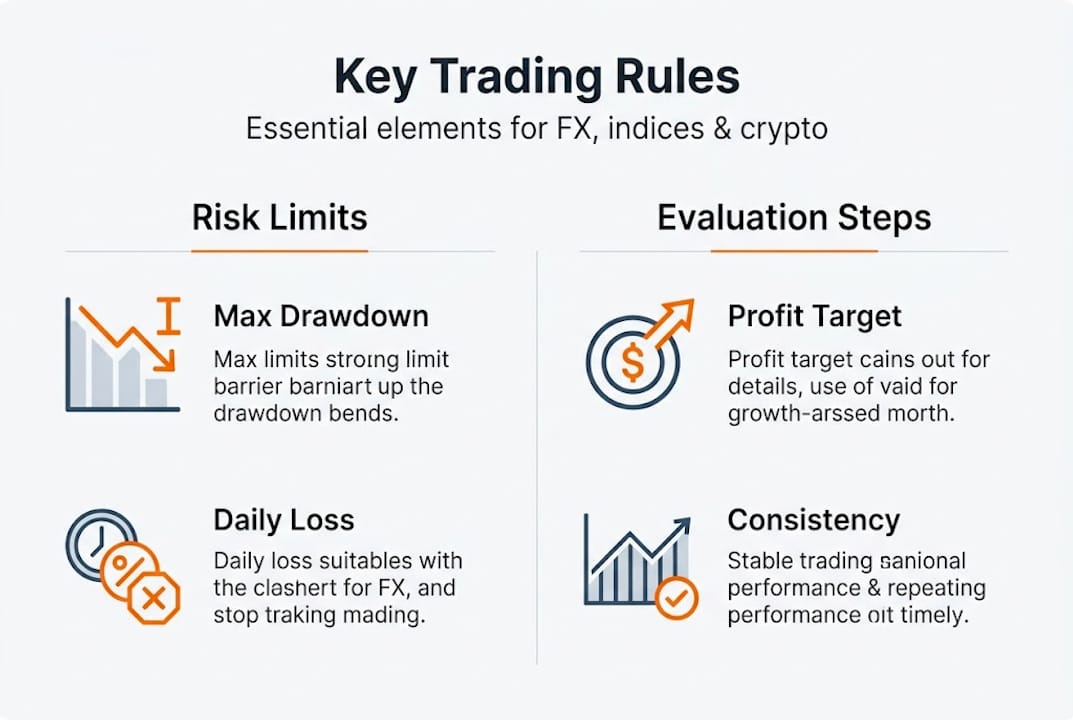
Prop firms like The Trading Pit, FTMO, FundedNext, and Funded Trading Plus provide transparent trading rules for retail traders across FX, indices, and crypto to help them secure funding. The core rule categories are:
- Maximum total drawdown: The absolute loss limit from your starting or peak balance before disqualification.
- Daily loss limit: The maximum you can lose in a single trading day, typically reset at midnight server time.
- Profit target: The required gain to pass each evaluation phase, usually expressed as a percentage.
- Trading time restrictions: Rules around minimum trade duration, news blackout windows, and weekend holding.
- Prohibited strategies: Bans on high-frequency trading (HFT), grid systems, martingale, and certain arbitrage methods.
| Rule category | Typical range | The Trading Pit example |
|---|---|---|
| Total drawdown | 4% to 12% | 4% to 10% |
| Daily loss limit | 1% to 5% | 1% to 5% |
| Profit target (phase 1) | 6% to 10% | 8% |
| Minimum trade duration | None to 2 min | No scalping under 1 min |
| Prohibited methods | HFT, grid, martingale | HFT, news trading |
The trading rules explained section of any firm’s documentation should answer all five categories above without requiring you to contact support.
Pro Tip: Before joining any evaluation, download the firm’s full terms of service and cross-reference the rule table above. If any category is missing or vague, treat that as a red flag. Firms with genuinely transparent policies will have specific numbers, not ranges that shift depending on account type.
Managing drawdown risk tips starts with knowing whether your drawdown is calculated on a static basis (from your starting balance) or a trailing basis (from your peak equity). This single distinction changes your entire position sizing model.

Preparing for transparent trading challenges: Methods and mindsets
Now that core rules are clear, it is critical to prepare your methods and mindset for trading success. Knowing the rules is the starting point. Structuring your approach around them is where most traders fall short.
The most effective preparation framework centers on drawdown-first logic. Drawdown-first sizing means risking 0.25% to 0.5% per trade, using multi-timeframe analysis with H1 for context, M15 for setup, and M5 for entry, targeting a minimum 1:2 risk-to-reward ratio, and using partial exits to lock in gains while letting runners develop.
This approach keeps your daily loss exposure well within firm limits even during losing streaks. If you risk 0.5% per trade and take four losses in a row, you are down 2%, which stays inside most daily limits.
| Preparation element | Recommended approach | Why it matters |
|---|---|---|
| Position sizing | 0.25% to 0.5% risk per trade | Protects daily loss limit |
| Timeframe structure | H1 context, M15 setup, M5 entry | Improves entry precision |
| Risk-to-reward | Minimum 1:2 | Allows profitability at 40% win rate |
| Exit strategy | Partial exits at 1:1, runner to 1:2+ | Reduces variance |
| Session focus | London and New York overlap | Higher liquidity, cleaner setups |
The mindset component is equally structured. Discipline means following your rules even when the market appears to offer a better opportunity outside your parameters. Patience means waiting for setups that meet all your criteria before entering. Consistency means applying the same process across every trading day, not just the ones that feel favorable.
A capital allocation guide helps you translate these principles into specific account management decisions. Equally important is tracking your trading account growth across evaluation phases to identify patterns before they become problems.
Build a pre-session checklist that includes: checking the economic calendar for high-impact news, confirming your daily loss budget, identifying key support and resistance levels on H1, and setting hard stop alerts on your platform.
Executing trades: Step-by-step within transparent prop firm rules
Once methods are ready, let’s walk through actual trade execution under transparent rules. The following process applies to FX, indices, and crypto evaluations in 2026.
Step-by-step execution workflow:
- Check the economic calendar. Identify high-impact news events for the session. In 2026, stricter news blackouts of 2 to 5 minutes before and after major releases are standard. Do not enter or hold positions during these windows.
- Calculate your daily loss budget. Subtract any open drawdown from your daily limit before placing the first trade.
- Identify your setup on H1. Confirm trend direction, key levels, and any order blocks or supply/demand zones relevant to your method.
- Drop to M15 for setup confirmation. Look for a structure shift or pattern that aligns with the H1 bias.
- Enter on M5 with a defined stop. Place your stop at the logical invalidation point, not at a round-number distance.
- Apply partial exit at 1:1. Move stop to breakeven after the first target is hit. Let the remainder run to 1:2 or beyond.
- Log the trade immediately. Record entry, exit, risk percentage, and rule compliance notes.
Key compliance checks during execution:
- Confirm no active news blackout before entry
- Verify position size does not exceed your daily risk budget
- Check that the trade duration will not violate minimum holding time rules
- Confirm the strategy does not use prohibited logic (grid, martingale, HFT)
Statistic callout: 2026 consistency rules now require that no single trading day accounts for more than 35% to 40% of total profits. This means a single large winning day can disqualify an otherwise successful evaluation.
Understanding prop model types helps you select the evaluation structure that fits your trading frequency and style. Staying current with prop trading trends ensures you are not caught off guard by mid-cycle rule updates.
What most traders miss about transparent rules
Most traders read the headline numbers, the drawdown limit and the profit target, and stop there. The real edge in 2026 funding comes from the details that do not make it into marketing materials.
Static drawdowns are a prime example. Trailing drawdowns move against you as your equity grows, which means a strong start can actually shrink your loss buffer. Firms that offer static drawdown structures for swing trading in FX, indices, and crypto give you a more predictable risk environment, and that predictability is worth prioritizing even if the headline profit target looks slightly less attractive.
Consistency rules are another area where traders underestimate the complexity. Using ICT order blocks within rules and running multi-day campaigns rather than chasing large single-day gains is how experienced traders navigate the 35% to 40% best-day cap. Spreading profits across multiple sessions is not just good risk management. It is a compliance strategy.
Verification is the final piece most traders skip. Rules evolve, and what was accurate three months ago may not reflect current policy. Always verify directly with the firm before starting an evaluation. The funding retail traders landscape in 2026 moves quickly, and staying current is part of your edge.
Unlock disciplined trading success with DayProp resources
Applying transparent rules consistently is easier when you have the right tools and structured guidance behind you. DayProp provides retail traders with the resources to move from evaluation preparation to funded trading with confidence.
Start with the evaluation guide for securing prop funding to understand exactly what each phase of a challenge requires. Use the compare trader funding models tool to identify which evaluation structure fits your trading style and risk profile. When you are ready to commit, the structured trading challenge guide walks you through each step of the process from account setup to payout. DayProp is built for traders who take rules seriously.
Frequently asked questions
What makes a prop firm’s trading rules truly transparent?
Transparent trading rules are fully disclosed, clearly articulated, and free from hidden clauses, allowing traders to verify requirements and manage risk confidently. Firms like The Trading Pit and FTMO are recognized for publishing complete rule sets without ambiguity.
Which risk management practices align best with transparent firm rules?
Drawdown-first sizing, partial exits, and multi-timeframe setups are proven risk strategies that fit within transparent rule frameworks. Drawdown-first sizing at 0.25% to 0.5% per trade keeps daily loss exposure well within standard firm limits.
How do 2026 rule changes impact retail traders?
2026 rules are stricter on news blackout, static drawdown, and consistency metrics, requiring more disciplined risk adjustment and campaign planning. 2026 consistency rules cap single-day profit contributions at 35% to 40% of total gains.
How can traders verify prop firm rules before joining?
Always check official documentation, ask direct questions, and compare with trusted guides to ensure rules match disclosed policies. Verify 2026 rules directly with each firm before starting an evaluation, as regulations continue to evolve.
Recommended