

Retail crypto traders face a market that can move 20% in hours, wipe out weeks of gains in a single session, and punish emotional decisions without mercy. Most traders focus on finding the next big trade rather than protecting the capital they already have. That is the wrong priority. Surviving 50 to 100 losing trades is entirely possible when proper risk rules are in place, and that kind of resilience is exactly what separates funded traders from those who blow their accounts. This article covers the core rules, frameworks, and tools you need to manage risk like a professional.
Table of Contents
- Essential risk management rules for crypto traders
- Adapting rules for volatility and edge cases
- Comparison: Fixed risk vs. variable risk strategies
- Journaling, review, and technology: Tools for disciplined risk management
- Take your risk management to the next level with prop funding
- Frequently asked questions
Key Takeaways
| Point | Details |
|---|---|
| Risk only 1–2% per trade | Limiting risk per trade preserves your account and lets you survive the toughest losing streaks. |
| Adapt rules for volatility | Adjust your risk management when markets become highly volatile or liquidity dries up to avoid catastrophic losses. |
| Fixed risk beats variable | Sticking to fixed percentage risk per trade reduces emotional decisions and protects against revenge trading. |
| Use journals and alerts | Tracking trades and setting up automated risk alerts with manual review sharpens your discipline and performance. |
| Discipline leads to funding | Consistent risk management is rewarded in prop trading evaluations and opens doors to funded trading opportunities. |
Essential risk management rules for crypto traders
The foundation of professional risk management is straightforward: never risk more than you can afford to lose on a single trade. In practice, that means applying a fixed percentage rule to every position you open, regardless of how confident you feel about the setup.
The standard benchmark is risking 1 to 2% of your total account balance per trade. If your account holds $10,000, your maximum loss on any single trade should be $100 to $200. This rule alone prevents the kind of catastrophic drawdowns that end trading careers. The position sizing formula makes this concrete:

Position size = (Account balance × Risk %) ÷ (Entry price – Stop loss price)
For example, with a $10,000 account, 1% risk, an entry at $30,000, and a stop at $29,500, your position size is ($10,000 × 0.01) ÷ $500 = 0.2 BTC. This formula keeps your exposure consistent regardless of market conditions.
Here are the core rules every retail crypto trader should follow:
- Risk no more than 1 to 2% per trade. This is non-negotiable for long-term survival.
- Use the position sizing formula on every trade. Guessing your size is not a strategy.
- Avoid revenge scaling. After a loss, the instinct to double down is dangerous. Stick to your fixed percentage.
- Set automated circuit breakers. Many platforms allow daily loss limits. Use them to enforce discipline when emotions run high.
- Separate experimental trades from core capital. Using multiple accounts lets you test new setups without exposing your primary balance.
The Bitmex risk framework reinforces that consistent position sizing is the single most effective tool for preserving capital over time. Applying it consistently builds the kind of track record that leads to consistent trading profits and opens doors to funded programs.
Pro Tip: Set your risk percentage before you open your charting platform each session. Deciding it in advance removes the temptation to adjust it based on how a trade feels in the moment. This is one of the core trading habits for profit that separates disciplined traders from reactive ones.
Adapting rules for volatility and edge cases
Mastering the basics is necessary, but crypto markets regularly produce conditions that stress-test even well-designed rule sets. Flash crashes, exchange outages, and liquidity crises require you to adapt your framework without abandoning it.
Slippage is one of the most underestimated risks in crypto. Mid-cap assets carry average slippage of 3.2%, meaning your stop loss may execute significantly worse than planned during volatile conditions. Thin order books amplify this problem. Before entering any large position, check the Depth of Market (DOM), which shows the volume of buy and sell orders at each price level, to confirm there is enough liquidity to support your trade.
Here is a practical process for handling edge cases:
- Stress-test your rules monthly. Simulate how your current position sizing would have performed during events like the March 2020 crash or the FTX collapse in November 2022.
- Expand stops during high volatility. Tighter stops get triggered by noise during volatile sessions. Widen them and reduce your position size proportionally to maintain the same dollar risk.
- Check DOM before large entries. Thin books mean your order can move the market against you before it fills.
- Reduce overall exposure during macro events. Scheduled events like Federal Reserve announcements or major protocol upgrades can spike volatility unpredictably.
- Have an exit plan for exchange failures. The FTX collapse showed that counterparty risk is real. Diversify across exchanges and keep withdrawal limits in mind.
“The traders who survived the FTX collapse were those who had already stress-tested their exposure to single-exchange risk. Risk management is not just about trade sizing. It is about system-level thinking.” — Risk framework analysis, Kalena AI
Reviewing trading challenge types that simulate volatile conditions can help you practice these adaptations before real capital is at stake. Platforms that mirror real market conditions give you the experience needed for scaling trading accounts responsibly. Additional crypto risk tips from practitioners reinforce these principles across different market environments.
Comparison: Fixed risk vs. variable risk strategies
Once you understand how to handle volatility, the next decision is which risk allocation model fits your trading style. Two dominant approaches exist: fixed percentage risk and variable risk.
Fixed percentage risk means you risk the same percentage of your account on every trade, regardless of setup quality or market conditions. Variable risk means you adjust your risk percentage based on factors like conviction level, volatility, or recent performance.
| Factor | Fixed % risk | Variable risk |
|---|---|---|
| Consistency | High | Low to moderate |
| Emotional control | Easier to maintain | Harder to maintain |
| Drawdown protection | Strong | Weaker during losing streaks |
| Flexibility | Limited | High |
| Best for | Developing traders | Experienced traders with proven edge |
| Risk of revenge scaling | Low | High |
Fixed percentage sizing prevents revenge scaling and makes it easier to automate circuit breakers. Variable risk can work for experienced traders with a statistically verified edge, but it introduces behavioral risks that most retail traders are not equipped to manage consistently.
Key considerations when choosing your approach:
- Fixed risk builds the discipline required to pass funded trading evaluations.
- Variable risk requires a large sample of reviewed trades before it can be applied reliably.
- Mixing both approaches without clear rules leads to inconsistency.
- Drawdown limit rules in funded programs almost always favor fixed risk behavior.
For most retail traders, starting with fixed percentage risk and only considering variable risk after reviewing at least 100 live trades is the most defensible path. Trading multiple instruments with a fixed risk model also helps diversify exposure without increasing overall account risk. The Zipmex risk framework similarly recommends fixed sizing as the default for traders building their track record.
Journaling, review, and technology: Tools for disciplined risk management
A strong risk framework on paper means nothing if you do not track whether you are actually following it. Journaling every trade and reviewing your performance systematically is what converts rules into habits.
Journaling and regular review are essential practices, and AI-powered alert tools can support threshold monitoring, but human judgment remains necessary for interpreting nuanced market conditions. The combination of both produces the best outcomes.
Here is what an effective journaling and review system looks like:
- Log every trade. Record entry, exit, position size, risk percentage, setup type, and emotional state at entry.
- Track rule adherence, not just profit and loss. A losing trade that followed your rules is a good trade. A winning trade that broke your rules is a warning sign.
- Use alert tools for risk thresholds. Set automated alerts when your daily drawdown approaches your limit. This removes the need for constant manual monitoring.
- Review in batches, not after every trade. Reviewing individual trades leads to overreaction. Patterns only become visible across larger samples.
- Apply human judgment for context. Automated systems flag rule breaks, but only you can assess whether a deviation was justified by genuine market conditions.
Understanding why trading rules matter becomes clearer when you can see your own data over time. The DayProp trading blog covers practical frameworks for building review systems that work alongside your trading plan. Consistent review also reinforces the trading discipline required to maintain performance under pressure. The Phemex trading rules resource provides additional structure for traders building their review process from scratch.
Pro Tip: Review at least 20 trades before making any changes to your system. Adjusting rules after three or four trades is reacting to noise, not signal. Patterns that justify system changes only emerge from statistically meaningful sample sizes.
Take your risk management to the next level with prop funding
You now have a structured framework for managing risk across normal conditions, volatile edge cases, and long-term performance review. The next logical step is applying that framework in an environment that rewards it directly.
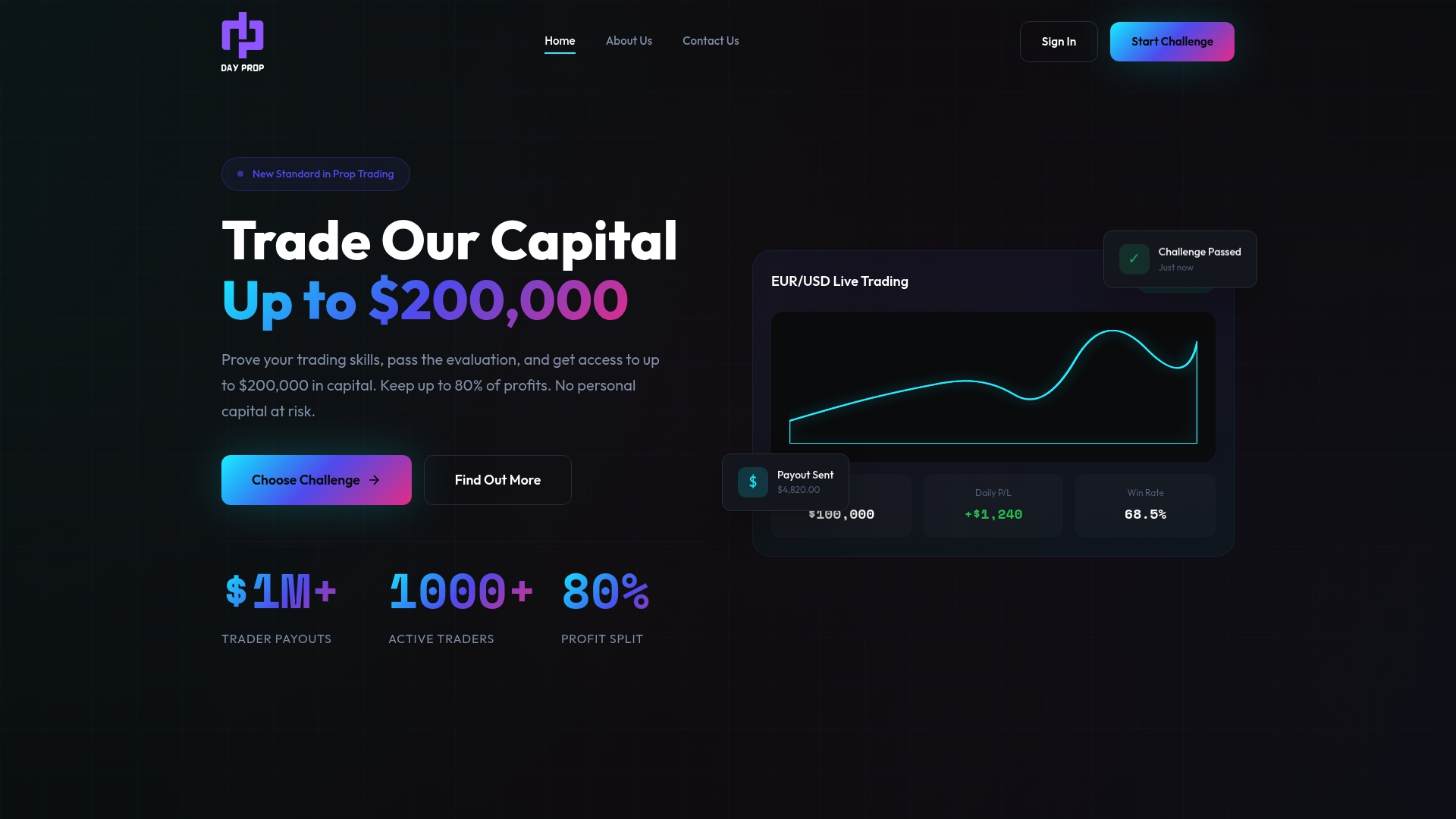
DayProp is built for traders who take risk management seriously. Our trading evaluation process is designed to identify traders who demonstrate consistent discipline, not just occasional wins. The evaluation parameters mirror real institutional risk standards, including drawdown limits, position sizing requirements, and consistency metrics that align directly with the rules covered in this article. If you are ready to put your framework to the test and access funded capital without risking your own, the funding evaluation guide walks you through exactly what to expect and how to prepare.
Frequently asked questions
What is the 1 to 2% risk rule in crypto trading?
The 1 to 2% rule means risking only 1 to 2% of your account balance on a single trade, which protects your capital from large losses and allows you to survive extended losing streaks without blowing your account.
How do I account for slippage and volatility in my risk management?
During volatile or thinly traded conditions, traders should widen stop losses, reduce position size, and check DOM liquidity before entering large positions to avoid unexpected execution gaps.
Should I use fixed or variable risk per trade?
Fixed percentage risk maintains discipline and prevents emotional mistakes, while variable risk offers flexibility but significantly increases the chance of larger losses during losing streaks, especially for developing traders.
What role do trading journals and reviews play in risk management?
Journaling and reviewing trades helps identify rule violations, improve strategy consistency, and reinforce discipline, particularly when combined with AI alert tools that monitor risk thresholds in real time.
How does risk management help in securing prop trading funding?
Disciplined risk management is the primary criterion in most evaluation processes, and traders who can survive losing streaks with consistent position sizing demonstrate exactly the behavior that prop firms fund.
Recommended
- Proprietary trading rules explained for retail traders – DayProp Funding
- Why use trading rules: improve risk and gain funding in 2026 – DayProp Funding
- How to manage risk in trading for consistent profits 2026 – DayProp Funding
- Types of trading challenges every retail trader should master – DayProp Funding