

Most retail traders fund their own accounts, absorb their own losses, and eventually run out of capital before they develop a real edge. Funded trader programs change that equation entirely. Instead of risking personal savings, you pass a structured evaluation, access a prop firm’s capital, and keep up to 80-90% of the profits you generate. It sounds straightforward, but the reality is more nuanced. Pass rates sit between 5-10%, and only 7% of all traders ever receive a payout. This guide breaks down exactly how funded trading works, what the rules actually require, and what separates traders who succeed from those who burn through evaluation fees.
Table of Contents
- Defining a funded trader: The basics and misconceptions
- How prop firm funding works: Evaluation, models, and payouts
- Nuances, rules, and red flags: What most traders miss
- The realities: Benefits, risks, and common critiques
- Keys to success as a funded trader: Discipline, risk, and continuous improvement
- Next steps: Comparing programs and mastering your funded trading journey
- Frequently asked questions
Key Takeaways
| Point | Details |
|---|---|
| Access firm capital | Funded traders use prop firm capital after passing challenges, minimizing personal risk. |
| Strict rules apply | Success depends on adhering to consistency, risk management, and profit target rules. |
| Low pass rates | Only a small percentage of applicants pass evaluations and receive real payouts. |
| Discipline is critical | Journaling, risk control, and strategy development are essential for long-term success. |
Defining a funded trader: The basics and misconceptions
Now that we’ve highlighted why funded trading is capturing attention, let’s clarify what being a funded trader really means and what it doesn’t.
A common misconception is that funded accounts are simply glorified demo accounts with a payout attached. That’s not accurate. A funded trader accesses firm-provided capital after passing a prop firm’s evaluation challenge, trading forex, indices, crypto, and other assets without risking personal funds beyond the initial challenge fee, and typically keeping 80-90% of profits generated.
Understanding what proprietary trading means is the first step toward recognizing how this model differs from retail brokerage. In a prop firm structure, the firm provides capital and absorbs the downside risk beyond the trader’s challenge fee. The trader’s job is to follow the rules and generate consistent returns.
Here’s what the funded trader model actually involves:
- Paying a one-time or recurring challenge fee to enter an evaluation
- Trading within defined risk parameters, including daily and overall drawdown limits
- Hitting a profit target within a set timeframe
- Receiving a funded account and splitting profits with the firm
- Following prop trading rules consistently to maintain funding status
“The funded trader model is not a shortcut. It is a structured filter designed to identify traders who can manage risk and generate returns under real pressure.”
The ‘easy money’ narrative around funded trading is one of the most damaging myths in retail trading. Firms set strict rules precisely because they need to protect their capital. Traders who treat evaluations casually almost always fail.
How prop firm funding works: Evaluation, models, and payouts
With basic definitions clear, let’s see exactly how funded trading works, what traders go through, and how programs differ.
Most funded trader programs follow a structured sequence. Here is the typical process:
- Sign up and pay the challenge fee for your chosen account size
- Complete Phase 1 of the evaluation, hitting a profit target while staying within drawdown limits
- Complete Phase 2 (if applicable), which often has a lower profit target but the same risk rules
- Receive a funded account and begin trading with firm capital
- Request payouts according to the firm’s schedule, typically bi-weekly or monthly
The indices funding process follows the same structure but may include specific rules around trading hours and instrument restrictions.
Fee structures vary significantly. Some firms charge a flat one-time fee per evaluation attempt. Others use monthly subscription models. The average trader spends $4,270 on evaluation fees before receiving a payout, which underscores the importance of being prepared before paying to enter a challenge.
| Feature | Evaluation model | Instant funding model |
|---|---|---|
| Upfront cost | Lower challenge fee | Higher flat fee |
| Access speed | Slower (2-4 weeks) | Immediate |
| Rule strictness | Moderate | Often tighter |
| Profit split | 80-90% | 70-85% |
| Best for | Disciplined, patient traders | Experienced traders with proven edge |
Top firms like FTMO have paid out over $450 million to funded traders, which confirms that payouts do happen. But with pass rates between 5-10% and a payout rate of just 7%, the odds demand serious preparation.
Nuances, rules, and red flags: What most traders miss
Understanding firm models is essential, but knowing the fine print and program pitfalls could make or break your funded journey.
Most traders focus on profit targets and ignore the rules that get them disqualified. The importance of trading rules cannot be overstated. Here are the most commonly overlooked rule categories:
- Consistency rules: Some firms prohibit earning more than 25-40% of total profits in a single trading day
- Drawdown calculation: End-of-day (EOD) drawdown and intraday drawdown are calculated differently and can catch traders off guard
- EA and automation restrictions: EA use is possible but carries risk, and many firms ban specific types of algorithmic strategies
- Scaling requirements: Moving to larger account sizes requires consistent performance over multiple payout cycles
- Instant funding trade-offs: Instant funding skips the evaluation phase but typically comes with higher fees and tighter rules
For traders interested in algorithmic trading with EAs, verifying a firm’s automation policy before paying any fees is critical.
Red flags to watch for when evaluating a firm include vague payout enforcement language, delays in processing withdrawals, and unclear rules around news trading or overnight positions. Established firms like FTMO, which holds a 4.8/5 Trustpilot rating and has distributed over $450 million in payouts, set the standard for transparency. Newer firms with limited track records deserve extra scrutiny.
Proper managing drawdown discipline is what separates traders who maintain funded accounts from those who lose them within weeks.

| Rule type | What to check | Why it matters |
|---|---|---|
| Drawdown type | EOD vs. intraday | Affects how you size positions |
| Consistency rule | Max % per day | Limits aggressive trading days |
| EA policy | Allowed or banned | Determines strategy flexibility |
| Payout schedule | Frequency and minimums | Affects cash flow planning |
| Scaling path | Requirements to grow | Defines long-term earning potential |
Pro Tip: Before paying for any evaluation, read the firm’s full rulebook and simulate your strategy against those rules using a demo account. Traders who skip this step account for a disproportionate share of early disqualifications.
The realities: Benefits, risks, and common critiques
The details can sound daunting, so let’s balance the hype with real-world outcomes, including both success stories and common criticisms.
Funded trading offers genuine advantages for disciplined traders. The core benefits include:
- No personal capital at risk beyond the challenge fee
- High profit splits of 80-90% on generated returns
- Built-in discipline enforcement through strict risk rules
- Access to larger capital than most retail traders could self-fund
But the risks are equally real. Critics point out that the fee churn model means firms profit even when traders fail, that strict rules limit certain legitimate strategies, and that simulated accounts don’t always replicate live market conditions accurately.
The statistic that defines the industry: only 7% of funded traders ever receive a payout. That number should recalibrate how you approach an evaluation. It’s not a lottery. It’s a business proposal that requires preparation, a proven strategy, and consistent execution.
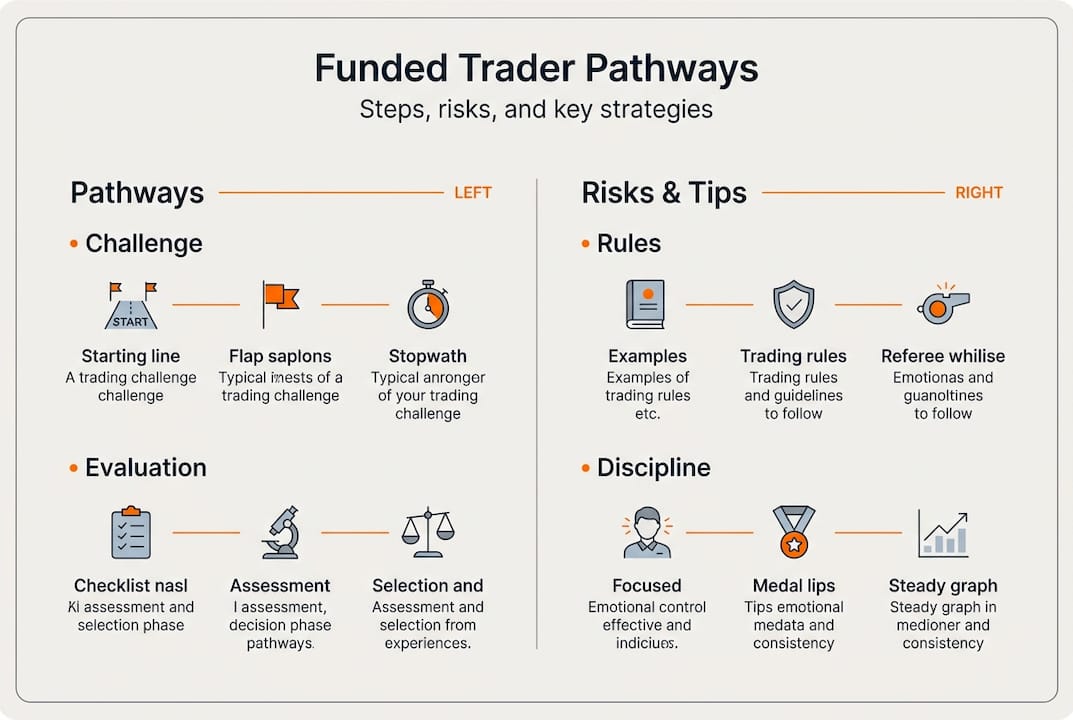
Funded programs enforce discipline through their rules, which makes them genuinely useful for traders who are still developing their edge. But they require a proven approach before you invest in challenge fees.
Pro Tip: Track your discipline and profitability metrics across at least 50-100 demo trades before entering a paid evaluation. If your strategy isn’t consistently profitable in a no-pressure environment, it won’t perform better under evaluation conditions.
Keys to success as a funded trader: Discipline, risk, and continuous improvement
So what can you control if you want a real shot at passing and withdrawing profits? Here are the habits top funded traders rely on.
Success in funded programs demands keeping risk per trade below 2%, maintaining a detailed trading journal, and reviewing performance regularly. These aren’t suggestions. They’re the baseline behaviors that separate funded traders from those who repeatedly fail evaluations.
Here are the most common habits of successful funded traders:
- Risking no more than 1-2% of account balance per trade
- Using a fixed position sizing formula rather than adjusting by feel
- Journaling every trade with entry rationale, exit reason, and emotional state
- Reviewing weekly performance to identify patterns in losses
- Avoiding trading during high-impact news events unless the strategy specifically accounts for volatility
Here are the steps to maximize your probability of passing a funded evaluation:
- Develop and backtest a strategy with at least 100 historical trades before paying any fees
- Run the strategy on a demo account under the exact rules of your target firm
- Apply strict risk management in trading with position sizes calculated before each trade
- Track your consistency metrics and ensure no single day dominates your profit curve
- Use capital allocation strategies to manage exposure across multiple positions
- Plan your scaling your trading account path from the start so you know what consistent performance looks like at each level
For traders exploring automation, risk management automation tools can help enforce position sizing rules systematically, reducing the emotional decision-making that causes most evaluation failures.
The traders who succeed treat funded trading as a professional discipline, not a side experiment. Every trade is documented. Every rule is respected. Every loss is analyzed.
Next steps: Comparing programs and mastering your funded trading journey
With actionable strategies in place, you’re ready to take the next step, choosing the right funded trading partner and deepening your knowledge.
Not all funded trader programs are built the same. Profit splits, drawdown rules, payout schedules, and instrument availability vary widely across firms. Taking time to compare trader funding models before committing to an evaluation fee is one of the highest-value decisions you can make as an aspiring funded trader.
DayProp provides structured trading challenges, transparent risk parameters, and a clear path from evaluation to funded status across forex, indices, and crypto markets. Whether you’re reviewing your first evaluation or refining your approach after a previous attempt, the trading evaluation guide covers the process in detail. When you’re ready to move forward, launch your funded trading journey with a platform built by experienced market professionals who prioritize discipline, consistency, and long-term trader development.
Frequently asked questions
How do I become a funded trader?
You must pass a prop firm’s evaluation challenge by hitting a profit target while following their risk rules. Passing the evaluation qualifies you to access firm-provided capital without risking personal funds beyond the challenge fee.
What is the average pass rate and payout rate for funded trader programs?
Pass rates average 5-10% across most programs, and only about 7% of all traders who enter evaluations ever receive a payout. Preparation and rule adherence are the primary factors that separate those who succeed.
Can I use automated trading or EAs in funded trader programs?
Some programs allow expert advisors, but policies vary significantly by firm. EA use carries risk because many firms restrict specific automation types, and violations can result in immediate disqualification.
Are funded trader accounts simulated or real?
Most funded accounts operate on simulated capital, particularly during and immediately after evaluation. Some firms offer real accounts after traders establish a verified performance track record over multiple payout cycles.
What is the biggest mistake aspiring funded traders make?
Underestimating the rules and risking too much per trade are the most common failure points. Success requires keeping risk below 2% per trade, maintaining a journal, and treating the evaluation as a structured business process rather than a speculative opportunity.
Recommended
- Compare trader funding models to find your best fit 2026 – DayProp Funding
- Why fund retail traders: benefits and challenges 2026 – DayProp Funding
- Proprietary trading guide 2026: fund your trading career – DayProp Funding
- Role of structured trading: Boost discipline and funding – DayProp Funding
- Step by Step Trading Workflow for Automated Crypto Success