

Many retail traders believe structured trading kills creativity and locks them into rigid patterns. Research shows the opposite: structured trading methods create disciplined approaches that reduce emotional decisions and improve consistency by over 30%. For FX, indices, and crypto traders, structure offers the pathway to consistency, better risk management, and access to funded accounts without risking personal capital.
Table of Contents
- Introduction To Structured Trading
- Fundamental Concepts Behind Structured Trading
- Benefits Of Structured Trading For Retail Traders
- Common Misconceptions About Structured Trading
- Access To Funded Trading Through Structured Evaluation
- Practical Frameworks Of Structured Trading
- Structured Trading Specifics In Crypto Markets
- Conclusion And Next Steps
- Explore Dayprop Funding And Evaluation Guides
Key takeaways
| Point | Details |
|---|---|
| Discipline reduces emotional trading | Structured methods create frameworks that minimize impulsive decisions and improve accuracy. |
| Risk management improves profitability | Defined stop losses and position sizing rules protect capital and reduce drawdowns. |
| Access to funded accounts | Consistent structure demonstrates trading skill required for platform evaluations and funding. |
| Misconceptions limit adoption | False beliefs about rigidity prevent traders from benefiting from flexible, disciplined frameworks. |
| Practical frameworks provide action steps | Documented plans, systematic entries, and metric tracking enable immediate implementation. |
Introduction to structured trading
Structured trading is a disciplined, systematic approach to entering, managing, and exiting trades using predefined rules and risk parameters. Unlike discretionary trading that relies on gut feelings or reactive impulses, structured methods document specific conditions for every decision. This framework addresses the chaos many retail traders face: inconsistency across trades, emotional reactions to losses, and unclear risk boundaries that drain accounts.
Retail traders in FX, indices, and crypto markets struggle with common challenges:
- Inconsistent results from changing strategies without proper testing
- Impulsive entries driven by fear of missing out or revenge trading after losses
- Undefined risk parameters leading to oversized positions and catastrophic drawdowns
- Lack of performance tracking preventing improvement and pattern recognition
Structured trading solves these issues by creating repeatable processes. When you follow documented entry criteria, position sizing formulas, and exit rules, you remove the guesswork. Each trade becomes part of a larger statistical sample rather than an isolated gamble. This shift transforms trading from emotional chaos into professional execution, setting the foundation for consistency that funding platforms require. Integrating trading accounts discipline profitability principles creates measurable improvement in both psychology and results.
Fundamental concepts behind structured trading
Effective structured trading rests on understanding core market concepts that inform systematic decisions. Trends identify the directional bias of price movement over time, showing whether markets favor buyers or sellers. Liquidity zones reveal where large orders cluster, creating support and resistance levels that structure entries and exits. Order flow analysis tracks real-time buying and selling pressure, providing context for whether trends will continue or reverse.
Systematic order placement transforms these concepts into actionable rules:
- Define exact entry triggers based on price action patterns, indicator signals, or structure breaks
- Set stop loss placement rules that protect capital while giving trades room to develop
- Calculate position sizing formulas tied to account risk percentage, never risking more than 1-2% per trade
- Establish profit targets using risk-reward ratios of minimum 1:2 or trailing stops that lock gains
Defined risk limits reduce psychological stress by removing real-time decision making. When you know exactly where you exit before entering a trade, fear and greed lose their grip. Your brain shifts from emotional reaction mode to clinical execution mode. A structured forex trading plan serves as a roadmap that guides traders through volatility, lowering psychological stress and increasing precision.
Pro Tip: Start by defining your maximum daily loss limit and risk per trade percentage before opening any position. Document these rules in writing and review them before each trading session to reinforce discipline and accountability.
Building structure requires understanding setting trading objectives for risk management and developing essential trading skills for funded traders. Learning market structure basics provides the foundation for recognizing high-probability setups that fit within your systematic framework.
Benefits of structured trading for retail traders
Discipline dramatically reduces emotional trading mistakes that destroy accounts. When you follow a predefined plan, you eliminate the internal debate about whether to take a trade or hold a losing position. Decision fatigue drops because the plan already decided. Data shows traders with structured plans report 30% higher trade accuracy and 25% lower psychological stress compared to discretionary traders.

Structured risk limits extend account survivability by preventing catastrophic losses. A trader risking 1% per trade can survive 20 consecutive losses and still retain 80% of capital. Compare this to undisciplined traders risking 10% per position who blow accounts after three bad trades. Effective risk management frameworks within structured trading limit maximum daily loss and position sizing, increasing trader longevity from months to years.
Key benefits include:
- Consistent execution regardless of recent wins or losses
- Reduced drawdowns through systematic position sizing and stop placement
- Improved decision accuracy from removing emotional variables
- Clear performance metrics enabling data-driven strategy refinement
- Professional-level risk management attractive to funding platforms
Structured trading transforms gambling into business. When every trade follows documented rules with defined risk, you create an edge through consistency rather than hoping for lucky streaks. Long-term profitability comes from repeating proven processes, not chasing excitement.
Adopting trading habits for consistent profits compounds these benefits over time. The psychological relief alone improves sleep quality, reduces trading-related anxiety, and creates the mental space needed for continuous learning and adaptation.
Common misconceptions about structured trading
Many traders avoid structured approaches based on false beliefs that limit their growth. The biggest myth claims structure kills creativity and prevents adaptation to changing markets. Reality shows the opposite: structured trading restricts creativity misconception while fostering frameworks that enhance decision-making consistency and adaptability. Structure provides the foundation from which creative pattern recognition and strategic adjustments emerge.
Discipline differs fundamentally from rigidity. Structured traders regularly review performance data and adjust rules based on statistical evidence. A rigid trader never changes despite losing results. A disciplined trader evolves the system while maintaining consistency in execution. The structure itself includes built-in review periods for testing new approaches and refining parameters.
Common false beliefs about structured and funded trading:
- Structure means following the exact same strategy forever without adaptation
- Funded trading platforms offer easy money without real skill requirements
- Passing an evaluation guarantees long-term funded account success
- Structured rules prevent capitalizing on unexpected market opportunities
- Only algorithmic or robotic trading qualifies as truly structured
The reality: funded programs require demonstrable skill and risk management. Evaluation rules exist to identify traders who can preserve capital while generating returns. Failing to understand these requirements leads to disqualification and wasted evaluation fees. Structure actually increases your ability to spot and execute opportunities because you know exactly what qualifies as a valid setup.
Pro Tip: Balance discipline with strategic flexibility by scheduling weekly reviews where you analyze performance data and adjust parameters if statistical evidence supports changes. This creates evolution within structure rather than abandoning it.
Understanding trading account growth disciplined approach clarifies how structure and adaptation work together for sustainable results.
Access to funded trading through structured evaluation
Funded trading platforms use structured evaluations to identify traders who demonstrate consistent risk management and profitability. These programs offer tiered progression where successful traders scale from smaller initial accounts to six-figure capital allocations. The evaluation process tests your ability to generate returns while respecting maximum daily loss limits, overall drawdown thresholds, and position sizing rules.
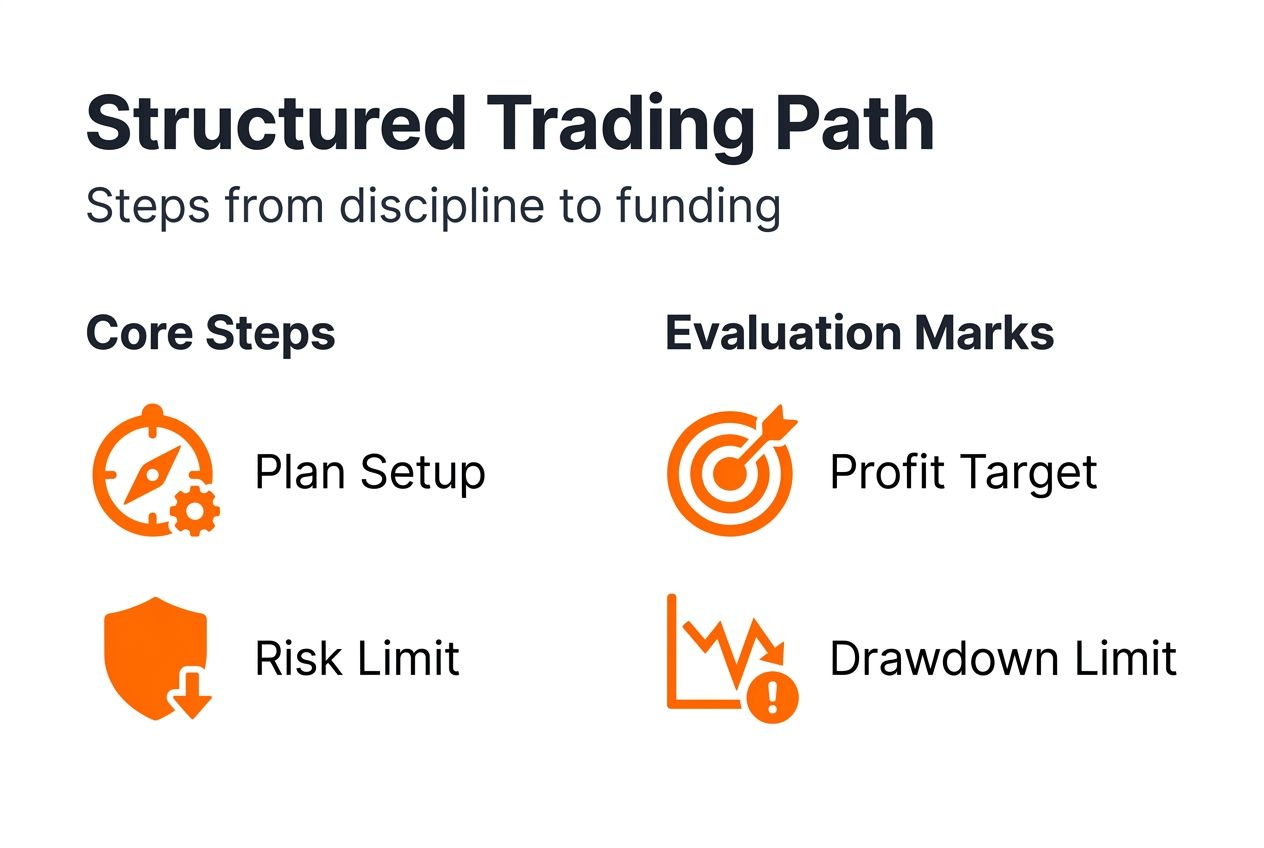
Structured trading platforms offering tiered progression allow retail traders to build skills and scale from small to large accounts while managing risk transparently. You trade real market conditions without risking personal capital. Passing evaluations unlocks funded accounts where you receive profit splits, typically 70-90% of gains.
| Aspect | Traditional Trading | Funded Account Scaling |
|---|---|---|
| Capital Risk | Personal funds at risk | Platform capital, zero personal risk |
| Account Size | Limited by savings | Scales to $200K+ based on performance |
| Risk Rules | Self-imposed, often ignored | Platform-enforced, mandatory compliance |
| Profit Potential | Capped by account size | Unlimited through tier progression |
| Learning Curve | Expensive mistakes | Structured feedback and clear rules |
Benefits of funded evaluation programs:
- Transparent rules eliminate confusion about what qualifies as acceptable trading
- Growth incentives reward consistency and discipline over short-term luck
- Professional risk parameters teach institutional-level capital preservation
- Fast-track payout models provide income without years of capital accumulation
- Performance data creates accountability and measurable improvement targets
Evaluation milestones typically include profit targets of 8-10% with maximum daily loss limits of 3-5% and total drawdown caps of 8-10%. These parameters force structured approaches, making undisciplined trading styles immediately obvious and unsuccessful. Learning the trading evaluation guide for prop funding prepares you for these requirements.
Practical frameworks of structured trading
Implementing structured trading requires a systematic plan development process. Start by defining specific goals: target monthly return percentage, maximum acceptable drawdown, and daily time commitment. Document your complete trading plan including markets traded, timeframes analyzed, entry criteria, exit rules, position sizing formulas, and risk parameters. Choose systematic methods that match your schedule and risk tolerance, whether trend following, mean reversion, or breakout strategies.
Risk parameter examples:
- Maximum daily loss of 3% of account balance before stopping trading for the day
- Risk per trade limited to 1% of total capital using position size calculators
- Maximum of three open positions simultaneously to prevent overexposure
- Profit target exits at 2:1 risk-reward minimum or trailing stop activation
Grid trading offers a practical structured strategy for volatile, non-directional markets. Structured trading utilizes market structure understanding to place systematic orders, such as grid trading strategies, that capitalize on volatility without predicting direction. You place buy and sell orders at regular price intervals, profiting from oscillations regardless of overall trend.
| Method | Best Market Condition | Risk Control | Skill Level |
|---|---|---|---|
| Grid Trading | Range-bound, high volatility | Fixed spacing limits exposure | Intermediate |
| Trend Following | Strong directional moves | Trailing stops protect gains | Beginner to Advanced |
| Risk-Defined Spreads | Any condition | Maximum loss known at entry | Advanced |
| Systematic Breakouts | Consolidation before expansion | Stop placement at structure | Intermediate |
Evaluation and iteration close the loop. Track every trade in a journal recording entry/exit prices, reasons, emotional state, and outcome. Review weekly to identify patterns in wins and losses. Adjust rules quarterly based on statistical evidence, not emotional reactions to recent trades.
Pro Tip: Use a simple spreadsheet to track win rate, average win size, average loss size, and profit factor weekly. When metrics fall below acceptable thresholds for two consecutive weeks, pause live trading and return to simulation until consistency returns.
Explore performance-based trading evaluation guide and indices trading strategy steps for market-specific structured approaches.
Structured trading specifics in crypto markets
Crypto markets present unique volatility challenges requiring enhanced structure. Bitcoin and altcoins regularly experience 10-20% daily price swings that would devastate accounts using traditional FX position sizing. Structure becomes even more critical when single-day moves can trigger multiple stop losses or create extraordinary profit opportunities.
Crypto-specific structured approaches:
- Reduce position sizes to 0.5% risk per trade compared to 1-2% in FX markets
- Implement wider stop losses accounting for typical volatility while maintaining risk percentage
- Use time-based exits to avoid overnight gap risk from 24/7 trading
- Apply correlation analysis preventing overexposure to similar cryptocurrencies
Cryptocurrency derivatives and structured products offer professional tools for managing crypto volatility and risk. Options strategies like covered calls and protective puts define maximum loss while maintaining upside potential. Perpetual futures with funding rates create mean reversion opportunities within structured frameworks. These instruments transform crypto’s chaos into manageable risk profiles.
Structured crypto trading improves performance by:
- Reducing emotional reactions to extreme price moves through predefined rules
- Capitalizing on volatility through systematic entry signals rather than chasing moves
- Protecting capital during flash crashes via automatic stop placement
- Enabling consistent sizing regardless of recent market behavior
The key difference: crypto requires stricter adherence to structure because the emotional temptation to overtrade or revenge trade multiplies during high volatility periods. Your plan must explicitly address crypto-specific scenarios like exchange outages, liquidity gaps, and correlation breakdowns during market stress.
Conclusion and next steps
Structured trading transforms retail trading from emotional gambling into professional capital management. The frameworks outlined deliver improved discipline, superior risk management, consistent execution, and access to funded accounts. These benefits compound over time as you refine your approach based on performance data rather than gut feelings.
Next steps for implementation:
- Define your specific trading goals and acceptable risk parameters in writing today
- Document a complete trading plan covering all decision points before your next trade
- Start tracking every trade in a performance journal with objective metrics
- Research funded trading platforms and their evaluation requirements
- Commit to weekly performance reviews and quarterly plan adjustments based on data
The path from struggling retail trader to funded professional runs through disciplined structure. Markets reward consistency, risk management, and emotional control over lucky streaks or complex strategies. Begin with simple, well-defined rules you can execute repeatedly. Complexity comes later after you prove the ability to follow basic structure.
Explore DayProp funding and evaluation guides
Applying structured trading principles becomes easier with clear evaluation pathways and professional support. DayProp provides transparent risk rules, tiered account progression, and educational resources designed for disciplined traders ready to scale their skills into funded capital.
Our performance-based trading evaluation guide walks you through exactly what evaluators assess and how to demonstrate the consistency required for funding approval. The trading evaluation guide for prop funding offers practical strategies for meeting profit targets while respecting risk parameters. Visit DayProp to explore evaluation options, review transparent rules, and start your journey toward funded trading with institutional-level capital backing your proven edge.
FAQ
What is the main advantage of structured trading for retail traders?
Structured trading provides disciplined frameworks that eliminate emotional decision-making and improve consistent profitability. Predefined entry, exit, and risk rules remove subjective judgment that leads to impulsive mistakes and account destruction.
How does structured trading help reduce emotional decision-making?
Following documented trade plans with fixed entry criteria, stop placement, and position sizing formulas limits subjective impulses during live market conditions. You execute predetermined decisions rather than reacting emotionally to price fluctuations or recent win/loss streaks.
Can retail traders access funded accounts using structured trading?
Yes, funding platforms specifically require demonstrated risk discipline and execution consistency that structured trading frameworks naturally provide. Evaluation processes test your ability to follow rules under pressure, making structure essential for qualification and long-term funded success.
What are common misconceptions about structured trading?
Many believe structure kills creativity, creates excessive rigidity, or that funded trading offers easy money without real skill requirements. All three misconceptions are false: structure enhances adaptability, allows strategic evolution, and funding platforms rigorously test genuine trading ability.
What practical steps should I take to start structured trading?
Define specific performance goals and risk tolerance limits first. Write a complete trading plan documenting entry/exit criteria and position sizing rules. Set maximum daily loss and per-trade risk parameters. Track every trade with detailed metrics. Review performance weekly and adjust rules quarterly based on statistical evidence, not emotions.
Recommended
- Trading Rule Transparency Boosts Funded Success 25% – DayProp Funding
- 6 Essential Trading Skills Every Funded Trader Needs – DayProp Funding
- Indices Trading Strategy Steps for Consistent Funding – DayProp Funding
- Trading Accounts: Building Discipline and Profitability – DayProp Funding
- Add a structure – LPS Manager