

TL;DR:
- Prop trading evaluation platforms help traders gain funding by assessing discipline and risk management. Proper preparation, rule comprehension, and disciplined trading are essential to passing evaluations and sustaining long-term funded accounts. Adapting strategies to firm constraints, maintaining strict risk controls, and ongoing review ensure ongoing success beyond initial challenges.
You have the skills to trade, but without sufficient capital, scaling your results is slow and often frustrating. Prop trading evaluation platforms exist precisely to solve this problem: they assess your discipline and risk management, then fund your account if you meet their criteria. This guide walks you through every concrete step, from preparing the right tools and documentation to sustaining a funded account over the long term. Whether you trade FX, indices, or crypto, these instructions are direct, practical, and grounded in how real evaluation programs actually work.
Table of Contents
- What you need to start: Requirements and tools
- Step-by-step: How to secure trading funding
- Common pitfalls and how to avoid them
- Mastering discipline for long-term growth
- A fresh perspective: Why passing prop challenges is only half the battle
- Next steps: Start your funding journey with confidence
- Frequently asked questions
Key Takeaways
| Point | Details |
|---|---|
| Know the requirements | Get your KYC, budgeting, and trading tools ready before applying for prop funding. |
| Follow each step | Select your firm, pass the evaluation, complete KYC, then start trading under strict rules. |
| Expect multiple tries | Most traders need 2–4 attempts, so stay persistent and adapt after every challenge. |
| Prioritize risk discipline | Limit risk to 1% per trade and use written checklists to protect your account long-term. |
| Adapt to firm rules | Study each firm’s specific requirements since small mistakes can cost you your funded status. |
What you need to start: Requirements and tools
Before spending a single dollar on an evaluation fee, it pays to confirm that you meet the basic eligibility requirements and have the right trading environment set up. Skipping this preparation phase is one of the most common ways traders waste both time and money.
KYC documentation and basic eligibility
Almost every prop firm requires Know Your Customer (KYC) verification before granting a funded account. Prepare a government-issued photo ID, proof of address dated within the last three months, and in some cases a selfie with your ID. Age requirements are typically 18 or older. Having these documents ready before you start the evaluation saves significant delays once you pass.
Platform and software selection
Most evaluation programs support MetaTrader 4, MetaTrader 5, or cTrader. Some crypto-focused firms also use proprietary dashboards. Your platform choice affects order execution speed and the range of assets you can trade. Understanding the crypto trading tools available to you is especially important if you plan to trade digital assets alongside FX pairs and indices, since margin requirements and session rules can differ significantly.
Choosing the right evaluation account
Account sizes typically range from $10,000 to $200,000 in simulated capital. Start with an account size that matches your strategy’s natural position sizing. Trading too large forces you to over-leverage, which increases the likelihood of a drawdown breach. Review the proprietary trading basics to align your choice with your actual trading style before committing.
Budget for fees and multiple attempts
Evaluation fees range from roughly $50 for a small account to several hundred dollars for a $100,000 or larger challenge. The step-by-step process for securing prop funding also includes understanding profit targets, daily drawdown caps, and maximum drawdown limits, all of which vary by firm. Budget for at least two to four attempts from the start, not because failure is inevitable, but because preparation is realistic.
Here is a quick reference of common evaluation parameters:
| Parameter | Typical range |
|---|---|
| Profit target (Phase 1) | 8% to 10% |
| Profit target (Phase 2) | 4% to 5% |
| Maximum drawdown | 8% to 12% |
| Daily drawdown limit | 4% to 5% |
| Minimum trading days | 5 to 10 |
| Profit split (funded) | 75% to 95% |
You can also compare top prop firms across these parameters before committing to any single platform.
Pro Tip: Before paying any evaluation fee, open a demo account and trade it exactly as you would during a real challenge. Use a spreadsheet to track daily drawdown, cumulative profit, and total trade count. This simulation exposes weaknesses in your strategy before they cost you real money.
Step-by-step: How to secure trading funding
With everything prepared, here is the exact sequence to move from candidate to funded trader.
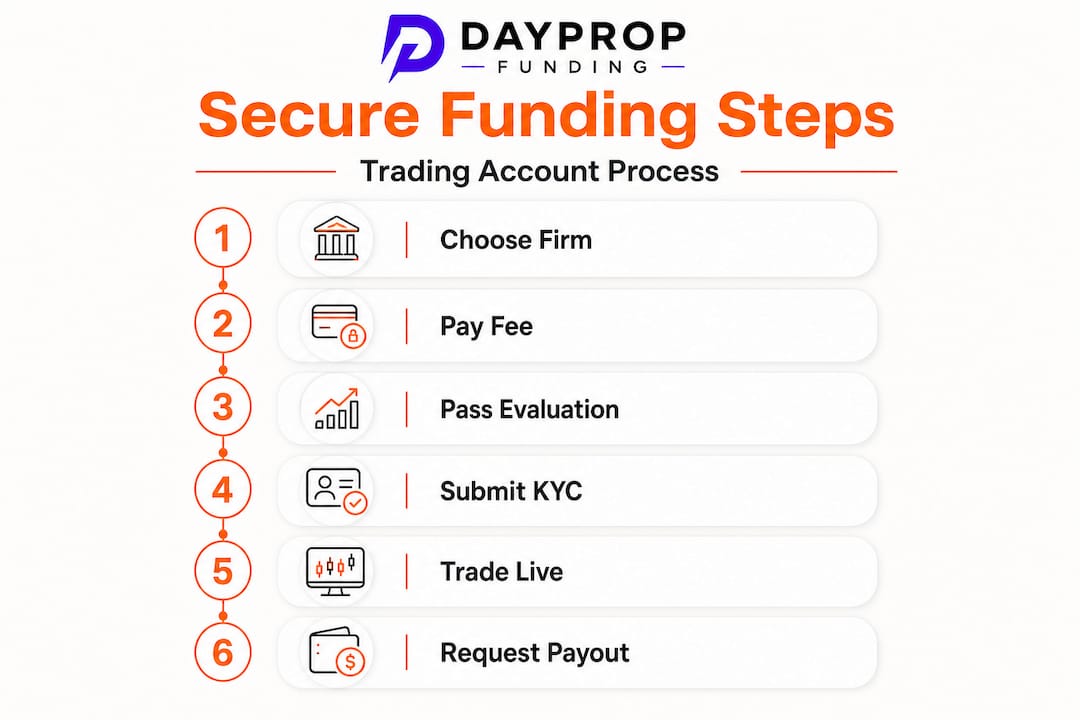
1. Select your firm and account size
Research firms based on rule transparency, payout history, and the asset classes you trade. Look for firms with clearly published rules, independent reviews, and a track record of consistent payouts. Then choose an account size that suits your strategy’s expected drawdown profile.
2. Purchase and begin the evaluation
Pay the evaluation fee and activate your Phase 1 challenge. Focus on hitting the profit target without breaching the daily drawdown or maximum drawdown limits. Consistency matters more than speed here. One strong week followed by one reckless week is a common failure pattern.

3. Complete Phase 2 (if applicable)
Many two-phase programs reduce the profit target in Phase 2 while maintaining the same risk parameters. This phase is designed to confirm that your Phase 1 performance was not just luck. Treat it with the same discipline. Review the funded account workflow to understand what’s required at each stage.
4. Submit KYC and sign the trader agreement
Once you pass both phases, the firm will request your identity documents and require you to sign a funded account agreement. Read the agreement carefully, particularly the sections on trailing drawdown, prohibited strategies, and payout schedules.
5. Trade the funded account under live conditions
Your funded account may operate on a live or simulated environment, depending on the firm. In either case, the rules are binding. Manage each trade as if a rule breach means losing the account outright, because it does. Following prop firm evaluation tips from experienced traders can help you navigate the nuances of live funded trading.
6. Request payouts and scale
Once you hit the profit threshold, submit a payout request. Most firms process withdrawals within 1 to 14 business days. Consistent profitability over multiple payout cycles often qualifies you for scaling, where your account size increases in exchange for sustained performance. The full secure prop funding process, from evaluation to scaling, is a structured progression that rewards patience and consistency over speculation.
Here is a comparison of key features across evaluation models:
| Feature | Standard two-phase | Instant funding | One-phase |
|---|---|---|---|
| Time to funded | 2 to 6 weeks | Immediate | 1 to 3 weeks |
| Profit split | 80% to 90% | 50% to 75% | 80% to 90% |
| Evaluation cost | Moderate | Low to moderate | Moderate to high |
| Rule complexity | Moderate | Low | High |
Industry data shows that pass rates industry-wide sit between 5% and 10% overall, with some structured programs approaching 10%. This underscores that passing is achievable but requires deliberate preparation, not just trading ability.
Pro Tip: Before starting any evaluation, print out or save the firm’s specific rules and review them before each trading session. Adapting your position sizing, stop placement, and trading hours to those exact parameters significantly improves your pass rate compared to trading your default strategy without adjustments.
Common pitfalls and how to avoid them
Understanding the steps is essential, but knowing where traders stumble can save you significant time, money, and stress.
The most frequent mistakes
- Breaching the daily drawdown limit in the first two days of a challenge, often due to oversized positions during high-volatility sessions
- Ignoring firm-specific rules such as trading around news events or holding positions over the weekend
- Abandoning a consistent strategy after one or two losing trades and switching to a completely different approach
- Treating the evaluation as a lottery rather than a controlled demonstration of skill
- Not reviewing the understand prop firm rules before committing to an account
Why simulating the challenge matters
Running a full simulation on a demo account before paying the evaluation fee is not just a confidence booster. It reveals whether your strategy’s natural drawdown profile fits within the firm’s daily and maximum drawdown limits. A strategy that draws down 5% over a week may work perfectly in live trading but would fail a challenge with a 4% daily drawdown cap if it concentrates risk on single sessions.
“Trailing drawdown rules can induce early profit-taking, and 40 to 50% of funded traders lose their funded accounts within the first 90 days, often due to a failure to adapt their strategy to the firm’s specific constraints.”
This statistic is not discouraging. It is instructive. The traders in that 40 to 50% are typically the ones who trade the same way they did during the evaluation, without accounting for the psychological weight of managing real or near-real capital and the stricter behavioral rules that apply post-funding.
Additionally, most evaluation failures happen in the first week, driven primarily by daily drawdown breaches. The average trader attempts two to four evaluations before achieving a funded status. This is normal. Budget for it and treat each attempt as a calibration exercise rather than a pass/fail event.
Review the drawdown risk tips available for your asset class, and also consult the prop firm consistency rules to understand how consistency scoring affects your evaluation outcome at many firms.
Pro Tip: Budget for two to four evaluation attempts from the very beginning. Set aside the full budget before your first attempt so that a failed attempt does not force you to stop or trade recklessly to recover fees.
Mastering discipline for long-term growth
Once you have secured funding and avoided early pitfalls, your long-term success depends on discipline and sustained growth, not just continued profitability.
Core habits for funded traders
- Keep a daily trade journal that records entry rationale, emotional state before the trade, and post-trade review
- Use a pre-trade checklist before every session to confirm that the setup meets your criteria, that your position size respects the firm’s risk limits, and that you are not trading within a news blackout window
- Cap your risk at 1% per trade or lower. Firms that fund serious traders recommend risking 0.25% to 1% per trade for long-term account survival, combined with a consistent pre-trade checklist and a focus on trade expectancy rather than win rate
- Review your weekly performance every Friday before the close. Look for deviations from your plan, not just the profit and loss figure
Focus on trade expectancy, not just win rate
A trader with a 40% win rate and a 2:1 reward-to-risk ratio has a higher expectancy than a trader with a 60% win rate and a 0.8:1 ratio. Prop firms reward consistent profitability, not perfect accuracy. Understanding this distinction is critical for long-term account retention and for meeting the criteria required to scale your account.
Strategies with a maximum drawdown below 15% to 30% are the ones most likely to survive under prop firm conditions over time. Low drawdown strategies such as EMA-based swing systems, which in some backtests show drawdowns as low as 2.8%, often outperform high-win-rate scalping strategies in prop environments because they produce smoother equity curves that stay within daily and maximum drawdown limits.
Here is a recommended risk control framework for funded accounts:
| Control metric | Recommended value |
|---|---|
| Risk per trade | 0.25% to 1% of account |
| Maximum daily loss | 2% to 3% of account |
| Drawdown recovery rule | Reduce size by 50% after 3% drawdown |
| Trade review frequency | Daily and weekly |
| News blackout window | 15 minutes before and after major releases |
For actionable frameworks on growing your account systematically, review the guidance on scaling for account growth and the approach to consistent gains strategies that sustain funded status across multiple payout cycles.
External resources on staying disciplined during drawdown periods are also worth reading, particularly for traders who struggle with emotional decision-making after a losing sequence.
Pro Tip: Track your trade expectancy every month, not just your win rate. If your expectancy is positive and your drawdown stays within the firm’s limits, you are on the right trajectory regardless of how many losing trades you had.
A fresh perspective: Why passing prop challenges is only half the battle
Most trading guides treat the funded account as the finish line. It is not. It is the starting point of a more demanding phase.
The uncomfortable reality is that prop firm rules actively shape your trading behavior, often in ways that diverge from how you trade naturally. Trailing drawdown rules push traders to take profits earlier than their strategy dictates. Daily loss limits discourage participation in high-volatility sessions that might actually offer edge. These constraints are not flaws. They are the firm’s way of managing institutional risk. But they can subtly distort your trading if you are not consciously adapting.
The traders who retain funded status over 12 or more months are not necessarily the most profitable traders from evaluation. They are the ones who accepted that their strategy needed adjustment to coexist with the firm’s rule set. Chasing a 95% profit split from a firm with aggressive rules is often less sustainable than accepting an 80% split from a firm with clear, trader-friendly parameters and reliable payouts. Rule transparency and payout reliability matter far more for long-term financial outcomes than headline profit split numbers.
It is also worth recognizing that most guides focus on how to pass an evaluation. Very few address how to sustain your funded account and grow it across multiple payout cycles. Understanding how rule sets affect real trading behavior is the foundation of that sustainability.
Sustainable funded trading looks like this: smaller position sizes than you think you need, a lower trade frequency than you are used to, and a consistent review process that keeps your performance data honest. That is not exciting. But it is what separates traders who build real income from prop funding from those who cycle through evaluations indefinitely.
Next steps: Start your funding journey with confidence
Securing prop trading funding is a process built on preparation, structured execution, and ongoing discipline. DayProp provides the tools, resources, and structured evaluation frameworks that traders need to move through each of these phases with clarity.
Whether you are preparing for your first challenge or looking to refine your approach after a failed attempt, the complete evaluation guide covers every stage of the funding process in detail. If you want to identify the right program for your trading style, you can compare funding models side by side to find the structure that matches your goals. For traders who want to directly address their evaluation pass rate, the resource on how to pass more prop challenges provides expert-backed strategies grounded in real evaluation data.
Frequently asked questions
What are the most common reasons traders fail prop firm evaluations?
Violating daily drawdown limits, particularly in the first week of the challenge, accounts for the majority of evaluation failures across all firm types and account sizes.
How much money should I budget for funding attempts?
Budget for two to four evaluation fees since most traders require multiple attempts before securing a funded account, and planning for this reduces financial pressure during the process.
What’s an ideal risk per trade to keep a funded account safe?
Keeping your risk at or below 1% per trade gives you the best chance of long-term survival, with some conservative frameworks recommending as low as 0.25% per trade for strategies that prioritize account longevity.
How soon can I request a payout after getting funded?
You can submit a payout request as soon as you meet the profit threshold defined by your firm, which typically happens within two to four weeks of starting the funded account, depending on your trading pace.
What happens if I breach a rule after getting funded?
Your funded account can be revoked immediately upon a rule breach, and 40 to 50% of funded traders lose their accounts within the first 90 days, most often because they failed to fully adjust their strategy to the firm’s post-funding constraints.
Recommended
- Master the funded trading account workflow: 3-phase guide – DayProp Funding
- Streamline your crypto trading workflow: step-by-step guide – DayProp Funding
- Indices Trading Strategy Steps for Consistent Funding – DayProp Funding
- Structured trading challenge: Step-by-step guide to funding – DayProp Funding