

TL;DR:
- Choosing indices over individual stocks offers prop traders risk smoothing, cost efficiency, and structured risk management. Their predictable session behavior and fixed contract specs facilitate systematic trading and evaluation success. However, platform quality and product mechanics are crucial, as misaligned environments can negate index advantages.
Choosing the right instrument for a prop trading evaluation is one of the most consequential decisions a retail trader makes, yet most traders spend far more time on strategy development than on instrument selection. Many assume that trading individual stocks offers greater edge because of more price movement or sector-specific stories. In practice, the most disciplined funded traders consistently gravitate toward indices, and for precise, structural reasons. This article explains why indices offer measurable advantages in risk management, cost efficiency, and systematic execution, and how those advantages directly improve your chances of passing funded evaluations and sustaining long-term performance.
Table of Contents
- What makes indices unique in prop trading?
- Liquidity, execution, and real costs: The prop trader’s advantage
- Risk management and rule-based evaluation: Why indices excel in funded settings
- Systematic trading, sessions, and macro sensitivity: Facilitating the prop process
- Limitations, pitfalls, and what most guides miss
- The uncomfortable truth: Indices make the rules clearer, until your broker doesn’t
- Take the next step: Index mastery for prop evaluation success
- Frequently asked questions
Key Takeaways
| Point | Details |
|---|---|
| Diversify with indices | Indices offer retail and prop traders broad market exposure and lower idiosyncratic risk than picking stocks. |
| Liquidity optimizes costs | High-liquidity indices reduce slippage and spread costs, supporting consistent funded trading results. |
| Enable systematic risk control | Standardized contracts make managing stops and drawdowns simpler in prop firm environments. |
| Repeatable session patterns | Indices show predictable session rhythms and macro-event sensitivity, perfect for developing systematic trading strategies. |
| Beware execution pitfalls | Strategy success relies on matching the right index product to your trading platform and funding program rules. |
What makes indices unique in prop trading?
Now that you know why picking the right instrument is a critical fork in your prop trading journey, let’s examine why indices stand apart from the rest.
At the most fundamental level, an index aggregates a large basket of individual securities into a single tradeable instrument. The S&P 500, Nasdaq-100, and FTSE 100 each track dozens to hundreds of companies across multiple sectors. This means when you take a position on the Nasdaq-100, you are expressing a directional view on an entire segment of the economy rather than betting on one company’s earnings call or regulatory outcome.
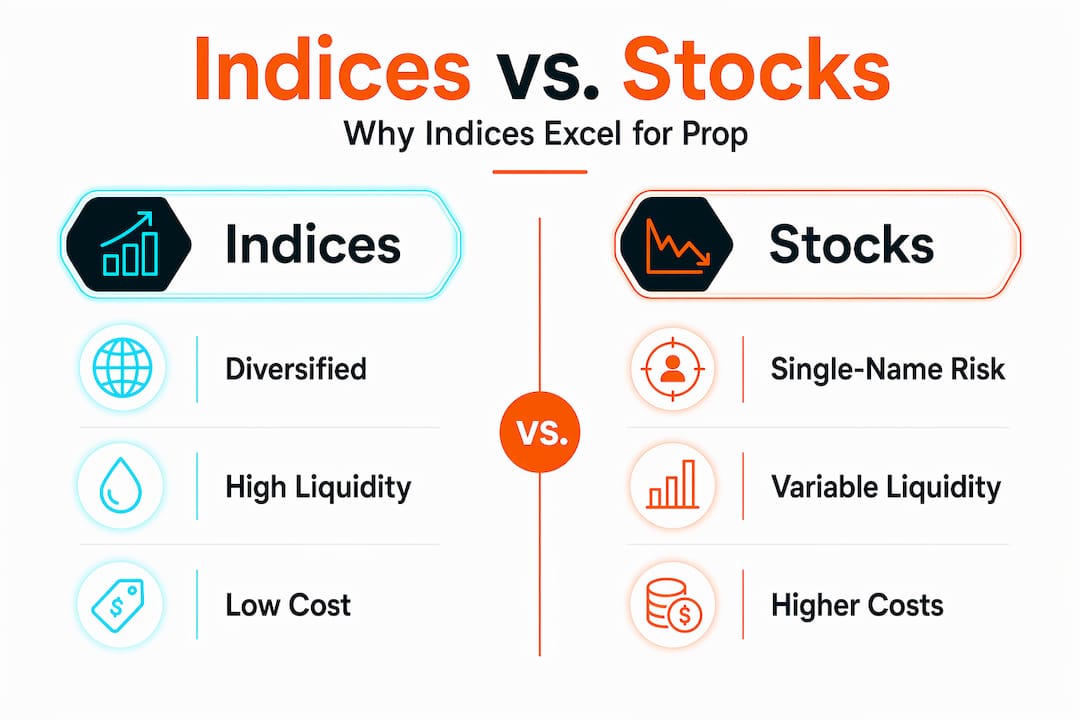
Retail traders use indices in prop trading because index instruments provide exposure to a broad basket and reduce single-name idiosyncratic risk versus trading individual stocks. A single stock can gap 30% overnight on a product recall, an accounting scandal, or a CEO departure. An index absorbs that shock across all its components, smoothing the impact significantly. For a funded trader operating under strict drawdown limits, that risk-smoothing effect is not cosmetic. It is structural protection.
Indices also simplify the entire risk management process. When you are trading multiple instruments for funding, calculating stop distances, tick value, and position size across multiple correlated stocks becomes complex. With an index, the entire calculation centers on one product with known contract specifications, one spread, and one orderbook. The cognitive overhead drops dramatically.
The key structural advantages of trading indices in a prop environment include:
- Diversified exposure across sectors reduces event-driven gap risk from individual names
- Standardized contracts with clear tick values simplify position sizing and margin calculations
- High visibility benchmarks that every prop firm, broker, and institutional desk monitors daily
- Reduced correlation complexity compared to managing a portfolio of sector stocks
- Global macro connectivity that gives you a clear framework for reading sentiment and direction
“Indices function as the most efficient distillation of broad market direction. When you trade them, you are trading consensus rather than speculation on a single story.” This principle is central to why prop firms evaluate traders on index products first.
The index trading strategies that work in funded environments almost always exploit these structural characteristics rather than fight against them.
Liquidity, execution, and real costs: The prop trader’s advantage
With diversification and index structure explained, let’s examine how core mechanics like liquidity and cost efficiency shape your prop trading results.
Liquidity is not just a theoretical concept. It directly determines your fill quality, your spread cost on every single trade, and whether your stop orders execute at the intended price or slip through to a worse level. The S&P 500 E-mini futures (ES) and Nasdaq-100 E-mini futures (NQ) are consistently among the most liquid instruments on earth. Average daily volume on ES regularly exceeds 1 million contracts, with tight bid-ask spreads that remain stable throughout the primary session.

Indices concentrate market information into a single, highly liquid, actively traded benchmark, useful for building a repeatable process and managing costs such as spreads and slippage that can make or break short-horizon prop strategies. This is especially critical during funded evaluations where profit targets must be hit within specific timeframes and every basis point of cost counts.
Instrument cost comparison
| Instrument | Typical Spread | Liquidity | Slippage Risk | Intraday Suitability |
|---|---|---|---|---|
| S&P 500 CFD | 0.4 to 0.6 pts | Very High | Very Low | Excellent |
| Nasdaq-100 CFD | 1.0 to 1.5 pts | Very High | Very Low | Excellent |
| Individual large-cap stock | 0.05 to 0.15% | High | Low to Moderate | Good |
| Small-cap stock | 0.3 to 1.0%+ | Low | High | Poor |
| Exotic FX pair | 2.0 to 8.0 pips | Low | High | Poor |
The cost difference compounds significantly over an evaluation period. A trader executing 50 round-trip trades per week on a small-cap stock with moderate slippage can lose 3 to 5 times more in transaction costs than a trader executing the same number of trades on the ES futures. That gap directly erodes profit target progress.
Consider a realistic scenario. A funded trader targets 8% profit over a 30-day evaluation. They execute 200 trades. If each trade carries 0.08% in total cost on an index versus 0.25% on a liquid stock, the index trader saves approximately 34% of their gross gains in transaction costs. This is not a minor difference. It is often the difference between passing and failing an evaluation.
Pro Tip: When selecting your index product, always check whether the prop firm offers CFD-based indices or access to actual futures markets. The difference in spread, rollover cost, and execution quality between these two product types can be substantial, especially on overnight positions.
The trading models for retail traders that consistently produce funded accounts are almost always built around cost-efficient instruments. Indices sit at the top of that list precisely because of their institutional trading conditions that retail traders can access through modern prop structures.
Risk management and rule-based evaluation: Why indices excel in funded settings
Understanding the cost structure leads naturally to the next critical factor. Let’s see how indices create a reliable framework for passing funding evaluations.
Prop firms impose strict rules. Maximum daily drawdown, maximum overall drawdown, and minimum trading days are all enforced with precision. A trader who cannot control position sizing and stop placement with clarity will consistently fail evaluations regardless of their raw trading skill. Indices make this control far more achievable.
Prop and funded-trader environments favor standardized, rules-based instruments and cleaner mechanics for risk, and indices let traders define stops and tick risk more concretely than most alternatives. A single tick on the ES futures is $12.50. On the NQ, it is $5.00 per tick on the MNQ micro contract. These values are fixed, published, and never change mid-session. Position sizing becomes a mathematical exercise rather than an approximation.
Micro index futures contract specifications
| Contract | Ticker | Tick Size | Tick Value | Typical Margin | Exchange |
|---|---|---|---|---|---|
| Micro S&P 500 | MES | 0.25 pts | $1.25 | ~$40 | CME |
| Micro Nasdaq-100 | MNQ | 0.25 pts | $0.50 | ~$100 | CME |
| Micro Dow Jones | MYM | 1.0 pt | $0.50 | ~$50 | CME |
| Micro Russell 2000 | M2K | 0.10 pts | $0.50 | ~$40 | CME |
The numbered risk controls you can automate more easily when trading indices include:
- Fixed tick-based stop placement. You define exactly how many ticks of risk you accept per trade, then calculate size accordingly. No approximation needed.
- Clear max loss per trade rules. Most prop trading rules for funded accounts specify dollar-based loss limits, which map cleanly onto fixed tick values.
- Daily drawdown monitoring. Because index tick values are stable, your real-time P&L is always predictable and transparent.
- Scaling rules. Adding or reducing size by one contract produces a precisely known change in dollar risk per tick.
- Session-based risk resets. Indices settle on defined schedules, making daily risk tracking cleaner than 24-hour OTC markets.
Pro Tip: Practice your drawdown management tips on micro contracts before scaling to standard sizes. Micro index futures let you develop precision habits under real market conditions with minimal capital exposure.
Systematic trading, sessions, and macro sensitivity: Facilitating the prop process
Efficient risk management and rule clarity are important, but systematic execution separates the pros. Indices empower a much more structured approach than most instruments allow.
Indices are frequently chosen because they tend to have structured session behavior, including opens, gaps, liquidity rhythms, and macro sensitivity, which enables more systematic intraday playbooks and risk controls. This is not an incidental feature. It is a core reason why experienced funded traders build entire systems around index session structure.
The U.S. equity index session, for example, has distinct phases. The pre-market develops context and gap direction. The first 30 minutes after the cash open deliver the highest volume and volatility. The midday session often consolidates. The final 90 minutes see renewed volume and directional resolution. Each phase offers distinct setup types that can be standardized, tested, and executed with process-driven precision.
Common session-based prop setups in index markets include:
- Opening gap fade or continuation. When price gaps at the open relative to the prior session close, a systematic rule set can define entry, target, and stop based on historical gap-fill statistics.
- Opening range breakout (ORB). The high and low of the first 15 or 30 minutes form the range. A breakout with volume confirmation triggers entry. This setup occurs reliably enough to build a repeatable process around.
- Macro data reactions. CPI, NFP, FOMC announcements all produce predictable volatility spikes in indices. Structured traders define their approach to these events in advance rather than reacting emotionally.
- VWAP-based intraday mean reversion. Indices respect volume-weighted average price levels with enough frequency to support systematic mean reversion strategies, particularly in the midday session.
- Session close momentum. The last 30 minutes of the primary session often exhibit directional bias driven by institutional rebalancing and options expiration flows.
“The most effective index traders are not predicting the market. They are responding to a defined set of conditions with a pre-tested response. The index’s session structure provides the framework for that response to exist.” This process orientation is what systematic intraday playbooks are built on.
The trading strategies for indices that succeed in prop evaluations are almost always session-aware and macro-sensitive. Understanding your capital allocation guide across these session phases improves both consistency and drawdown control.
Limitations, pitfalls, and what most guides miss
Before you start designing your own index prop system, you need to know the edge is not automatic and pitfalls are real. Here is what most guides miss.
What looks like an “index advantage” can disappear if costs, execution quality, or product mechanics do not match the strategy. This is the uncomfortable reality that generic overviews of index trading almost never address. The instrument’s structural properties only produce an edge when the entire trading environment supports them.
Common pitfalls to avoid when trading indices in funded accounts include:
- CFD rollover costs on longer holds. CFD-based indices carry overnight financing charges that compound on multi-day positions, quietly eroding profitability without appearing in your trade history as an explicit cost.
- Volatility regime shifts. A strategy optimized for moderate volatility (VIX 15 to 20) may perform poorly or generate outsized losses during high-volatility regimes (VIX 30+). Always define regime filters in your system.
- Platform latency during high-impact events. Some prop platforms experience execution delays during FOMC announcements or major data releases. Slippage during these events can turn a profitable setup into a losing trade.
- Contract expiration and roll mechanics. Futures-based index contracts expire quarterly. Failing to roll positions correctly can result in automatic position closure or exposure to widened spreads near expiration.
- Hidden liquidity gaps in off-session hours. Index liquidity drops sharply outside primary sessions. Strategies that work during the U.S. session may perform very differently in Asian or early European hours.
See the full funded trading guide for a complete breakdown of evaluation mechanics and how to navigate these challenges systematically. Understanding
index derivative mechanics before you commit capital to an evaluation is non-negotiable.
Pro Tip: Always paper trade or sim trade a new index strategy through at least one earnings season and one major macro event before running it in a live funded evaluation. Edge that disappears during volatility spikes is not real edge.
The uncomfortable truth: Indices make the rules clearer, until your broker doesn’t
Now that you’ve seen both sides of index trading in prop, here is what those generic explainer articles will not tell you.
Indices do reduce complexity. They make prop firm rules more transparent because tick values are fixed, session structure is predictable, and macro catalysts are well-telegraphed. All of that is real. But the index itself is only one layer of the trading environment. The broker, the platform, the product type, and the firm’s specific rule set form the rest of that environment, and those layers can cancel out the index’s structural advantages entirely.
Many traders fail funded evaluations not because they chose the wrong market, but because they chose the right market on the wrong platform. A trader running an opening range breakout strategy on an index CFD with a 1.5-point spread is at a substantial disadvantage compared to a trader running the same strategy on ES futures with a 0.25-point spread. Both are trading the same underlying market. Their real cost structures are not even close.
The success of funded traders in index markets depends far more on the alignment between instrument, platform, and firm rules than on the generic merits of indices as an asset class. When you evaluate proprietary trading models, always ask whether the model was designed for the specific product type and execution environment you are actually trading in.
The traders who consistently pass evaluations and retain funded status understand this alignment at a deep level. They test their strategies on the exact product, the exact platform, and the exact spread conditions they will face in the evaluation. They do not assume that index advantages transfer automatically across product types. That assumption is where most funded trading careers stall before they begin.
Take the next step: Index mastery for prop evaluation success
With a solid foundation on why and how to use indices in prop trading, here’s where to build your edge with actionable next steps.
DayProp provides structured resources and evaluation pathways specifically designed for retail traders who want to build and validate index-based trading strategies under real funded conditions.
Start by reviewing the different types of trading challenges to understand how evaluation structures align with index trading approaches. Then work through the full prop trading evaluation guide to build a clear picture of how to progress from challenge phase to funded account status. For strategy-specific resources, the index strategy tips section provides practical frameworks for turning index structure into consistent, rules-based performance. DayProp’s transparent evaluation system is built for traders who are serious about systematic index trading and want institutional-level capital without personal risk.
Frequently asked questions
Why do prop firms prefer traders use indices over individual stocks?
Indices offer greater liquidity, lower single-stock risk, and enable systematic rules-based evaluation by prop firms. As noted, index instruments provide broad basket exposure and reduce single-name idiosyncratic risk versus trading individual stocks.
Is index trading always better for funded trader challenges?
Not always. It depends on the trader’s strategy and the firm’s platform, since costs, access, and product mechanics can affect results significantly. The index advantage can disappear if execution quality or product mechanics do not match the strategy.
What makes indices more reliable for managing drawdowns?
Indices provide transparent contract specs and fixed tick values, allowing for precise standardization and risk control. Prop environments favor standardized instruments because they let traders define stops and tick risk more concretely than less regulated instruments.
How do index sessions and macro events help systematic trading?
Indices respond to regular session patterns and macro events, enabling repeatable setups and risk controls. Structured session behavior including opens, gaps, and liquidity rhythms provides the foundation for systematic intraday playbooks that individual stocks simply cannot replicate.
Recommended
- Indices Trading Strategy Steps for Consistent Funding – DayProp Funding
- Master capital allocation in prop trading: retail guide – DayProp Funding
- Essential trading performance metrics with real examples – DayProp Funding
- Types of proprietary trading models for retail traders in 2026 – DayProp Funding