
TL;DR:
- Most traders fail prop firm evaluations because they underestimate the importance of discipline, rule adherence, and appropriate risk management. Success requires systematic preparation, real-time drawdown tracking, and learning from each attempt to improve odds iteratively. Viewing the challenge as a developmental process rather than a binary pass/fail increases the likelihood of eventually securing funded capital.
Most traders enter prop firm evaluations believing that a solid strategy is all they need. The reality is far more demanding. Industry estimates place evaluation pass rates in the single digits to low double digits per attempt, with payout rates even lower. Challenge phase trading is not simply a performance test — it is a structured filter designed to identify traders who combine genuine edge with iron discipline. This guide breaks down every component of the process, exposes the most common failure points, and gives you concrete strategies to improve your odds.
Table of Contents
- What is challenge phase trading?
- Why do most traders fail the challenge phase?
- Challenge phase requirements: A closer look
- Keys to passing the challenge phase
- A fresh perspective: Why treating the challenge as a ‘pass/fail’ exam is a mistake
- Ready for your challenge? How DayProp supports aspiring funded traders
- Frequently asked questions
Key Takeaways
| Point | Details |
|---|---|
| Very low pass rates | Only a small fraction of traders pass the challenge phase and go on to receive payouts, which underscores the importance of thorough preparation. |
| Strict performance rules | Meeting profit targets and drawdown limits is essential and varies by firm and asset class. |
| Preparation is key | Success relies on risk management, discipline, and adapting strategy to firm-specific criteria. |
| Success is probabilistic | Treat challenge attempts as part of a process, learning from each, rather than a one-time win or loss. |
What is challenge phase trading?
Challenge phase trading is the formal evaluation period that prop firms use to assess a trader’s skill before allocating real capital. Think of it as a job audition for institutional-level funding. Rather than handing capital to unproven traders, firms run a structured simulation under real market conditions, with strict rules that mirror the risk controls of professional trading operations.
Understanding proprietary trading basics helps clarify why this evaluation exists. Prop firms risk their own capital, so they need high confidence that a trader will protect it. The challenge phase creates that confidence filter.
A standard challenge phase includes the following components:
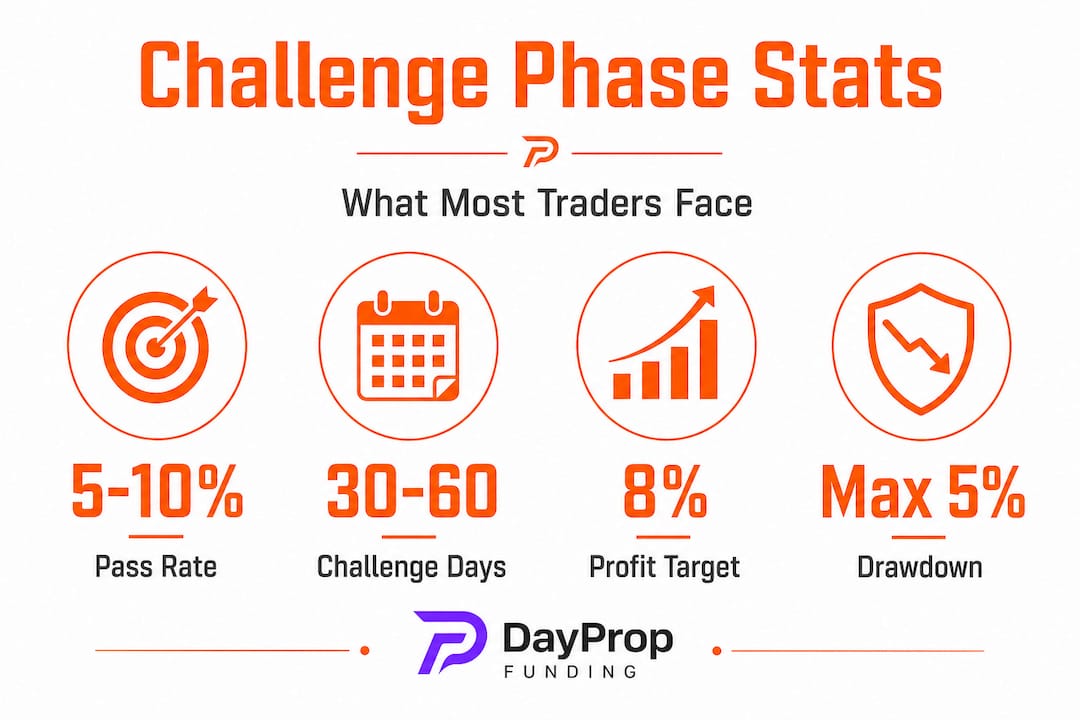
- Profit target: A minimum percentage gain you must reach, typically between 8% and 10% over the evaluation period.
- Maximum drawdown: A hard ceiling on losses, often set at 5% to 10% of account equity, both daily and overall.
- Minimum trading days: Many firms require you to trade for a set number of days to prove consistency rather than lucky single-day performance.
- Time limit: Challenges usually run for 30 to 60 calendar days, though some firms offer unlimited time windows.
- Prohibited behaviors: Rules around news trading, weekend holding, and hedging vary by firm and must be read carefully.
“The challenge phase is not a demo contest. It is a professional evaluation that mirrors the risk culture of funded trading desks, and it demands the same discipline.”
Learning what is prop trading and how evaluations function gives you a clearer picture of the standards involved. According to industry data, only 5% to 10% of traders pass prop firm evaluations. That number makes structured preparation non-negotiable, not optional.
Why do most traders fail the challenge phase?
Understanding the structure of the challenge phase, it is important to dig into why these requirements defeat most traders. Many enter with strong backtested strategies but collapse under live evaluation pressure. The gap between knowing a strategy and executing it under strict rules is wider than most anticipate.
Here are the most common reasons traders fail:
- Over-leverage: Sizing positions too large to hit profit targets faster. One bad trade can breach the maximum drawdown before a trader even realizes the risk.
- Rule violations: Missing fine-print rules like prohibited trading hours or news event restrictions. A single violation ends the challenge immediately at most firms.
- Emotional trading: Revenge trading after a losing session or abandoning a system mid-challenge due to fear or frustration.
- Lack of adaptability: Applying a strategy optimized for one market condition to a different environment without adjustment.
- Misreading the evaluation as a demo: Treating the challenge like a no-stakes simulation encourages risky behavior incompatible with funded trading standards.
- Ignoring post-challenge discipline: Payout rates are lower than pass rates because even traders who pass the evaluation struggle to maintain consistent performance once they manage real capital.
Industry data confirms that only about 5% to 10% pass prop firm evaluations, with even fewer receiving payouts. This is not a coincidence. The gap between passers and payout recipients reveals a critical truth: discipline must persist beyond the evaluation window, not just during it.
Pro Tip: Review a detailed evaluation guide for prop funding before you begin any challenge. Understanding exactly what the firm measures prevents rule violations that could end an otherwise successful attempt.

Many traders also fall into the trap of believing that prop trading myths — like “any winning strategy will pass” — are true. In practice, the evaluation tests behavioral discipline as much as market skill.
Challenge phase requirements: A closer look
To make these challenges concrete, here is an in-depth look at the requirements you will need to meet and how they differ by market and firm.
Industry data confirms that strict profit targets and drawdown rules are standard across prop evaluations. However, the specific thresholds vary considerably between asset classes and individual firms. Understanding those differences is part of preparation.
| Requirement | FX typical range | Indices typical range | Crypto typical range |
|---|---|---|---|
| Profit target | 8% to 10% | 8% to 10% | 10% to 15% |
| Max daily drawdown | 4% to 5% | 4% to 5% | 5% to 8% |
| Max overall drawdown | 8% to 10% | 8% to 12% | 10% to 15% |
| Time limit | 30 to 60 days | 30 to 60 days | 30 to 90 days |
| Minimum trading days | 5 to 10 | 5 to 10 | 5 to 10 |
Crypto challenges tend to carry higher profit targets and looser drawdown thresholds to account for the asset class’s higher volatility. FX and indices challenges are generally tighter and more standardized.
Sound capital allocation in prop trading directly determines whether you can sustain performance within these limits. Misallocating capital is the fastest route to a drawdown breach.
Every trader preparing for a challenge should address the following areas before beginning:
- Risk per trade: Most professionals recommend risking no more than 0.5% to 1% of account equity per trade during a challenge.
- Position sizing: Scale position sizes to the volatility of the asset class. Crypto requires smaller size than FX at equivalent leverage.
- Rule checklist: Build a written checklist from the firm’s rulebook and review it before every session.
- Drawdown tracking: Monitor both daily and cumulative drawdown in real time, not just at the end of a session.
- News calendar awareness: Know exactly when high-impact events occur and how your firm’s rules address them.
Reading about prop trading drawdown limits gives specific insight into how these limits are structured and why breaching them is so easy when position sizing is not tightly controlled. Proper risk management is the single most reliable factor separating passers from failures across every market and firm type.
Keys to passing the challenge phase
With challenge expectations clear, here is how to maximize your odds of passing and move closer to managing real prop firm capital.
Challenge-phase preparation is probabilistic, not guaranteed. No strategy or mindset eliminates failure entirely. What structure and preparation do is shift the probability in your favor, enough to make funded trading a realistic outcome rather than a long shot.
Core habits that produce consistent challenge passers include:
- Journaling every trade: Record entry, exit, rationale, emotional state, and outcome. Patterns in your losses will become visible within a few sessions.
- Daily rule review: Read the firm’s rule summary before each trading session. This takes five minutes and prevents costly violations.
- Fixed risk parameters: Set a maximum risk per trade and a daily loss limit that you will not override under any circumstance.
- Weekly performance review: Assess what worked, what broke down, and what adjustments are needed before the next week.
- Simulated pressure sessions: Practice trading under time pressure or after a losing trade to build emotional control before the real evaluation.
Pro Tip: Treat each challenge attempt as structured data collection, not a win/lose event. Log what failed, adjust one variable, and retry. Traders who approach the evaluation this way build a clear picture of their edge over time.
| Attempt number | Key focus area | Typical improvement | Likely outcome |
|---|---|---|---|
| 1 | Rule familiarity, basic discipline | Low, high error rate | Fail, valuable data |
| 2 | Rule compliance, reduced errors | Moderate, fewer violations | Closer pass, sometimes success |
| 3 | Full system execution, optimized risk | High, clear pattern | Realistic pass rate improves significantly |
| 4+ | Fine-tuning, edge refinement | Incremental | Sustained consistency |
Building a reliable crypto trading workflow guide is particularly valuable for traders focusing on digital assets, where volatility can accelerate both profits and breaches.
After passing, maintaining discipline is equally critical. Understanding handling prop trading payouts ensures that your post-challenge performance keeps earning capital rather than losing it. Additionally, studying hedging strategies can help protect open positions during volatile periods while staying within firm rule boundaries.
A fresh perspective: Why treating the challenge as a ‘pass/fail’ exam is a mistake
Most traders frame the challenge phase as a binary event. Either you pass and move forward, or you fail and lose your fee. That framing is understandable, but it is also the reason so many traders cycle through repeated failures without making meaningful progress.
The more accurate frame is this: the challenge phase is a structured development process that happens to end with a funding decision. Every attempt provides data. Every failure narrows the gap between where your trading currently is and where it needs to be. The traders who eventually receive funding are not necessarily more talented than those who fail repeatedly. They are simply more systematic about learning from each attempt.
Consider how professional athletes approach competition. No serious coach designs a single high-stakes game and expects peak performance from an unprepared athlete. Training is cumulative, deliberate, and iterative. The challenge phase functions the same way when approached correctly. Each attempt is a training session with real consequences, which makes the feedback sharper and more useful than any demo account.
Success rates remain in the single to low double digits, which makes repeated, structured attempts more realistic than expecting a one-shot pass. Industry data supports this consistently. The traders who design a systematic retry strategy — with documented adjustments between attempts — outperform those who retry with the same approach hoping for a different outcome.
Adopting a probabilistic mindset also reduces the emotional damage of failure. When you expect that passing may take multiple attempts and you plan for that reality, each failure costs money but produces knowledge. That knowledge has real value if you use it properly.
Understanding the benefits and challenges of retail trading places this evaluation process in broader context. The challenge phase is not an obstacle designed to drain fees. It is a quality filter that produces better funded traders and more sustainable trading careers.
Ready for your challenge? How DayProp supports aspiring funded traders
After reframing your approach to the challenge, take advantage of resources that can accelerate your journey to funded trading.

DayProp provides structured resources built specifically for retail traders working toward prop funding. The comprehensive trading evaluation guide covers exactly what you need to prepare for challenge requirements across FX, indices, and crypto markets. For traders looking to understand the full evaluation structure, the performance-based trading process guide outlines how performance metrics translate into funded status. If your challenge history includes failures, the resource on how to pass more challenges breaks down the most common failure patterns and the specific corrections that lead to passing. DayProp’s evaluation framework is designed to reward discipline and consistency, not speculation, giving serious traders a transparent and fair path to funded capital.
Frequently asked questions
How long does the challenge phase take in prop trading?
Most prop firm challenges last between 30 and 60 calendar days, though some firms offer unlimited time windows that allow traders to hit the profit target at their own pace.
Can you fail a challenge phase and try again?
Yes, most firms allow multiple attempts after failure. Some offer discounted retry fees or partial refunds on passed phases, making a structured retry approach financially viable.
What’s the difference between passing a challenge and getting funded?
Passing the challenge means you met the evaluation criteria within the test environment. Getting funded means the firm reviewed your results and allocated real capital to your account. According to industry data, only about 7% of passers ever receive a payout, highlighting that the standards for capital allocation are even stricter than the evaluation itself.
Is the challenge phase the same for FX, indices, and crypto traders?
The core structure is similar across markets, but specific requirements like profit targets and drawdown limits vary by asset class. Industry data confirms that strict thresholds are standard everywhere, though crypto challenges typically carry higher targets to reflect greater volatility.
Recommended