

TL;DR:
- Many skilled retail traders face account blocks due to incomplete or failed KYC verification, not performance issues.
- KYC verifies trader identity and funding sources, crucial for regulatory compliance and fraud prevention in prop trading.
A significant number of skilled retail traders are blocked from funded prop trading accounts every year, and trading performance is rarely the reason. Incomplete or failed KYC (Know Your Customer) verification is one of the most common causes of account denial across the entire prop trading industry. Most traders spend months sharpening their strategies, mastering risk management, and building consistent track records, only to be stopped at the compliance stage. This guide explains exactly what KYC is, why every serious trader must prioritize it, and how to pass the verification process with minimal friction.
Table of Contents
- What is KYC and why is it essential in prop trading?
- How KYC stops fraud and financial crime in prop trading
- KYC compliance: Practical steps for retail traders
- KYC and risk: Why compliance matters for your trading longevity
- Why most traders underestimate KYC and what you can do differently
- Next steps: Securely scale your trading with KYC-ready funding programs
- Frequently asked questions
Key Takeaways
| Point | Details |
|---|---|
| KYC is essential | KYC protects prop trading by ensuring only verified traders get access to firm capital. |
| Prevents financial crimes | Proper KYC processes greatly reduce the risk of fraud and money laundering. |
| Compliance means opportunity | Staying KYC-compliant is required to participate and stay funded in prop trading. |
| Be prepared for KYC | Organize your documents and respond quickly to pass the KYC process and avoid funding delays. |
What is KYC and why is it essential in prop trading?
To understand its role in prop trading, we first need to define the KYC process and see why regulated firms insist on it.
KYC stands for Know Your Customer. It is the formal process trading firms use to verify the identity of every person who wants to access their capital or trading infrastructure. The goal is to confirm that a trader is who they claim to be, that their funds come from legitimate sources, and that they are not subject to any sanctions, bans, or legal prohibitions that would prevent them from trading.
For anyone new to prop trading basics, this might seem like a formality. In practice, it functions as the first real test of a trader’s professionalism.
Common KYC documents required by prop firms include:
- A government-issued photo ID (passport, national ID, or driver’s license)
- Proof of current residential address (utility bill, bank statement, or official letter dated within 90 days)
- Source of funds documentation (bank statement or employment records, particularly for large withdrawals)
- In some cases, a signed declaration of trading experience or regulatory status
KYC is a requirement for all major regulated trading firms to prevent financial crimes. This is not a procedural suggestion. It is a legal obligation imposed by financial authorities in every major jurisdiction, including the United States, the European Union, and the United Kingdom.
“Firms that skip or rush KYC verification expose themselves to regulatory penalties, legal liability, and reputational damage that can end operations entirely.”
Pro Tip: Prepare a dedicated digital folder with high-resolution scans of all your KYC documents before you apply to any prop firm. This single habit removes the most common source of onboarding delay.
KYC is not bureaucracy for its own sake. Firms use it to protect their trading capital, their regulatory standing, and by extension, the traders they fund. A firm that operates without proper compliance infrastructure is an unstable foundation for any trader’s career.
How KYC stops fraud and financial crime in prop trading
With the basics clear, let’s see why every prop trading desk is so focused on KYC enforcement: fighting crime and protecting their capital.
Prop trading firms manage institutional-level capital and distribute it to traders based on verified performance. Without strict identity verification, that capital becomes a target. Robust KYC procedures drastically reduce the risk of money laundering in trading firms. The fraud risks in this environment are specific and well-documented.

Common fraud scenarios and how KYC blocks them:
| Fraud scenario | KYC safeguard |
|---|---|
| Multiple account abuse (same trader, different names) | Government ID matching and biometric verification |
| Identity theft (using stolen credentials to pass challenges) | Liveness checks and document authenticity scanning |
| Money laundering through trading profits | Source of funds verification and transaction monitoring |
| Sanctioned individuals accessing funded accounts | Database checks against global sanctions lists |
| Account sharing or brokerage (selling funded accounts) | IP tracking combined with identity verification |
Each of these scenarios represents a real threat to legitimate traders and the firms that fund them. When one trader abuses a system through multiple accounts, it distorts evaluation data and reduces capital availability for compliant traders. Proper proprietary trading rules exist precisely to prevent this kind of abuse.
Consequences of failed KYC enforcement include:
- Regulatory fines and license revocation for the prop firm
- Frozen accounts and clawed-back payouts for traders found in violation
- Permanent bans from accessing any funded trading program
- Potential criminal referrals in cases involving deliberate fraud or money laundering
Different prop trading models carry different risk profiles, but all of them require the same baseline: verified trader identity. Evaluation-based models, where traders prove skill in a simulation before receiving funding, are particularly dependent on the integrity of the KYC process. If accounts can be transferred or shared, the evaluation itself becomes meaningless.
Understanding how KYC intersects with capital allocation best practices reinforces why compliance is inseparable from performance. Firms allocate capital based on trust, and trust begins with verified identity.
Global regulators, including FATF (Financial Action Task Force), FinCEN in the United States, and the FCA in the United Kingdom, publish mandatory guidance on KYC and anti-money laundering (AML) standards. Prop firms that operate in multiple jurisdictions must align with the strictest applicable standard, which means verification requirements may be more rigorous than traders expect.
KYC compliance: Practical steps for retail traders
Understanding the ‘why’ is useful, but here’s what you need to do today to make sure you’re KYC-ready.
Properly prepared KYC documents and timely responses speed up the onboarding process and increase your chances of being funded. This is not just a theoretical benefit. Slow or incomplete submissions are the primary reason traders miss funding windows.
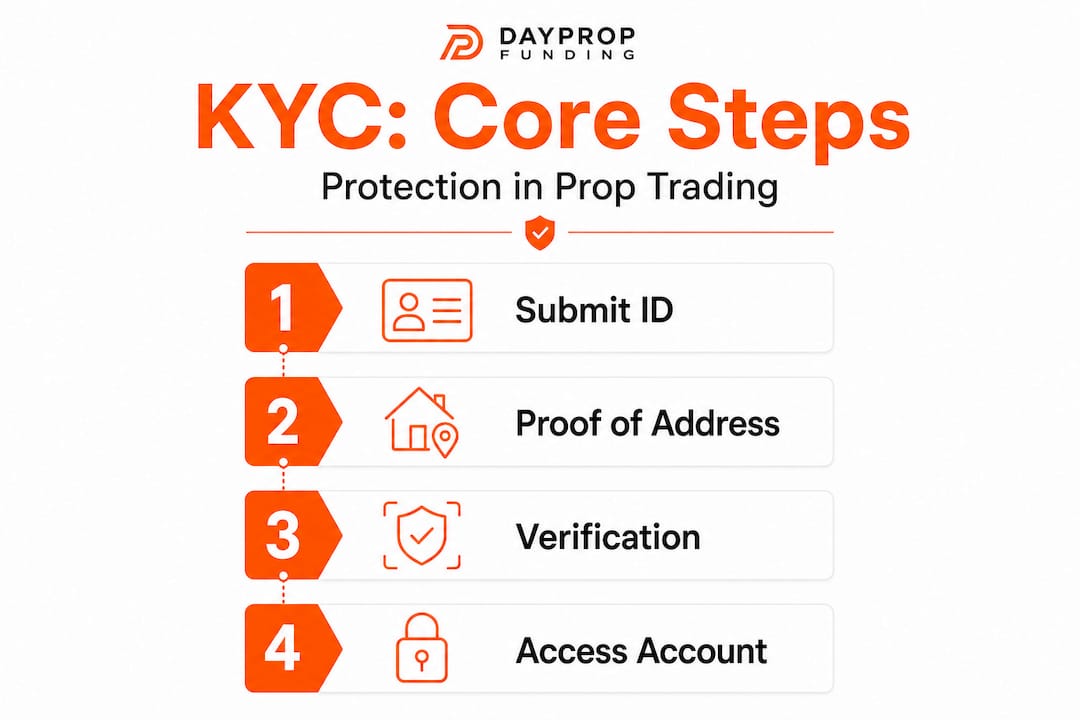
Step-by-step KYC process for retail traders in prop trading:
-
Registration and account creation. Complete the registration form with accurate personal details. Every field must exactly match the information on your ID documents. Discrepancies in spelling, date of birth, or address cause immediate delays.
-
Identity document submission. Upload a clear, unobstructed scan or photograph of your government-issued photo ID. Both sides are typically required for national IDs and driver’s licenses. Ensure the document is current and not expired.
-
Proof of address verification. Submit a document that clearly displays your full name, current address, and an issue date within the last 90 days. Bank statements and utility bills are the most widely accepted formats. Ensure no information is cropped or obscured.
-
Source of funds confirmation. For traders requesting large withdrawals or entering high-capital programs, a recent bank statement showing regular income or savings is typically required. This step is particularly relevant for handling prop trading payouts efficiently.
-
Biometric or liveness verification. Many modern prop firms require a short video selfie or a real-time liveness check through a third-party provider. This confirms that the person submitting documents is the same person in the ID photo.
-
Review and response. After submission, a compliance team reviews your documents. If anything is unclear or missing, they will request additional information. Respond within the specified window to avoid your application being marked as abandoned.
-
Approval and account activation. Once all checks pass, your account is activated and you can begin the evaluation process or access funded status, depending on where you are in the program.
A detailed compliance document checklist can help traders organize everything before submission.
Pro Tip: File all KYC documents in PDF format with a resolution of at least 300 DPI. Low-quality images are the number one rejection reason in automated verification systems used by prop firms. Set a recurring calendar reminder every 90 days to update your proof of address document so it never expires when you need it most.
Ongoing KYC maintenance matters just as much as the initial submission. Prop firms periodically conduct re-verification checks, especially when traders scale to higher capital tiers or request unusually large payouts. Keeping your records current avoids disruption at critical stages of your trading career.
KYC and risk: Why compliance matters for your trading longevity
With your KYC process complete, it’s critical to understand how staying compliant affects both your short-term and long-term trading career.
KYC compliance is part of the risk controls that keep retail traders eligible for ongoing funding. This is a key point that many traders overlook. They treat KYC as a one-time checkbox rather than an ongoing obligation. The traders who scale successfully within prop firms tend to be the ones who approach compliance with the same rigor they apply to their trading strategies.
Risks of KYC non-compliance for retail traders:
- Account suspension or permanent termination without prior notice if compliance checks fail
- Blocked payouts with funds held pending investigation until identity is re-verified
- Reputational damage that follows a trader across multiple firms through shared databases in some jurisdictions
- Disqualification from re-entry into evaluation programs after a compliance-related termination
A statistic worth noting: industry compliance analysts estimate that a significant portion of all prop trading account closures, often cited at 20 to 30 percent of total account flags, are compliance-related rather than performance-related. Traders who protect their trading careers with consistent prop trading risk tips and disciplined compliance practices are simply better positioned for longevity.
For traders active in crypto markets specifically, compliance requirements have intensified significantly since 2022. Crypto risk management now includes an understanding of how on-chain transaction history, wallet addresses, and exchange transfer records may be reviewed during KYC assessments.
Professional risk management in the context of prop trading extends well beyond drawdown limits and position sizing. It includes maintaining a clean compliance record, understanding jurisdictional requirements, and treating verification as an asset rather than an obstacle. Traders who build a strong compliance foundation can move between firms, scale accounts, and request larger payouts with far fewer disruptions.
Why most traders underestimate KYC and what you can do differently
Having seen the essential connection between KYC and risk management, let’s step back and consider what most traders miss about KYC’s bigger role.
The dominant mindset among retail traders is that prop firm success is entirely about trading skill. Entries, exits, risk-to-reward ratios, win rates. These things matter enormously. But the traders who actually build sustained, scalable careers within the prop trading ecosystem tend to hold a different view: compliance is the infrastructure that trading performance runs on.
Think about it from the firm’s perspective. When a prop firm allocates $100,000 or $200,000 to a trader, they are not just betting on that trader’s strategy. They are betting that the trader is a verified, legitimate person operating within legal boundaries, that payouts can be processed without regulatory risk, and that the relationship will remain stable over time. KYC is how they establish that foundation.
Most traders who fail KYC do not fail because they are attempting fraud. They fail because they submit blurry documents, use a nickname that does not match their ID, provide an address that has since changed, or simply do not respond to compliance requests quickly enough. These are fixable problems, but they require intentionality.
What experienced traders actually do differently is treat their compliance profile the way they treat their trading journal. It is current, organized, and reviewed regularly. They understand proprietary trading rules not just as performance constraints but as the full operating framework that governs their relationship with capital providers.
There is also a strategic advantage to getting KYC right early. Traders who pass verification quickly and cleanly build a compliance track record that some firms use to expedite future applications, especially when scaling to higher capital tiers or accessing premium programs. Being KYC-ready is a competitive differentiator, not just a baseline requirement.
The actionable advice for future-proofing your trading business is straightforward. Build a compliance routine. Keep one folder, physical or digital, with all your current documents. Update it when you move, when your ID is renewed, and when your bank statements roll into a new month. Treat it as part of your trading business operations, because that is exactly what it is.
Next steps: Securely scale your trading with KYC-ready funding programs
Ready to put your KYC and trading knowledge to work? Here’s how you can move forward with confidence.
DayProp provides retail traders with a structured path from evaluation to funded trading, built on transparent compliance standards and professional risk parameters. Understanding KYC is the first step. Applying that knowledge in a well-designed evaluation environment is the next.
Whether you are preparing for your first evaluation or looking to scale an existing funded account, DayProp’s resources are designed to help you navigate every stage with clarity. Start with the complete trading evaluation guide to understand exactly how to align your trading performance with compliance requirements. For traders ready to engage with the full process, the performance-based evaluation process explains how DayProp rewards consistency, discipline, and real trading skill across FX, indices, and crypto markets.
Frequently asked questions
What documents are needed for KYC in prop trading?
Most firms require a government-issued photo ID, proof of address, and sometimes a source of funds document for KYC compliance. KYC typically requires checking photo ID and proof of address for trading account access.
How long does KYC approval take for retail traders?
Most prop firms approve KYC within 1 to 5 business days if all documents are accurate and complete. Timely document submission speeds up onboarding significantly for retail traders.
What happens if you fail a KYC check?
Failure results in denied account access or an account freeze, blocking all trading activity and payouts until the issue is resolved through re-verification or appeal.
Is KYC required for all types of prop trading models?
Yes, nearly every regulated prop trading model in FX, indices, and crypto requires KYC verification. KYC is mandatory for all major regulated trading firms to prevent financial crimes.
Does KYC affect payout speed from prop trading?
Yes, delays in KYC approval, particularly for re-verification triggered by large withdrawals, can delay or block profit payouts until compliance checks are cleared.
Recommended
- Transparent trading rules guide: FX, indices & crypto funding – DayProp Funding
- Proprietary trading rules explained for retail traders – DayProp Funding
- Streamline your crypto trading workflow: step-by-step guide – DayProp Funding
- Why fund retail traders: benefits and challenges 2026 – DayProp Funding