

TL;DR:
- Passing a prop trading evaluation requires strict psychological discipline and consistent process adherence under pressure. Traders must integrate technical and fundamental analysis, manage risk rigorously, and follow a structured routine to succeed. Systematizing trading behavior and adapting to specific firm rules are essential for long-term success and account retention.
Passing a prop trading evaluation is one of the highest bars in retail trading. Most traders have a strategy that works in favorable conditions, but the evaluation environment is unforgiving. One violation of risk rules, one emotionally driven trade, or one session of inconsistent execution can end your challenge entirely. The skills that separate traders who secure funding repeatedly from those who cycle through failed attempts are not primarily about finding the perfect setup. They are about demonstrating a complete, disciplined trading profile across every single session.
Table of Contents
- 1. Psychological discipline: The core of prop trading success
- 2. Market analysis: Combining technical and fundamental skills
- 3. Risk management: Protecting capital for long-term growth
- 4. Process consistency: The edge in passing trading evaluations
- 5. Adaptability: Evolving with market and firm requirements
- The most overlooked aspect of prop trading readiness
- Take your trading to the next level with DayProp
- Frequently asked questions
Key Takeaways
| Point | Details |
|---|---|
| Discipline first | Emotional discipline is the foundation for passing funded trading challenges. |
| Mixed analysis matters | Success in FX and crypto prop trading depends on blending technical and fundamental analysis. |
| Risk rules are non-negotiable | Strict risk management is required for both firm criteria and long-term survival. |
| Consistency beats perfection | Stable routines and process adherence improve pass rates more than perfect trade calls. |
| Adaptability wins | The best traders evolve their methods and mindset to suit changing market and firm demands. |
1. Psychological discipline: The core of prop trading success
Psychological discipline is the ability to follow your trading rules consistently, regardless of recent outcomes or emotional state. It governs every decision you make during a live session, from whether you enter a trade to how long you hold a losing position. In a prop trading evaluation, where psychological discipline is repeatedly identified as a core requirement for funded trading success, a single moment of emotional decision-making can cost you an entire challenge attempt.
The most common psychological pitfalls that traders encounter during evaluations include:
- Revenge trading: Immediately re-entering the market after a loss to recover quickly, often with oversized positions.
- Overtrading: Taking more trades than your plan allows, usually driven by boredom, excitement, or the pressure to hit profit targets faster.
- Rule deviation after drawdown: Abandoning your entry criteria or risk parameters because you feel you need to “make it back” before the evaluation ends.
- Confirmation bias: Selectively reading price action to justify a trade you have already emotionally committed to.
- Premature exits: Closing winning trades too early out of fear, which skews your risk-to-reward ratio and undermines the statistical edge of your strategy.
Funded challenges reward rule-consistent execution across days, not brilliant individual trades. A trader who produces a 6% return in two sessions and then breaks the drawdown rule in a third session has failed. A trader who returns 1% per day with no rule violations has passed. That distinction is purely psychological.
“Discipline in execution across a sustained period is the single most differentiating factor between traders who receive funding and those who do not.”
Pro Tip: Keep a dedicated trading journal that logs not just your entries and exits, but your emotional state before and during each trade. Review patterns monthly to identify specific conditions where your discipline breaks down. This is one of the most direct methods for overcoming trading psychology pitfalls that cost funded traders their accounts.
For structured trading psychology guidance, building a pre-session routine that includes a brief review of your rules and risk limits is a proven starting point that professional traders use consistently.
2. Market analysis: Combining technical and fundamental skills
With a disciplined mindset in place, understanding and interpreting the markets is the next core skill. Prop trading evaluations in FX and crypto are not conducted in a vacuum. Markets respond to central bank decisions, macroeconomic data releases, geopolitical developments, and liquidity conditions. Traders who rely exclusively on technical analysis miss half the picture.
Funded traders require market and instrument-specific analysis skills that combine technical analysis with fundamental and news awareness, which is especially critical in FX and crypto markets where macroeconomic events can invalidate a technically sound setup in seconds. Blending both approaches gives you the context to know when to trade and when to stay out entirely.
Here is a practical process for performing complete pre-trade analysis:
- Check the economic calendar. Before each session, identify any scheduled releases that could create outsized volatility in your instruments, including interest rate decisions, employment reports, and inflation data.
- Establish the macro bias. Determine the prevailing directional pressure on your asset based on recent central bank commentary or market-wide sentiment. This gives you a framework for which direction setups carry lower risk.
- Identify key technical levels. Mark support and resistance zones, recent highs and lows, and any significant moving averages or trend lines on your primary timeframe.
- Align your setup with both lenses. Only execute trades where the technical setup is consistent with the fundamental backdrop. A short setup in a currency pair that the central bank is actively supporting carries additional risk.
- Define your invalidation point. Before entering, know exactly what price action or news development would mean your thesis is wrong. This prevents you from holding losers out of stubbornness.
For applied FX trading strategies that integrate both analysis methods, reviewing session-based approaches is an efficient way to build this skill systematically.
Pro Tip: Build a daily news filter by listing the top three events of the day with their expected impact level. Avoid trading in the 15 minutes before and after any high-impact release unless your strategy is specifically designed for that environment. Tools for integrating news and analysis into your pre-session routine can streamline this process considerably.
3. Risk management: Protecting capital for long-term growth
Once you have mastered reading the markets, protecting your capital through strict risk management is the critical foundation for longevity in any prop trading program. Risk management in this context is not just about using stop losses. It is a complete framework that governs every aspect of your position sizing, daily exposure limits, and behavioral boundaries.
The key types of risk that funded traders must manage include:
- Market risk: The probability that price moves adversely against your position due to volatility, news, or liquidity events.
- Max drawdown risk: The cumulative loss that, if reached, terminates your funded account or evaluation attempt.
- Emotional risk: The tendency to override your risk parameters based on conviction or urgency, which is often the actual cause of breaching firm-imposed limits.
- Concentration risk: Over-allocating capital to a single instrument or correlated trades, which amplifies losses when that market moves against you.
Most challenge failures stem from inadequate risk discipline, not from a flawed strategy. The risk management requirements stressed by prop firms place trading psychology and emotional control alongside technical skill for a clear reason: discipline without risk controls is insufficient.
| Factor | Strict risk management | Lax risk management |
|---|---|---|
| Challenge pass rate | Significantly higher | Significantly lower |
| Average drawdown | Stays within firm limits | Frequently breaches limits |
| Account longevity | Sustainable across months | Typically short-lived |
| Emotional consistency | Stable, rule-based | Reactive, erratic |
| Scalability | Fundable and scalable | Disqualified or capped |
Practical tools that help you maintain strict prop trading risk limits include position size calculators that factor in account balance, stop distance, and maximum risk per trade. Setting hard daily loss alerts within your broker platform ensures you are notified before reaching a critical threshold. A detailed forex risk management guide provides a structured framework for applying these principles in real trading conditions.
For a broader perspective on managing trading risk and building consistent profitability, applying principles from risk scenario analysis reinforces the importance of forward-planning for adverse outcomes before they occur.
4. Process consistency: The edge in passing trading evaluations
With risk controls in place, what separates consistent winners is how reliably they stick to their process. A written trading plan is not a suggestion. It is the operating manual for your trading business. Prop firms evaluate traders over a defined period precisely because they want to observe whether a trader’s performance reflects a repeatable process or a series of isolated decisions.
An effective daily trading process looks like this:
- Pre-market preparation. Review overnight price action, mark key levels, check the economic calendar, and confirm your instruments are in a tradeable condition for the session.
- Session intention setting. Write down your maximum number of trades, the setups you are willing to take, and your hard stop for the day in terms of maximum loss.
- Active session execution. Follow your entry and exit criteria without deviation. If a setup does not meet all criteria, do not take it. If your daily loss limit is reached, stop trading entirely.
- Post-trade review. After each closed trade, log the outcome, the emotional state during the trade, and whether the execution matched your plan. Note any rule deviations immediately.
- End-of-session assessment. Review the full session against your written plan. Identify one specific area for improvement and carry it forward to the next session’s preparation.
“Discipline in execution is often more important than stock picking.”
Traders who consistently review and adapt their plans outperform those who operate on intuition alone. The data below reflects typical performance patterns among traders who implement structured review processes compared to those who do not.
| Metric | Plan-review traders | No-review traders |
|---|---|---|
| Rule violations per week | 0.8 average | 3.4 average |
| Challenge completion rate | 64% | 21% |
| Risk-adjusted return | Higher and stable | Variable and inconsistent |
| Drawdown recovery rate | Faster | Slower or nonexistent |
A structured funded account workflow breaks this process into three distinct phases: evaluation, funded trading, and scaling. Following a phase-specific routine reduces the cognitive load of decision-making during live sessions. Research into rule-based performance strategies consistently demonstrates that structured, rule-following approaches outperform discretionary improvisation under conditions of uncertainty and pressure.
5. Adaptability: Evolving with market and firm requirements
All of these skills are amplified by your ability to adapt your methods for evolving market conditions and program requirements. No two prop firms run identical evaluations. Leverage limits, instrument restrictions, time-based rules, and profit target structures vary significantly. A trader who performs well on one platform may struggle immediately on another without understanding the specific parameters of that firm’s evaluation.
Common scenarios that require adaptability in prop trading include:
- Leverage restrictions: A firm that offers 1:10 leverage instead of 1:30 requires you to adjust your position sizing and profit expectations accordingly.
- Instrument limitations: Some firms restrict news trading, specific currency pairs, or crypto assets, requiring you to develop proficiency in the permitted instruments.
- Time-based rules: Certain evaluations prohibit holding positions overnight or over weekends, which fundamentally changes how you manage trades entered late in a session.
- Profit target structures: Multi-phase evaluations require you to pace your performance across phases rather than targeting maximum returns in the first phase.
- Scaling plan criteria: As accounts grow, the rules often change regarding minimum trading days, required consistency ratios, or maximum position size per trade.
Account scaling for growth requires that you continuously reassess your strategy as your funded balance increases. What works at a $25,000 account level in terms of volatility tolerance and position size may not scale cleanly to a $100,000 account.
Pro Tip: Before starting any new evaluation, run at least 10 sessions on a demo account that mirrors the firm’s specific rules. Use realistic leverage settings, apply their exact daily loss limits, and follow their instrument restrictions. This simulated environment reveals weaknesses in your adaptability before real capital is at stake.

The most overlooked aspect of prop trading readiness
Most traders approaching their first or second prop trading evaluation focus almost entirely on strategy refinement. They test more setups, adjust their indicators, and search for higher probability entry signals. This approach addresses only one layer of what evaluations actually measure.
In our assessment, the traders who consistently pass evaluations and retain funded accounts are not those with the most sophisticated strategies. They are the traders who have systematized every element of their trading behavior. Their psychological state during a session is managed through routine, not willpower. Their risk controls are built into their pre-trade checklist, not enforced through in-the-moment judgment. Their market analysis follows a repeatable sequence, not an improvised read of the chart.
The uncomfortable reality is that most retail traders fail evaluations not because their edge is insufficient but because their execution infrastructure is not built to sustain that edge under pressure. A trading journal, a daily planning checklist, and a post-session review are not optional enhancements. They are the operational foundation of a funded trader.
Building these systems before you enter an evaluation is more productive than any additional hours spent on strategy backtesting. Treat your first funded account attempt as a test of your systems, not just your strategy.
Take your trading to the next level with DayProp
If you are ready to apply these skills in a structured, professionally designed evaluation environment, DayProp provides the framework you need. Our evaluations are built around transparent risk parameters, real market conditions, and scalable funding designed for traders who demonstrate genuine edge.
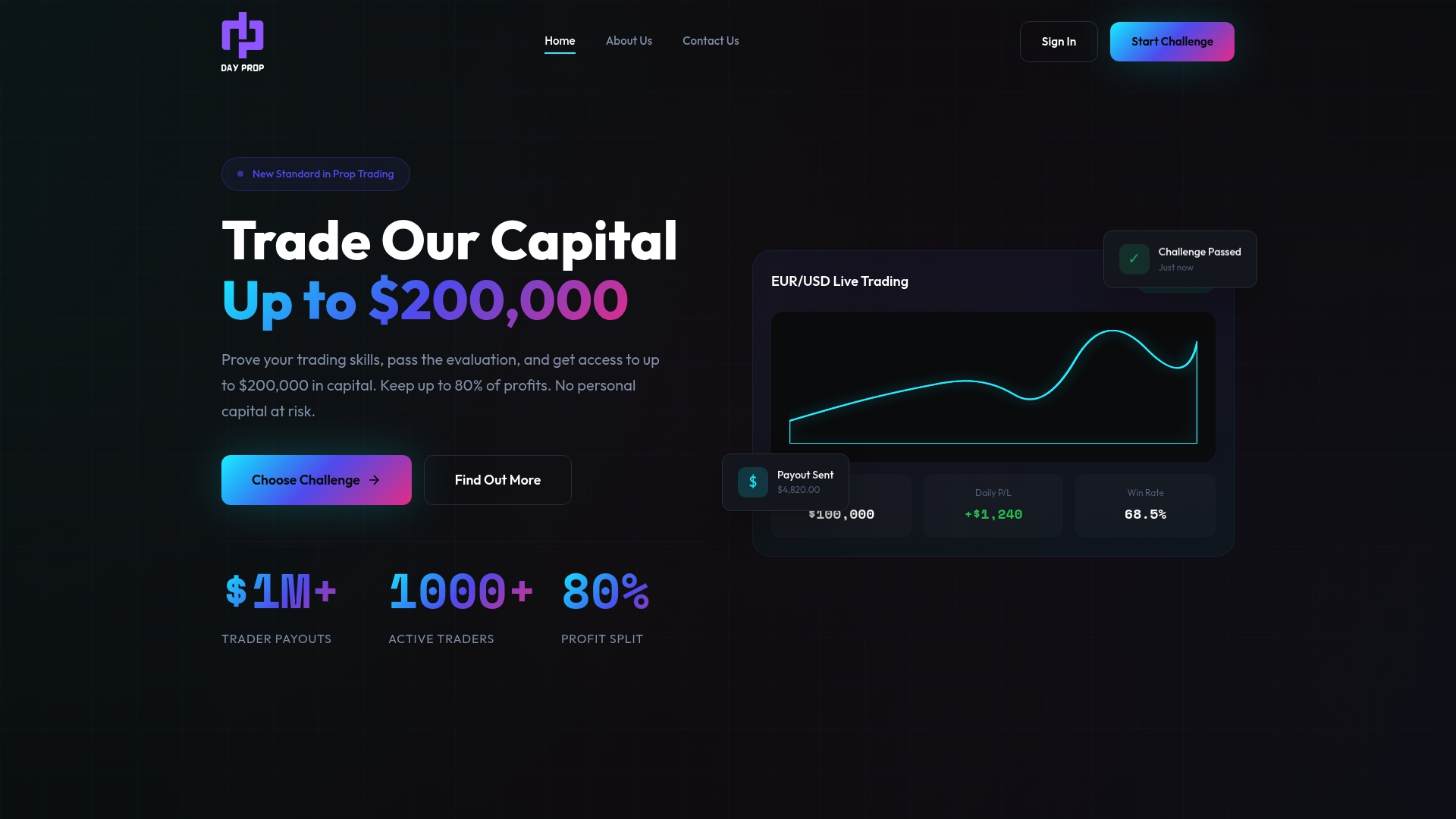
At DayProp, we assess traders across FX, indices, and crypto markets through structured challenges that reward consistency and disciplined risk management. Our funded trading programs offer clear rules, fast-track payout models, and performance-based scaling so you can grow without risking personal capital. Whether you are preparing for your first evaluation or refining your process to retain existing funding, DayProp provides the environment where disciplined traders thrive.
Frequently asked questions
What is the most important skill for a prop trader?
Psychological discipline, including emotional control and consistent process adherence, is the single most important skill for achieving and sustaining funded trading status.
How important is risk management in prop trading challenges?
Risk management is absolutely essential, as the majority of funding failures result directly from poor adherence to drawdown limits and risk controls rather than a flawed strategy.
Do prop firms expect traders to use both technical and fundamental analysis?
Yes, especially in FX and crypto. Combining technical and news-based analysis is now standard because economic events can override even the strongest chart setups in seconds.
Can process consistency really improve my prop trading results?
Consistent process execution reduces emotional errors and aligns your trading behavior with the rule-based requirements that prop firm evaluations are specifically designed to measure and reward.
Recommended