

TL;DR:
- Compliance in trading involves following legal and regulatory requirements that influence trading limits, leverage, and funding eligibility.
- Understanding and maintaining proper documentation enhances credibility, improves risk management, and increases prop funding chances.
Compliance in trading is often misread as bureaucratic fine print that only concerns large financial institutions. That assumption is costly. What is compliance in trading, really? It is the framework of legal requirements, firm-level policies, and regulatory guidelines that directly shapes what you can trade, how much leverage you can access, and whether you qualify for funded trading opportunities. For retail traders in forex, indices, and crypto markets, understanding compliance is not optional background knowledge. It is a practical requirement for staying in the markets, building credibility, and advancing toward institutional-level capital.
Table of Contents
- Understanding compliance in trading: What it means for retail traders
- How regulatory bodies shape retail trading rules for forex, indices, and crypto
- Key compliance rules affecting retail trader behavior and risk management
- Crypto compliance essentials: Navigating FATF rules and Travel Rule impacts
- Using compliance to enhance trading discipline and gain funding opportunities
- Why compliance is your ultimate trading edge—beyond just avoiding fines
- Unlock your trading potential with DayProp funding’s expert guidance
- Frequently asked questions
Key Takeaways
| Point | Details |
|---|---|
| Compliance basics | Compliance means following trading laws and internal policies like KYC and AML to trade legally and safely. |
| Regulatory impact | Different regulators set rules that affect leverage, asset access, and transaction monitoring. |
| Crypto rules | Crypto traders must comply with FATF’s Travel Rule requiring KYC and information sharing for large transfers. |
| Trading discipline | Understanding compliance enhances risk management, discipline, and funding opportunities. |
| Strategic advantage | Viewing compliance as a trading edge fosters trust, consistency, and long-term success. |
Understanding compliance in trading: What it means for retail traders
Compliance, in its simplest form, means following the rules set by regulatory authorities and the internal policies of the brokers or platforms you trade through. Regulatory compliance requires adherence to laws covering areas such as Know Your Customer (KYC) and Anti-Money Laundering (AML), both of which directly affect your leverage limits, asset access, and account verification status.
KYC is the process by which a broker or platform verifies your identity before granting trading access. AML measures monitor transaction patterns to detect and prevent illegal financial activity. Together, these two pillars form the foundation of compliance for any retail trader.
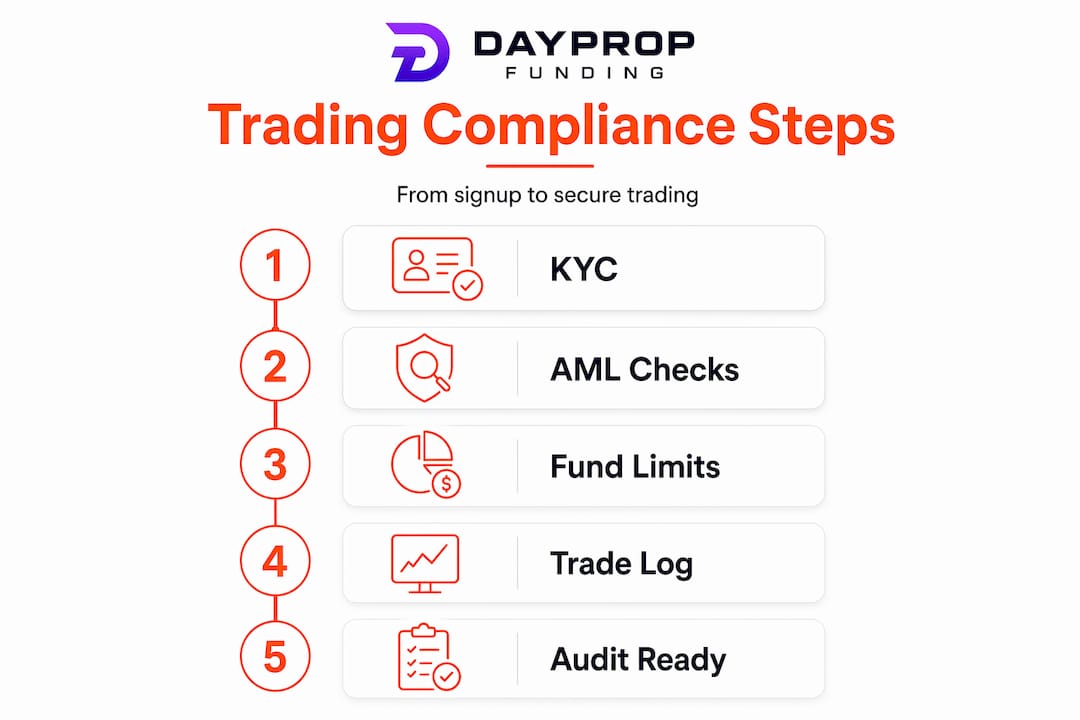
The scope of compliance extends well beyond opening an account. It governs how you deposit and withdraw funds, what position sizes you can hold, and which instruments are available in your jurisdiction. Understanding how KYC protects prop trading access is particularly relevant if you are pursuing funded trading evaluations.
Non-compliance carries serious consequences:
- Account restrictions or full suspension
- Financial penalties imposed by regulators
- Forced liquidation of open positions
- Permanent reputational damage with brokers and prop firms
- Disqualification from funding programs
Retail traders who treat compliance as a box-checking exercise often encounter these outcomes. Those who understand it as a framework for structured trading tend to avoid them entirely.
How regulatory bodies shape retail trading rules for forex, indices, and crypto
Compliance does not exist in a vacuum. It is enforced by specific regulatory bodies, each with distinct authority over different asset classes and geographic regions.
In the United States, the CFTC and NFA regulate forex and indices trading, imposing leverage caps and requiring client fund segregation to protect retail accounts from broker insolvency. In the UK, the FCA caps retail forex leverage at 30:1, restricts crypto derivatives, and has mandated full crypto firm authorization by 2027. Globally, the Financial Action Task Force (FATF) drives crypto compliance through its Travel Rule, which requires KYC verification on crypto transfers exceeding $1,000 across most jurisdictions.

Here is how maximum leverage limits compare across key regulatory regions for major forex pairs:
| Regulatory body | Region | Max leverage (major FX pairs) | Crypto derivatives allowed |
|---|---|---|---|
| ESMA | European Union | 30:1 | Restricted |
| CFTC/NFA | United States | 50:1 | Limited |
| FCA | United Kingdom | 30:1 | Banned (retail) |
| ASIC | Australia | 30:1 | Restricted |
Beyond leverage, regulators impose several operational requirements on brokers and platforms:
- Fund segregation: Client funds must be held separately from broker operating capital.
- Transaction monitoring: Platforms must flag suspicious activity in real time.
- Reporting requirements: Trades above certain thresholds must be reported to regulators.
- Sanctions screening: Traders from restricted jurisdictions face additional verification or denial of service.
These rules directly affect your trading conditions. If you trade crypto, understanding the crypto risk management rules tied to compliance requirements will help you avoid transfer blocks and account freezes. For forex and indices, familiarizing yourself with essential FX trading rules puts you ahead of most retail participants.
Key compliance rules affecting retail trader behavior and risk management
Knowing the regulators is one thing. Knowing the specific rules you must follow daily is another. Several compliance requirements directly shape how you manage risk and execute trades.
- KYC and AML requirements. Before you can fund an account or withdraw profits, you must submit government-issued identification and proof of address. Platforms use this to verify your identity and screen against sanctions lists.
- Margin requirements. Regulators set minimum margin levels that brokers must enforce. Falling below these thresholds triggers margin calls or forced position closures.
- Intraday margin framework. In 2026, FINRA replaced the pattern day trader rule with a risk-based intraday margin framework, shifting focus from trade count restrictions to real-time margin monitoring.
- Position limits. Certain asset classes carry maximum position sizes to prevent market manipulation.
- Reporting obligations. Large transactions or unusual activity must be reported, both by platforms and, in some jurisdictions, by traders themselves.
The 2026 FINRA changes deserve particular attention. The old pattern day trader rule required traders with fewer than $25,000 in their accounts to limit themselves to three day trades in a rolling five-day period. The new intraday margin framework replaces this blunt restriction with a system tied to actual risk exposure, which defines margin requirements and forced liquidation risks based on real-time position data rather than trade counts.
Pro Tip: Keep a daily log of your trades, margin levels, and any compliance-related communications from your broker. This documentation becomes critical if your account is ever reviewed or if you apply for prop firm funding. Reviewing proprietary trading rules alongside broker requirements gives you a clear picture of where the two overlap.
Crypto compliance essentials: Navigating FATF rules and Travel Rule impacts
Crypto trading carries its own compliance layer, and it has evolved rapidly. What was once loosely enforced is now operational requirement. As of 2026, crypto compliance has transitioned from an abstract regulatory concept to active enforcement with real financial consequences.
The FATF Travel Rule is the most significant compliance requirement for retail crypto traders. It mandates that Virtual Asset Service Providers (VASPs), which includes exchanges and custodial wallets, collect and share the personal information of both the sender and receiver on any transfer exceeding $1,000. Practically, this means that VASPs must share originator and beneficiary info before processing qualifying transactions.
What this means for you as a retail crypto trader:
- Complete KYC before transferring funds. Exchanges will block transfers until your identity is verified.
- Use compliant wallets and platforms. Transfers to non-compliant wallets or platforms may be flagged or rejected.
- Expect transaction delays. Compliance checks on large transfers are not instant.
- Sanctions screening applies. If your wallet has ever interacted with a sanctioned address, your account may be flagged even if you were unaware.
- Document your transfer history. Records of transaction origins protect you during any compliance review.
Non-compliance in crypto carries penalties that are not abstract. Exchanges have faced fines running into the billions for inadequate KYC and AML controls. As a retail trader, the immediate risk is your funds being frozen while a platform investigates a flagged transaction.
Pro Tip: Before moving crypto between wallets or exchanges, confirm that both platforms are Travel Rule compliant and that your identity is fully verified on both ends. Reviewing the KYC role in prop trading explains how these requirements extend to funded trading programs as well.
Using compliance to enhance trading discipline and gain funding opportunities
Most retail traders think of compliance as a barrier. The more accurate view is that it functions as a filter, and passing through it separates serious traders from undisciplined ones.
Compliance builds trader credibility that is essential for prop firm funding, which requires demonstrable adherence to regulatory standards. Prop firms are not just evaluating your profitability. They are evaluating whether you are the kind of trader they can trust with institutional capital. That trust is built through documented compliance.
The numbers are stark. Prop firms reject 70% of applicants who lack audit-ready trade documentation, even when their performance results look strong.
Here is how compliant and non-compliant traders typically compare in funding outcomes:
| Factor | Compliant trader | Non-compliant trader |
|---|---|---|
| KYC documentation | Complete and current | Incomplete or missing |
| Trade records | Detailed and audit-ready | Incomplete or informal |
| Risk management | Consistent with stated parameters | Inconsistent or undocumented |
| Funding application success | Higher approval rates | Frequent rejection |
| Account standing | Stable | Vulnerable to restriction |
Maintaining compliance as an ongoing practice, rather than a one-time setup, also improves your trading discipline in measurable ways. Traders who track their compliance status tend to track their risk metrics with equal rigor. That habit alone improves consistency. The benefits of trader funding become accessible only to those who have built that foundation. A structured trading evaluation guide can help you align your existing habits with what prop firms actually require.
Building financial credibility through consistent, documented compliance behavior is not just about avoiding penalties. It is about building the kind of verifiable track record that institutions take seriously.
Why compliance is your ultimate trading edge—beyond just avoiding fines
The conventional framing of compliance is defensive: follow the rules to avoid getting penalized. That framing misses the most important point. Compliance, when treated as a professional discipline rather than a legal obligation, actively improves your trading outcomes.
Consider the 2026 FINRA intraday margin changes. The old pattern day trader rule created artificial constraints that pushed traders toward workarounds, offshore accounts, or excessive risk-taking to hit profit targets within restricted trade counts. The FINRA 2026 amendments modernize day trading by focusing on real-time risk exposure instead of arbitrary trade count limits. Disciplined traders benefit directly. They get more operational freedom, provided their margin management is sound.
The traders who suffer under any compliance regime are those who were using non-compliance as a crutch, trading above safe leverage levels, bypassing KYC on platforms, or failing to document their activity. When rules tighten, those traders face account closures, fund freezes, and funding denials.
The deeper point: compliance and trading discipline are the same thing, expressed in different languages. A trader who manages risk carefully, keeps accurate records, and operates within regulated parameters is already compliant. The paperwork formalizes behavior that was already sound.
For retail traders pursuing discipline and funding, the connection is direct. Prop firms do not fund traders who treat rules as optional. They fund traders who demonstrate, through documented history, that they operate with the same rigor that institutional desks require. Compliance is not the ceiling on your trading career. It is the floor you build everything else on.
Unlock your trading potential with DayProp funding’s expert guidance
Understanding compliance is the first step. Applying it in a structured evaluation environment is where the real opportunity begins. DayProp is built specifically for retail traders in forex, indices, and crypto who are ready to trade with discipline and access institutional-level capital without risking personal funds.
DayProp’s evaluation framework is designed around the same compliance principles covered in this article. Risk parameters, documentation requirements, and consistent performance metrics all align with what regulatory bodies and professional trading environments demand. If you have been building compliant trading habits, you are already closer to passing an evaluation than you realize. Start with the performance-based evaluation guide to understand exactly what DayProp looks for, explore the benefits of retail trader funding to see what becomes possible, and use the trading evaluation guide to align your preparation with the process.
Frequently asked questions
What does compliance mean in trading?
Regulatory compliance is the process of adhering to relevant laws, guidelines, and specifications that govern trading activity, ensuring fair and secure market participation for all involved parties.
Why is KYC important for retail traders?
KYC verifies your identity to prevent fraud and financial crime, and ensures customers are verified before they can access trading platforms, protecting both the trader and the institution from illicit activity.
How does the Travel Rule affect crypto traders?
The Travel Rule requires exchanges to share sender and receiver information on transfers above $1,000, and FATF mandates identification sharing for qualifying crypto transfers to prevent money laundering and illicit fund movement.
Can non-compliance affect my ability to get funding?
Yes, and the impact is significant. Prop firms reject 70% of applicants who cannot provide audit-ready compliance documentation, regardless of how strong their performance results appear on paper.
What are the recent changes to day trading rules?
In 2026, FINRA modernized day trading rules by replacing the pattern day trader restriction with an intraday margin framework that evaluates real-time risk exposure rather than counting the number of daily trades made.
Recommended