

TL;DR:
- Most retail traders struggle to turn their market knowledge into consistent results by neglecting daily discipline and behavioral controls. Effective risk management, formal trade planning, proper order types, journaling, and realistic backtesting are essential practices that reinforce long-term success. Traders who systematically implement these methods are more likely to gain access to institutional capital and sustain performance over time.
Turning a well-researched trading strategy into consistent, real-world results is where most retail traders struggle. The gap between understanding market theory and executing trades with discipline, every single session, is significant. Many traders invest heavily in finding the right system but neglect the daily processes, behavioral controls, and structured frameworks that actually determine long-term outcomes. The practices covered here are actionable, evidence-backed, and designed specifically for Forex, indices, and cryptocurrency traders who want to improve their performance and sustain it over time.
Table of Contents
- Predefine your risk using position sizing and loss constraints
- Always trade with a formal plan: entries, stops, and exits
- Order types and stop management: Tools for real risk control
- Journaling and structured review: The trader’s self-diagnostic
- Smarter strategy validation: Realistic backtesting and filtering for edge
- Our perspective on what actually separates funded traders from the rest
- Take your trading discipline to the next level with DayProp
- Frequently asked questions
Key Takeaways
| Point | Details |
|---|---|
| Predefine risk for every trade | Setting a risk limit and using position sizing formulas helps protect your account from dangerous losses. |
| Always trade with a plan | A structured trade plan with entry, stop-loss, and exit removes emotion and builds discipline. |
| Use effective order types | Stop-loss, limit, and trailing stop orders are essential for automatic risk management. |
| Self-review boosts performance | Regular journaling and structured review let you correct mistakes and sustain rule-following. |
| Test for real-world results | Validate strategies with execution realism and focus on improving trade quality, not just win rate. |
Predefine your risk using position sizing and loss constraints
With your motivation in focus, the first and most impactful best practice is mastering risk control at the trade level. Before you enter any position, you need to know exactly how much you are willing to lose if the trade does not work out.
A consistent risk management framework starts with defining your maximum acceptable risk per trade. The widely accepted standard is 1% to 2% of account equity per trade. This means if you have a $10,000 account, your maximum loss on any single trade should be between $100 and $200. This constraint prevents a single bad decision from significantly damaging your account.
To calculate position size precisely, use this formula:
Position Size = (Account Balance × Risk %) / (Stop-Loss Distance × Pip Value)
For example, on a $10,000 account risking 1% with a 30-pip stop-loss on EUR/USD (where each standard lot pip value is approximately $10), the calculation would be: $100 / (30 × $0.10 per mini lot) = approximately 3.3 mini lots.
Here is a practical numbered approach to applying this at the trade level:
- Set your maximum account risk threshold (1% to 2% of equity) before the trading session begins.
- Identify your entry price and the technical level where your trade thesis is invalidated (your stop-loss level).
- Calculate the stop-loss distance in pips or points.
- Apply the position sizing formula to determine your lot size.
- Enter the trade only with the calculated position size, regardless of conviction level.
A durable retail-trader best-practice is to predefine a risk model and constrain loss per trade, often framed as approximately 1 to 2% of account equity, using position sizing tied to stop-loss distance. This method removes the guesswork that leads to over-leveraging, which remains one of the primary reasons retail accounts are wiped out.
Statistic: Exceeding planned risk on individual trades is consistently identified as a top cause of account blow-ups among retail traders, not strategy failure.
Pro Tip: Review your last 20 trades and check whether your actual dollar loss per trade matched your stated risk rules. If they do not align, your position sizing process needs to be corrected before any other improvement will take hold. Applying crypto risk management rules is equally important in volatile asset classes where price moves can be extreme.
Always trade with a formal plan: entries, stops, and exits
With risk controlled, consistency depends on your commitment to a formal trading plan. Having a plan means documenting your trade logic before you enter the market, not after.

A formal trade plan that defines entry, stop-loss, and exits reduces emotional decision-making and improves process consistency across sessions and market conditions. Without this structure, traders are vulnerable to impulsive adjustments: moving stops further from entry to avoid a loss, holding positions too long hoping for a reversal, or cutting profits early out of anxiety.
Every trade should include these documented elements before execution:
- Entry level: The exact price or zone at which you will enter the trade.
- Stop-loss level: The price at which the trade is automatically closed at a loss.
- Profit target: The price level at which you intend to exit with a gain.
- Trade rationale: A brief note on why the setup qualifies under your strategy rules.
- Risk amount: The dollar value at risk, pre-calculated from your position sizing formula.
Trade plans do not need to be complex. A simple one-page template repeated across all instruments works effectively. Many professional traders use a checklist format that takes less than two minutes to complete before each trade.
“Failing to plan is planning to fail.”
Applying a plan to FX trading strategies and to retail trading basics alike reinforces that this practice is foundational, not optional. The discipline of writing down your trade rationale also forces you to identify weak setups before capital is at risk.
Pro Tip: Set a calendar reminder or trading platform alert 15 minutes before each planned trading session. Use that window to document your plan for the session, including setups you are watching and the conditions required to enter.
Order types and stop management: Tools for real risk control
Now, it is time to operationalize your plan using the right market tools. Knowing which order type to use in each market condition is a technical skill that directly affects risk management outcomes.
For risk control, explicitly employing order types and stop techniques rather than relying only on favorable price movement is a key discipline across Forex, indices, and crypto. Here is a direct comparison of the three most relevant order types:
| Order type | How it works | Best used in | Key risk consideration |
|---|---|---|---|
| Guaranteed stop | Closes position at exact stop price regardless of gaps or slippage | Volatile Forex pairs, crypto during news events | May carry a premium fee |
| Trailing stop | Moves stop price as the trade moves in your favor | Trending markets, indices momentum trades | Can be stopped out by short-term volatility |
| Limit order | Executes at a specified price or better | Range-bound Forex, defined entry zones | May not fill if price does not reach target |
Practical use cases for each order type:
- Guaranteed stops are especially valuable in crypto markets where overnight or weekend price gaps are common and a standard stop-loss may execute well below the intended level.
- Trailing stops work best in trending indices positions, such as during sustained equity rallies, where you want to capture extended moves without sacrificing unrealized profits.
- Limit orders for entries prevent you from chasing price, which is a common source of poor execution quality in Forex pairs with tight ranges.
Most losing streaks escalate not because of a poor strategy, but because of inconsistent stop discipline. A trader who manually overrides a stop-loss, even once, introduces a behavioral precedent that is difficult to correct. Using crypto risk controls and structured order placement eliminates that decision point entirely. You can also explore practical stop techniques for additional context on applying these tools across different market environments.
Journaling and structured review: The trader’s self-diagnostic
With technical and behavioral tools in place, the final edge is gained from structured learning and self-review. A trading journal is not a performance log for its own sake. It is a diagnostic tool that reveals patterns in your decision-making that you cannot identify in real time.
Journaling and structured review across markets quantifies decision quality and maintains rules compliance over time. Setting up a journal is straightforward. Each entry should capture:
| Field | Description | Example entry |
|---|---|---|
| Date and time | When the trade was opened and closed | March 12, 2026, 09:30 EST |
| Instrument | Asset traded | GBP/USD |
| Plan summary | Entry, stop, target at the time of entry | Long at 1.2740, stop 1.2700, target 1.2800 |
| Result | Actual outcome in pips and dollars | +32 pips, +$64 |
| Emotional tag | Your psychological state during the trade | Calm / Anxious / Overconfident |
| Rule compliance | Did you follow your plan fully? | Yes / Partial / No |
The emotional tag field is one of the most underused yet powerful data points in trading. Over 30 to 50 trades, patterns emerge: losses tend to cluster around trades marked “overconfident,” or rule violations spike on Fridays near market close.
Here are numbered steps to build your review routine:
- Log every trade immediately after closing it, while the context is still fresh.
- Conduct a weekly review comparing planned versus actual trade outcomes and identifying rule compliance rates.
- Conduct a monthly review to look for session-level patterns, instrument-specific results, and emotional trends.
- Adjust rules only based on statistical evidence from your journal, not from memory or recent emotion.
- Track progress metrics such as average reward-to-risk achieved, rule compliance percentage, and win rate by session.
For traders building toward funded account eligibility, performance reviews are directly connected to demonstrating consistency to evaluation programs. You can also study structured review practices to understand how systematic retrospective analysis improves professional decision-making in disciplines beyond trading.
Smarter strategy validation: Realistic backtesting and filtering for edge
Finally, strategy validation should reflect how you actually execute, not just how software or theory predicts. This is a distinction most retail traders overlook when building confidence in a system.
Best-practice backtesting for retail traders must include psychological realism and should not assume perfect mechanical execution. Discounting execution friction and cognitive bias can completely invalidate backtest results. In practice, this means building into your test data the following realistic assumptions:
- Slippage: Price at execution differs from the intended entry price, especially in fast-moving markets.
- Partial fills: Particularly relevant in crypto markets with limited order book depth at specific levels.
- Time delays: Manual traders do not execute at the exact candle open. A 2 to 5 second delay can shift entry price meaningfully.
- Psychological avoidance: Certain setups that appear in backtests may be emotionally difficult to take in real time, for example, re-entering after a recent stop-out.
Common psychological traps in backtesting include:
- Hindsight bias: Selecting trades that look obvious in retrospect but would not have been clear at the time of the signal.
- Curve fitting: Optimizing parameters to perfectly match historical data, producing results that do not hold in live markets.
- Survivorship bias: Testing only on instruments or periods that performed well, ignoring market regimes where the strategy failed.
- Overstating win rate: Counting near-miss trades or incomplete sequences that would not have been executed with discipline.
Furthermore, improving trade quality can materially lift expectancy by eliminating the lowest-quality executions rather than searching for a new strategy. This is a critical insight. Filtering out your bottom 20% of trades by setup quality, using your journal data, often improves overall results more than overhauling an entire system.
Pro Tip: Log all trades by session (London, New York, Asian) and calculate your win rate and average reward-to-risk separately for each session. Most traders find they have a clear edge in one session and negative expectancy in another. Removing trades from your weak session alone can significantly improve your results. For strategy validation for retail models, this type of granular analysis is essential. You can also review careful backtest validation approaches used in other data-driven disciplines for methodological reference.
Our perspective on what actually separates funded traders from the rest
Most traders approach skill development by looking outward: searching for a better indicator, a new market, or a different timeframe. The evidence consistently points in a different direction. The traders who demonstrate funded account eligibility and sustain capital access are those who have turned inward, systematically addressing their own behavioral patterns and process gaps.
Position sizing and stop discipline are not advanced concepts. They are foundational. Yet the majority of retail traders, even experienced ones, apply them inconsistently. What separates the trader who passes an evaluation challenge from the one who fails is not strategy sophistication. It is the ability to execute the same process, under varied market conditions, without deviation.
There is also an uncomfortable truth about backtesting that the trading industry underemphasizes. A backtest conducted without accounting for your own psychological tendencies, hesitation, fear of re-entry, and overconfidence during winning streaks, is not a realistic model of your future performance. It is a model of how a robot would trade your rules. That is a fundamentally different thing.
The structured practices covered here, risk predefinition, formal trade planning, appropriate order type selection, journaling, and realistic strategy validation, are not separate techniques. They are a system. Each one reinforces the others. Journaling reveals where your stop discipline breaks down. Realistic backtesting confirms whether your edge survives execution friction. A formal trade plan prevents the impulsive decisions that journaling would later document as errors.
Traders who adopt all five of these practices together, not selectively, are the ones who build the track record that access to institutional capital requires.
Take your trading discipline to the next level with DayProp
Building disciplined trading habits is the first step. Demonstrating them under real evaluation conditions is where funded capital becomes accessible.
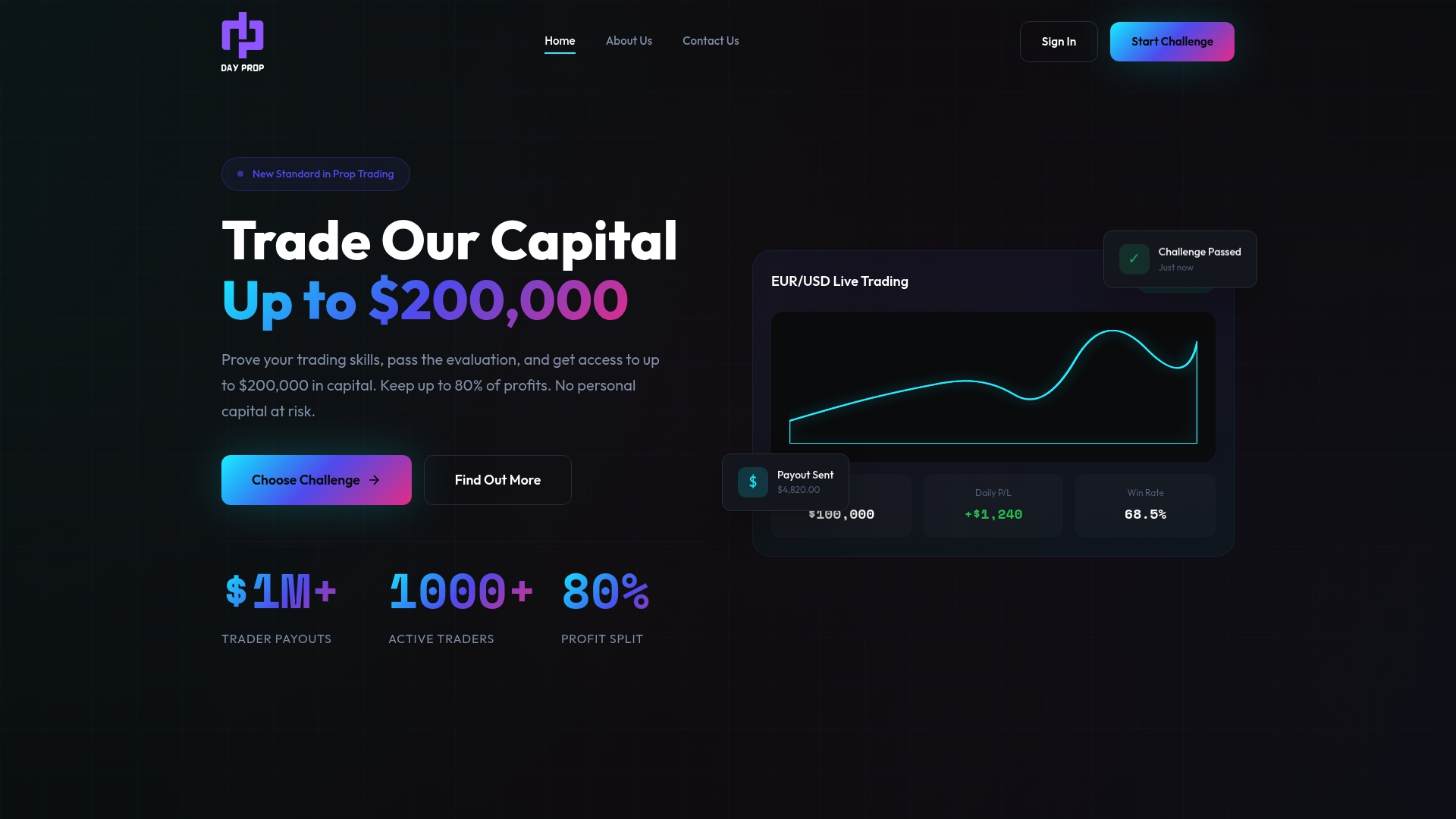
DayProp is a proprietary trading evaluation platform designed to identify and fund disciplined traders across FX, indices, and crypto markets. Our structured challenges apply professional risk parameters, including maximum drawdown limits and consistency requirements, that directly reward the practices covered in this article. If you have built your process around position sizing, formal trade planning, and structured review, the DayProp evaluation platform gives you a transparent path to scale your trading with institutional-level capital and no personal capital risk. Start your evaluation today and put your discipline to work.
Frequently asked questions
What risk percentage per trade do most experts recommend for retail traders?
The consensus is to risk only 1 to 2% of your trading account equity on any single trade for long-term account durability and drawdown control.
What should a retail trader always include in their trade plan?
Every trade plan should include your entry, stop-loss, and planned exit before placing the order, following formal trade plan standards that reduce emotional decision-making.
How does journaling improve trading performance?
Journaling trades helps quantify decision errors and track rule compliance session by session, leading to more consistent performance over time.
Is a high win rate always necessary for trading success?
No. System quality depends on both win rate and reward-to-risk ratio, and win rate alone does not determine whether a system is profitable or sustainable.
How do I make backtesting more realistic?
Factor in psychological realism and execution friction, including slippage, partial fills, time delays, and cognitive biases, when assessing strategy performance against historical data.
Recommended
- Trading account scaling tips for consistent growth in 2026 – DayProp Funding
- Trader skill vs luck: What really drives trading success – DayProp Funding
- Essential trading success factors for consistent profits – DayProp Funding
- FX Trading Best Practices: Proven Strategies for Retail Success – DayProp Funding