

TL;DR:
- Retail traders often fail not due to market moves but because they neglect fundamental trading rules. Implementing strict risk management, including stop losses and daily drawdown limits, separates consistent traders from those who blow accounts. Simplifying and documenting these core rules enhances discipline, leading to better performance and increased funding opportunities.
Most retail forex traders spend months testing indicators, studying chart patterns, and refining entry signals, yet still fail to achieve consistent results. The real issue is rarely the strategy. Research consistently shows that the majority of retail traders lose money primarily because they ignore or misapply fundamental trading rules, not because the market moved against them. Understanding and applying clear FX trading rules is what separates traders who grow their accounts from those who cycle through blown accounts and frustration. This guide covers exactly what those rules are, why they matter, and how to use them.
Table of Contents
- What are FX trading rules and why do they matter?
- Core FX trading rules every retail trader should follow
- How leverage, compliance, and broker rules shape your trading
- Common mistakes when ignoring FX trading rules
- How to build your own FX trading rulebook
- A practical trader’s perspective: Why simplicity wins with FX trading rules
- Next steps: Level up your trading with advanced rule sets
- Frequently asked questions
Key Takeaways
| Point | Details |
|---|---|
| Rules drive consistency | Strict trading rules lead to more predictable and sustainable trading performance. |
| Risk management is essential | Rules like stop losses and risk limits prevent major drawdowns and account losses. |
| External factors matter | Leverage and broker policies shape your trading and must be reviewed beforehand. |
| Mistakes stem from rule breaks | Ignoring fundamental rules usually causes the most costly trading errors. |
| Build your own rulebook | Personalizing and documenting rules boosts discipline and long-term success. |
What are FX trading rules and why do they matter?
FX trading rules are predefined guidelines that govern every aspect of how you operate in the market. They cover risk parameters, entry and exit criteria, position sizing, and daily loss limits. Think of them as the operating framework around your strategy. While your strategy tells you when the market offers an opportunity, your rules determine how you respond to that opportunity without letting emotion take over.
Trading rules improve risk management and instill discipline that makes your trading repeatable. Without rules, two traders running the same strategy can produce wildly different results simply because one follows a structured process and the other improvises under pressure.
Here is why rules serve as the foundation of trading success:
- Reduce emotional decisions. When a rule says “maximum 1% risk per trade,” there is no negotiation after a losing streak.
- Create repeatability. Consistent results require consistent behavior. Rules enforce that behavior every session.
- Enable performance review. You cannot improve a process you do not define. Rules give you something measurable to analyze.
- Increase funding eligibility. Prop firms and evaluation platforms specifically look for traders who demonstrate trading discipline rules in their data.
“Rules do not limit a trader’s potential. They protect it. A trader without rules is simply speculating. A trader with rules is building a process.”
One important distinction worth clarifying: a trading strategy and trading rules are not the same thing. Your strategy might be a breakout approach on the EUR/USD during the London session. Your rules specify the maximum stop loss distance, position size, daily trade limit, and conditions under which you will not trade at all. Strategy identifies opportunity. Rules manage execution. Understanding transparent trading rules that govern both internal and external aspects of your trading gives you a far stronger foundation.
Core FX trading rules every retail trader should follow
With the importance and function of rules established, the focus now shifts to identifying the specific FX trading rules every trader must internalize and apply. According to a step-by-step risk management framework, instituting rules such as max risk per trade, stop loss usage, and daily drawdown thresholds are foundational to any sustainable trading practice.
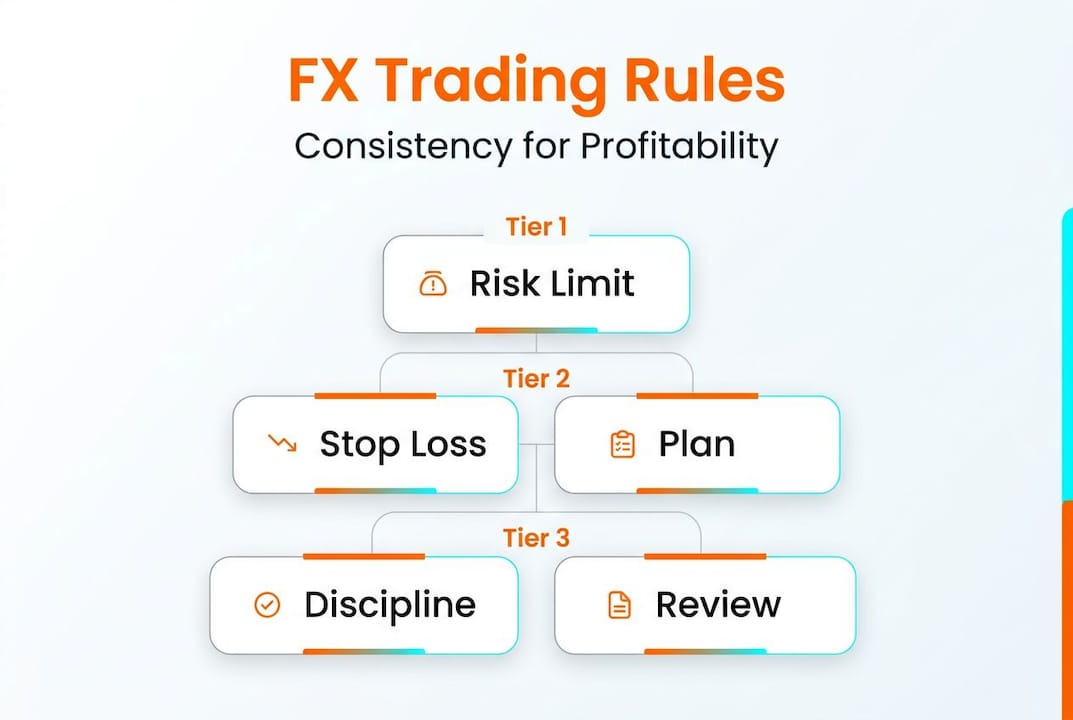
Here are the core rules every retail FX trader should follow:
- Define your maximum risk per trade. Most experienced traders risk between 0.5% and 2% of account equity per trade. Staying within this range means even a string of ten consecutive losses does not destroy your account.
- Always use a stop loss. A stop loss is not optional. It is a non-negotiable rule. Entering a trade without one removes your only guaranteed protection against catastrophic loss.
- Set a daily drawdown limit. Decide in advance the maximum account drawdown you will accept in a single trading day, typically between 2% and 5%. Once hit, stop trading for that session.
- Define your profit targets. Open-ended trades often turn winners into losers. Predefined take-profit levels keep you disciplined and prevent greed from overriding a good trade outcome.
- Only trade setups that match your plan. If a setup does not meet your predefined criteria, you do not take it. Period. This rule alone eliminates a significant portion of avoidable losses.
- Track every trade. A trading journal is not just useful, it is part of your rulebook. Without data, you cannot identify patterns in your mistakes or strengths.
Understanding trading success factors reveals that traders who follow structured rules consistently outperform those who rely purely on instinct or market feel. Similarly, applying consistent risk management practices across every trade significantly reduces variance in your results over time.
| Core trading rule | Consequence of breaking it |
|---|---|
| Max risk per trade | Single loss can wipe a significant portion of capital |
| Always use a stop loss | Unlimited downside exposure on any trade |
| Daily drawdown limit | Emotional decisions compound losses in a single session |
| Profit target defined | Winning trades reverse into losses due to hesitation |
| Only trade plan setups | Overtrading and low-quality entries erode performance |
| Trade journaling | No basis for identifying what works or what needs improvement |
It is also worth noting the connection between understanding investment risks in broader financial markets and the specific risk parameters you set within your FX trading rules. Markets carry inherent uncertainty. Rules exist to manage your exposure to that uncertainty, not to eliminate it.
Pro Tip: Use a pre-trade checklist embedded in your trading platform or notebook to confirm each rule is satisfied before you enter any position. Automating rule adherence, through platform alerts or automated position sizing tools, dramatically reduces emotional interference in execution.
How leverage, compliance, and broker rules shape your trading
Knowing your internal rule set is only part of the picture. External rules, including leverage restrictions, compliance requirements, and broker-specific policies, can directly affect how your strategy performs and whether your account remains in good standing.
Understanding leverage requirements and broker restrictions is essential to avoid compliance-based account issues and unexpected risk exposure. This is not just regulatory noise. These external rules can close positions at the worst possible time, restrict your strategy during high-impact news events, or result in account suspension if not followed.

| External rule | Definition | Trading impact |
|---|---|---|
| Leverage cap | Regulatory limit on position size relative to account balance | Reduces maximum exposure; also limits potential gain |
| Margin call | Broker-triggered notice when equity falls below a threshold | Forces position closure at unfavorable prices |
| News trading restriction | Some brokers or prop firms disallow trades around major events | Limits strategy during high-volatility windows |
| Anti-money laundering (AML) | KYC and fund source documentation requirements | Can delay withdrawals or restrict account activity |
| Minimum account balance | Floor below which trading is suspended | Forces premature position closure |
Retail leverage caps in major markets vary significantly. In the European Union, ESMA regulations cap retail FX leverage at 30:1 for major pairs. In the United States, NFA rules limit retail FX leverage to 50:1. In Asia and offshore markets, leverage can reach 500:1, which comes with substantially higher risk exposure. Understanding how leverage affects risk at each level is critical before scaling a position.
Broker rules around margin calls are especially important. Many traders discover these rules only after being caught in a fast-moving market. Your broker can liquidate positions automatically once margin falls below a required level, often without prior warning. Building your position sizing rules around worst-case margin scenarios, not best-case scenarios, is the professional approach.
Refer to transparent rules for FX for a full breakdown of how compliant trading frameworks apply across FX, indices, and crypto markets.
Pro Tip: Before depositing funds with any broker, read the full terms around margin, news trading, and withdrawal conditions. These details directly affect your trading plan and risk calculations. What you do not read will eventually cost you.
Common mistakes when ignoring FX trading rules
Understanding what other traders get wrong reinforces why following rules matters. Most account failures are not the result of complex market dynamics or unexpected black swan events. They stem from predictable, avoidable behaviors that surface when rules are not in place or are ignored under pressure.
Mistakes like overleverage and emotional trading typically result from ignoring rules, not from unforeseeable market events. The patterns repeat across thousands of trader accounts.
The most common rule-breaking behaviors include:
- Risking too much per trade. A trader confident in a setup pushes 10% of their account into a single position. One adverse move, and the account is down significantly before recovery becomes realistic.
- Trading without a stop loss. The logic is usually “I’ll watch it closely.” In volatile markets, seconds matter. Without a stop, a 20-pip move can become a 200-pip loss in minutes.
- Revenge trading after a loss. This is one of the most destructive patterns in retail FX. A trader takes a loss, then immediately enters another trade to “get it back,” often in violation of their plan setup criteria.
- Ignoring daily drawdown limits. A bad morning becomes a catastrophic afternoon when there is no rule forcing a trading pause. Losses compound emotionally and financially.
- Inconsistent position sizing. Traders increase position size after wins or decrease it erratically after losses, eliminating the statistical edge their strategy may have had.
“Most trading losses come from ignoring basic rules, not from bad market calls.”
The consequences extend beyond the immediate account balance. Failing a prop firm evaluation, losing the confidence to trade, and developing poor habits that persist for years are all direct outcomes of rule-breaking behavior. Reviewing resources on avoiding common funding errors provides useful perspective on how rule violations translate to lost opportunities and capital destruction.
How to build your own FX trading rulebook
All of this knowledge only becomes useful when you translate it into a personal rulebook you will actually follow. Personalizing and documenting your trading rules increases accountability and long-term consistency. Here is a structured process to build one.
- Identify your current weaknesses. Review your last 20 to 30 trades. Look for patterns in your losses. Are you risking too much? Entering without confirmation? Exiting too early? Your rules need to address your actual weaknesses, not generic ones.
- Write rules that directly counter those weaknesses. If you tend to move stop losses, your rule states: “Stop loss is set at entry and not adjusted against the position under any circumstance.” Specific rules are enforceable rules.
- Keep the rulebook short. Five to eight rules that you genuinely apply are more effective than a 30-point checklist that overwhelms you before every trade. Brevity drives compliance.
- Document everything in a trading journal. Note every trade, including whether you followed your rules or broke them. The journal becomes your accountability system and your improvement tool.
- Review and update quarterly. As your experience grows and your strategy evolves, so should your rules. Schedule a formal quarterly review to assess whether your current rules are still solving the right problems.
- Test rule changes on a demo account first. Before adjusting a live rule, test how the change affects your results in a demo environment. Only migrate changes that demonstrate measurable improvement.
This process keeps your rulebook relevant and practical rather than an aspirational document that exists but never gets used.
Pro Tip: Print your top five rules and place them next to your trading station. Run a brief checklist before every session. The physical act of reading your rules before trading activates conscious compliance and reduces autopilot mistakes.
A practical trader’s perspective: Why simplicity wins with FX trading rules
Here is a view that does not get enough attention in trading education. Most retail traders do not fail because they lack a sophisticated enough system. They fail because their rulebook is too complex to apply consistently under real market pressure.
Traders often chase elaborate rule sets, believing that more conditions and filters will produce better results. In practice, the opposite is true. When the market moves fast and a position is open, there is no time to consult a 40-point decision tree. What works is a small set of clear, internalized rules that require no deliberation.
Consider the stepwise risk management approach. At its core, it reduces to three operational principles: define how much you can lose, know where you are wrong, and exit before the loss exceeds your plan. Traders who apply just these three principles consistently outperform traders running complex multi-indicator systems with no defined risk rules.
The best traders at institutional desks are not running the most complicated frameworks. They are running well-practiced, tightly controlled processes that do not leave room for impulsive decisions. The edge is not found in a secret indicator or a breakthrough pattern. It comes from disciplined rule application, session after session, trade after trade, without exception. Simplicity is not a limitation. It is the mechanism that makes consistency possible.
Next steps: Level up your trading with advanced rule sets
For traders who have established a solid rule foundation, the next logical step is putting those rules to work in a structured evaluation environment. DayProp provides prop funding challenges designed to reward exactly the behaviors this article has outlined, disciplined risk management, consistent execution, and rule-based trading.
If you are ready to test your rulebook under real evaluation conditions, our trading evaluation guide walks you through the full process of securing prop funding. For a closer look at how assessments are structured, the trading evaluation process page explains performance benchmarks and payout timelines. Traders who want to understand what type of challenge best matches their current skill level should review the trading challenge types available through DayProp. Disciplined rule application is not just good practice. It is what gets you funded.
Frequently asked questions
What are the top three FX trading rules I should never break?
Never risk more than a set percentage per trade, always use a stop loss, and keep a clear daily max drawdown limit. These three foundational risk rules prevent large losses and build the consistency needed for long-term profitability.
How do broker rules affect my trading plan?
Broker rules can restrict leverage, dictate margin requirements, and limit trading around scheduled news events. As outlined in proprietary trading rule details, these restrictions directly affect how and when you can execute trades.
What is the best way to stick to my trading rules?
Write your rules down, keep them visible at your trading station, and review them before every session. Documenting your trading rules increases accountability and builds the habit of consistent rule application over time.
What happens if I break my FX trading rules?
You risk larger losses, failed evaluations, and a breakdown in trading discipline that compounds over time. As covered in resources on avoiding trading mistakes, rule violations often lead to account losses that far exceed what the original market move would have caused.
Are trading rules the same as a trading strategy?
No. Trading rules set the boundaries for risk and execution, while strategy identifies when and why to trade. Trading rules improve risk management and provide structure around a strategy, but the two serve distinct functions in a trader’s process.
Recommended
- 7 Trading Habits for Consistent Profits in FX and Crypto – DayProp Funding
- Essential professional trading rules to boost discipline – DayProp Funding
- Essential trading success factors for consistent profits – DayProp Funding
- FX Trading Best Practices: Proven Strategies for Retail Success – DayProp Funding