

TL;DR:
- A structured trading workflow improves consistency and performance for retail crypto traders.
- Proper account setup, risk management, and journaling are essential for long-term success.
- Prop firm funding rewards disciplined traders who demonstrate reliable results and risk control.
Most retail crypto traders share a common frustration: inconsistent results, emotional decisions, and no clear system to follow. Only 12-18% of retail traders are consistently profitable, while 70-80% lose money every year. The difference rarely comes down to strategy alone. It comes down to workflow. A structured, repeatable process gives you control over your decisions, your risk, and your progress. This guide walks you through every stage of a professional crypto trading workflow, from account setup to post-trade review, and shows you how that discipline can open the door to prop firm funding and scalable capital.
Table of Contents
- Secure account setup: Building a strong foundation
- Core trading process: From market analysis to review
- Risk management essentials for retail traders
- Unlocking capital: The prop firm pathway
- Expert insights: Benchmarking, edge cases, and optimization
- Why most retail traders struggle—and how workflow discipline changes the game
- Next steps: Put your workflow to the test and access prop funding
- Frequently asked questions
Key Takeaways
| Point | Details |
|---|---|
| Start with security | Setting up your trading environment securely protects your assets from day one. |
| Follow a structured routine | Daily workflows with planning, execution, and review establish discipline and measurable improvement. |
| Prioritize risk management | Limiting risk per trade and setting drawdown rules protects you from major losses. |
| Leverage funding opportunities | Pass prop firm evaluations to access larger trading capital while following strict rules. |
| Track and refine your edge | Use benchmarks and performance tracking to optimize and sustain your trading improvements. |
Secure account setup: Building a strong foundation
Before placing a single trade, your account environment needs to be properly configured. Skipping this step is one of the most common mistakes retail traders make. A secure crypto trading workflow starts with choosing the right exchange, completing identity verification, and locking down your security settings.
For most retail traders, regulated exchanges like Binance or Coinbase are the logical starting point. They offer strong liquidity, a wide range of assets, and established security infrastructure. Understanding retail trading basics will help you evaluate which platform fits your goals before committing capital.
Here are the core steps to complete before funding your account:
- Choose a regulated exchange with strong security features, high liquidity, and clear fee structures
- Complete KYC verification to unlock higher withdrawal limits and full platform access
- Enable two-factor authentication (2FA) using an authenticator app, not SMS
- Set withdrawal whitelists to restrict transfers to pre-approved wallet addresses only
- Fund via fiat or stablecoins for flexibility and to avoid unnecessary conversion fees
A cryptocurrency trading guide typically outlines these same steps: select exchange, KYC, enable security, fund account. They exist in that order for a reason. Each step builds on the last.
Exchange onboarding comparison
| Exchange | KYC required | 2FA options | Fiat deposit | Withdrawal whitelist |
|---|---|---|---|---|
| Binance | Yes | App, hardware key | Yes | Yes |
| Coinbase | Yes | App, SMS | Yes | Yes |
| Kraken | Yes | App, hardware key | Yes | Yes |
| Bybit | Yes | App | Limited | Yes |
For traders who need guidance on setting up a secure crypto banking setup, especially for business or high-volume accounts, additional steps may apply depending on jurisdiction.
Pro Tip: Never use SMS-based 2FA for a trading account. SIM-swapping attacks are common in crypto. Use an authenticator app like Google Authenticator or Authy instead.
Core trading process: From market analysis to review
Once your account is secure, the next priority is building a repeatable daily process. Consistency in execution is what separates traders who improve from those who stay stuck.
A professional trading workflow follows a clear sequence: analyze, size your position, select order type, set stop-loss and take-profit levels, monitor, and journal. Each step feeds the next.
Here is the daily process in order:
- Market overview — Check macro conditions, major news events, and overall crypto sentiment before anything else
- Plan setups — Identify high-probability setups using technical and fundamental tools across multiple timeframes
- Define risk — Set your risk per trade at 1-2% of account capital before selecting entry
- Execute with rules — Use limit orders where possible; avoid chasing price
- Set stop-loss and take-profit — Define both before entering, not after
- Monitor open trades — Review positions with discipline; adjust only when your original thesis changes
- Log every trade — Record rationale, result, and key metrics in your trading journal
A Binance trading walkthrough can help newer traders understand how to navigate order types and execution mechanics on a live platform.
Daily workflow performance benchmarks
| Metric | Developing trader | Consistent trader | Funded-ready trader |
|---|---|---|---|
| Win rate | Below 45% | 45-55% | 55%+ |
| Risk per trade | Over 3% | 2-3% | 1-2% |
| Journal completion | Irregular | Most days | Every trade |
| Daily review | Rarely | Weekly | Daily |
Journaling and routine discipline are consistently linked to better outcomes. It is not glamorous, but it is measurable. Building trading discipline through structured daily habits is the foundation that everything else rests on. You can find additional trade journaling tips to help you design a system that works for your style.

Pro Tip: Review your last 20 trades before placing your next one. Patterns in your mistakes are often more valuable than patterns in the market.
Risk management essentials for retail traders
A structured workflow only works if risk is kept in check. Without hard limits, even a solid process can produce catastrophic losses during volatile market conditions.
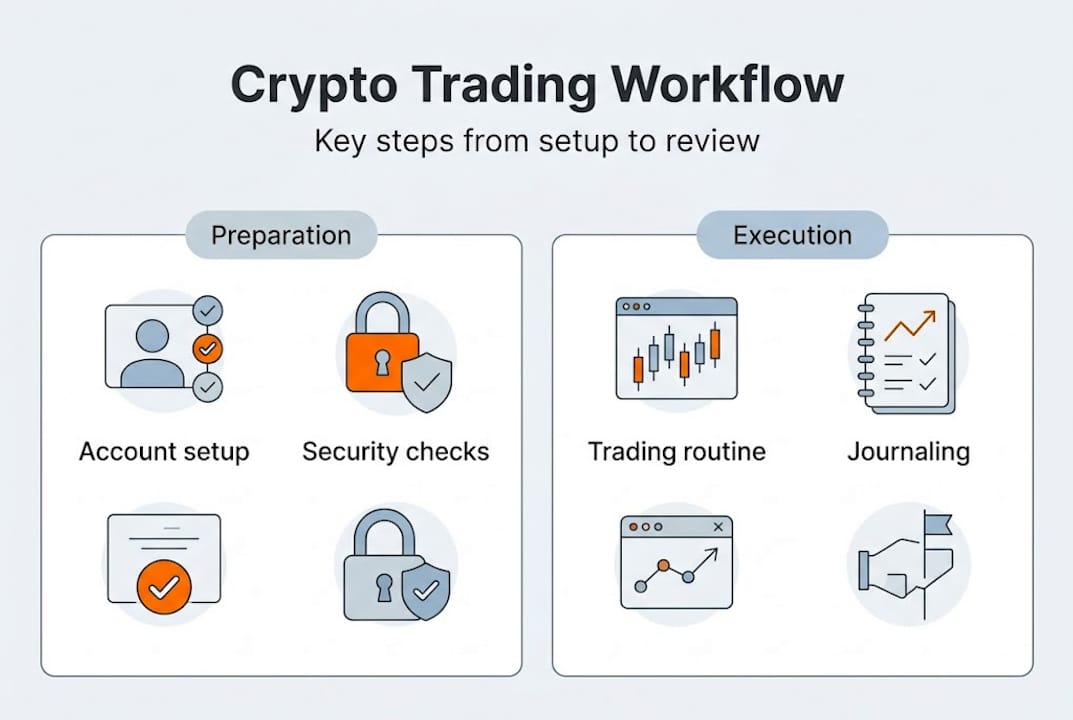
The core rules are straightforward. Risk no more than 1-2% per trade, implement a 3-5% daily loss limit, and set a maximum drawdown cap of 6-10% on your account. These benchmarks exist because they protect your ability to keep trading. Blow past them, and recovery becomes exponentially harder.
Key risk management rules for retail crypto traders:
- Position sizing: Use a fixed percentage of account capital per trade, calculated before entry
- Daily loss limit: Stop trading for the day once you hit 3-5% in losses
- Max drawdown cap: Define a total account drawdown limit (6-10%) beyond which you reduce size or pause
- Profit factor target: Aim for a profit factor above 1.5, which means your gross profit is at least 1.5 times your gross loss
- Kelly Criterion (optional): For advanced traders, use a fractional Kelly approach to size positions based on edge probability
For additional structure, reviewing crypto risk management rules specific to retail traders can help you calibrate these numbers to your account size and strategy.
Benchmark insight: Most retail traders lose annually, and passive HODL strategies often outperform active retail trading in net returns. This does not mean active trading is wrong, but it does mean your risk process must be tight enough to justify the activity.
Understanding trading challenge risk rules used by prop firms can also give you a useful framework for calibrating your own limits. These firms have tested their parameters across thousands of traders.
For deeper context on how prop trading strategies handle risk at scale, external resources can show how professional capital allocation differs from retail defaults.
Pro Tip: Set your daily loss limit as a hard stop in your platform settings where possible. Removing the decision from the moment of loss removes the temptation to override it.
Unlocking capital: The prop firm pathway
Once your private trading process is reliable, you can take advantage of external capital through prop firm opportunities. Prop trading gives disciplined retail traders access to significantly larger capital without putting personal funds at risk.
The structure typically works in phases. You complete an evaluation with defined profit targets and drawdown limits, then move to a funded account. Prop firm funding models generally require 8-10% profit targets, maximum drawdowns of 4-10%, and offer profit splits of 80-90%.
Key factors to evaluate when choosing a prop firm program:
- Profit target: Typically 8-10% per evaluation phase
- Drawdown model: End-of-day (EOD) drawdown is more favorable than tick-based drawdown
- Evaluation period: Look for programs without arbitrary time pressure
- Scaling path: Confirm the account size range ($5,000 to $200,000+) and growth conditions
- Profit split: 80-90% to the trader is the current market standard
- Restricted rules: Avoid programs with unnecessary consistency rules or news trading bans if your strategy requires flexibility
The EOD drawdown model is generally considered more trader-friendly than tick-based models because it measures your account at the close of each session rather than at the worst intraday point.
Prop firm model comparison
| Feature | Standard model | Preferred model |
|---|---|---|
| Drawdown type | Tick-based | End-of-day (EOD) |
| Profit target | 10%+ | 8-10% |
| Consistency rule | Required | None |
| News trading | Restricted | Permitted |
| Profit split | 70-80% | 80-90% |
Reviewing prop firm funding rules in detail before committing to an evaluation is critical. You should also spend time comparing funding models to find the structure that matches your trading style. For a full breakdown, prop trading rule details can clarify what each parameter means in practice.
For a broader view of prop trading evaluations, external guides provide useful context on how different firms structure their programs.
Pro Tip: Treat your evaluation phase exactly like a funded account. Traders who pass consistently are those who trade the same way in evaluation as they plan to trade with real capital.
Expert insights: Benchmarking, edge cases, and optimization
With the foundational workflow in place, the next step is using data to sharpen your edge and prepare for funded scale.
Start with your performance benchmarks. Only 12-18% of retail traders are consistently profitable, and elite performers typically carry a Sharpe ratio above 0.8. A win rate of 59% or higher, combined with a profit factor above 1.5, places you in a strong position for prop firm evaluation.
Key optimization areas for advanced retail traders:
- Win rate: Track it weekly. A sustained rate above 55-59% signals a genuine edge
- Sharpe ratio: Measures risk-adjusted return. Above 0.8 is considered strong for active traders
- Profit factor: Gross profit divided by gross loss. Above 1.5 is the target
- Hybrid allocation: Consider an 80% HODL, 20% active split to balance stability with skill development
- Volatility-adjusted sizing: Reduce position size during high-volatility periods to protect drawdown limits
- Multi-timeframe confirmation: Use higher timeframes to confirm direction before executing on lower timeframes
Volatility-adjusted sizing and multi-timeframe setups are two of the most commonly cited edges among top-performing prop traders. They are not complicated, but they require consistent application.
Statistic: HODL often outperforms active retail trading in raw return terms. The value of active trading lies in skill development, not guaranteed outperformance.
Adapting to market regimes matters too. A strategy that works in trending conditions may fail in a range-bound market. Traders who recognize regime shifts and adjust their approach, rather than forcing trades, tend to preserve drawdown limits more effectively.
For a deeper look at crypto performance analysis and how active trading compares to other income models, external benchmarks can provide useful context. Building trading habits for consistency is what converts short-term skill into long-term results.
Pro Tip: Review your Sharpe ratio and profit factor monthly, not just your win rate. A high win rate with poor risk-reward ratios is a common trap that looks good on the surface but fails under scrutiny.
Why most retail traders struggle—and how workflow discipline changes the game
Most retail traders do not fail because of bad strategies. They fail because they have no repeatable system. They chase indicators, react to social media signals, and skip the review process when results are uncomfortable. The result is a trading account that behaves like speculation rather than a structured business.
Structured routines and performance metrics are what convert trading from a luck-driven activity into an incremental improvement process. Journaling every trade, reviewing daily, and enforcing hard risk limits are not optional extras. They are the mechanism by which skill actually compounds over time.
Prop firm pathways are most effective for traders who have already internalized this discipline. Scaling capital before mastering consistency does not accelerate growth. It accelerates losses. The traders who pass evaluations and retain funded accounts are those who treat every session the same way, regardless of whether they are in profit or drawdown.
True edge does not come from a better indicator or a paid signal group. It comes from self-knowledge: understanding your own patterns, your risk tolerance, and your decision-making under pressure. That knowledge only develops through structured trading performance insights and honest self-audit over time.
Next steps: Put your workflow to the test and access prop funding
Building a structured crypto trading workflow is the clearest path from inconsistent retail results to funded, scalable performance. DayProp provides the resources and evaluation structure to help you take that next step with confidence.
If you are ready to formalize your process, the prop funding evaluation steps guide walks you through exactly what to expect during a structured assessment. You can also compare funding models to identify which program aligns with your risk parameters and trading style. For traders focused on measurable performance, DayProp’s performance-based evaluations reward consistency and risk discipline, not luck. Start with your workflow, then let your results speak.
Frequently asked questions
What is a crypto trading workflow?
A crypto trading workflow is a set of repeatable steps, from account setup to journaling, that helps traders operate with consistency and avoid costly, emotion-driven mistakes.
How much should I risk per trade in crypto?
Most professionals recommend risking 1-2% per trade to limit drawdown exposure and keep decision-making rational during losing streaks.
Are prop firms a good option for retail crypto traders?
Prop firms are a strong option for disciplined traders. You must pass structured evaluation phases with consistent performance and low drawdown before accessing funded capital.
Is HODLing better than active crypto trading?
Research shows HODL often outperforms active retail trading in total returns, but active trading builds measurable skills and risk discipline that compound over time.
Recommended