

Most traders who want funded accounts never get one. Not because they lack skill, but because they walk into a structured trading challenge without a clear process. The evaluation is designed to filter out impulsive, undisciplined traders and reward those who can manage risk under pressure. This guide gives you a practical, sequenced approach to preparing, executing, and verifying your challenge so you can access institutional capital without putting your own money on the line.
Table of Contents
- What is a structured trading challenge?
- Essential requirements and evaluation phases
- How to prepare: Tools, mindset, and practice routines
- Executing the challenge: Your step-by-step process
- Common mistakes and troubleshooting guide
- Assessing results and verifying your challenge progress
- Next steps: Secure funding and accelerate your trading journey
- Frequently asked questions
Key Takeaways
| Point | Details |
|---|---|
| Follow the rules strictly | Success in structured trading challenges depends on mastering rule compliance, not just profitability. |
| Prioritize risk management | Capping risk per trade and practicing consistency dramatically boost your pass odds. |
| Simulate before you trade | Practice in an environment identical to the real challenge to build confidence and discipline. |
| Prepare proof for verification | Keep detailed records of trades to simplify the funding approval process after passing. |
What is a structured trading challenge?
A structured trading challenge is a simulated evaluation where a prop firm tests your trading ability before committing real capital to you. You trade a demo account under specific rules, and if you meet the targets without breaking the limits, you get funded. It sounds simple. In practice, it requires more discipline than most traders expect.
Prop firms use these challenges because they need to identify consistent traders, not lucky ones. As prop firms evaluate traders with strict rules on risk, profit, and drawdown, the goal is to find people who can perform repeatedly, not just once. The challenge is the filter.
The core mechanics typically include a profit target (often 8-10% for phase one), a maximum daily drawdown, an overall drawdown limit, and a minimum number of trading days. You must hit the profit target without breaching any of the risk rules. Understanding the different trading challenge types available helps you choose the right structure for your strategy.
Here’s how structured challenges compare to standard live account trading:
| Feature | Structured challenge | Live account trading |
|---|---|---|
| Capital at risk | None (demo funds) | Your own money |
| Profit target | Required (e.g., 8-10%) | No requirement |
| Drawdown limit | Strict (e.g., 5-10%) | Self-managed |
| Minimum trading days | Yes (e.g., 5-10 days) | None |
| Prohibited strategies | Yes (varies by firm) | Generally unrestricted |
| Outcome | Funded account | Profit or loss |
Key rules you’ll encounter in almost every challenge:
- Profit target: Reach a set percentage gain within the challenge window
- Maximum daily drawdown: Don’t lose more than a fixed percentage in a single day
- Overall drawdown: Your account can’t fall below a total floor from peak equity
- Minimum trading days: You must trade on a set number of calendar days
- Prohibited strategies: Certain approaches are banned outright
Essential requirements and evaluation phases
Most prop firm challenges run in two or three phases. Each phase has its own profit target and risk rules. Phase one is typically the hardest because the profit target is highest. Phase two usually has a lower target but the same risk limits. After both phases, you move to a live funded account.
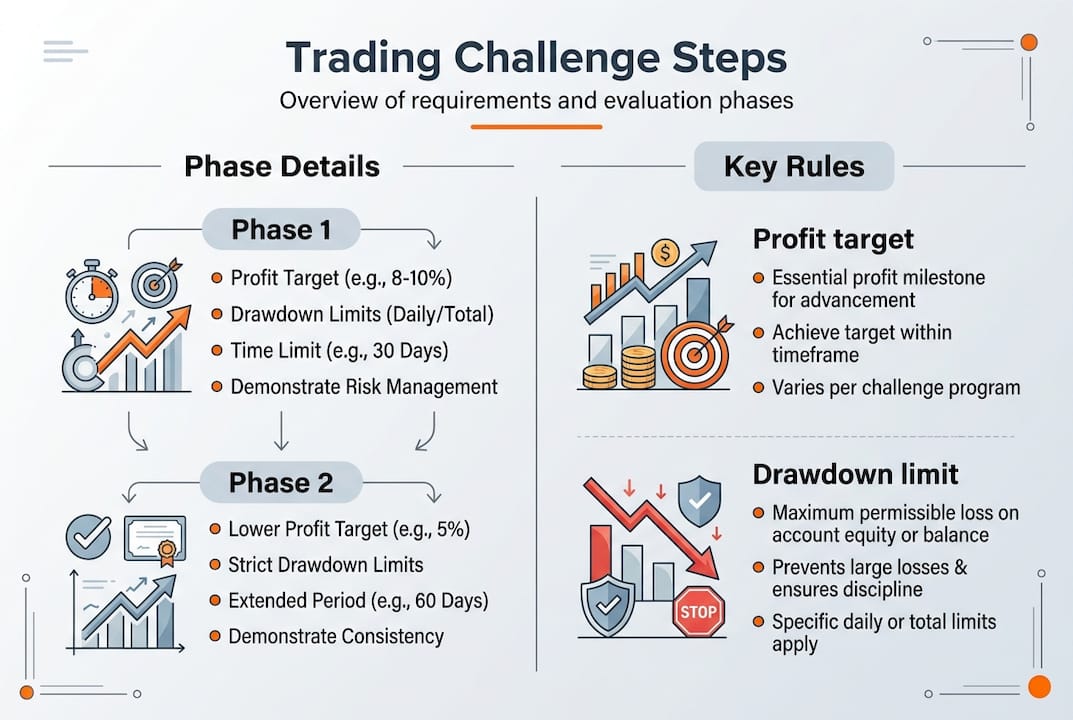
The rules that catch traders off guard are the edge cases. Trailing drawdown mechanics tighten as your equity grows, meaning a profitable account can still fail if equity dips after a peak. Some firms calculate drawdown end-of-day, others use intraday highs. Consistency rules can cap how much profit you’re allowed to make in a single session. Knowing these details before you start is critical. You can find a full breakdown in this trading evaluation phase guide.
Strategies that are typically prohibited include:
- Martingale: Doubling position size after losses
- News exploitation: Trading specifically around high-impact news releases to exploit spreads
- High-frequency arbitrage: Using latency or price feed differences to scalp risk-free
- Copy trading from external signals: Some firms restrict this entirely
Here’s a summary of what each phase typically looks like:
| Phase | Profit target | Max daily drawdown | Max overall drawdown | Min trading days |
|---|---|---|---|---|
| Phase 1 (Demo eval) | 8-10% | 4-5% | 8-10% | 5-10 days |
| Phase 2 (Verification) | 4-5% | 4-5% | 8-10% | 5-10 days |
| Live funded stage | No target | 4-5% | 8-10% | None |
Prioritize managing risk in challenges from day one. The rules don’t get easier as you progress.
How to prepare: Tools, mindset, and practice routines
Before you ever place a real challenge trade, proper preparation will set you apart from 90% of applicants. Most traders skip this phase entirely and pay for it.
Start by selecting a platform that mirrors the challenge conditions as closely as possible. If the firm uses MT4 or MT5, practice on the same platform. Match the spreads, the execution speed, and the instrument list. Tailoring your strategy to the rules means keeping risk per trade low, avoiding overtrading, and practicing in an identical demo environment before you start the real evaluation.
Mindset matters more than most traders admit. Multi-phase challenges create psychological pressure that compounds over time. A losing day in phase two feels heavier than the same loss in a regular demo. Building stress resistance before the challenge starts is a real skill. Explore trading psychology tips and work on building trading discipline as part of your prep routine.
Habits that separate top performers from the rest:
- Review your last 20 trades before starting any new challenge
- Set a hard daily loss limit below the firm’s limit (e.g., if the firm allows 4%, cap yourself at 2%)
- Trade only your A-setup, not every signal you see
- Log every trade with entry reason, exit reason, and emotional state
- Take at least one full rest day per week during the challenge
If you’re exploring different approaches, scalping and market making strategies can work in challenges, but only if they comply with the firm’s rules on trade duration and frequency.
“The traders who pass consistently aren’t the ones with the best entries. They’re the ones who never break their own rules, even when the market tempts them.”
Pro Tip: Run a full 10-day mock challenge on a demo account before you pay for the real evaluation. Use the exact same rules, targets, and risk limits. If you can’t pass the mock, you’re not ready for the real thing.
Executing the challenge: Your step-by-step process
With the foundations in place, let’s walk through each step of the execution phase, where most traders hit trouble.

The single most important rule during execution is position sizing. Risk 0.5-1% per trade initially, then scale dynamically as your buffer grows. Focus on consistency over speed. A steady 0.5% gain per day compounds faster than you think, and it keeps you far from the drawdown limits.
Only about 10-20% of traders pass prop firm challenges on their first attempt, which means execution errors are the norm, not the exception. Use the step-by-step evaluation process to structure your approach from day one.
Here’s the sequence that works:
- Set your daily risk cap before the session opens. Write it down. Non-negotiable.
- Trade only pre-identified setups. No impulse trades, no revenge trades.
- After each trade, log the result and check your running drawdown against the firm’s limit.
- If you hit your daily loss cap, stop trading. Close the platform if you need to.
- At the end of each week, review your consistency. Are your gains spread across multiple days or concentrated in one?
- Adjust position size upward only after you’ve built a 3-5% buffer above your starting balance.
- In the final days of the challenge, protect your gains. Reduce size and avoid high-risk setups.
Pro Tip: Avoid trading the first 15 minutes after a major news release unless your strategy is specifically built for it. Spreads widen, fills are unpredictable, and one bad trade can wipe out days of progress.
For drawdown risk tips and a deeper look at professional risk management, these resources will help you build a framework that holds up under pressure. Automated risk tools can also help enforce your limits if manual discipline is a weak point.
Common mistakes and troubleshooting guide
Even great traders can get tripped up by hidden requirements or rule quirks. Here’s how to avoid them.
The most common failure points are not dramatic blowups. They’re slow leaks: slightly too much risk per trade, one extra trade on a bad day, or a misread of the drawdown calculation method. Trailing drawdown mechanics are especially dangerous because they tighten as your equity grows, meaning a profitable account can still be disqualified if equity dips after a peak.
Warning: You can be up 7% on a challenge with a 10% target and still fail. If your equity peaked at 6% above starting balance and then dropped 5%, you may have breached the trailing drawdown. Always know your high-water mark.
Common errors and how to fix them:
- Breaking the daily loss limit: Set a personal cap 1-2% below the firm’s limit. Use a hard stop on your platform.
- Overtrading to recover losses: Revenge trading is the fastest way to fail. Walk away after hitting your daily cap.
- Ignoring consistency rules: Some firms cap single-day profits. Spreading gains across multiple sessions is safer.
- Misreading EOD vs. intraday drawdown: Check whether the firm calculates drawdown on end-of-day balance or intraday equity. The difference matters.
- Using prohibited strategies unknowingly: Read the rules document fully before you start. Twice.
Before each session, run through this quick mental check: Do I know today’s drawdown limit? Do I have a clear setup to trade? Am I in the right headspace? If the answer to any of these is no, don’t trade. Review common challenge failures to see where most traders go wrong.
Assessing results and verifying your challenge progress
When the challenge ends, your work isn’t done. Verification is where funded accounts are won or lost on technicalities.
Start by pulling a full trade history export from your platform. Cross-reference every trade against the firm’s rules: minimum trading days met, no prohibited strategies used, drawdown never breached. Trailing drawdown and consistency rules are the two areas firms scrutinize most closely, so verify these manually even if your dashboard shows a pass.
Here’s how to prepare your verification package:
- Export your full trade history as a PDF or CSV from your trading platform.
- Take dated screenshots of your account equity curve at the end of each trading day.
- Confirm minimum trading days by counting active trading sessions in your log.
- Check your peak equity and verify that no subsequent drawdown breached the trailing limit.
- Respond promptly to any follow-up questions from the firm’s compliance team.
After submission, most firms take between 1 and 5 business days to review and approve funding. Some platforms are faster. Use this window to prepare your funded account trading plan so you’re ready to trade the moment access is granted. Securing verification early in the process reduces delays significantly.
Pro Tip: Keep a daily session log throughout the challenge, not just at the end. A simple spreadsheet with date, trades taken, P&L, and running drawdown takes five minutes per day and gives you a clean compliance record if the firm asks questions.
Next steps: Secure funding and accelerate your trading journey
You’ve built the process. Now it’s time to put it to work and access capital that scales with your performance.

At DayProp, we’ve designed our evaluation structure specifically for disciplined traders in FX, indices, and crypto who are ready to prove their edge without risking personal capital. Our performance-based process guide walks you through every stage of the evaluation in detail. If you want to understand exactly what to expect before you apply, the prop funding evaluation guide covers rules, phases, and verification requirements. Not sure which funding structure fits your strategy? The funding model comparison breaks down every option so you can choose with confidence. The process works. The capital is available. The next step is yours.
Frequently asked questions
What is the biggest reason traders fail structured challenges?
Most traders fail due to poor risk management practices and misunderstandings about how drawdown or consistency rules actually work in practice. Knowing the rules before you start is just as important as your trading strategy.
How much should I risk per trade in a prop challenge?
Start with 0.5-1% per trade to protect your account from early elimination, then scale up only after you’ve built a meaningful buffer above your starting balance.
Can I use high-frequency or martingale strategies in structured trading challenges?
Martingale, news exploitation, and high-frequency arbitrage are typically prohibited in prop firm challenges. Always read the firm’s full rules document before you begin.
Do I need to trade every day to pass the challenge?
Most challenges require a minimum number of trading days, so you can’t rush through in two or three sessions. Spacing trades across the required days also helps manage risk more effectively.
What happens after I pass all the challenge phases?
You submit your account metrics for compliance review, and if all rules were followed, funding is granted within a few business days. Having your trade history and screenshots ready speeds up the process considerably.
Recommended
- Trading Evaluation Guide for Securing Prop Funding – DayProp Funding
- Proprietary trading guide 2026: fund your trading career – DayProp Funding
- Why fund retail traders: benefits and challenges 2026 – DayProp Funding
- Indices Trading Strategy Steps for Consistent Funding – DayProp Funding
- Mithril Money – Automated Trading Strategies & DeFi Tools