

Most retail traders obsess over indicators and entry signals while ignoring the single factor that determines whether they’ll survive their first 100 trades. Trading psychology governs every decision you make under pressure, from holding a losing position too long to revenge trading after a bad day. Understanding how your mind responds to volatility, loss, and opportunity separates funded traders from those who blow accounts. This guide breaks down the mental frameworks, cognitive biases, and practical tools you need to build discipline and achieve consistency in FX, indices, and crypto markets.
Table of Contents
- Key takeaways
- What is trading psychology and why does it matter?
- Common psychological challenges in retail trading and how to recognize them
- Proven methods to build discipline and consistency through trading psychology
- Advanced nuances in trading psychology for volatile FX, indices, and crypto markets
- Enhance your trading with DayProp Funding
- Frequently asked questions
Key Takeaways
| Point | Details |
|---|---|
| Psychology drives discipline | Mental control shapes risk decisions and execution under pressure. |
| Journaling and risk rules | A trade journal and fixed risk limits build consistent habits. |
| Process over outcomes | Consistency comes from following a proven process across many trades rather than chasing individual wins. |
| Risk management matters most | Professional risk controls and rule adherence yield high consistency even when win rates are only average. |
What is trading psychology and why does it matter?
Trading psychology is the mental and emotional framework influencing traders’ decisions and discipline. It encompasses how you process fear when a trade moves against you, how greed tempts you to overtrade after a win, and how cognitive biases like confirmation bias lead you to see only signals that support your existing position. Your technical analysis might be flawless, but poor emotional control will sabotage execution every time.
Retail traders face distinct psychological challenges in FX, indices, and crypto markets due to extreme volatility and 24/7 access. A currency pair can gap 200 pips on central bank news. Bitcoin can swing 15% in hours. These movements trigger primal fear and greed responses that override rational planning. You planned to risk 1% per trade, but after three losses, panic pushes you to risk 5% trying to recover quickly. That’s trading psychology in action.
Common pitfalls sabotage even experienced traders:
- Fear prevents you from taking valid setups after a losing streak
- Greed makes you hold winners too long, turning profits into losses
- Overconfidence after a winning streak leads to oversized positions
- Impulsivity drives revenge trading to recover losses immediately
Most traders underestimate how emotional control directly impacts trading discipline master consistent profits. You can’t separate psychology from performance. A trader with a 55% win rate and excellent discipline will outperform a trader with a 65% win rate who can’t follow their own rules. The difference isn’t strategy. It’s mental habits.
“The market doesn’t care about your emotions, but your emotions determine whether you’ll survive the market. Master your psychology or your psychology will master your account.”
Mental habits can be trained through deliberate practice, structured frameworks, and accountability systems. Trading psychology isn’t fixed. You’re not doomed to emotional trading if you’ve struggled in the past. The traders who succeed long term are those who recognize psychological weaknesses early and build systems to counter them. That process starts with identifying the specific challenges you face.
Common psychological challenges in retail trading and how to recognize them
Retail traders battle predictable cognitive biases that undermine consistent execution. Loss aversion makes you hold losing trades too long, hoping they’ll reverse, while cutting winners early to lock in small gains. The pain of a $100 loss feels roughly twice as intense as the pleasure of a $100 gain, so you make asymmetric decisions that destroy your edge over time. You risk $100 to make $50 instead of the reverse.

Revenge trading emerges after losses trigger emotional responses. You deviate from your plan, increase position size, and take lower-probability setups trying to recover quickly. FOMO (fear of missing out) drives you into trades without proper confirmation because you see others posting wins. Confirmation bias makes you interpret neutral price action as supporting your existing position, ignoring contradictory signals. These aren’t character flaws. They’re predictable human responses to uncertainty and loss.
Gamified trading apps worsen these biases by design. Avoid high-DEP apps that gamify trading and exacerbate biases, prioritizing journaling and 1% risk rules for discipline. Apps with slot machine sounds, confetti animations, and leaderboards trigger dopamine responses that reinforce impulsive behavior. You start trading for the rush instead of the process. That’s gambling psychology, not trading psychology.
Recognize behavioral warning signs through systematic self-analysis:
- You check positions obsessively every few minutes, unable to let trades develop
- You feel physical anxiety (racing heart, sweating) when positions move against you
- You rationalize breaking your own rules in the moment
- You avoid reviewing losing trades because it feels uncomfortable
- You increase risk after wins, feeling invincible
Pro Tip: Implement circuit breakers immediately after recognizing emotional trading. Use circuit breakers like post-loss pause and multi-dimensional confluence over single signals to reduce cognitive load. Close your platform for 30 minutes after any trade where you deviated from your plan or felt strong emotion. This pause interrupts the emotional cycle and prevents compounding mistakes.
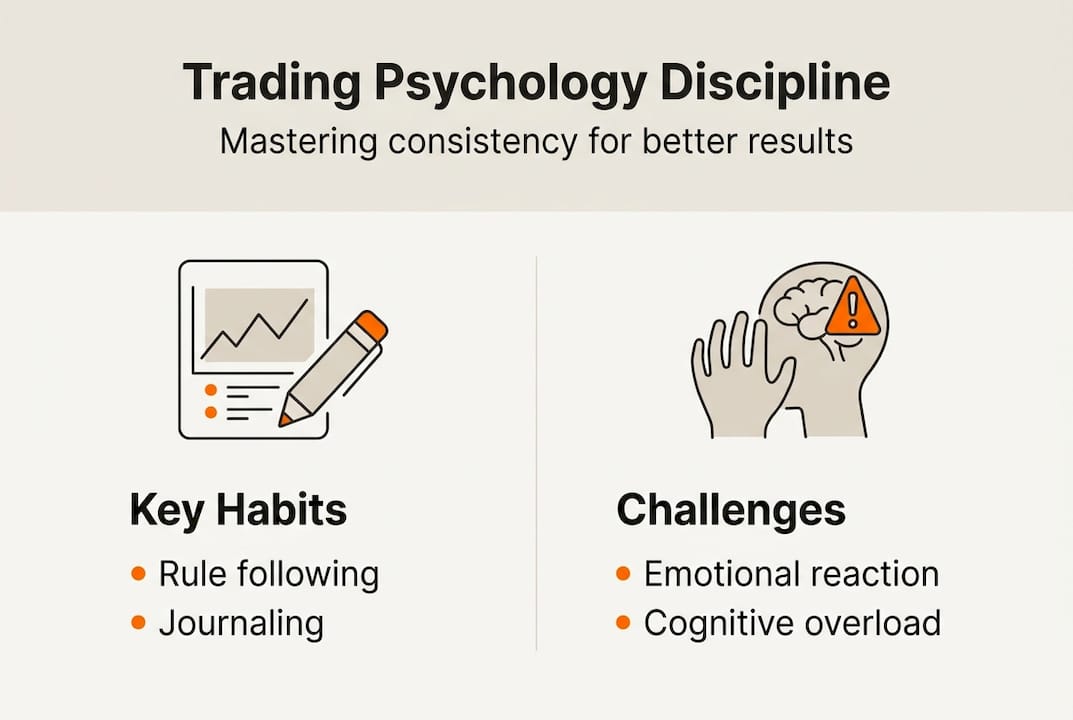
Cognitive overload compounds these challenges in volatile markets. You’re tracking multiple timeframes, monitoring news, watching price action, and managing open positions simultaneously. Your brain can’t process everything, so it takes mental shortcuts that introduce errors. You miss stop-loss adjustments. You enter trades based on incomplete analysis. You forget your risk limits mid-session. Managing cognitive load requires simplifying decision frameworks and reducing the variables you track in real time. That’s where manage risk trading consistent profits and professional risk management become essential. Structured risk rules remove decisions when emotions run high.
Proven methods to build discipline and consistency through trading psychology
Trading journals transform vague self-awareness into concrete behavioral data. Record every trade with entry reasoning, emotional state, rule adherence, and outcome. After 20 trades, patterns emerge. You notice you break rules most often during the last hour of your session when fatigue sets in. You see that trades taken after watching social media perform worse. You identify that your best trades come from specific setups where you waited for full confirmation. This data drives targeted improvement.
Effective journaling captures:
- Pre-trade plan: setup type, entry/exit levels, position size, risk percentage
- Emotional state: calm, anxious, excited, frustrated (rate 1 to 10)
- Rule adherence: did you follow your plan completely (yes/no with explanation)
- Outcome: profit/loss amount and percentage
- Lesson: one specific insight to apply to future trades
Review your journal weekly. Calculate your rule adherence percentage. Track how emotional state correlates with performance. You’ll discover that your win rate matters less than your consistency. Prioritize journaling and 1% risk rules to build discipline for retail FX and crypto traders. The 1% rule means risking only 1% of your account per trade, regardless of conviction level. This caps losses during inevitable drawdowns and prevents emotional decision-making when trades go wrong.
Process adherence over 100 trades with 90%+ rule-following yields consistency despite typical 50-60% win rates. Focus on executing your plan perfectly, not on whether individual trades win. Here’s how process focus changes performance:
| Approach | Win Rate | Rule Adherence | Result |
|---|---|---|---|
| Outcome Focused | 55% | 60% | Inconsistent, emotional trading, frequent drawdowns |
| Process Focused | 52% | 92% | Consistent profitability, controlled risk, scalable results |
The process-focused trader with a slightly lower win rate dramatically outperforms because they execute their edge consistently. The outcome-focused trader sabotages their own strategy by breaking rules when emotions spike. Over 100 trades, the difference compounds into the gap between funded traders and those who cycle through accounts.
Multi-dimensional confluence reduces false signals in volatile indices and crypto markets. Instead of entering on a single indicator, require three independent confirmations: trend direction on higher timeframe, support/resistance level, and momentum indicator alignment. This framework limits trades but increases quality. You take fewer setups with higher probability, reducing the emotional rollercoaster of frequent losses.
Pro Tip: Set automatic circuit breakers using calendar reminders. After any trade where you felt strong emotion (positive or negative), set a 30-minute timer before you can enter another position. After three losses in a session, stop trading for the day regardless of opportunities. After hitting 3% account drawdown in a week, reduce position size by 50% until you recover. These rules remove discretion when psychology is compromised. You can’t trust your judgment in the moment, so you trust the system you built when you were calm. This approach directly supports using trading rules to improve risk and accelerates progress toward building discipline and profitability. As you demonstrate consistency, you position yourself for trading account scaling tips that compound your edge across larger capital.
Advanced nuances in trading psychology for volatile FX, indices, and crypto markets
Cognitive load management determines decision quality under pressure. Your brain has limited processing capacity. When you track 12 indicators across 4 timeframes while monitoring news and managing 3 open positions, cognitive overload forces mental shortcuts that introduce errors. Simplified multi-factor signals improve accuracy by reducing variables to essential elements. Instead of analyzing everything, focus on three high-probability factors that align with your edge.
Use circuit breakers and multi-dimensional confluence to counter cognitive load in volatile markets. Circuit breakers are structured pauses triggered by specific events: consecutive losses, emotional trades, or hitting daily loss limits. These aren’t suggestions. They’re mandatory stops that prevent compounding mistakes when your psychology is compromised. You close your platform, step away, and reset before continuing.
Multi-dimensional confluence requires independent confirmation from separate analysis categories before entering trades. For indices, you might require: daily trend alignment, 4-hour support/resistance level, and 1-hour momentum confirmation. For crypto, you might need: weekly trend direction, significant volume level, and RSI divergence. This framework dramatically reduces trade frequency but increases win rate and average profit per trade.
| Approach | Trade Frequency | Avg Win Rate | Emotional Impact | Cognitive Load |
|---|---|---|---|---|
| Single Signal | High (8-12/day) | 48-52% | High stress, frequent losses | Overwhelming |
| Multi-Dimensional | Low (2-4/day) | 58-65% | Moderate, fewer decisions | Manageable |
The single signal approach generates constant activity and emotional volatility. You’re always in trades, always monitoring, always reacting. The multi-dimensional approach creates space between trades. You wait for high-probability setups, execute with confidence, and manage positions calmly. The psychological difference is profound.
Balancing risk and emotion during volatile swings requires pre-defined responses. Before crypto flash crashes or FX news events, you’ve already decided: if price moves X% against you, you exit at stop-loss without hesitation. If price moves X% in your favor, you trail stops by Y% to protect gains. These decisions made in advance remove emotion from execution. You’re not deciding whether to hold or fold when Bitcoin drops 8% in 20 minutes. You’re executing the plan you created when calm.
Expert traders separate analysis from execution. They build their trading plan during off-market hours when emotions are neutral. They identify setups, define entries, set stops, and calculate position sizes before the market opens. During live trading, they simply execute the plan. No discretion. No improvisation. This separation prevents emotional decision-making and reduces cognitive load during high-stress periods.
Pro Tip: Integrate psychological tactics into your trading evaluation guide securing funding process by treating evaluation periods as psychology tests, not just performance tests. Focus on demonstrating rule adherence, consistent risk management, and emotional control rather than maximizing profits. Prop firms fund traders who show discipline under pressure, not gamblers who got lucky. Document your process adherence. Show you can follow rules for 30+ consecutive trades. Prove you can handle drawdowns without revenge trading. This psychological consistency is what separates traders who pass evaluations from those who cycle through attempts. Your technical edge matters less than your ability to execute it consistently. That’s the insight that transforms your approach to indices trading strategy steps and accelerates your path to consistent funding.
Enhance your trading with DayProp Funding
Mastering trading psychology requires more than knowledge. It demands structured accountability, professional risk frameworks, and performance-based evaluation that rewards discipline over luck. DayProp’s performance-based trading evaluation process guide provides the framework to demonstrate your psychological consistency under real market conditions. You prove you can follow rules, manage risk, and execute your edge across volatile FX, indices, and crypto markets.
Our evaluation challenges test the exact psychological skills this article covers: adherence to risk limits, emotional control during drawdowns, and process consistency over outcome obsession. We provide transparent rules, professional risk parameters, and expert resources on manage risk trading consistent profits to support your development. When you pass evaluation, you receive funding to trade institutional capital without personal risk. Your discipline becomes your competitive advantage. Explore our trading evaluation guide secure prop funding to see how applying these trading psychology principles translates into consistent funding and long-term growth.
Frequently asked questions
What is trading psychology?
Trading psychology encompasses the mental and emotional aspects affecting your trading decisions, including how you process fear, greed, and uncertainty under market pressure. It determines whether you follow your trading plan or deviate based on emotion, directly impacting discipline and long-term profitability.
Why does maintaining discipline improve long-term profitability?
Discipline ensures you execute your edge consistently across many trades, allowing statistical probability to work in your favor. Without discipline, you sabotage your own strategy by breaking rules during emotional moments, turning a profitable system into inconsistent results regardless of technical skill.
How can I recognize and manage emotions during trading?
Track your emotional state in a trading journal, rating anxiety or excitement on a 1 to 10 scale for each trade. When you notice physical symptoms like racing heart or obsessive position checking, implement circuit breakers by closing your platform for 30 minutes to interrupt the emotional cycle.
How does journaling support self-awareness and process adherence?
Journaling creates concrete data on your behavioral patterns, revealing when and why you break rules. After 20+ entries, you identify specific triggers like fatigue or social media that correlate with poor decisions, allowing targeted improvements to your routine and environment.
What are circuit breakers and when should I implement them?
Circuit breakers are mandatory trading pauses triggered by specific events: consecutive losses, emotional trades, or daily loss limits. Implement them immediately after any trade where you felt strong emotion or deviated from your plan, preventing compounding mistakes when your psychology is compromised.
Recommended