

Transparent trading rule disclosure increases trader success rates by 25%, yet most retail traders overlook this critical factor when choosing proprietary trading platforms. Rule clarity isn’t just about reading fine print. It shapes your risk management, emotional discipline, and ability to secure funding in FX, indices, and crypto markets. This guide explains what trading rule transparency means, why it matters for funded traders, and how to leverage clear rules to pass evaluations and scale your accounts.
Table of Contents
- Introduction To Trading Rule Transparency
- How Trading Rule Transparency Enhances Risk Management
- Common Misconceptions About Trading Rule Transparency
- Framework For Understanding And Evaluating Trading Rule Transparency
- Practical Examples Of Transparent Trading Rules In FX, Indices, And Crypto
- Benefits Of Transparent Trading Rules For Funding Opportunities And Trader Performance
- Summary And How To Apply Trading Rule Transparency In Your Trading Practice
- Explore DayProp’s Transparent Trading Rules And Funding Programs
- Frequently Asked Questions About Trading Rule Transparency
Key Takeaways
| Point | Details |
|---|---|
| Transparency drives success | Clear trading rules reduce breaches and increase funded challenge pass rates by 25%. |
| Risk management improves | Defined limits on drawdown, position size, and daily losses keep traders disciplined. |
| Complex can be transparent | Well-communicated rules remain clear even when sophisticated. |
| Evaluation framework matters | Assess platforms on rule clarity, accessibility, enforcement, and feedback loops. |
| Tools support compliance | Real-time dashboards and documentation make transparency actionable. |
Introduction to Trading Rule Transparency
Trading rule transparency means clearly communicating every criterion, constraint, and expectation a trader must follow. In proprietary trading, this includes maximum drawdown limits, daily loss caps, position sizing rules, prohibited strategies, and profit targets. When platforms publish these parameters upfront and enforce them consistently, traders gain confidence from clear rules.
Retail traders pursuing funded accounts face a minefield of hidden restrictions and vague guidelines. Transparent rules eliminate surprises. You know exactly what behaviors trigger violations before risking capital or evaluation fees. This clarity improves discipline because boundaries are obvious, not subjective.
Benefits extend beyond rule compliance. Transparency fosters trust between traders and platforms. You can plan strategies around known parameters rather than guessing intentions. Emotional trading decreases when limits are concrete. Evaluation success rises because you understand exactly what evaluators measure.
Pro Tip: Always review platform rules in full before opening any live or evaluation account. Screenshot or save rule documents so you can reference them during trading sessions and avoid costly misunderstandings.
How Trading Rule Transparency Enhances Risk Management
Clear risk parameters are the foundation of sustainable trading. When platforms define maximum account drawdown, daily loss limits, and position size caps explicitly, you can structure trades within safe boundaries. Risk breaches decrease significantly when risk limits are clearly defined and communicated.
Emotional discipline improves when you know exactly where the line sits. Vague rules tempt traders to push boundaries or argue interpretations after violations occur. Transparent limits remove ambiguity. You either stay within parameters or you don’t. This binary clarity reduces stress and impulsive decisions during volatile market conditions.
Follow these steps to maximize risk management through transparency:
- Review all risk rules before trading, noting exact percentages and dollar amounts for drawdown and daily loss limits.
- Use platform monitoring tools or third-party dashboards that display real-time compliance metrics as you trade.
- Maintain a trading journal linking each position to specific risk parameters, reinforcing awareness of boundaries.
- Set personal alerts at 80% of maximum limits to create buffers before breaching rules.
Traders who combine transparent risk rules with technical analysis supporting risk control achieve consistency that separates funded professionals from gamblers. Clear limits don’t restrict profitability. They protect capital and ensure you survive long enough to capture winning trades.
Common Misconceptions About Trading Rule Transparency
Many traders mistakenly believe complexity equals opacity. Reality check: platforms with complex but clearly explained rules achieve success rates comparable to simpler rule sets. Transparency depends on communication quality, not rule simplicity. A platform can enforce sophisticated risk matrices while documenting every variable clearly.
Another myth claims strict rules can’t be transparent. Traders fear rigid parameters hide gotchas. Actually, strictness and transparency are independent. A platform can enforce tight daily loss limits while publishing exact thresholds, calculation methods, and violation consequences upfront. Consistency matters more than leniency. Knowing a rule is strict but predictable beats lenient rules applied arbitrarily.
The most dangerous misconception: transparency guarantees profits. Clear rules eliminate compliance surprises but don’t remove market risk. You still face volatility, slippage, and losing trades. Transparency creates a fair playing field where skill determines outcomes, not hidden traps or subjective enforcement.
Common false beliefs include:
- Transparent platforms must have simple rules (complexity can be clearly documented)
- Strict rules mean hidden penalties (strictness and clarity are separate)
- Rule transparency removes all trading risk (market uncertainty remains)
- Opaque platforms offer more freedom (lack of clarity creates stress and violations)
Pro Tip: Always ask platform support for clarifications if any rule seems ambiguous. Reputable platforms welcome questions and provide detailed explanations. Evasive responses signal potential transparency issues.
Framework for Understanding and Evaluating Trading Rule Transparency
Use this four-pillar framework to assess any platform before committing capital or evaluation fees. First, Clearly Defined Rules means every parameter is quantified. Look for specific percentages, dollar amounts, and concrete examples rather than vague phrases. Second, Easy Accessibility requires rules to be published where traders can find them anytime, not buried in lengthy legal documents.
Third, Consistent Enforcement means platforms apply rules uniformly across all traders without selective interpretation. Check reviews and forums for enforcement complaints. Fourth, Trader Feedback Loops involve support channels where you can ask questions, request clarifications, and appeal violations with evidence.
This comparison table shows how transparency manifests in practice:
| Pillar | Transparent Platform | Opaque Platform |
|---|---|---|
| Defined Rules | “Max daily loss: 5% of starting balance” | “Excessive daily losses prohibited” |
| Accessibility | Rules page linked in dashboard header | Rules hidden in 50-page PDF |
| Enforcement | Automated real-time violation alerts | Manual review with inconsistent decisions |
| Feedback | Live chat and email support respond in hours | Generic automated responses only |
Apply this framework by:
- Reading platform rule documents before signup and scoring each pillar
- Comparing multiple platforms using the same evaluation criteria
- Prioritizing platforms scoring high on all four pillars over those excelling in just one or two areas
- Checking evaluating trading platforms for transparency and performance-based evaluations to understand what professional evaluation looks like
Traders who systematically assess transparency before trading report fewer rule violations and higher evaluation success rates. The framework transforms vague impressions into actionable decision criteria.
Practical Examples of Transparent Trading Rules in FX, Indices, and Crypto
Leading platforms implement transparency through real-time compliance dashboards. These tools display current drawdown percentages, daily profit or loss, open position exposure, and distance to violation thresholds. Traders see exactly where they stand without manual calculations. This prevents accidental breaches and reinforces discipline.

Clear documentation goes beyond listing rules. Transparent platforms provide examples showing how rules apply in different scenarios. They explain how drawdown is calculated (from starting balance or peak balance?), when daily limits reset (midnight UTC or account opening time?), and what happens during weekends (do open positions count toward risk limits?).
Audit-friendly processes accelerate dispute resolution when questions arise. Trading audits are completed 20% faster when rule transparency standards are met. Platforms track every trade with timestamps, prices, and rule compliance status. If you believe a violation was incorrectly assessed, you can reference transparent logs to support your appeal.
This table compares transparency features across market types:
| Market | Real-Time Tools | Documentation Quality | Audit Support |
|---|---|---|---|
| FX | Live spread monitoring, position size calculators | Detailed pip calculation examples | Full trade history with rule flags |
| Indices | Market hours tracking, leverage indicators | Contract specifications and margin rules | Automated compliance reports |
| Crypto | 24/7 volatility alerts, wallet exposure metrics | Network fee impact on P&L explained | Blockchain-verifiable trade records |
Transparency best practices for traders:
- Use platform-provided dashboards as primary compliance monitors
- Save rule documentation versions in case policies change
- Test small positions first to verify your understanding of limits
- Participate in platform communities where experienced traders share rule interpretations
- Request written clarifications for any rule ambiguity before trading large sizes
Benefits of Transparent Trading Rules for Funding Opportunities and Trader Performance
Transparency directly impacts your ability to secure and keep funding. Platforms with clear rules see 25% higher challenge pass rates because traders avoid unintentional violations. You can focus energy on strategy execution rather than decoding hidden requirements. This confidence translates to better decision making under pressure.
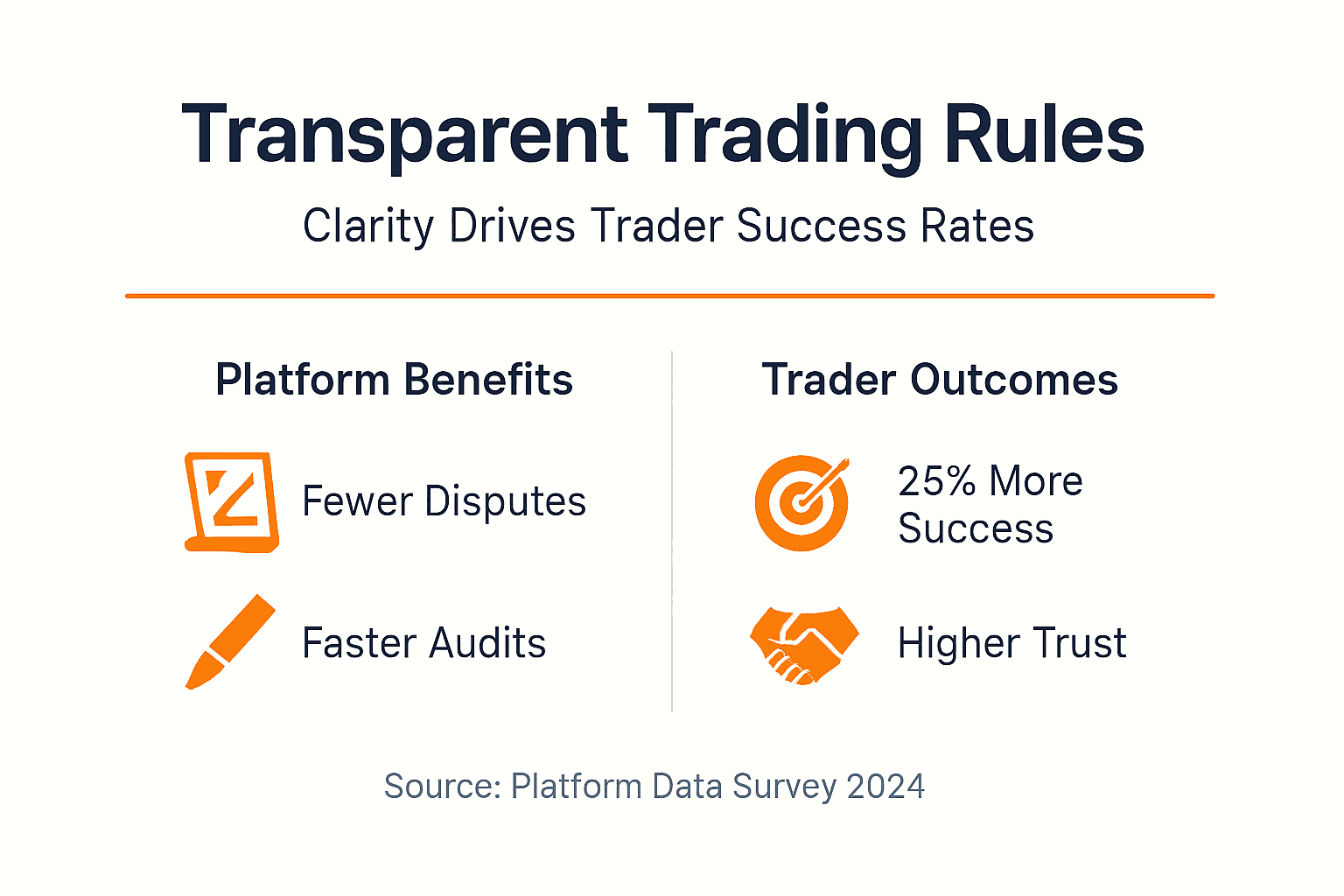
Trader motivation increases when success criteria are unambiguous. Knowing exactly what metrics determine funding eligibility creates clear goals. You can track progress objectively rather than wondering if subjective factors influence outcomes. Lower attrition rates follow because traders feel evaluation processes are fair and achievable.
Disciplined risk management becomes natural when rules provide structure. Transparent limits force you to size positions appropriately and exit losing trades before they spiral. Over time, these behaviors become habits that persist after you secure funding. You develop skills that ensure long-term profitability, not just challenge completion.
Key benefits linking transparency to performance:
- Funding success and transparency correlation shows traders using transparent platforms achieve funding faster
- Skills to leverage transparent rules transfer to live trading, creating consistency across evaluation and funded phases
- Disciplined growth with transparent rules enables account scaling without proportional risk increases
- Clear rules reduce psychological stress, allowing traders to focus on market analysis rather than compliance anxiety
- Transparent platforms attract serious traders, creating peer communities that share strategies and support development
Summary and How to Apply Trading Rule Transparency in Your Trading Practice
Trading rule transparency transforms how you approach funded trading opportunities. Clear, accessible, consistently enforced rules reduce breaches, improve discipline, and increase evaluation success rates by 25%. Transparency doesn’t eliminate market risk but creates fair conditions where skill determines outcomes.
Apply these steps to leverage transparency in your trading:
- Review platform rules thoroughly before opening any account, noting exact limits and calculation methods.
- Use real-time monitoring tools provided by the platform or third-party services to track compliance continuously.
- Maintain a detailed trading journal that links every decision to specific rules, reinforcing awareness of boundaries.
- Ask questions immediately when any rule seems unclear, requesting written clarifications you can reference later.
- Evaluate multiple platforms using the four-pillar framework (defined rules, accessibility, enforcement, feedback) before committing.
- Start with smaller challenges on transparent platforms to verify your understanding before scaling to larger accounts.
Choose platforms that publish complete rule sets, provide real-time compliance feedback, and enforce policies uniformly. Avoid platforms with vague language, hidden restrictions, or inconsistent violation decisions. Your success in funded trading depends as much on understanding rules as on market analysis skills.
Building discipline through transparent rules creates sustainable trading habits. You develop risk management instincts that protect capital in all market conditions. This foundation enables you to scale accounts, maintain funding, and achieve long-term profitability in FX, indices, and crypto markets.
Explore DayProp’s Transparent Trading Rules and Funding Programs
DayProp eliminates guesswork by publishing every rule upfront. Our performance-based trading evaluation process clearly defines risk limits, profit targets, and evaluation phases so you know exactly what’s required.
We offer structured challenges up to our $200,000 funding challenge with transparent entry criteria and consistent enforcement. Real-time dashboards track your compliance automatically, preventing accidental violations. Our support team answers rule questions promptly with detailed explanations, not generic responses. Explore the DayProp blog for trading tips on applying our transparent rules to FX, indices, and crypto strategies. Join traders who value clarity, discipline, and fair evaluation processes.
Frequently Asked Questions About Trading Rule Transparency
What does trading rule transparency mean?
Trading rule transparency means openly sharing clear, detailed trading criteria and limits so traders fully understand what is expected. It ensures rules are accessible, consistently enforced, and allow trader feedback. Transparent platforms quantify every parameter with specific numbers rather than vague descriptions.
How does transparency improve funded trading success?
Transparency helps traders follow risk limits and rules strictly, reducing breaches and emotional mistakes. It improves discipline and confidence, leading to a 25% higher chance of passing funding challenges. Clear boundaries let you focus on strategy execution rather than decoding hidden requirements.
Can complex trading rules still be transparent?
Yes, complexity doesn’t mean opacity if rules are clearly documented and explained. Clear communication and support channels make complex rules understandable and enforceable. Platforms can maintain sophisticated risk matrices while publishing every variable and calculation method upfront.
How to verify if a platform’s rules are transparent?
Check if the rules are published clearly and fully, accessible anytime. Look for real-time compliance tools and consistent enforcement policies. See if the platform offers support or feedback options on rules, and read trader reviews about enforcement experiences.
What steps help apply transparent rules to your trading?
Thoroughly review rules before trading, noting exact percentages and limits. Use monitoring dashboards to track compliance in real time. Maintain a trading journal linking decisions to rules, reinforcing awareness of boundaries. Ask questions to clarify uncertainties before they lead to violations.
Recommended
- Grow Trading Capital: 70% Avoid Failure with 2-5% Returns – DayProp Funding
- Trading Account Growth: Pathways to Consistent Gains – DayProp Funding
- 6 Essential Trading Skills Every Funded Trader Needs – DayProp Funding
- Indices Trading Strategy Steps for Consistent Funding – DayProp Funding
- Dragonfly Capital Launches $650M Crypto Fund Amid Market Turmoil / Naijatipsland