

TL;DR:
- Leverage allows traders to control larger positions with less capital, but it must be used within a systematic risk management framework. Responsible traders employ strict position sizing, stop placement, and leverage limits to avoid catastrophic losses and ensure consistent progress. Mastering leverage through disciplined processes distinguishes successful traders from those prone to account depletion.
Leverage is one of the most debated tools in retail trading, and its reputation is deeply polarizing. Most retail CFD accounts lose money, and leverage is often cited as a primary reason. Yet dismissing leverage entirely misses the point. When applied within a structured framework of position sizing, risk controls, and consistent process, leverage becomes a precision instrument rather than a liability. This guide covers what leverage actually is, why disciplined traders use it strategically, how it creates risk when misused, and what best practices separate profitable traders from the majority who fail.
Table of Contents
- What is leverage in trading?
- Why use leverage? Benefits and strategic advantages
- Risks and realities: The dangers of leverage for retail traders
- Best practices for using leverage safely
- Why mastering leverage is the real edge most traders miss
- Next steps: Apply discipline and get evaluated for capital
- Frequently asked questions
Key Takeaways
| Point | Details |
|---|---|
| Leverage amplifies both gains and risk | It allows you to control more capital per trade but can cause rapid losses without strict discipline. |
| Most traders misuse leverage | Over 70% of retail accounts lose money, often from poor leverage and risk controls. |
| Moderate leverage maximizes opportunity | Smart leverage paired with position sizing and stops can create a strategic edge for disciplined traders. |
| Risk management is essential | Structured plans incorporating position sizing and stop losses are non-negotiable for using leverage safely. |
| Mastery requires a system | A methodical, rule-based approach to leverage separates successful traders from the rest. |
What is leverage in trading?
Leverage in trading allows you to control a position larger than your deposited capital. You commit a fraction of the total trade value, known as margin, and your broker or platform funds the rest. This ratio is expressed as 5:1, 10:1, 50:1, or even 100:1 depending on the asset class and platform rules.
A simple example illustrates the mechanics clearly. At 10:1 leverage, a $1,000 margin deposit controls a $10,000 position. A 2% move in your favor generates a $200 return on a $10,000 exposure, which equals 20% on your actual margin. Without leverage, that same 2% move returns just $20 on a $1,000 position. The amplification works both ways: a 2% adverse move loses $200, not $20.
Leverage is most widely used across three markets:
- Forex (FX): Currencies typically move in small increments, making leverage necessary for retail traders to generate meaningful returns from short-term price moves. Regulated brokers in the U.S. cap FX leverage at 50:1 for major pairs.
- Indices: Trading instruments like the S&P 500, NASDAQ, or DAX via CFDs or futures allows access to broad market exposure with controlled capital outlay.
- Crypto: Cryptocurrency derivatives offer some of the highest leverage ratios available, sometimes exceeding 100:1, though this comes with substantially elevated liquidation risk in fast-moving markets.
| Leverage ratio | Margin required | Position size controlled |
|---|---|---|
| 5:1 | $2,000 | $10,000 |
| 10:1 | $1,000 | $10,000 |
| 50:1 | $200 | $10,000 |
| 100:1 | $100 | $10,000 |
Platforms offer leverage primarily because it increases trading volume and transaction frequency. For traders, understanding the hidden costs of leverage is essential. Overnight financing charges, spread costs on larger notional sizes, and margin call mechanics all reduce net returns.
Pro Tip: Responsible traders approach managing risk with leverage by establishing maximum position sizes before placing any trade. A clear rule, such as risking no more than 1% of account equity on any single position, removes emotional decision-making from the equation. As leverage experts note, leverage can only be used correctly when the trading plan is built around position sizing, stop placement, and the reality of liquidation risk, particularly in the 24/7 crypto market where gaps and sudden volatility are routine.
Why use leverage? Benefits and strategic advantages
With a clear grasp of leverage mechanics, the case for using it responsibly becomes more apparent. Disciplined traders do not use leverage to chase outsized gains. They use it to operate efficiently with available capital, scale structured strategies, and maintain flexibility across market conditions.
Capital efficiency is the primary benefit. Without leverage, generating consistent absolute returns from small short-term moves in liquid markets like FX requires large capital commitments. A trader with $5,000 in account equity who wants meaningful exposure to a EUR/USD move would find unleveraged positions yield minimal dollar returns. Moderate leverage changes that equation without forcing the trader to deposit capital beyond their risk tolerance.
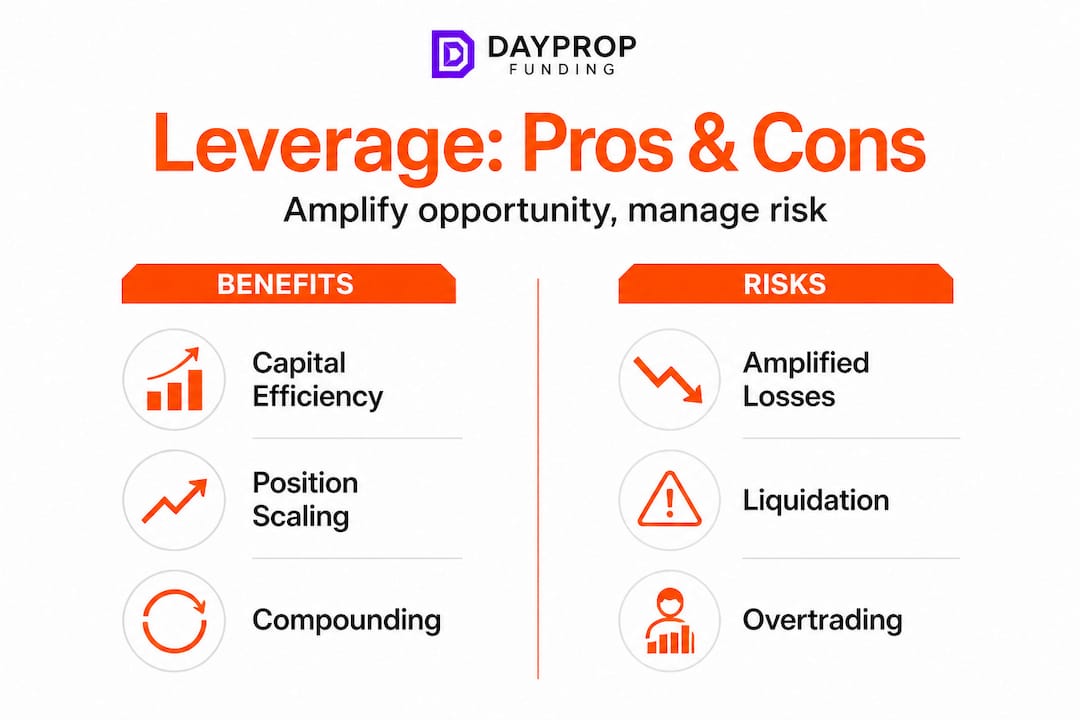
Efficient position scaling allows traders to diversify across multiple setups simultaneously. Rather than committing all available capital to one position, a trader can allocate margin across several trades in different asset classes, maintaining overall portfolio balance while adhering to their risk rules.
Consider how FX trading best practices emphasize the ability to take structured exposure across correlated and uncorrelated pairs. This flexibility matters because a single-position approach to unlevered trading concentrates both opportunity and risk into one outcome.
Here is a comparison showing how leverage affects hypothetical trade returns under the same market conditions:
| Scenario | Account size | Leverage | Position size | Market move | Dollar P&L | Return on account |
|---|---|---|---|---|---|---|
| No leverage | $10,000 | 1:1 | $10,000 | +2% | +$200 | +2% |
| Moderate leverage | $10,000 | 5:1 | $50,000 | +2% | +$1,000 | +10% |
| High leverage | $10,000 | 20:1 | $200,000 | +2% | +$4,000 | +40% |
| High leverage (loss) | $10,000 | 20:1 | $200,000 | -2% | -$4,000 | -40% |
The table makes visible what disciplined traders understand instinctively. Moderate leverage amplifies returns without pushing the account toward catastrophic loss territory on a single adverse move. Aggressive leverage at 20:1 on a 2% loss would wipe 40% of the account in one trade.
Enabling responsible compounding is another strategic advantage. Traders who consistently apply leverage at controlled ratios, say 3:1 to 5:1, with strict stops and a positive expectancy strategy, can compound returns over time without the volatility destruction that aggressive leverage brings. This compounding effect matters tremendously for those pursuing long-term performance records. For context on building this type of record, reviewing trading success factors clarifies what separates sustainable performance from lucky streaks.
Pro Tip: In prop trading evaluations, using lower leverage than the maximum permitted is often a strategic advantage. It demonstrates risk awareness, reduces drawdown volatility, and makes it easier to maintain the consistency metrics that funded account evaluations require.
Risks and realities: The dangers of leverage for retail traders
An honest discussion of leverage requires direct examination of why it damages so many retail trading accounts. The numbers are not subtle. Retail loss rates across regulated CFD and FX providers consistently show 71% to 79% of retail accounts lose money. This statistic, required by regulatory disclosures from FCA and ESMA-regulated brokers, reflects a real pattern rather than selective data.
“The majority of retail investor accounts lose money when trading CFDs and leveraged products. These figures are reported by regulated brokers under requirements from the FCA and ESMA.”
Understanding why so many traders lose with leverage requires examining four primary failure modes:
- Overleveraging: Using 50:1 or 100:1 leverage on volatile instruments like crypto means a 1% adverse move generates a 50% to 100% loss on margin. Many retail traders mistake maximum available leverage for appropriate leverage.
- Poor stop loss placement: Setting stops too wide relative to position size, or not using stops at all, allows losing trades to run far beyond planned risk. In fast markets, this accelerates losses beyond intended levels.
- Trading position sizes that are too large: A single oversized position can eliminate weeks of consistent gains in one session. Proper position sizing is a mathematical discipline, not an intuition exercise.
- Market whipsaws and gaps: Prices sometimes move sharply against open positions due to news events, economic data releases, or low-liquidity periods. In crypto’s 24/7 market, gap risk is particularly pronounced during weekends or exchange-specific disruptions.
Understanding trader discipline and risk is directly linked to survival in leveraged markets. Without process, even temporary drawdowns can become permanent account losses through the compounding effect of repeated overleveraged trades.
Numbered steps for minimizing leverage disaster risk:
- Calculate your position size based on account equity and maximum acceptable dollar risk per trade, not on gut feeling.
- Place stop loss orders at technically validated levels before entering any trade.
- Track your leverage ratio actively and set a maximum threshold you will not exceed, regardless of conviction level.
- Monitor drawdown limits relative to both daily and overall account parameters.
- Reduce position size after a losing streak. Averaging down or increasing size to recover losses is one of the fastest paths to account liquidation.
Liquidation mechanics deserve specific attention. In crypto futures and CFDs, when a position moves against you to the point where margin falls below the maintenance requirement, the platform closes the trade automatically. You do not receive a phone call. You receive a confirmation that your position has been liquidated. The remaining balance, if any, is what is left. This automatic closure without trader discretion is structurally different from traditional stock trading and must be factored into every leveraged trade plan.
Best practices for using leverage safely
Top traders treat leverage as a parameter within a rule-based system, not as a dial they turn up when they feel confident. The distinction matters enormously for long-term performance.
Position sizing with leverage starts with defining maximum risk in dollar terms before calculating how large a position to take. If your rule is to risk 1% of a $20,000 account on each trade, that means a maximum risk of $200 per trade. With a stop loss set 30 pips away on EUR/USD, you can calculate the appropriate lot size to keep that loss within your threshold. Leverage determines how much notional exposure that lot size represents, but the loss amount is fixed by your sizing rule. Documented frameworks on using leverage safely in crypto futures reinforce that position sizing and stop discipline are the foundational controls, not leverage ratio selection itself.
Risk/reward targeting should follow consistent rules for every trade. Many disciplined traders target a minimum 2:1 reward to risk ratio, meaning they will only enter a trade where the expected gain is at least twice the expected loss. Over a series of trades, this ratio allows a strategy to remain profitable even with a win rate below 50%.
Best practices checklist for disciplined leverage use:
- Set a hard maximum leverage ratio for each asset class and do not exceed it
- Use stop loss orders on every leveraged position without exception
- Size positions using a fixed percentage risk model tied to account equity
- Track margin utilization as a percentage of total account balance before each new trade
- Review crypto risk management rules specific to the 24/7 nature of crypto derivative markets
- Never add to a losing position with additional leverage
- Assess liquidation price before entry on any crypto futures or high-leverage CFD position
Pro Tip: Keep a trading log that records not only entry and exit prices but also the leverage ratio used, position size, stop placement rationale, and post-trade review notes. Reviewing this log weekly reveals patterns in where leverage discipline holds and where it breaks down. That pattern recognition is what separates improving traders from those who repeat the same costly behaviors.
Why mastering leverage is the real edge most traders miss
Most traders who struggle with leverage are not struggling with leverage specifically. They are struggling with the absence of a structured process. Fear of leverage, when examined closely, is typically fear of uncertainty and lack of control. Without a documented system governing position sizing, stop placement, and maximum risk per trade, any leverage ratio becomes dangerous. With a robust system, even moderate leverage becomes a managed variable rather than a threat.
The difference between traders who blow up and traders who build funded accounts is not their ability to predict markets. It is their relationship with process. Professional traders operating with institutional or proprietary capital follow explicit rules. They know their maximum daily drawdown before markets open. They know their position size limits. They know their leverage caps. These rules are not suggestions. They are operating constraints.
Here is the insight most educational content on leverage gets wrong: the danger is not the leverage ratio number itself. A 10:1 position managed with precise stops and consistent sizing is structurally less risky than a 2:1 position where the trader moves stops, adds to losses, and trades without a clear plan. The ratio is secondary. The process is primary.
This is especially relevant in prop trading environments where the evaluation criteria center on trading psychology as much as on raw returns. Evaluators look for traders who demonstrate that their behavior is rule-bound and repeatable. Inconsistent leverage use, even if it produces short-term gains, signals a process that will eventually fail at scale. Mastering leverage means internalizing it as one variable inside a larger systematic framework rather than treating it as either a growth accelerator or a risk to avoid.
Next steps: Apply discipline and get evaluated for capital
For disciplined traders ready to implement a structured approach, real opportunity starts with the right process, accountability, and evaluation path.
The principles covered in this guide, specifically conservative leverage ratios, rigorous position sizing, consistent stop placement, and rule-based decision-making, are precisely the behaviors that DayProp Funding evaluates and rewards. Our performance-based evaluation guide outlines exactly how disciplined traders can demonstrate their edge and progress toward funded accounts in FX, indices, and crypto markets. Understanding the range of available formats through our trading challenge types allows you to select the structure that best matches your trading style and risk approach. For traders who have built a systematic process around leverage and risk management, the next step is demonstrating it under evaluation conditions.
Frequently asked questions
What is the main advantage of using leverage in trading?
Leverage lets you control a larger position size with less capital, maximizing opportunity when used with discipline and proper position sizing. As noted in safe leverage frameworks, its value depends entirely on how well it is integrated into a structured trading plan.
How much leverage is safe for a retail trader?
There is no universal safe ratio, but conservative leverage combined with strict stops and small position sizes significantly reduces the risk of catastrophic loss. Guidance on moderate leverage use consistently emphasizes that higher ratios leave progressively less room before losses accelerate toward liquidation.
Why do most retail traders lose money with leverage?
Most lose because they use excessive leverage, set stops too wide or not at all, and underestimate liquidation risk in fast-moving markets. Retail trading data shows loss rates of 71% to 79% across regulated CFD and FX accounts.
What markets offer the highest leverage to retail traders?
Cryptocurrency derivatives and FX markets offer the highest leverage ratios available to retail traders. Crypto’s volatility and 24/7 exposure make high leverage in that market particularly consequential when trades move adversely.
Can you use leverage safely in highly volatile markets?
Yes, but only with a pre-defined plan covering position sizing, strict stop placement, and constant monitoring of liquidation price levels. Safe leverage application requires that every variable is controlled before the trade is entered, not adjusted reactively during market movement.
Recommended
- How to manage risk in trading for consistent profits 2026 – DayProp Funding
- Understanding maximum loss in trading: safeguard your capital – DayProp Funding
- Why use trading rules: improve risk and gain funding in 2026 – DayProp Funding
- Grow Trading Capital: 70% Avoid Failure with 2-5% Returns – DayProp Funding
- Maximize Trading Performance By Optimizing Your Algorithms