

TL;DR:
- Most retail traders fail mainly due to psychological and behavioral issues rather than lack of analysis.
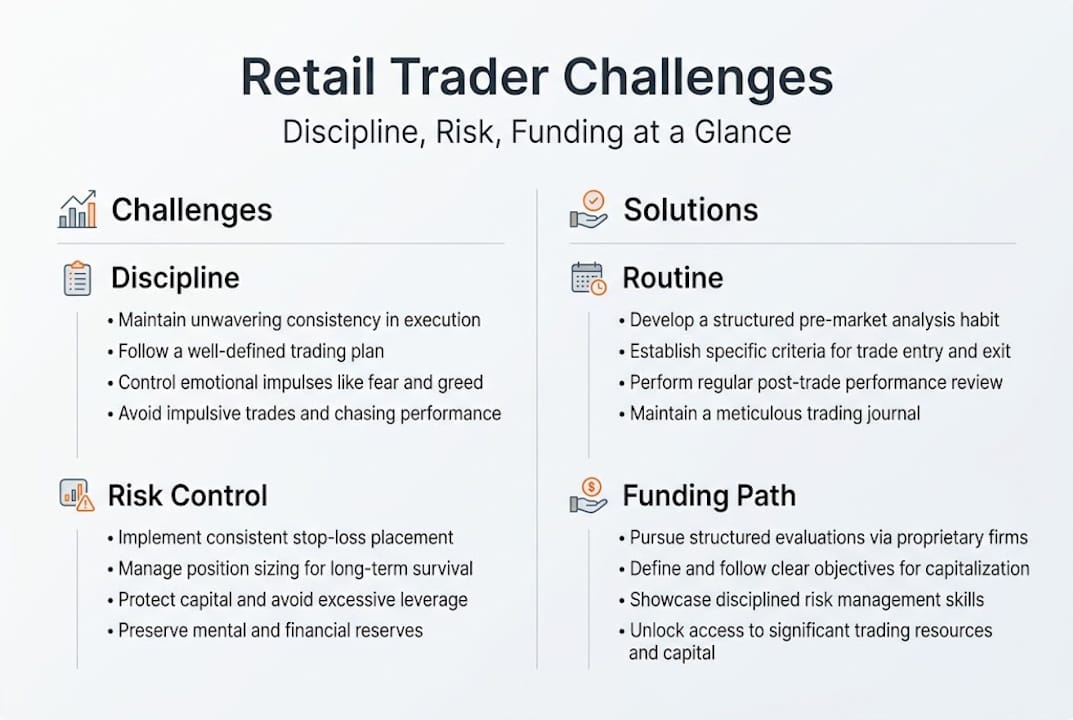
- Discipline, structured risk management, and consistent habits are essential for long-term trading success.
- Access to proper capital and maintaining strict rules increase chances of passing funding evaluations and building wealth.
Between 70 and 90 percent of retail traders lose money consistently, yet most of them have studied charts, read books, and followed market news for months or years. The uncomfortable reality is that knowledge rarely separates profitable traders from losing ones. What actually determines long-run performance is behavioral control, structured risk management, and access to sufficient capital. This guide breaks down each of those three pillars in practical terms, with specific frameworks you can apply in FX, indices, and crypto markets. If you are serious about turning consistent effort into consistent results, the information ahead is worth your full attention.
Table of Contents
- Why do most retail traders fail?
- The discipline gap: Trading process, consistency, and mindset
- Risk management: The rules most traders break
- Accessing capital: Challenges and pathways to trader funding
- A hard truth: Why trading success demands more than knowledge
- Upgrade your trading journey with funding and support
- Frequently asked questions
Key Takeaways
| Point | Details |
|---|---|
| Mindset and discipline matter most | Over 80% of traders lose due to emotional and behavioral mistakes, not lack of theory. |
| Strict risk management is essential | Limiting risk to 1-2% per trade and using clear stop-losses protects your trading account. |
| Process trumps prediction | Success comes from following structured routines and journaling, not chasing the perfect trade. |
| Funding requires proven consistency | Only disciplined, risk-aware traders consistently earn prop funding and grow capital. |
Why do most retail traders fail?
The statistics are difficult to ignore. Retail traders face failure rates of 70 to 90 percent across asset classes, and the numbers are even more striking when you look at day trading specifically. The common explanation is that losing traders simply do not know enough about markets. That explanation is wrong.
“97% of day traders fail, and 80% of those losses trace back to psychology and behavior, not analytical ability.”
This means the vast majority of retail traders already understand technical analysis, support and resistance, and basic risk concepts. They fail because they cannot execute their plans under real market pressure. Understanding the key retail trading challenges means confronting behavioral patterns, not just analytical gaps.
Common myths vs. reality:
| Myth | Reality |
|---|---|
| Traders fail because they lack strategy | Most failing traders have a strategy but abandon it under pressure |
| More indicators mean better decisions | Indicator overload leads to analysis paralysis and late entries |
| Profitable traders take big risks | Professionals use strict position sizing and accept small, frequent losses |
| Losing streaks mean the system is broken | Losing streaks are statistically normal; abandoning systems during them is the real problem |
| You need a high win rate to be profitable | Risk-to-reward ratio matters more than win percentage |
The specific behavioral pitfalls that repeat across losing traders include:
- Overtrading: Taking positions out of boredom or to recover losses, not because a setup qualifies
- Impulse entries: Entering trades without waiting for confirmation signals
- Ignoring stop-losses: Moving stops further away when a trade goes against you
- Position sizing errors: Risking too much on a single trade after a winning streak
- Revenge trading: Attempting to recover a loss immediately with a larger, unplanned position
The benefits and hurdles for retail traders are well documented, and the pattern is consistent. Traders who survive long enough to become profitable do so by solving behavioral problems, not by finding better indicators.
The discipline gap: Trading process, consistency, and mindset
Behavioral pitfalls are preventable when you build discipline into your process rather than relying on willpower alone. Willpower is finite. A structured routine is not.
Mastering trading discipline starts with accepting that your daily process determines your results more than any individual trade. Research supports this directly: one trading system, consistent journaling, and a fixed risk rule per trade are the three habits that separate improving traders from stagnating ones.
Habits of disciplined traders vs. undisciplined traders:
- Disciplined: Follows a written trading plan for every session
- Undisciplined: Adjusts the plan based on how the morning feels
- Disciplined: Reviews every trade in a journal, win or loss
- Undisciplined: Only reviews losing trades, and only when frustrated
- Disciplined: Stops trading after hitting a daily loss limit
- Undisciplined: Continues trading to recover losses, often compounding them
- Disciplined: Sizes positions based on pre-set risk rules
- Undisciplined: Sizes positions based on confidence level or recent results
Avoiding emotional trading requires structure that removes in-the-moment decision-making. The best traders do not make many decisions during a live session. They make decisions before the session starts and then execute a pre-defined plan.
Steps to implement a discipline system this week:
- Write a one-page trading plan that defines your setup criteria, entry rules, stop placement, and profit targets
- Create a pre-trade checklist with five to seven questions you must answer before placing any order
- Set a maximum daily loss limit and a rule that stops trading immediately when it is hit
- Open a trading journal and record every trade with entry reason, outcome, and emotional state
- Review your journal at the end of each week and identify the one behavioral pattern causing the most damage
Pro Tip: A pre-trade checklist is one of the most effective tools available. Discipline techniques including trading plans, checklists, and journaling are consistently cited by professional traders as foundational, not optional. Use trading psychology essentials to build the mental framework that keeps your checklist honest.
Risk management: The rules most traders break
Even perfect discipline will not save you if your risk parameters are poorly designed. Risk management is the structural layer beneath discipline, and most retail traders break its core rules repeatedly.

The most common violations include trading position sizes that are too large, skipping stop-losses because a trade “feels” right, and engaging in revenge trading after a loss. Each of these behaviors accelerates account drawdown in ways that are mathematically difficult to recover from.
Risk benchmarks by asset class:
| Asset class | Recommended risk per trade | Typical stop-loss range | Volatility level |
|---|---|---|---|
| FX (major pairs) | 1% of account | 10-30 pips | Low to moderate |
| Indices (S&P 500, DAX) | 1-1.5% of account | 5-15 points | Moderate |
| Crypto (BTC, ETH) | 0.5-1% of account | 1-3% price move | High |
Professional risk methods consistently point to 1 to 2 percent risk per trade as the standard that preserves capital long enough for a trader’s edge to play out statistically. Crypto requires tighter sizing because overleveraging in volatile markets is the fastest documented path to account failure.
Pro Tip: Decide your stop-loss level and position size before you enter any trade, not after. Post-entry decisions are almost always emotionally influenced and statistically worse than pre-entry decisions.
The unbreakable risk rules followed by professional traders:
- Never risk more than 2% of total account equity on a single trade
- Always place a stop-loss before the trade is live, not after
- Do not increase position size after a winning streak without reviewing your statistical edge
- Reduce position size by 50% during a drawdown period until performance stabilizes
- Never add to a losing position to average down without a pre-defined plan for doing so
For crypto risk management rules and proven FX risk management frameworks, the underlying principle is the same: protect capital first, and let your edge generate returns over time.
Accessing capital: Challenges and pathways to trader funding
With discipline and risk controls in place, the final obstacle for most retail traders is capital. Limited personal funds push traders toward oversized positions and short-term thinking, both of which conflict directly with professional risk management.
Popular funding avenues for retail traders:
- Personal savings: Full control, but limited scale and high personal risk
- Proprietary trading firms: Access to institutional capital in exchange for passing a structured evaluation
- Trading competitions: Prize-based funding, often with short time horizons that encourage risk-taking
- Social trading platforms: Profit-sharing based on follower capital, requires a public track record
- Investor backing: Informal arrangements that require an audited performance history
Prop trading evaluations are the most structured and scalable path for disciplined traders. However, only 5 to 10 percent of traders who attempt prop challenges successfully gain funding. The failure rate mirrors the broader retail trading failure rate for the same reasons: poor discipline and weak risk management.
Steps to qualify for a prop firm funding account:
- Review the evaluation rules in full before trading a single position, paying close attention to maximum drawdown limits and daily loss caps
- Trade your challenge account exactly as you would trade a funded account, with no behavioral changes
- Prioritize capital preservation in the first third of the evaluation period to build a buffer
- Maintain a consistent position size throughout the evaluation rather than scaling up to hit profit targets faster
- Document every trade during the evaluation to identify patterns and demonstrate process to reviewers
Knowing how to secure prop trading funding requires understanding what evaluators actually measure. It is not raw profit. It is consistency, drawdown control, and rule adherence. You can compare funding models to find the structure that aligns with your trading style, and use a structured funding challenge guide to prepare systematically.
A hard truth: Why trading success demands more than knowledge
Most retail traders spend their first year collecting information. They read about strategies, study indicators, watch webinars, and follow analysts. Very few of them build a repeatable daily process and stick to it through losing periods. That distinction is what actually separates funded traders from the majority who cycle through accounts.
Institutions understand retail behavioral patterns well. They know that most retail participants will overtrade during volatility, abandon systems during drawdowns, and size up positions after wins. Structure is your defense against those tendencies. Trading with a disciplined approach means accepting that boredom and adversity are part of any legitimate trading process, not signs that your system needs changing.
The practical steps that actually move the needle are straightforward: commit to one trading system for a minimum of three months without modification, and conduct a five-minute written reflection after every session. Not after every trade. After every session. Those two habits, applied consistently, produce more measurable improvement than any new strategy or indicator you could add.
Upgrade your trading journey with funding and support
If you are ready to move from understanding these principles to applying them in a structured environment, DayProp offers the resources to help you do exactly that.

DayProp’s prop trading evaluation guide walks you through the full process of preparing for and passing a funded account evaluation. The trading challenges guide covers the specific challenge formats you will encounter, and the step-by-step funding guide gives you a clear preparation framework. DayProp is built for traders who are serious about process, consistency, and long-term capital growth. If that describes you, the next step is straightforward.
Frequently asked questions
What is the biggest challenge for retail traders?
The biggest challenge is managing emotions and discipline. Over 80% lose from behavioral mistakes rather than information gaps, making psychology the primary obstacle for most retail participants.
How much should a retail trader risk per trade?
Experts recommend 1 to 2 percent of account equity per trade. This limit preserves capital through losing streaks and allows a trader’s statistical edge to produce results over time.
Why do prop trading challenges have a low success rate?
Most traders fail prop challenges because of poor discipline, overtrading, and inadequate risk controls. Only 5 to 10 percent of challenge participants succeed, reflecting the same behavioral issues that drive broader retail failure rates.
How can retail traders improve discipline?
Follow a written trading plan, journal every trade, and use a pre-trade checklist before each entry. Discipline techniques including checklists and cooling-off periods after losses are consistently identified as the most effective behavioral tools available.
Recommended
- Types of trading challenges every retail trader should master – DayProp Funding
- FX Trading Best Practices: Proven Strategies for Retail Success – DayProp Funding
- Why fund retail traders: benefits and challenges 2026 – DayProp Funding
- Structured trading challenge: Step-by-step guide to funding – DayProp Funding