

TL;DR:
- Most traders fail prop evaluations primarily due to misunderstanding rules, especially drawdown limits, rather than trading inability.
- Preparation through thorough rule comprehension, paper trading, and conservative risk management is essential to success in prop assessments.
Most traders who fail a prop trading evaluation do not fail because they cannot trade. They fail because they did not understand the rules well enough before they started. A step by step prop trading evaluation requires more than a profitable strategy. It demands a systematic approach to risk management, rule compliance, and behavioral discipline that most retail traders have never had to practice at this level. This guide covers every phase of the process, from preparation through funded account activation, so you enter your next evaluation with a clear plan rather than guesswork.
Table of Contents
- Key takeaways
- What you need before starting a prop trading evaluation
- Executing the evaluation step by step
- Common mistakes that cause evaluation failures
- How to verify success and prepare for a funded account
- What I have learned from seeing hundreds of evaluations
- Start your evaluation with the right resources
- FAQ
Key takeaways
| Point | Details |
|---|---|
| Drawdown is the real test | Daily loss limit breaches cause 85% of evaluation failures, not missed profit targets. |
| Paper trade before you pay | Test your strategy against firm-specific rules for at least two weeks before beginning a paid evaluation. |
| Consistency rules matter | No single trading day should generate more than 30% to 50% of your total profit target. |
| Set personal safety buffers | Trade as if your real limits are 1% to 2% below the firm’s stated thresholds to prevent accidental breaches. |
| Verification is step five | Passing the profit target is only the start. Confirm consistency compliance before claiming your funded account. |
What you need before starting a prop trading evaluation
Preparation is where evaluations are won or lost. Most traders skip this phase and pay for it.
Choosing the right firm and account size
Not all evaluation programs are structured the same way. Evaluation fees range from $49 to $500 depending on account size, with profit splits ranging from 70% to 90%. Selecting an account size that matches your actual trading style is critical. A $25,000 account has different dollar-value drawdown thresholds than a $100,000 account, even when the percentage rules are identical.
Before committing, read the official terms document for your chosen firm from start to finish. Pay specific attention to four areas: the profit target percentage, the maximum drawdown limit, the daily loss limit, and any consistency rules. Write these numbers down in dollar terms, not percentages.
Understanding evaluation rules in full
Daily loss limits are typically set at 4% to 6% of the starting balance, while maximum trailing drawdown rules sit at 8% to 12%. These are the hard boundaries that determine whether you remain in the evaluation or get reset.

Two rule types that confuse many traders are trailing drawdown and static drawdown. Trailing drawdown rises with your equity highs, locking your floor progressively higher as you profit. Static drawdown stays fixed to your starting balance. Knowing which type applies to your account changes how aggressively you should trade in the early sessions.
News trading policies and overnight holding restrictions also vary significantly. Some firms permit news trading while others enforce blackout periods around major economic releases. Confirm these rules before placing a single trade.
Setting up tools and testing your strategy
Your trading platform, risk calculator, and position sizing tools should all be configured before day one. If you plan to use an Expert Advisor, test it on a demo account running the firm’s exact parameters.
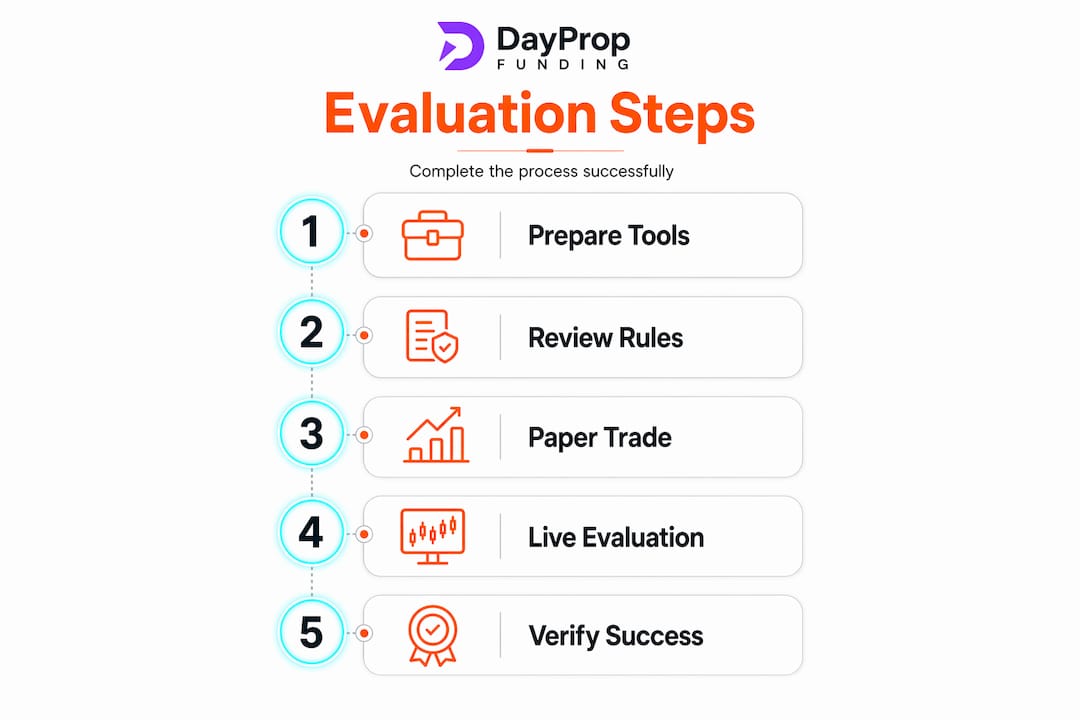
Pro Tip: Paper trade under firm rules for a minimum of two weeks before paying any evaluation fee. This surfaces rule conflicts in your strategy before they cost you money.
The table below summarizes common evaluation rule structures across the industry to help you benchmark what you are signing up for.
| Parameter | Typical range | Notes |
|---|---|---|
| Profit target | 8% to 10% | Two-phase evaluations may require 5% in phase one |
| Daily loss limit | 4% to 6% | Usually calculated on starting or current balance |
| Max drawdown | 8% to 12% | Trailing or static depending on firm |
| Consistency rule | Max 30% to 50% per day | Best day cannot represent most of total target |
| Evaluation fee | $49 to $500 | Refundable on some programs after first payout |
Executing the evaluation step by step
Once your account is active and your rules are memorized, execution begins. Follow this sequence from day one through completion.
-
Activate the account and set your dollar limits. Convert every percentage threshold into an exact dollar figure. Post these numbers somewhere visible while you trade. Your daily loss limit on a $50,000 account at 5% is $2,500. Treat that number as absolute.
-
Size positions conservatively in week one. Use 0.5% to 1% of account equity per trade for the first five to seven trading days. This phase is for confirming that your strategy works within the firm’s conditions, not for accelerating toward the profit target. Trailing drawdown traps traders by locking bust levels at equity peaks. Small early positions protect you from getting pushed out before you find your rhythm.
-
Apply stop-loss orders to every trade without exception. Your stop-loss should be sized so that even if three consecutive trades hit their stops, your daily loss stays below 60% of the daily limit. This buffer is not optional.
-
Manage news and volatility events deliberately. Check the economic calendar each morning. If a high-impact release falls during your preferred trading window, either close open positions beforehand or widen your stop expectations and reduce position size. Intraday trailing drawdowns are less forgiving than end-of-day calculations, which means a sharp spike during a news event can breach your limit even when the price recovers within minutes.
-
Distribute profits across multiple sessions. The consistency rule prevents you from passing with one standout day. Aim to generate no more than 25% of your total profit target on any single day, even if the firm allows up to 50%. Spreading profits across eight to twelve trading sessions is a practical standard.
-
Track real-time drawdown throughout each session. Do not rely on end-of-day reports. Use your platform’s account monitoring tools or a spreadsheet to track your floating equity every hour. If your floating drawdown reaches 70% of the daily limit during a session, reduce exposure immediately.
-
Configure automated risk controls if you use Expert Advisors. Expert Advisors can automate stop-loss placement, position sizing, and equity monitoring. Program hard kill-switches at your personal buffer thresholds, not the firm’s official limits. An EA that stops trading when your daily loss hits $1,800 on a $2,500 limit gives you a $700 buffer against technical errors or slippage.
Pro Tip: Build a simple evaluation checklist and complete it at the end of each trading session. Record your starting equity, ending equity, number of trades, daily loss consumed, and cumulative progress toward the profit target. This takes three minutes and removes the guesswork from where you stand.
The following table maps each evaluation phase to its primary goal and timing benchmark.
| Phase | Goal | Timing |
|---|---|---|
| Account activation | Confirm all rules in dollar terms | Day 0 before first trade |
| Week one | Low-risk strategy validation | Days 1 to 5 |
| Week two to three | Controlled profit accumulation | Days 6 to 15 |
| Final stretch | Consistency confirmation | Days 16 to 30 |
| Completion review | Verify all rules met before submitting | After profit target hit |
Common mistakes that cause evaluation failures
Understanding where traders go wrong is as useful as understanding what to do right.
-
Misreading drawdown type. Confusing a trailing drawdown with a static one is one of the most expensive errors in the prop trading assessment process. If your account uses trailing drawdown, every new profit high tightens your floor. Treating it like a fixed number will eventually breach your limit on a normal pullback.
-
Ignoring floating losses. Many traders watch their realized balance and forget that open trade floating losses count toward the daily limit in real time. A position sitting at minus $800 unrealized, combined with two earlier closed losses of $600 each, puts you at $2,000 against a $2,500 daily limit. You are not safe just because you have not clicked “close.”
-
Overleveraging after a strong day. A big winning session creates false confidence. Traders increase position size the following day and breach the daily loss limit within the first hour of trading. Emotional decisions cause most rule breaches at this stage, not market conditions.
-
Skipping firm-specific restrictions. If the firm prohibits holding trades over the weekend and you hold a position into Friday’s close because you are confident in the setup, you have violated the rules regardless of the outcome.
The single most productive thing you can do during a failing evaluation is stop trading immediately. Review your journal, identify the specific rule you broke or the behavioral pattern that led there, and do not restart the session until you have a written correction plan.
Pro Tip: Set your personal daily loss cap at 1% to 2% below the firm’s official limit. If the firm’s limit is 5%, trade as if your real limit is 3.5%. This buffer accounts for slippage, spread widening during volatility, and human error.
After a failed evaluation, do not pay for an immediate reset. Take at least five to seven days away from live trading to review your journal, assess whether your strategy genuinely fits the firm’s rules, and confirm that the failure came from a correctable error rather than a fundamental mismatch.
How to verify success and prepare for a funded account
Hitting the profit target is necessary. It is not sufficient.
Before submitting for funded account activation, work through this checklist:
- Confirm your total profit meets or exceeds the target percentage on the firm’s calculation method.
- Verify that no single trading day contributed more than the firm’s allowed percentage of total profit. The best day rule forces traders to demonstrate consistent profitability rather than relying on one or two outsized sessions.
- Confirm that no daily loss limit was breached on any trading day, including days where you ended positive.
- Verify that all overnight and weekend holding restrictions were followed throughout the evaluation period.
- Review your maximum trailing drawdown against your lowest equity point during the entire evaluation.
Once funded, the same risk discipline applies. Profit splits of 70% to 90% are only accessible if you maintain compliance in the funded phase. Firms can withdraw funding for the same rule violations that would have failed the evaluation. Treat the funded account with greater discipline than you applied during the challenge itself.
For scaling, most firms require a defined period of consistent performance before increasing account size. Track your performance metrics weekly. A structured approach to trading skills becomes the difference between a single payout and a long-term funded career.
What I have learned from seeing hundreds of evaluations
I have reviewed the results of a large number of prop trading evaluations, and one pattern repeats without exception. Traders who focus on the profit target as their primary goal fail at a much higher rate than traders who focus on staying within drawdown limits as their primary goal.
The profit target takes care of itself when your risk management is solid. The drawdown limit does not forgive you when you are chasing returns. I have seen traders reach 9% profit on a 10% target and then wipe their evaluation in a single session because they pushed position size trying to close the last 1%.
My view on automated tools like Expert Advisors is nuanced. They are genuinely useful for enforcing rules mechanically, particularly for traders who struggle with discipline under pressure. But an EA configured for a different firm’s parameters, or one copied without modification from a public forum, will get you failed faster than manual trading. Every automation must be built from the specific ruleset of the specific account it runs on.
Systematic preparation, specifically paper trading under the firm’s exact conditions before committing capital, is the highest-value activity available to any trader before starting an evaluation. It is not exciting. It is effective.
— Nikola
Start your evaluation with the right resources
Dayprop provides structured trading evaluation resources designed specifically for traders who want to approach prop challenges with a defined process rather than intuition alone.
Whether you are completing your first evaluation or rebuilding after a failed attempt, Dayprop’s step-by-step evaluation process covers risk parameters, consistency rules, and funding timelines in practical detail. The platform is built around transparent rules, real-world trading conditions, and performance-based funding. Explore Dayprop’s funding model comparison to find the account structure that fits your trading style and risk tolerance before your next challenge begins.
FAQ
What is the most common reason prop evaluations fail?
Daily loss limit breaches cause approximately 85% of prop evaluation failures. Most traders fail not because they cannot reach the profit target but because they exceed the daily or maximum drawdown threshold during a losing session.
What is trailing drawdown and why does it matter?
Trailing drawdown is a dynamic floor that rises as your account equity rises and never moves downward. It means that profits lock in a higher bust level, so a normal pullback after a strong run can breach your limit even when your overall account is still profitable.
How long does a typical prop trading evaluation take?
Most evaluations are designed to be completed within 30 to 60 days, though there is usually no minimum time requirement. Distributing profits across 10 to 15 trading sessions is a practical target for satisfying consistency rules while managing risk.
Can I use automated trading tools during a prop evaluation?
Most firms permit Expert Advisors and automation, provided they do not use prohibited strategies like high-frequency trading or latency arbitrage. Always configure any automated tool specifically around your firm’s rule parameters, not a generic template.
What happens after I pass the evaluation?
After passing, you submit your account for review and the firm verifies full rule compliance before issuing a funded account. Profit splits typically range from 70% to 90%, and scaling opportunities become available after a defined period of consistent funded performance.
Recommended