

TL;DR:
- Swing trading involves capturing short- to intermediate-term price movements through disciplined analysis, risk management, and execution. It requires consistent process, clear entry and exit planning, and maintaining emotional discipline to survive drawdowns and achieve profitability. Proper position sizing and strict risk limits, like risking 1% per trade, are essential for long-term success and proving process integrity in evaluations.
Swing trading is frequently described as simply “holding trades for a few days instead of a few hours,” but that framing misses everything that matters. Swing trading is a trading style built around capturing short- to intermediate-term price moves through structured analysis, predefined risk, and repeatable execution. The timeframe is secondary. What separates a swing trader from someone who just forgot to close a position is discipline, process, and a clearly defined edge. This guide breaks down exactly how swing trading works, how to build a reliable execution process, and what funded traders need to prioritize to stay in the game.
Table of Contents
- Defining swing trading: Basics, timeframes, and core principles
- Swing trading mechanics: How trades are planned and executed
- The 1% rule: Professional risk and position sizing for swing traders
- Managing emotions and avoiding common swing trading mistakes
- Why most traders misunderstand swing trading and what really works
- Next steps: Put swing trading discipline to work with proven tools
- Frequently asked questions
Key Takeaways
| Point | Details |
|---|---|
| Swing trading defined | Swing trading targets multi-day moves with structured entries, exits, and risk controls. |
| Process beats intuition | Consistent swing trading success comes from repeatable processes, not gut feeling. |
| 1% risk rule | Capping risk per trade to 1% of account equity helps prevent large drawdowns and enables long-term survival. |
| Discipline over emotions | Sticking to stop-losses and plans matters far more than trying to predict every price move. |
| Perfect for funded traders | Swing trading’s structured approach fits the evaluation criteria for most prop trading programs. |
Defining swing trading: Basics, timeframes, and core principles
Before diving into strategies and mechanics, it is worth clarifying exactly what swing trading means and how it fits among other trading approaches.
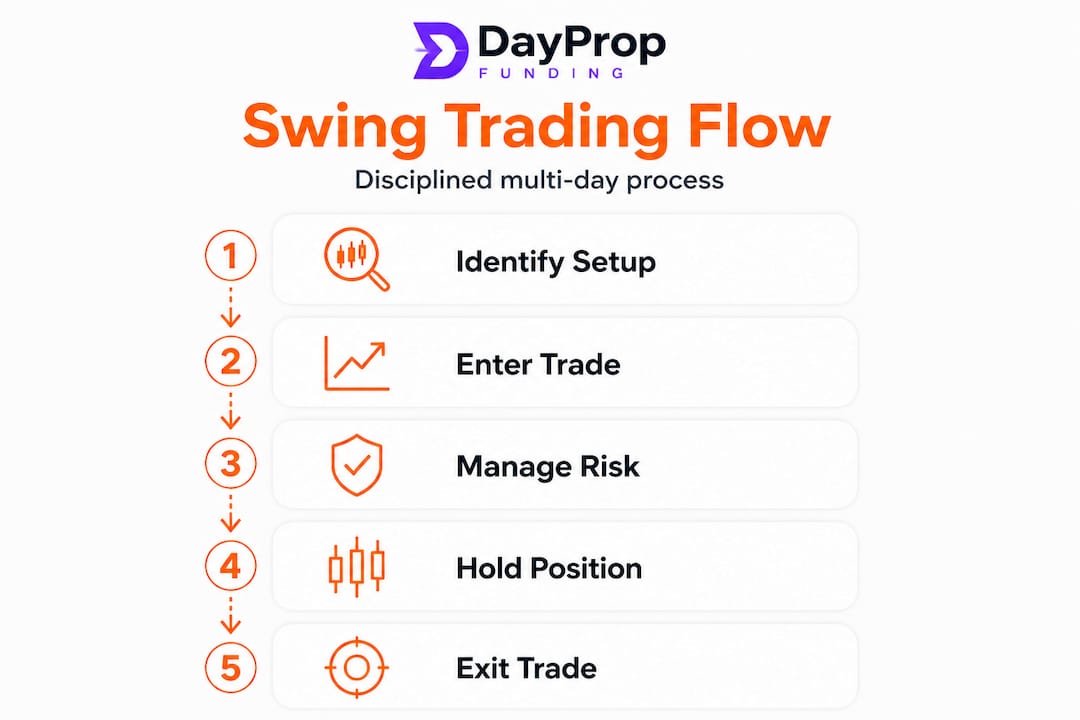
Swing trading targets price moves that develop over several days to a few weeks. The goal is to enter a position at a logical point in the market structure, ride the move while it has momentum, and exit before the cycle reverses. It is not passive investing, and it is not day trading. It sits deliberately between those two approaches in terms of both time horizon and decision frequency.
How swing trading compares to other styles
| Style | Holding period | Decisions per week | Primary tools |
|---|---|---|---|
| Scalping | Seconds to minutes | Hundreds | Level 2, order flow |
| Day trading | Minutes to hours | 5 to 20+ | Intraday charts, news |
| Swing trading | Days to weeks | 1 to 5 | Daily/4H charts, structure |
| Position trading | Weeks to months | 1 to 4 | Weekly charts, fundamentals |
| Investing | Months to years | Occasional | Fundamentals, macro |
Swing trading appeals to retail traders because it does not require constant screen time, which makes it compatible with a structured preparation process rather than reactive decision making. For aspiring funded traders exploring indices strategies for funding or those evaluating why trade multiple instruments, swing trading offers enough opportunity frequency to build a track record without the noise of intraday speculation.

Core principles that define swing trading
Successful swing trading rests on a small number of repeatable principles:
- Edge: A statistically viable reason to enter a trade, not a feeling or a guess
- Planning: Every trade has a defined entry, stop, and target before the position is opened
- Risk management: Position size is calculated from the stop distance, not from a fixed lot amount
- Patience: Waiting for price to come to a setup rather than chasing moves
- Review: Consistent logging and performance analysis to refine the process over time
Understanding which retail trading models align with these principles helps you choose the right evaluation structure. These principles are also what separate traders who survive drawdown periods from those who blow accounts after a single bad week. The trading success factors that consistently show up in funded trader performance all trace back to this foundation.
Swing trading mechanics: How trades are planned and executed
With the fundamentals in place, it is time to break down exactly how swing trades are constructed and managed in practice.
Swing trade execution involves identifying market structure and using technical analysis to time entries and exits, with risk defined before the trade is opened. That process, done correctly, turns a vague idea into a structured, repeatable workflow.
Step-by-step trade construction
- Instrument selection: Focus on markets with sufficient liquidity, clear trending behavior, and manageable spread. Forex majors, liquid crypto pairs, and major indices all work well for swing setups.
- Bias identification: Use the daily or weekly chart to determine the dominant trend direction. Trading in the direction of the higher-timeframe trend increases setup probability.
- Structure mapping: Mark key support and resistance levels, supply and demand zones, and recent swing highs and lows. These are the levels where price is likely to react.
- Entry trigger: Drop to the 4-hour or 1-hour chart to find a specific entry signal. This could be a candlestick pattern, a moving average crossover, or an oscillator reading that confirms the setup.
- Stop placement: Place the stop-loss at a technically logical level, just beyond the structure you are trading from. The stop defines your maximum loss on the trade.
- Target setting: Identify the next meaningful resistance or support level as your initial target. Calculate the risk-to-reward ratio before entering. A minimum of 1:2 is a reasonable baseline for most setups.
- Position sizing: Calculate lot size based on your risk amount divided by the stop distance in pips or points. This keeps every trade consistent regardless of setup type.
Common technical tools for swing traders
| Tool | Purpose | Common settings |
|---|---|---|
| Moving averages | Trend direction, dynamic support/resistance | 20 EMA, 50 SMA, 200 SMA |
| RSI (Relative Strength Index) | Momentum, overbought/oversold | 14-period, levels 30 and 70 |
| MACD | Trend momentum and crossovers | 12, 26, 9 standard |
| Support/Resistance | Price reaction zones | Manual mapping on daily chart |
| Volume | Confirming breakouts | Raw volume or OBV |
Pairing two or three of these tools is more effective than using all of them. The goal is confluence, meaning multiple signals pointing in the same direction. A solid forex risk management guide will reinforce how these tools integrate into a rules-based framework.
Pro Tip: Market gaps are a real risk in swing trading, particularly in crypto and during news events in forex. Your actual stop execution may be worse than your planned price. Reduce position size slightly on setups taken into known risk events to account for potential slippage. Never assume you will be filled exactly at your stop level.
The 1% rule: Professional risk and position sizing for swing traders
Once your trading process is set, managing risk with discipline becomes your survival tool. Here is how the 1% rule plays out for swing traders.
“A practical risk benchmark often cited for swing traders is risking about 1% of account equity per trade, while letting the stop-loss define the maximum loss.”
This is the most widely cited and most practically useful risk guideline in retail trading. It is not a guarantee of profits, but it is a structural safeguard that keeps you in the game long enough for your edge to play out.
How to calculate 1% risk per trade
- Determine your account equity: For example, $10,000
- Calculate 1% of equity: $10,000 × 0.01 = $100 maximum risk per trade
- Define your stop distance: Your chart analysis places the stop 50 pips away from entry
- Calculate pip value: In a standard forex pair, 1 pip = $10 per standard lot, $1 per mini lot
- Calculate position size: $100 risk ÷ ($1 × 50 pips) = 2 mini lots
The math changes by instrument, but the logic is identical. You are sizing the position to match a fixed dollar risk, not picking an arbitrary lot size. This approach is essential when managing risk for profits in both evaluation accounts and live funded accounts.
Why the 1% rule matters practically
The real benefit is survivability. At 1% risk per trade, you would need to lose 20 consecutive trades before drawing down 20% of your account. That gives you enough statistical sample to distinguish a bad strategy from a bad streak. Without this framework, three or four bad trades can produce damage that takes months to recover.
Funded trading evaluations typically set maximum drawdown limits in the 5% to 10% range. Trading at 1% risk means you have between 5 and 10 full losing trades before hitting those limits, which is entirely manageable. Avoiding trading mistakes becomes significantly easier when your risk per trade is low enough that a single loss does not create panic or pressure to overtrade.
Pro Tip: The 1% rule is most effective when combined with a hard daily loss limit. If you lose two trades in a day, stop trading. Forcing a third trade after two losses is rarely logical analysis. It is almost always emotional recovery behavior that violates your risk structure.
Managing emotions and avoiding common swing trading mistakes
Solid risk rules and technical planning will get you started, but consistent profits come from mastering your psychology and avoiding common traps.
“Capping loss per trade at 1% of equity based on the stop-loss distance helps survive a sequence of losses while still participating in enough trades to make progress.”
This principle sounds straightforward. In practice, applying it consistently requires more behavioral discipline than technical knowledge for most traders.
Common emotional and execution mistakes in swing trading
- Overtrading: Taking setups below your quality threshold because you want to be in the market. Fewer, higher-quality trades outperform many low-probability entries.
- Moving stops wider: Widening a stop after price moves against you is a direct violation of your trade plan. It converts a defined-risk trade into an open-ended loss.
- Revenge trading: Immediately entering another trade after a loss to recover the money quickly. This bypasses your analysis process entirely.
- Exiting winners early: Closing a profitable trade before it reaches your target because of fear. This systematically lowers your actual risk-to-reward ratio versus your planned ratio.
- Ignoring slippage and gaps: Assuming price always fills at your exact stop level. Swing traders holding positions overnight or over weekends face real gap risk, especially in crypto.
For traders applying crypto risk management rules, the volatility and 24/7 market structure makes discipline even more critical. The same applies to those following prop trading risk tips inside evaluation frameworks where a single breach of daily loss limits can end a challenge.
Simple discipline techniques that work
Practical methods to stay consistent include trade journaling (writing down the reason for every entry and exit), reviewing your equity curve weekly instead of after each trade, and setting a fixed maximum number of active trades at any time. Keeping your watchlist small, typically five to ten instruments, also reduces the temptation to overtrade by looking for setups in markets you do not know well.
Pro Tip: If you feel a strong urge to enter a trade that does not clearly fit your criteria, write down why you want to take it before you do. Most of the time, the act of writing it out clarifies that the reason is emotional, not analytical. This simple pause breaks the impulsive entry cycle.
Why most traders misunderstand swing trading and what really works
With techniques and discipline in focus, it is worth stepping back and examining what actually separates swing traders who succeed from those who do not.
Most traders approach swing trading as a compromise. They believe it is easier than day trading because you do not need to watch charts all day, and more active than investing because you can profit from both directions. Both assumptions are partially correct but miss the point entirely.
Swing trading is not easier than day trading. It requires a different discipline. You are managing open risk overnight, across weekends, and through news events. You cannot monitor positions constantly, which means your planning before entry needs to be thorough enough to account for scenarios you will not be watching in real time.
For retail and aspiring funded traders, swing trading is best understood as a disciplined middle ground that still demands explicit entries and exits, risk sizing, and an awareness that protective stops can have execution slippage during gaps. The “middle ground” framing is only accurate if you bring the same rigor to process that a day trader applies to execution speed.
The funded trading context makes this even more specific. In an evaluation setting, you are not just trying to make money. You are demonstrating behavioral consistency under structured rules. A 10-trade winning streak built on oversized, high-risk positions tells evaluators nothing useful. A 30-trade dataset showing consistent risk sizing, logical entries, and controlled drawdown tells them everything. Building risk for consistent profits is not just about the P&L. It is about proving you can operate within a defined framework under pressure.
Survival through losing streaks is as important as capturing moves. An account that draws down 3% over 10 losing trades and then recovers is demonstrating exactly the behavior funded programs are looking for. An account that loses 8% on two trades is not, regardless of what follows.
Next steps: Put swing trading discipline to work with proven tools
Now that you know what works and why, make your next swing trade count by applying your process inside a structured evaluation framework.
DayProp provides a performance-based trading evaluation process built specifically for disciplined traders in forex, indices, and crypto markets. If you have developed a swing trading process with clear entries, defined risk, and consistent execution, the next step is proving it under real evaluation conditions. Explore the trader funding model comparison to find the structure that fits your trading style and account goals. For traders who have attempted evaluations before, the detailed breakdown of passing trading challenges covers the most common failure points and how to address them systematically.
Frequently asked questions
How long do swing trades typically last?
Swing trades usually last anywhere from a few days up to a few weeks, depending on the market structure and the quality of the signal at entry.
Is swing trading profitable for small accounts?
Yes, particularly when you risk 1% per trade and apply strict stop-losses, swing trading can generate consistent returns even from a small starting balance.
What tools do swing traders use for analysis?
Swing traders commonly use moving averages, RSI, and support/resistance levels to identify setups, confirm trend direction, and time entries and exits.
Does swing trading work in volatile crypto markets?
Yes, swing trading applies well to crypto, but higher volatility means position sizing discipline and gap risk management are more important than in traditional markets.
What is the biggest risk in swing trading?
The main risk is taking losses larger than planned because of improper stop placement or gap fills. Keeping risk per trade at 1% of equity is the most direct way to control that exposure.
Recommended
- What is retail trading? A practical guide for new traders – DayProp Funding
- Institutional trading conditions: A guide for retail traders – DayProp Funding
- FX Trading Best Practices: Proven Strategies for Retail Success – DayProp Funding
- Structured trading challenge: Step-by-step guide to funding – DayProp Funding
- What Is Live Trading? Guide for Forex & Crypto Retail Traders
- Forex Swing Trading Strategy: MT4MT5 Indicators, 83% Win Rate | FxShop24 Marketplace