

TL;DR:
- Prop trading models separate trader capital from trading risk and reward profits through profit splits.
- Binary options offer fixed payouts but require a high win rate due to all-or-nothing risk.
- Success depends on discipline, risk management, and understanding payout nuances for each model.
Most retail traders assume personal capital is always on the line. That assumption is wrong. Payout models in retail trading let disciplined traders earn real profits without exposing their own money, particularly through proprietary trading firms. This article breaks down the two dominant payout structures in FX, indices, and crypto markets: binary options and prop trading. You will learn how each model calculates returns, what risks are actually involved, and how to apply this knowledge to your trading strategy in a practical, informed way.
Table of Contents
- Defining payout models: Binary vs. prop trading
- How binary options payout models work
- How prop trading payout models work
- Nuances, edge cases, and common pitfalls
- Why payout models matter: A retail trading perspective
- Find your best payout fit with DayProp Funding
- Frequently asked questions
Key Takeaways
| Point | Details |
|---|---|
| Binary vs. prop payout | Binary options offer fixed, high-risk payouts; prop trading enables profit sharing with less capital risk. |
| Risk and reward structure | Binary options risk total loss per trade; prop trading shifts risk to evaluation but allows scaling for higher profit splits. |
| Success rates | Over 90% of prop trader applicants fail evaluation, highlighting the need for consistency and discipline. |
| Payout model selection | Choosing the right payout model can help retail traders maximize earnings while protecting their capital. |
| Practical application | Understanding payout mechanics empowers traders to refine strategies, pursue funding, and avoid costly mistakes. |
Defining payout models: Binary vs. prop trading
Having introduced the concept, let’s dig into the core differences between binary options and prop trading payout models.
A payout model is the mechanism that determines how, when, and how much a trader earns from a position. In retail trading, two models dominate the conversation: binary options and proprietary firm trading. Each has a fundamentally different structure, risk profile, and income ceiling.
Binary options operate on an all-or-nothing principle. You predict whether an asset price will be above or below a level at expiration. If correct, you receive a fixed payout of 70 to 95% of your stake. If wrong, you lose the entire stake. There is no middle ground. The appeal is simplicity, but the risk is absolute.
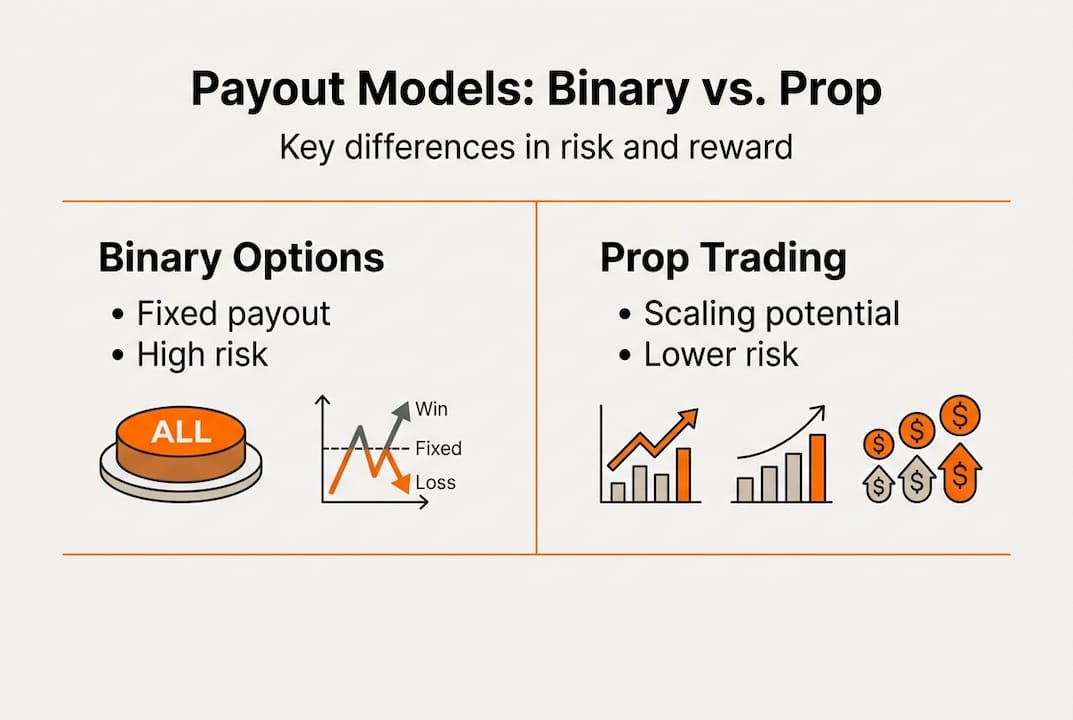
Prop trading firms work differently. The firm funds your account after you pass a structured evaluation challenge. You then trade that capital and share profits with the firm. Prop trading firms typically offer splits of 80% to 90% in the trader’s favor, with scaling paths pushing that figure even higher. Your personal financial exposure is limited to the evaluation fee, not trading capital.
| Feature | Binary options | Prop trading |
|---|---|---|
| Capital required | Your own funds | Firm’s capital |
| Payout type | Fixed percentage | Profit split |
| Payout range | 70 to 95% | 80 to 90%+ |
| Loss exposure | Full stake lost | Evaluation fee only |
| Scaling potential | None | Yes, up to 90 to 100% |
| Regulation | Often limited | Varies by firm |
Key differences to keep in mind:
- Binary options provide immediate, defined returns but carry full capital risk per trade
- Prop trading separates your personal capital from trading risk entirely
- Prop firms reward consistency and risk management, not just directional accuracy
- Profits from prop accounts are earned through discipline, not short-term prediction
The distinction matters because both models attract retail traders looking to grow income, but they reward fundamentally different skills.
How binary options payout models work
Now, let’s examine how binary options payout models work and what traders must consider.
Binary options have a straightforward payout formula. Before entering a trade, the broker displays a fixed payout percentage. If you stake $100 at an 85% payout rate and the trade closes in your favor, you receive $185 total: your $100 stake plus $85 profit. If the trade closes against you, you lose the full $100.
The formula is simple:
- Win: Payout = Stake + (Payout% x Stake)
- Loss: Payout = $0 (full stake forfeited)
Payout rates vary by asset class, broker platform, time of day, and market volatility. FX pairs and crypto assets tend to carry higher payouts than equity indices during peak sessions. Off-peak hours often see reduced rates, sometimes as low as 65%.
Some brokers offer a partial refund option on losing trades, typically 10% to 15% returned. This reduces the effective payout on winning trades but softens losses. It is a trade-off worth evaluating based on your win rate.
Break-even calculation is critical and often overlooked. If you trade at a 90% payout, your break-even win rate is roughly 52%. At 70%, that number rises above 59%. This means the math works against casual traders who do not maintain a structured edge.
Key insight: A 90% payout sounds generous, but you must win more than half your trades just to break even. Most retail traders underestimate this threshold.
Payout rates by asset type (approximate):
| Asset type | Typical payout range |
|---|---|
| Major FX pairs | 80 to 90% |
| Crypto (BTC, ETH) | 85 to 95% |
| Stock indices | 70 to 80% |
| Commodities | 75 to 85% |
Steps to evaluate a binary options broker payout fairly:
- Check the displayed payout before every trade, as it changes
- Calculate your personal break-even win rate at that payout level
- Compare payout rates across multiple assets before committing
- Confirm whether a refund option exists and at what percentage
- Track how rates shift during off-peak hours vs. active sessions
Pro Tip: Test payout rates on a demo account across different sessions. FX pairs during the London-New York overlap often yield stronger crypto risk-adjusted returns than lower-volatility windows.
How prop trading payout models work
With binary options explained, let’s switch to prop trading firms and their payout structures.

Prop trading payout models follow a clear sequence. First, you pass a multi-phase evaluation challenge. Most firms require you to hit a specific profit target, typically 8 to 10% on the account, while staying within daily and overall drawdown limits. Once you pass, you receive access to a funded account.
From that point, profits are split between you and the firm. Standard prop firm splits run from 80/20 to 90/10 in the trader’s favor. Some firms, including established names like FTMO and Apex, offer splits reaching 90 to 100% for traders who scale successfully.
Payout frequency varies. Common schedules include:
- Bi-weekly payouts: Standard for most platforms
- On-demand payouts: Available after a minimum number of trading days
- Monthly cycles: Less common but found in some structured programs
Scaling is a major advantage over binary options. As you demonstrate consistency, firms increase your funded account size and sometimes your profit split. A trader who starts at $50,000 with an 80% split can scale to $200,000 or more with a 90% split over time. This compounds earning potential without requiring additional personal capital.
Your actual financial risk in prop trading is the evaluation fee, not the account capital. Learn more about handling prop trading payouts to understand how payout timing and account management work together. Understanding capital allocation in prop trading is equally important once your account scales.
Pro Tip: Treat the evaluation challenge exactly as you would a live funded account. Traders who adopt identical risk parameters during evaluation have measurably higher pass rates and smoother transitions to consistent payouts.
Nuances, edge cases, and common pitfalls
With both models covered, let’s highlight the nuances and common mistakes traders often overlook.
Both payout models carry hidden complexity that catches traders off guard. Understanding these nuances separates consistent earners from those who repeatedly fail evaluations or misread binary returns.
Prop trading edge cases:
- Consistency rules require a minimum number of profitable trading days, not just a profit target
- News trading restrictions can void trades placed during high-impact economic releases
- Trailing drawdown rules reduce your maximum allowable loss as your account grows, not a fixed floor
- Automated strategy (EA) restrictions apply on many platforms without being clearly disclosed
- Strict drawdown violations immediately void funded accounts, regardless of overall profit
Binary options edge cases:
- Brokers adjust payout rates dynamically based on market conditions, often without clear notification
- Expiry timing near major data releases can shift rates significantly mid-session
- Platform spreads and delays on execution affect real effective payout
Reality check: More than 90% of traders fail prop firm challenges. Only a small fraction ever receive funded account payouts. This is not a barrier to entry, but it is a clear signal that unprepared traders pay evaluation fees repeatedly without result.
Common mistakes to avoid:
- Treating the prop challenge as a game rather than a professional performance review
- Ignoring trailing drawdown mechanics until an account is already at risk
- Selecting binary options brokers based solely on advertised payout rates without checking off-peak performance
- Abandoning a strategy mid-evaluation after a short losing streak
Pro Tip: Before starting any prop evaluation, write out your full trading plan including entry criteria, position sizing, and maximum daily loss tolerance. Firms reward professional risk management behavior, and having a written plan forces consistency from day one.
Why payout models matter: A retail trading perspective
To round out this discussion, here’s a direct retail perspective on payouts and their bigger meaning.
Most retail traders fixate on the payout percentage number. They compare 90% from a binary broker to 80% from a prop firm and make the wrong conclusion. The percentage alone means nothing without accounting for what capital is at risk and what edge produces the outcome.
Prop firm payout models are genuinely superior for retail traders who have a real edge and want to scale without personal capital risk. Binary options, by contrast, place your own money on the line every single trade. The all-or-nothing structure rewards luck as much as skill in the short term.
The traders who succeed in prop trading are not necessarily the ones targeting the highest split. They are the ones who master evaluation rules, apply consistent risk parameters, and treat funded trading as a professional engagement. A well-structured prop trading approach beats chasing high binary payouts every time, because the upside scales with performance rather than capping at a fixed rate per trade.
The real lesson is this: payout percentages are a result, not a goal. Build the discipline first.
Find your best payout fit with DayProp Funding
Choosing the right payout model is one of the most consequential decisions a retail trader makes. DayProp provides structured guidance to help you understand evaluation criteria, compare payout structures, and identify the path that fits your trading style and goals.
Explore DayProp’s resources on comparing funding models to see how different structures align with your strategy. Review the full performance-based evaluation guide to understand what firms actually measure. When you are ready to move from evaluation to income, the funded trader pathways page outlines exactly what to expect at each stage.
Frequently asked questions
What is a payout model in trading?
A payout model determines how traders are compensated, either through a fixed return per trade in binary options or through a profit-sharing arrangement in prop trading funded accounts.
Which trading payout model is safer for retail traders?
Prop firm models are safer because they remove personal capital from the equation entirely, though the capital-free profit sharing model still demands consistent performance to beat high challenge failure rates.
How do binary options calculate payouts?
Brokers display a fixed payout rate before entry; a correct trade returns stake plus the percentage, while a wrong trade forfeits the full stake with no partial recovery unless a refund option is active.
What is the average payout percentage for binary options?
Most top brokers deliver between 80% and 85% on average, with Pocket Option at 84% and IQ Option at 85%, while FX and crypto assets tend to outperform index-based instruments.
How can traders increase their prop trading payout share?
By maintaining consistency and passing scaling milestones, traders can raise their split to 90 to 100% with most major prop firms over time.
Recommended