TL;DR:
- Risk parameters are predefined limits that manage trader exposure and prevent catastrophic losses.
- Adhering to risk rules significantly improves funded challenge pass rates and account longevity.
- Enforcing strict risk limits fosters discipline, confidence, and systematic trading, essential for long-term success.
Most traders spend months refining entries, perfecting indicators, and testing strategies, yet they overlook the rules that actually determine whether they stay in the game. Risk parameters are the structured limits that separate disciplined traders from those who blow accounts and start over. Retail traders with set risk parameters are measurably more likely to pass funding challenges and maintain account growth. Understanding these rules is not optional for anyone serious about Forex, crypto, or indices trading. This article breaks down what risk parameters are, why they matter, how they work across different markets, and what happens when they are ignored.
Table of Contents
- What are risk parameters in trading?
- Why do risk parameters matter for retail traders?
- The most common risk parameters explained
- How risk parameters are enforced and what happens if you break them
- A fresh perspective: The real secret behind risk parameters
- Next steps: Boost your trading with professional risk management
- Frequently asked questions
Key Takeaways
| Point | Details |
|---|---|
| Risk parameters defined | They are specific rules that limit losses and control position size, not just generic ‘risk.’ |
| Critical for funding | Adhering to risk parameters is crucial for passing prop funding evaluations and long-term growth. |
| Market-specific rules | Parameters differ by market—Forex, crypto, and indices each require tailored risk controls. |
| Discipline breeds opportunity | Treating risk parameters as tools, not hurdles, sets traders apart and opens new career paths. |
What are risk parameters in trading?
Risk parameters are the predefined rules and limits that govern how much capital a trader can expose at any given time. They are not vague guidelines. They are specific, measurable boundaries built into a trading plan or enforced by a funding platform. Think of them as the operating limits of your trading system.
Many traders confuse risk parameters with the general concept of “risk,” meaning the possibility of losing money. These are not the same thing. Risk is an inherent feature of every trade. Risk parameters are the controls you put in place to manage that risk systematically.
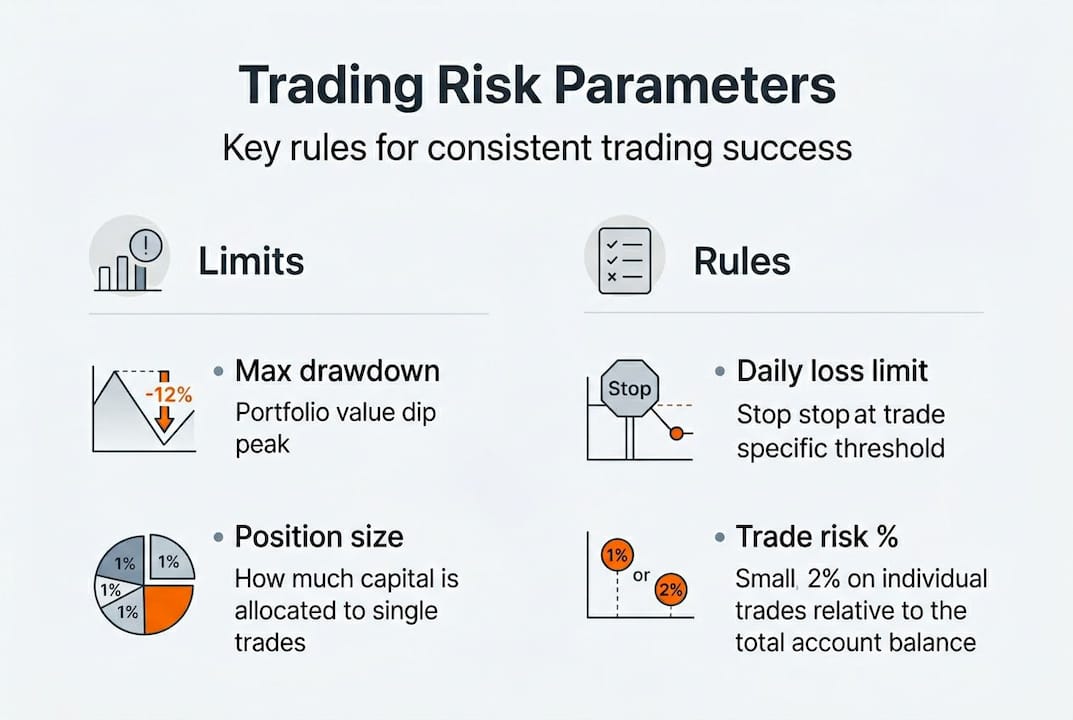
The most common risk parameters include:
- Max daily drawdown: The maximum percentage of account equity you can lose in a single trading day before your session is halted or your account is flagged.
- Max overall drawdown: The total loss limit from your account’s peak value, often set between 5% and 10% in funded programs.
- Risk per trade: The percentage of total account balance placed at risk on any single position, typically 1% to 2% for disciplined traders.
- Max position size: A cap on the number of lots or contracts you can hold simultaneously.
- Total exposure: The combined risk across all open positions at one time.
“Risk parameters help set rules that prevent catastrophic losses and align traders with professional standards.”
Professional traders never ignore these limits because they know that one uncontrolled loss can erase weeks of consistent gains. The goal is not to avoid risk entirely. The goal is to ensure that no single trade or session can permanently damage your account or disqualify you from a funding program.
Why do risk parameters matter for retail traders?
Risk parameters are not just administrative formalities. They are the foundation of every sustainable trading career. Retail traders who skip this step are essentially operating without a safety net, and the consequences are predictable.
One of the most common reasons traders fail is emotional decision-making under pressure. When you have no predefined limits, every losing trade becomes a judgment call made in real time, often while stressed and reactive. Risk parameters remove that discretion. They create a system where the rules are set in advance, so you execute without second-guessing.
The data supports this clearly:
| Risk parameter adherence | Challenge pass rate |
|---|---|
| No defined parameters | Below 20% |
| Partial adherence | 35% to 50% |
| Full adherence | 65% to 80% |
The numbers reflect a consistent pattern: traders who follow structured rules perform significantly better in funded evaluations. Consistent profit risk management is not just a concept. It is a measurable competitive advantage.
Here are the top three reasons risk parameters boost long-term performance:
- Discipline under pressure: Rules eliminate impulsive decisions during drawdown periods.
- Eligibility for funding: Most prop firms require strict adherence to risk limits as a condition of evaluation.
- Account longevity: Traders who cap their losses daily and weekly survive long enough to compound gains.
Pro Tip: Keep a trading journal and log every trade against your preset risk rules. Review it weekly to identify patterns where you come close to or exceed your limits. This habit alone can raise your challenge pass rate significantly.
For traders pursuing professional risk management, the shift from reactive to rule-based trading is the single most impactful change they can make.
The most common risk parameters explained
Knowing why risk parameters matter leads naturally to the next question: what specific rules should you pay attention to, and how do they differ by market?
Here is a breakdown of the most widely used parameters and how they vary across Forex, crypto, and indices:
| Parameter | Forex | Crypto | Indices |
|---|---|---|---|
| Max daily drawdown | 3% to 5% | 3% to 5% | 3% to 5% |
| Overall drawdown | 8% to 10% | 8% to 12% | 8% to 10% |
| Max leverage | Up to 1:100 | Up to 1:20 | Up to 1:50 |
| Risk per trade | 1% to 2% | 0.5% to 1.5% | 1% to 2% |
| Max open trades | 5 to 10 | 3 to 5 | 3 to 7 |
Crypto markets carry higher volatility, so drawdown risk tips often recommend tighter position sizing in that asset class. Indices tend to have more predictable intraday ranges, while Forex sits in between. Prop firms often use strict limits on drawdown and position size to filter for disciplined traders, and these limits are non-negotiable during evaluations.
Here is a step-by-step process for setting a risk parameter within your own trading system:
- Define your account risk tolerance: Decide the maximum percentage of your account you are willing to lose in a day and in total.
- Calculate position size per trade: Use a position size calculator to ensure each trade risks no more than 1% to 2% of your balance.
- Set hard stops on every trade: Never enter a position without a stop-loss that reflects your risk-per-trade limit.
- Track cumulative exposure: Before adding a new position, calculate your total open risk across all trades.
- Review and adjust weekly: As your account grows or shrinks, recalculate your position sizes to stay within percentage-based limits.
Pro Tip: Always read the rulebook of any types of trading challenges you enter. Parameters vary between firms and programs. What passes in one challenge may disqualify you in another.
How risk parameters are enforced and what happens if you break them
After detailing the main types of risk parameters, it is essential to address what happens when they are not followed. Accountability is not optional in professional trading environments.

Platforms and prop firms track rule adherence through automated systems. Every trade is logged in real time. When a parameter is breached, the system responds immediately, often without human intervention. There is no grace period.
The typical enforcement process follows this sequence:
- Warning or alert: Some platforms notify you when you are approaching a limit, such as 80% of your daily drawdown consumed.
- Automatic restriction: Once a limit is hit, new trades may be blocked for the remainder of the session or day.
- Account review: Repeated violations trigger a manual review of your trading history.
- Account closure or disqualification: A single breach of the overall drawdown limit typically results in immediate account termination.
Consider a practical example. A trader in a funded account has a 4% daily drawdown limit on a $50,000 account, meaning a $2,000 daily loss cap. If they enter an oversized position during a volatile news event and lose $2,100 in one session, the account is flagged and closed regardless of their overall profit up to that point. Breaking risk parameters is the number one reason funded accounts lose their status.
“Following risk rules is not about fear of failure. It is about building the kind of track record that earns you access to larger capital over time.”
Emotional reactions to rule violations are common. Traders often feel frustration or urgency to recover losses quickly, which leads to further violations. The path back to discipline starts with a full stop. Step away, review what happened, and return only when your trading plan is in place. Trading success factors consistently point to recovery discipline as a key differentiator between traders who rebuild and those who repeat the same mistakes.
A fresh perspective: The real secret behind risk parameters
Most traders treat risk parameters as restrictions imposed from the outside, rules designed to limit what they can do. That framing is counterproductive. The traders who reach funded accounts and scale their capital view parameters differently. They see them as the structure that makes freedom possible.
When you have a defined daily loss limit, you trade without fear of catastrophic outcomes. When you know your max position size, you stop second-guessing every entry. The rules create clarity, and clarity creates confidence. This is not abstract. It is the practical experience of traders who have moved from reactive to systematic.
The most contrarian advice in trading is this: set strict risk parameters even on demo accounts and small live accounts. The leverage does not matter. The habit does. Traders who practice rule-based behavior at every account size carry that discipline into funded environments. Those who treat small accounts casually tend to treat large ones the same way.
Avoiding revenge trading discipline failures is directly tied to how deeply these rules are internalized. The most consistent performers do not view each parameter as a hurdle. They treat it as a stepping stone toward the next level of capital and opportunity.
Next steps: Boost your trading with professional risk management
Understanding risk parameters is the first step. Applying them within a structured, professional environment is where real progress happens.
DayProp provides traders with transparent evaluation frameworks built around the same risk parameters discussed in this article. Whether you are preparing for your first challenge or looking to scale a funded account, exploring how to compare funding models can help you find the right fit for your trading style. For a step-by-step breakdown of how evaluations work, the trading evaluation for prop funding guide covers everything from challenge rules to payout structures. Apply what you have learned here and take the next step toward consistent, funded trading.
Frequently asked questions
What is a typical risk parameter for a funded trading account?
Most prop accounts set a max daily drawdown of 3% to 5% and limit risk per trade to 1% to 2% of total account balance.
How do I know if I’m following my risk parameters correctly?
Keep a trading journal and review your trades weekly to ensure you never exceed your preset limits. Journaling tracks rule adherence and reinforces the discipline needed for consistent performance.
What happens if I break a risk parameter on a prop challenge?
Most firms will restrict, freeze, or terminate your account immediately. Breaking risk parameters is the leading cause of funded account disqualification, regardless of overall profit or loss.
Are risk parameters different for Forex, crypto, and indices?
Yes. Leverage limits, volatility, and liquidity all influence the specific limits set by programs and brokers. Market-specific risk tolerances mean parameters vary meaningfully between asset classes.
Recommended
- How to manage risk in trading for consistent profits 2026 – DayProp Funding
- Essential trading success factors for consistent profits – DayProp Funding
- Crypto risk management rules: Strategies for retail traders – DayProp Funding
- Why traders need professional risk management in 2026 – DayProp Funding