

Scaling a trading account is one of the most challenging aspects of becoming a consistently profitable trader in FX, indices, and crypto markets. Many disciplined traders struggle to grow their capital without falling into the trap of overtrading, excessive risk, or emotional decision making. This article delivers evidence-backed, practical tips that help you scale your trading account through structured planning, rigorous risk management, and regular performance reviews. You’ll learn actionable strategies that transform inconsistent results into sustainable, long-term growth while protecting your hard-earned capital from unnecessary drawdowns.
Table of Contents
- 1. Establish A Disciplined Trading Plan As Your Foundation
- 2. Use Consistent Risk Management To Protect And Grow Your Capital
- 3. Conduct Regular Performance Reviews To Adapt And Improve Your Strategy
- 4. Understand Common Misconceptions And Practical Scaling Guidelines
- Explore Professional Funding Opportunities To Boost Your Trading Journey
Key takeaways
| Point | Details |
|---|---|
| Trading plan foundation | A disciplined trading plan defines risk parameters, entry rules, and markets to maintain consistency during scaling. |
| Risk management essentials | Consistent position sizing and stop-loss placement protect capital and enable sustainable account growth. |
| Performance review discipline | Regular metric tracking reveals strategy effectiveness and guides adaptive improvements for better outcomes. |
| Gradual scaling approach | Increase position sizes only after proven consistency and capital growth, respecting strict risk limits. |
| Misconception awareness | Scaling is not simply increasing trade size but aligning growth with account capital and risk tolerance. |
1. Establish a disciplined trading plan as your foundation
Every successful scaling journey starts with a well-defined trading plan that acts as your blueprint through market chaos. Building a trading plan is crucial for consistency, defining risk rules, entry criteria, and market focus. Without this foundation, you’re navigating volatile markets without a compass, making emotional decisions that sabotage your growth potential.
Your trading plan should clearly define several critical parameters that govern every trade you take. Risk per trade typically falls between 1-2% of your total account balance, ensuring that even a string of losses won’t devastate your capital. Entry and exit rules must be specific and objective, eliminating guesswork when you’re in the heat of the moment. Your plan should also specify which markets you’ll trade, whether FX pairs, stock indices, or crypto assets, allowing you to develop genuine expertise rather than spreading yourself too thin.
Consistent adherence to your trading plan dramatically improves your win rate and reduces the emotional rollercoaster that destroys accounts. When you follow predefined rules, you eliminate the temptation to chase trades, revenge trade after losses, or abandon your strategy during drawdown periods. This disciplined approach to trading account growth separates professionals from gamblers.
Key elements every trading plan must include:
- Maximum risk percentage per trade and per day
- Specific entry criteria based on technical or fundamental analysis
- Clear exit rules for both profits and losses
- Position sizing formulas that scale with account balance
- Markets and instruments you’ll focus on exclusively
- Daily and weekly review schedules to track adherence
Pro Tip: Update your trading plan quarterly after thorough performance reviews to incorporate lessons learned and adapt to changing market conditions. A static plan becomes obsolete as you grow and markets evolve.
The most successful traders treat their plans as living documents that evolve with experience. They understand that managing risk for consistent profits requires constant refinement based on real-world results, not theoretical assumptions.
2. Use consistent risk management to protect and grow your capital
Risk management is the cornerstone that determines whether you’ll scale successfully or blow up your account during inevitable losing streaks. Traders who consistently apply risk management strategies have a significantly higher probability of long-term profitability, including position sizing and stop-loss placement. These techniques include position sizing, strategic stop-loss placement, and accounting for market volatility that can spike without warning.

Fixed fractional position sizing, where you risk a consistent percentage per trade regardless of account size, significantly improves both survival rates and long-term profitability. When you risk 1-2% per trade, you can withstand 50 consecutive losses before depleting your account, a statistical improbability even for struggling traders. This approach automatically scales your position sizes as your account grows, creating compound growth without requiring manual adjustments.
Backtesting shows traders adhering to plans have more stable growth and 30% higher win rates compared to those who trade impulsively. This data reinforces why disciplined risk management isn’t optional for serious traders aiming to scale their accounts sustainably.
Common risk management strategies used by disciplined traders:
- Fixed fractional position sizing based on account percentage
- Volatility-adjusted position sizing using ATR or standard deviation
- Maximum daily loss limits to prevent emotional spiral trading
- Correlation analysis to avoid overexposure across similar assets
- Dynamic stop-loss placement based on market structure
Steps to determine and adjust your risk per trade:
- Calculate your total account balance at the start of each trading day
- Multiply your balance by your risk percentage (typically 1-2%) to get your dollar risk
- Identify your stop-loss distance in pips, points, or percentage based on technical levels
- Divide your dollar risk by your stop-loss distance to determine position size
- Verify your position size doesn’t violate maximum exposure rules for the asset class
- Adjust risk percentage downward during drawdown periods or increased market volatility
| Risk Approach | 6-Month Survival Rate | Average Drawdown | Account Growth |
|---|---|---|---|
| No formal risk management | 23% | 47% | Negative 18% |
| Consistent 1-2% risk per trade | 89% | 12% | Positive 34% |
| Variable risk without limits | 41% | 31% | Negative 7% |
Pro Tip: Review and tighten your risk settings immediately after any drawdown exceeding 10% of your account balance. Market conditions or your strategy may have shifted, requiring temporary risk reduction until you regain consistency.
Understanding how to set trading objectives for consistent risk management helps you maintain discipline even when facing psychological pressure to overtrade. Many traders also benefit from exploring different proprietary trading models that enforce strict risk parameters, providing external accountability during the scaling process.
3. Conduct regular performance reviews to adapt and improve your strategy
Routine tracking and analysis of your trading metrics transform you from a reactive trader into an adaptive decision maker who continuously improves. Regular reviews tracking metrics like win rate, expectancy, and drawdowns are essential for improving performance. Without these scheduled assessments, you’re flying blind, unable to identify what’s working and what’s sabotaging your results.
Key metrics every trader must track include win rate (percentage of profitable trades), expectancy (average profit per trade after accounting for wins and losses), maximum drawdown (largest peak to trough decline), and profit factor (gross profits divided by gross losses). These numbers reveal your strategy’s effectiveness far more accurately than gut feelings or selective memory about recent trades.
Regularly scheduled reviews, whether weekly or monthly, help you spot patterns that aren’t visible in day-to-day trading. You might discover you’re consistently profitable in trending markets but lose money in ranging conditions, or that your morning trades outperform afternoon sessions. These insights allow you to refine your approach, trading only during your high-probability setups and avoiding conditions where you lack edge.
Metrics to track and how to interpret them:
- Win rate above 50% suggests your entry timing is solid, below 40% indicates entry criteria need refinement
- Positive expectancy is mandatory for profitability; negative expectancy means you lose money over time regardless of win rate
- Maximum drawdown under 15% indicates good risk control; above 25% signals excessive risk or strategy problems
- Profit factor above 1.5 shows strong edge; below 1.2 suggests marginal strategy requiring improvement
- Average win to average loss ratio (R-multiple) above 1.5 allows profitability even with win rates below 50%
| Metric | Before Strategy Adjustment | After Strategy Adjustment | Change |
|---|---|---|---|
| Win Rate | 43% | 56% | +13% |
| Expectancy | $12 per trade | $47 per trade | +292% |
| Max Drawdown | 22% | 11% | -50% |
| Profit Factor | 1.18 | 1.84 | +56% |
Performance reviews also uncover emotional trading patterns that sabotage your scaling efforts. You might notice you take impulsive trades after losses, violate your risk rules on Friday afternoons, or exit winning trades prematurely due to fear. Identifying these psychological patterns allows you to implement specific rules or breaks that prevent repeated mistakes.
Leveraging a performance-based trading evaluation process can provide structured feedback and accountability that accelerates your improvement. These evaluations often reveal blind spots you wouldn’t notice through self-assessment alone. Combining regular reviews with a disciplined approach to account growth creates a powerful feedback loop that drives continuous improvement.
4. Understand common misconceptions and practical scaling guidelines
Many traders sabotage their scaling efforts by falling for misconceptions that seem logical but prove disastrous in practice. A common misconception is that scaling involves increasing position sizes without a corresponding increase in account capital or risk tolerance. This approach dramatically increases your risk of ruin, turning what should be gradual growth into a recipe for account destruction.
Scaling by simply doubling or tripling your position size while your account remains the same size means you’re now risking 4-6% or more per trade instead of your planned 1-2%. A normal losing streak that would have caused a manageable 10% drawdown now triggers a catastrophic 30-40% loss, potentially ending your trading career. Effective scaling means increasing position sizes proportionally as your account grows, maintaining the same risk percentage throughout.
Practical scaling guidelines for sustainable growth:
- Increase position sizes only after your account has grown by at least 25% through profitable trading
- Maintain your risk percentage (1-2%) constant even as absolute dollar amounts increase
- Require at least three consecutive profitable months before attempting to scale up
- Monitor market conditions and reduce size during periods of unusual volatility or uncertainty
- Scale gradually in 25% increments rather than doubling positions overnight
- Never scale up immediately after a large winning trade; wait for consistent results
| Scaling Approach | Position Size Increase | Risk Management | Typical Drawdown | Long-Term Success Rate |
|---|---|---|---|---|
| Poor scaling (arbitrary increases) | Doubles without account growth | Risk percentage balloons to 4-8% | 35-50% | 12% |
| Effective scaling (gradual, proportional) | Increases 25% after 25% account growth | Maintains constant 1-2% risk | 8-15% | 71% |
The psychological discipline required for proper scaling often proves more challenging than the mathematical calculations. You must resist the temptation to scale aggressively after a winning streak, recognizing that regression to the mean is inevitable. Similarly, you need the patience to scale down during drawdowns, even though your ego wants to trade larger to “win back” losses faster.
Successful scaling prioritizes capital preservation and consistent habits over chasing quick large gains. Understanding how to grow trading capital safely while avoiding common pitfalls helps you maintain the long-term perspective necessary for sustainable success. Recognizing why long-term growth matters more than short-term wins keeps you focused on the process rather than individual trade outcomes.
Explore professional funding opportunities to boost your trading journey
Once you’ve mastered the fundamentals of disciplined scaling through solid planning, risk management, and performance reviews, you’re ready to explore professional funding that accelerates your growth potential. DayProp offers innovative performance-based trading evaluations designed to identify and fund disciplined traders who demonstrate real skill in FX, indices, and crypto markets.
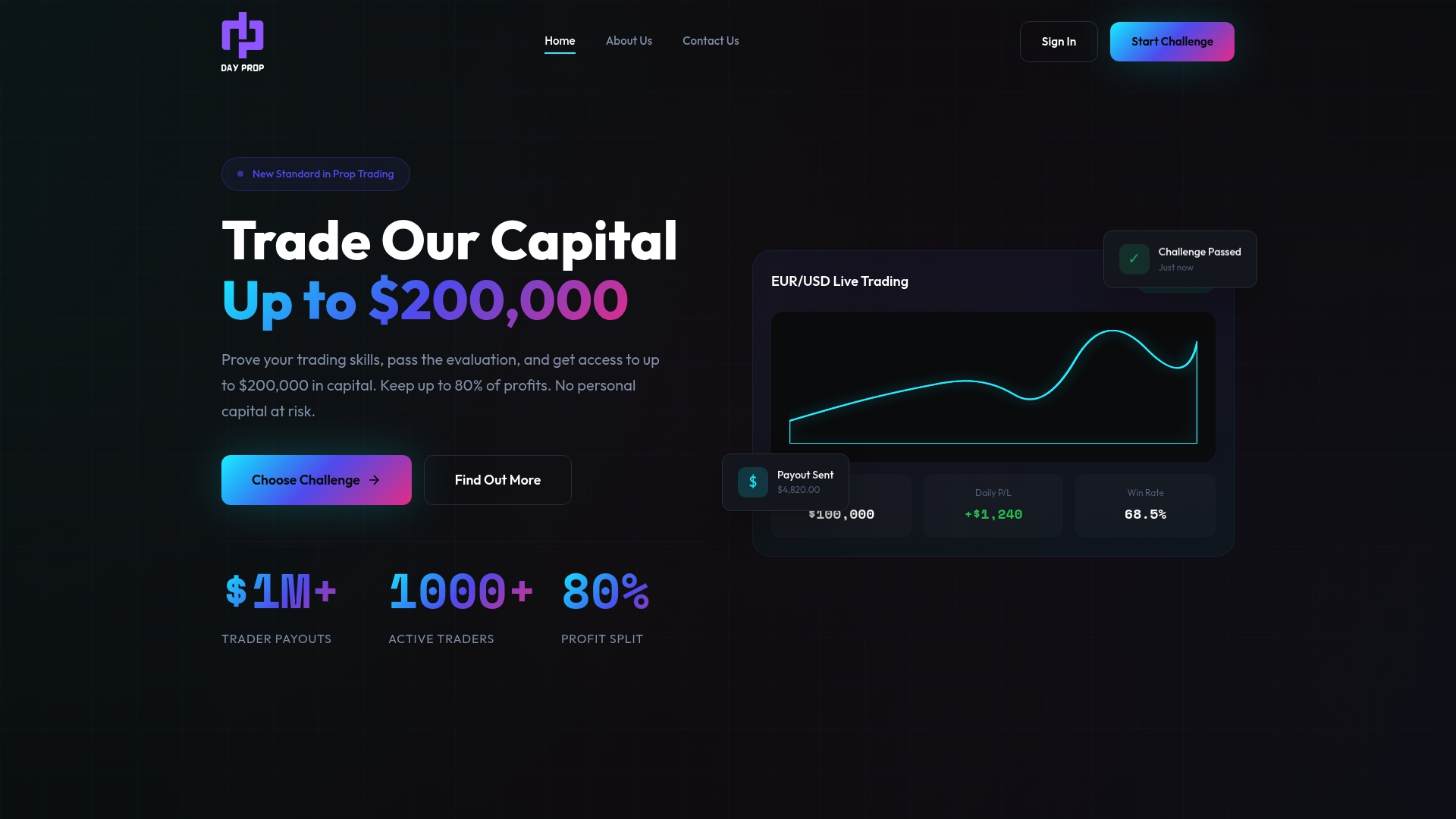
Their funding models align perfectly with traders focusing on consistency and risk management rather than gambling behavior. By providing structured challenges with transparent rules and professional risk parameters, DayProp helps you scale beyond your personal capital limitations. Explore their comprehensive trading evaluation guide to understand how you can secure funding, and compare different trader funding models to find the best fit for your trading style and goals in 2026.
FAQ
What is the ideal risk percentage per trade when scaling a trading account?
Typically, risking 1-2% per trade is recommended to protect capital while allowing sustainable growth. This percentage should remain constant even as your account grows, meaning your absolute dollar risk increases proportionally with your balance. Maintaining this discipline prevents the risk of ruin that destroys accounts during inevitable losing streaks. Learn more about managing risk for consistent profits to implement these principles effectively.
How often should I review my trading performance to scale effectively?
You should review your performance at least monthly or after every 20-30 trades, whichever comes first, to identify patterns and make timely adjustments. Regular reviews are essential for adapting and improving trading performance based on concrete data rather than emotions. These scheduled assessments help you spot both winning patterns to amplify and losing patterns to eliminate. A structured performance-based evaluation process provides additional accountability and insights.
What is a common misconception about scaling a trading account?
A common misconception is that scaling involves increasing position sizes without a corresponding increase in account capital or risk tolerance. Effective scaling means growing your positions proportionally as your account balance increases through profitable trading, maintaining constant risk percentages throughout. Simply trading larger without account growth dramatically increases your risk of ruin during normal drawdowns. Understanding how to grow capital safely helps you avoid this costly mistake.
How does consistent adherence to a trading plan improve scaling outcomes?
Following a disciplined trading plan eliminates emotional decision making, improves win rates, and creates the consistency necessary for sustainable scaling. Traders who stick to predefined rules avoid impulsive trades, revenge trading, and strategy abandonment during drawdowns. This consistency allows you to accurately assess your true edge and scale with confidence based on proven results rather than hope.
Recommended