

TL;DR:
- Most market professionals perform a range of functions beyond simply executing buy and sell orders, including research, compliance, and client advisory work. Understanding these roles is crucial for aspiring traders and finance students to make informed career decisions and navigate regulated environments effectively.
Most people assume market professionals spend their days clicking buy and sell buttons. That picture is incomplete by a wide margin. The role of market professionals spans execution, research, compliance, risk management, and client advisory work, often within the same firm and sometimes within the same person’s job description. For aspiring traders and finance students trying to map out a career or understand how capital markets actually function, getting clarity on these roles is not optional. It determines the decisions you make about what to study, what certifications to pursue, and what kind of trader or professional you want to become.
Table of Contents
- Key takeaways
- The role of market professionals in trading and investment
- Market makers and liquidity providers
- Regulations and certifications shaping professional responsibilities
- How market professionals collaborate within financial firms
- My perspective on what these roles actually demand
- Start building your professional trading track record with Dayprop
- FAQ
Key takeaways
| Point | Details |
|---|---|
| Roles extend beyond execution | Market professionals include traders, advisors, analysts, compliance officers, and market makers, each with distinct functions. |
| Market makers serve a public function | They provide liquidity by quoting bid and ask prices, enabling other participants to trade efficiently. |
| Certifications are legally required | Regulatory bodies like SEBI mandate certifications such as NISM or CFA for investment advisors operating in capital markets. |
| Collaboration defines real workflows | Traders, analysts, portfolio managers, and compliance teams operate in close coordination, not in isolation. |
| Technical and interpersonal skills both matter | Modern market roles increasingly demand quantitative ability alongside client-facing communication skills. |
The role of market professionals in trading and investment
The financial markets run on a division of specialized labor. Each professional role serves a specific function, and understanding the differences between them is the starting point for anyone serious about working in or alongside capital markets.
Traders are responsible for executing buy and sell orders on behalf of firms or clients. At institutional desks, front-office trading roles in 2026 are highly specialized, with traders spending most market hours on execution while quantitative researchers focus on coding and generating ideas. This is a meaningful distinction. A trader at a hedge fund is not the same as a quantitative researcher at that same fund, even if both sit at adjacent desks.
Investment advisors work directly with clients to recommend financial products and asset allocation strategies. Their responsibilities go far beyond picking stocks. They assess risk tolerance, construct portfolios, and document every recommendation in writing. In regulated markets like India, these professionals must register with SEBI and meet both educational and experience standards before operating.
Portfolio managers hold discretionary authority over client or firm capital. They are accountable for performance relative to a benchmark and must balance return objectives against risk constraints. Their decisions ripple through the positions of every asset they manage.
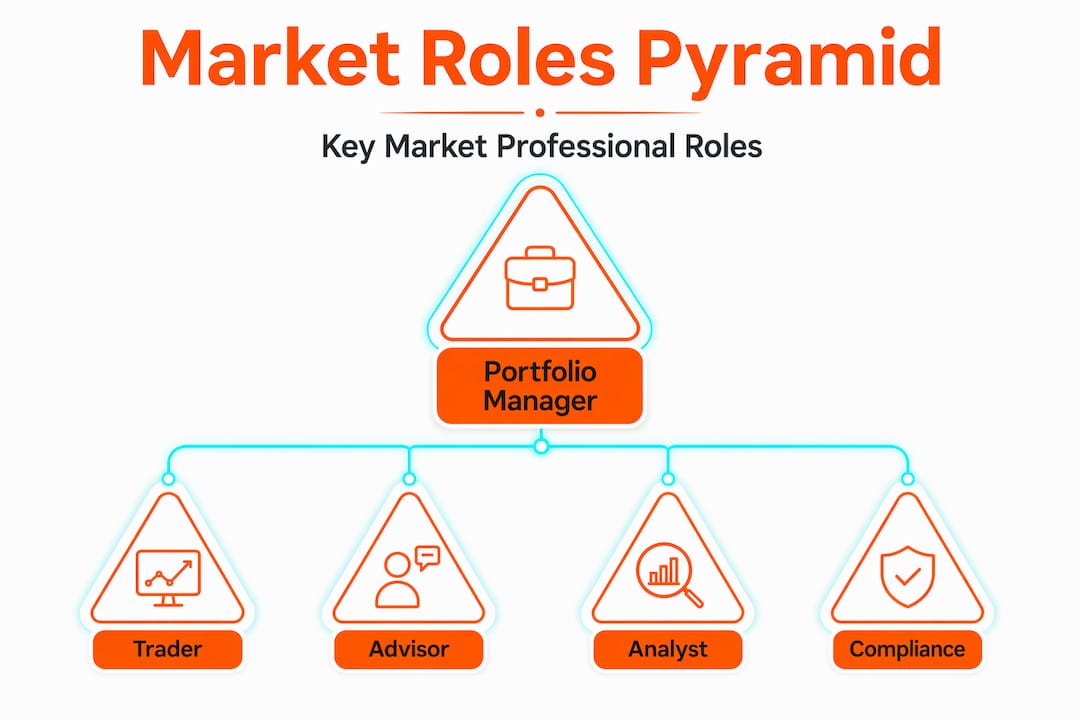
Research analysts produce the data and analysis that feeds both traders and portfolio managers. They cover specific sectors or asset classes, publishing reports that inform investment decisions across the firm.
The table below summarizes the primary distinctions between these core roles:
| Role | Primary function | Output |
|---|---|---|
| Trader | Order execution and position management | Filled trades, P&L |
| Investment advisor | Client-facing portfolio guidance | Recommendations, plans |
| Portfolio manager | Discretionary capital allocation | Portfolio performance |
| Research analyst | Sector or asset-class analysis | Research reports |
| Compliance officer | Regulatory adherence and audit oversight | Reports, audit trails |
Each of these roles carries a different risk profile, compensation structure, and career path. Knowing the difference helps aspiring professionals choose a direction with open eyes.
Market makers and liquidity providers
Market makers occupy a unique position in financial markets. They do not take directional bets on whether prices will rise or fall. Instead, they continuously quote both a bid price and an ask price for a given asset, profiting from the spread between the two. Market makers provide essential liquidity by quoting both bid and ask prices, but they also carry meaningful inventory risk that can exceed spread revenue on volatile days.
The risk is asymmetric. When markets move quickly in one direction, a market maker holding inventory on the wrong side can lose far more than the spread income it collected to take that position. Inventory imbalance risk can wipe out profits entirely on volatile trading sessions. This is why skilled inventory management, not price prediction, is the defining competency of a successful market maker.
To manage this exposure, market makers use several techniques:
- Dynamic quote adjustment: Widening spreads when uncertainty rises to compensate for higher risk.
- Hedging with correlated instruments: Offsetting delta exposure by trading related assets or derivatives.
- Algorithmic quote management: Using high-frequency trading systems to react to order flow in milliseconds.
- Position limits: Capping inventory to prevent catastrophic losses during market dislocations.
Pro Tip: If you are studying market microstructure, pay close attention to how market makers behave around scheduled news events. Their spread widening and quote pulling during these windows reveals exactly how they manage uncertainty in real time.
Major firms operating in this space include dedicated electronic market makers alongside bank trading desks. At the regulatory level, market makers comply with fair quoting and position reporting requirements enforced by exchanges. This is not merely a profit-driven activity. Tighter spreads and reliable two-sided quotes improve market quality for every other participant.
Regulations and certifications shaping professional responsibilities
The regulatory environment governing market professionals is detailed and non-negotiable. Certifications, registration requirements, and fiduciary duties are not administrative formalities. They define the legal boundaries within which these professionals operate.
In India, the framework is primarily shaped by SEBI. SEBI-registered investment advisors must operate under strict fiduciary obligations, renew certifications every three years, maintain independence from product distribution, and document every client recommendation. This three-year renewal cycle is designed to ensure that advisors keep their knowledge current as markets and regulations evolve.
The NISM and SEBI regulatory standards certification and regulatory framework ensures high ethical standards and professional capacity among market professionals. The NISM examinations, along with designations like the CFA, serve as entry gates to specific roles and signal competence to employers and clients alike.
The responsibilities of compliance officers deserve separate attention. Compliance officers oversee audits, disclosures, and client protection measures. Their mandate is market integrity, not revenue. They represent the internal enforcement layer between a firm’s commercial activities and its regulatory obligations.
The regulatory framework creates a structured sequence of requirements for market professionals:
- Meet minimum educational qualifications for the intended role.
- Pass the relevant certification examination (NISM, CFA, or equivalent).
- Register with the appropriate regulatory body (SEBI for India-based advisors).
- Operate under fiduciary duty, avoiding conflicts of interest in client recommendations.
- Submit to periodic audits and renew certifications within prescribed intervals.
“Fiduciary obligations and conflict-of-interest avoidance are central to the regulatory framework governing investment advisors, ensuring trust and transparency.” — SEBI investment advisor framework
Understanding compliance in trading is not just relevant to advisors. Any market professional handling client capital or providing recommendations carries some form of regulatory obligation, and ignorance of those obligations is not a legal defense.
How market professionals collaborate within financial firms
The functions of market experts rarely operate in isolation. Real trading desks and advisory firms run on tightly coordinated workflows where information moves between roles continuously. Understanding this collaboration is one of the most practical insights for anyone preparing to enter the profession.

A typical trade idea at a buy-side firm might begin with a research analyst publishing a sector report. A portfolio manager reads that report and decides to express the view through a specific position. The trader receives the order and executes it within defined parameters. The compliance officer reviews the trade for any regulatory or conflict-of-interest issues. Each step depends on the quality of the previous one.
The emergence of hybrid roles has added another dimension to this collaboration. Roles like “Strats” combine quantitative analysis, coding, and client-facing functions. These professionals support sales and trading desks with pricing and hedging models while also interfacing directly with clients. The combination of mathematical rigor and interpersonal skill in a single role reflects how markets have evolved.
Pro Tip: When studying for a finance career, map out the information flows between roles at the type of firm you want to join. Understanding who talks to whom, and why, gives you a clearer picture of how to position your skill set and which relationships matter most on the job.
The table below compares solo versus collaborative role structures across firm types:
| Firm type | Role structure | Collaboration level |
|---|---|---|
| Retail brokerage | Generalist advisors | Low |
| Hedge fund | Specialized traders and quants | High |
| Investment bank | Siloed but integrated desks | Very high |
| Proprietary trading firm | Traders and risk managers | Medium to high |
For aspiring professionals, the path into these collaborative structures increasingly runs through demonstrated performance. Firms want to see how you handle risk before they give you real capital. Learning the transition from retail to institutional trading requires building both technical credentials and a track record of disciplined decision-making.
My perspective on what these roles actually demand
I have spent years working alongside and observing market professionals across multiple firm types, and the clearest pattern I can describe is this: the gap between what people think these roles involve and what they actually demand is wide.
Most beginners focus on the visible outputs, filled orders, published research, client portfolios, without asking what makes those outputs reliable. In my experience, the answer almost always comes back to process discipline and regulatory awareness. The traders who wash out of institutional roles are rarely the ones who lacked raw analytical ability. They are the ones who underestimated how much of the job is about managing risk parameters, documenting decisions, and operating within compliance frameworks.
The evolution of the trader’s role into a hybrid of quantitative analysis and client advisory work is real, and it has raised the bar considerably. What I find underappreciated is that this shift has not replaced the need for interpersonal competence. If anything, client-facing skills have become more valuable as algorithmic systems have taken over pure execution.
My advice for anyone entering this field in 2026: learn the regulatory environment of your target market as rigorously as you learn technical analysis. The professionals who build lasting careers are the ones who understand that regulatory compliance is not a constraint on performance. It is the foundation that makes sustained performance possible.
— Nikola
Start building your professional trading track record with Dayprop
Understanding the responsibilities of market professionals gives you a framework. Turning that framework into a funded trading career requires demonstrating real performance under realistic conditions.
Dayprop is built by experienced market professionals who designed its evaluation process to reflect how capital is actually allocated in professional trading environments. The platform provides structured trading challenges, defined risk parameters, and a performance-based evaluation process that rewards consistency and discipline. Aspiring traders can demonstrate their edge across FX, indices, and crypto markets without risking personal capital. If you are ready to move from studying market professional roles to performing like one, the trading evaluation guide at Dayprop is the place to start.
FAQ
What is the primary role of market professionals?
The role of market professionals covers execution, research, risk management, compliance, and advisory functions. Different professionals specialize in one or more of these areas depending on their firm type and regulatory environment.
What do market makers do exactly?
Market makers continuously quote both bid and ask prices for financial instruments, earning the spread while managing inventory risk. They provide liquidity that allows other market participants to execute trades efficiently.
What certifications do market professionals need?
Requirements vary by role and jurisdiction. In India, investment advisors must pass NISM examinations and register with SEBI. Internationally, designations like the CFA are widely recognized as standards for investment professionals.
How do compliance officers fit into market professional teams?
Compliance officers oversee regulatory adherence, conduct audits, and manage disclosures to protect clients and maintain market integrity. Their role is distinct from revenue-generating functions and operates as an internal check on the firm’s activities.
How can aspiring traders develop professional-level skills?
Aspiring traders can develop professional skills by studying market structure, pursuing relevant certifications, and demonstrating consistent performance through structured trading evaluations. Platforms like Dayprop offer funded trading programs that replicate institutional risk conditions without requiring personal capital.
Recommended