

Choosing the right trader funding model can feel overwhelming with so many structured challenges, instant funding options, and market-specific programs competing for your attention. The key is understanding core evaluation criteria like risk limits, trial structures, payout splits, and fees to match a funding program with your trading style and goals. This guide breaks down the essential factors and funding types so you can make an informed decision and access capital without risking your own money.
Table of Contents
- How To Choose The Right Trader Funding Model
- Evaluation-Based Funding Challenges
- Instant Funding Models
- Market-Specific Trader Funding Models
- Risk Management In Funding Models
- Payout And Scaling Mechanics
- Pricing And Accessibility
- Trader Development And Education
- Summary Comparison And Situational Picks
- Explore DayProp’s Trader Funding Programs
Key takeaways
| Point | Details |
|---|---|
| Evaluation criteria matter most | Risk limits, trial duration, payouts, and fees determine your funding success and growth potential. |
| Two dominant funding models | Evaluation challenges and instant funding cover over 80% of proprietary trading programs globally. |
| Risk management shapes outcomes | Drawdown and daily loss limits profoundly impact funded account longevity and scalability. |
| Payout splits reward discipline | Traders typically earn 60-80% splits with scaling tied to consistent, rule-compliant performance. |
| Market alignment improves results | Matching funding models to your traded instruments and volatility tolerance increases success rates. |
How to choose the right trader funding model
Selecting a funding program starts with evaluating your risk tolerance and trading psychology. Maximum drawdown limits typically range from 3% to 6%, while daily loss limits sit between 1% and 2%. These parameters directly impact how much breathing room you have during volatile market conditions. Traders who underestimate their risk appetite often breach rules early and lose funding opportunities.
Trial formats vary significantly across programs. Single-phase challenges may require hitting an 8% profit target in 30 days, while multi-phase structures progressively increase targets and tighten risk controls to simulate real institutional pressure. Trading rule transparency correlates strongly with trader retention because clear expectations reduce ambiguity and emotional decision making.
Payout percentages and capital scaling rules directly affect your earning potential. Most programs offer 60-80% profit splits, with scaling unlocked after three or more consecutive profitable months. Higher splits often come with stricter entry requirements or longer trial periods, creating a tradeoff between immediate earnings and long-term growth. Setting trading objectives aligned with these payout structures helps you stay disciplined during evaluation phases.
Entry costs matter more than many traders realize. Fees range from $150 for smaller accounts to over $1,000 for six-figure allocations. Calculate the cost relative to potential returns and your personal financial situation before committing. A $500 entry fee for a $100,000 account with 80% splits offers better value than a $300 fee for a $25,000 account at 60% splits if you can consistently hit profit targets.
Real-market conditions enforcement separates legitimate programs from those using artificial constraints. Programs that allow news trading, hold trades overnight, and use live market spreads provide the most realistic environment to validate your edge. Avoiding firms with weekend holding restrictions or synthetic pricing protects you from developing habits that won’t translate to live funded trading.
Market-specific availability and volatility rules tailor funding models to your instruments. Forex and indices programs typically offer larger allocations with traditional risk parameters, while crypto funding features smaller accounts averaging $25,000 due to higher volatility. Understanding how proprietary trading funding models adjust for different markets helps you select programs matching your specialization.
Pro Tip: Test your risk management on a demo account using the exact drawdown and daily loss limits of your target funding program for at least 30 days before paying entry fees. This practice phase reveals whether the risk parameters fit your trading style without financial commitment.
Key selection factors include:
- Risk tolerance alignment with drawdown and daily loss limits
- Trial format matching your skill demonstration timeline
- Payout structures and scaling pathways for long-term growth
- Entry costs proportional to account size and earning potential
- Real-market condition enforcement for skill validation
- Market-specific rules tailored to your traded instruments
Evaluation-based funding challenges
Evaluation challenges remain the dominant funding model, requiring traders to demonstrate profitability and risk discipline over 14 to 30 days before receiving capital. Profit targets typically range from 6% to 10% depending on account size and program structure. These trials filter out gamblers and reward traders who can execute consistently under pressure without violating risk rules.
Multi-phase challenges progressively increase difficulty to simulate institutional trading environments. A two-phase program might require 8% profit in phase one with a 5% max drawdown, then 5% profit in phase two with a 4% max drawdown. Each phase tightens constraints to test whether initial profits resulted from skill or luck. This structure dramatically improves trader selection accuracy compared to single-phase evaluations.
Strict risk management rules protect firm capital and create high standards for funded traders. Maximum drawdown limits prevent catastrophic losses, while daily loss caps curb revenge trading and emotional decisions after losing sessions. Traders who respect these boundaries demonstrate the discipline necessary for long-term capital management. Violation of either rule typically results in immediate disqualification regardless of overall profitability.
Payout splits in evaluation models commonly range from 60% to 80%, with higher percentages reserved for larger accounts or traders who pass more rigorous challenges. Initial payouts may start at 60% and scale to 90% after sustained performance, creating incentive alignment between trader and firm. Payout processing usually occurs bi-weekly or monthly after meeting minimum profit thresholds, often around $100 to $200.
Evaluation challenges foster longer trader tenure compared to instant funding because the trial period builds discipline and familiarity with risk rules before real capital exposure. Traders who succeed in performance-based evaluations typically show higher retention rates and better long-term profitability because they’ve already proven consistency under structured constraints.
Pro Tip: Focus on hitting profit targets with at least 20% margin below maximum drawdown limits during trials. This buffer protects you from volatility spikes and demonstrates superior risk management to funding firms reviewing your performance.
Core features of evaluation challenges:
- Trial periods lasting 14 to 30 days with specific profit targets
- Multi-phase structures increasing difficulty and risk constraints
- Strict drawdown and daily loss limits protecting firm capital
- Payout splits from 60% to 80% based on performance and account size
- Higher trader longevity due to skill validation before funding
Instant funding models
Instant funding eliminates trial periods, providing immediate capital access for traders willing to accept significantly tighter risk constraints. This model appeals to experienced traders confident in their ability to operate within narrow margins. However, the tradeoff comes through stringent daily loss limits around 1% and maximum drawdown caps near 3%, creating virtually zero room for mistakes or learning curves.

The compressed risk parameters in instant funding programs result in shorter average tenure compared to evaluation models. Traders face immediate pressure to perform flawlessly from day one, with any rule breach triggering instant account termination. This structure favors scalpers and day traders who close all positions before market close and rarely hold through volatile sessions.
Best suited for highly experienced traders with proven track records, instant funding demands rapid decision making and exceptional risk discipline. New traders or those still developing consistency should avoid this model until they can demonstrate months of profitable trading within similar risk constraints. The psychological pressure of knowing one bad trade can end your funding creates stress that many traders underestimate.
Error margins shrink dramatically compared to evaluation challenges. A 1% daily loss limit on a $100,000 account means losing more than $1,000 in a single session ends your funding regardless of your monthly profit. This reality makes instant funding unsuitable for swing traders or position traders who accept larger drawdowns as part of their strategy. Only traders with tight stop losses and high win rates survive long term.
Quick adaptation to risk parameters becomes critical for survival in instant funding programs. Traders must immediately calibrate position sizing, stop loss placement, and daily profit targets to respect the narrow boundaries. Essential trading skills like emotional control and systematic execution matter more in instant funding than in evaluation challenges because there’s no trial period to adjust.
Key characteristics of instant funding:
- Immediate capital access without trial periods or profit targets
- Stringent daily loss limits around 1% and max drawdown near 3%
- Shorter average tenure due to unforgiving risk constraints
- Best suited for experienced traders with rapid decision-making ability
- Minimal error tolerance requiring flawless risk management from day one
Market-specific trader funding models
Crypto funding models typically allocate smaller capital amounts averaging $25,000 due to the market’s inherent volatility and 24/7 trading cycles. Firms recognize that crypto price swings can breach traditional risk limits quickly, so they compensate by tightening position size rules while slightly relaxing drawdown percentages to around 6-8%. This adjustment allows crypto traders room to navigate volatility without constant rule breaches.
Volatility-driven risk limits create meaningful differences across asset classes. Forex programs often permit 4-5% maximum drawdown on $100,000 accounts, while crypto programs may allow 6-8% on $25,000 accounts despite higher volatility. The logic centers on absolute dollar risk rather than percentage risk, ensuring firms maintain consistent capital protection across all markets regardless of instrument behavior.
Forex and indices funding programs feature larger account allocations, commonly starting at $50,000 and scaling to $200,000 or more for proven traders. These markets offer more predictable volatility patterns and established trading hours, allowing firms to confidently deploy greater capital with traditional risk parameters. The larger allocations attract professional traders seeking substantial income potential from their profit splits.
Risk parameters like drawdown limits and position sizing rules adapt to each market’s unique characteristics. Indices trading strategies require different risk approaches than forex pairs due to varying correlation structures and volatility profiles. Programs that customize rules demonstrate understanding of real trading conditions rather than applying one-size-fits-all constraints.
Some programs offer hybrid models combining evaluation phases with instant funding components, particularly in crypto markets. A trader might pass a 7-day crypto challenge with relaxed rules, then receive instant funding with tighter constraints for ongoing trading. This structure balances skill validation with the fast-paced nature of cryptocurrency markets where opportunities emerge and disappear rapidly.
Market-specific considerations include:
- Crypto models averaging $25,000 allocations due to higher volatility
- Volatility-adjusted risk limits higher in crypto versus forex and indices
- Forex and indices programs offering $100,000+ starting accounts
- Customized drawdown limits and position rules by market behavior
- Hybrid evaluation and instant funding models in crypto programs
Risk management in funding models
Drawdown limits form the foundation of capital protection in all funding models, typically ranging from 3% to 6% depending on account size and market conditions. These limits define the maximum equity drop from your starting balance or highest point, whichever is greater. Exceeding this threshold immediately terminates your funded account regardless of your overall profitability or trading history. Understanding how drawdown calculations work prevents confusion when volatility strikes.
Daily loss limits complement maximum drawdown by preventing rapid capital erosion within single trading sessions. Most programs enforce 1-2% daily caps to curb revenge trading and emotional decision making after losing trades. This rule protects both firm capital and trader psychology by forcing breaks after difficult sessions. Traders who consistently approach daily limits signal poor risk management even if they never breach the maximum drawdown.
Position sizing rules enforce maximum exposure per trade and overall portfolio risk, ensuring no single position can catastrophically damage your account. Common constraints include 2% risk per trade and 6% total portfolio risk across all open positions. These parameters force diversification and prevent over-leveraging, two critical elements of professional trading that separate funded traders from retail gamblers.
Strict adherence to risk rules dramatically improves chances of scaling capital and maintaining funding long term. Firms track how closely traders operate within boundaries, often using this data to determine scaling eligibility. Traders who consistently use 80-90% of their available drawdown show poor risk management, while those maintaining 40-50% utilization demonstrate discipline and room for growth. Prop trading risk tips emphasize staying well below maximum limits.
Effective risk management curtails emotional decision making by creating objective rules that override psychological impulses. When a trader knows violating a 5% drawdown limit ends their funding, the financial consequence creates powerful motivation to follow stop losses and avoid revenge trades. This external accountability structure helps traders develop professional risk habits faster than self-directed practice alone.
Critical risk management components:
- Maximum drawdown limits from 3% to 6% protecting capital sustainability
- Daily loss limits between 1% and 2% preventing rapid equity erosion
- Position sizing rules enforcing maximum exposure per trade and portfolio
- Rule adherence improving scaling chances and funding retention
- Objective constraints reducing emotional trading and impulse decisions
Payout and scaling mechanics
Payout splits for funded traders typically range from 60% to 80%, with the percentage depending on account size, challenge difficulty, and firm structure. Entry-level programs often start at 60-70% splits, while elite challenges with stricter rules or larger allocations may offer 75-80% immediately. Some firms implement tiered structures where splits increase from 60% to 90% as traders demonstrate sustained profitability over six to twelve months.
Scaling capital generally requires three or more consecutive profitable months while respecting all risk parameters. This timeframe allows firms to distinguish skill from luck and ensures traders can maintain consistency across different market conditions. Scaling increments vary by program, with common increases of 25% to 50% of the original account size. A trader starting with $50,000 might scale to $75,000 after three months, then $100,000 after six months of continued success.
Bonus and fast-track schemes provide additional motivation for high performers who exceed minimum profit targets while maintaining exceptional risk management. Some programs offer one-time bonuses of $500 to $2,000 for hitting aggressive profit goals in the first funded month. Fast-track scaling allows traders to jump account sizes more quickly, sometimes reaching $200,000+ within six months instead of the standard twelve-month progression.
Complex payout and scaling rules significantly impact trader psychology and engagement with funding programs. Clear, achievable milestones create motivation and reduce frustration, while opaque or constantly changing requirements damage trust and increase attrition. Traders perform best when they understand exactly what performance metrics unlock higher splits and larger capital allocations. Trading account growth accelerates when scaling pathways align with realistic trader capabilities.
Common scaling progression follows these steps:
- Complete evaluation challenge and receive initial funded account
- Trade for three consecutive profitable months with no rule violations
- Request and receive first capital increase of 25-50% original size
- Maintain profitability for three more months at new account level
- Unlock higher payout split percentage and additional capital scaling
- Continue cycle with potential to reach maximum account sizes of $200,000-$400,000
Payout and scaling features include:
- Profit splits ranging from 60% to 80% based on program and performance
- Scaling requiring three or more profitable months with rule compliance
- Bonus schemes and fast-track options rewarding exceptional performers
- Psychology impacts from clarity versus complexity in scaling rules
- Progressive capital increases tied to sustained, disciplined growth
Pricing and accessibility
Entry fees for proprietary funding programs range between $150 and $1,000+, with pricing scaling based on account size and payout structure. A $25,000 account challenge might cost $150-$300, while a $100,000 account challenge typically runs $500-$800. Programs offering higher payout splits or more favorable risk limits often charge premium fees to offset the increased firm risk and reduced profit margin.
Higher fees generally correlate with larger funded account allocations and more favorable terms for traders. A $1,000 entry fee for a $200,000 account with 80% splits and 5% drawdown limits provides better value than a $300 fee for a $50,000 account with 60% splits and 3% drawdown limits, assuming you can consistently hit profit targets. Evaluating cost per dollar of capital access reveals true program value beyond headline pricing.
Accessibility varies significantly by program rules, markets served, and geographic availability. Some firms restrict participation by country due to regulatory constraints, while others welcome traders globally. Market access matters too, certain programs limit crypto trading or prohibit specific instruments, restricting traders who specialize in those markets. Understanding accessibility requirements before paying fees prevents wasted money and frustration.
Fee structures influence trader commitment and perceived program value in measurable ways. Traders who invest $800 in a challenge demonstrate higher commitment than those paying $150, often translating to better preparation and more serious approaches to risk management. However, excessive fees create barriers for talented traders with limited capital, potentially excluding skilled individuals who could succeed with proper funding.
Selecting affordable programs matched to your financial situation optimizes your funding journey by reducing pressure and allowing multiple attempts if needed. Starting with lower-cost programs builds experience and confidence before committing to premium challenges. DayTraders.com alternatives offer various pricing tiers accommodating different budgets while maintaining professional standards and legitimate funding opportunities.
Pricing considerations include:
- Entry fees from $150 to $1,000+ scaling with account size
- Higher fees correlating with larger allocations and better payout splits
- Accessibility varying by geography, markets, and program restrictions
- Fee structures influencing trader commitment and preparation quality
- Affordability matching personal financial situation for optimal participation
Trader development and education
Over 70% of proprietary firms provide education, coaching, or mentorship alongside funding opportunities, recognizing that trader development directly impacts firm profitability through reduced attrition and higher success rates. Programs offering structured learning paths, live trading rooms, and performance feedback create environments where traders improve skills while pursuing capital access. This educational focus separates legitimate funding firms from those purely extracting entry fees.
Programs emphasize discipline and rule adherence over gambling behavior or reckless trading strategies. Educational content consistently reinforces the importance of stop losses, position sizing, and emotional control rather than promoting high-risk tactics that might generate short-term profits but guarantee long-term failure. Firms profit most when traders maintain funding long term, aligning incentives toward sustainable skill development.
Focus on long-term career growth rather than quick profits fosters sustainable funded trading careers. Programs that celebrate consistent 3-5% monthly returns over flashy 50% months teach realistic expectations and professional trading standards. Long-term growth mindsets reduce burnout and improve trader psychology, leading to better risk management and higher retention rates across funding programs.
Educational content improves trader psychology, risk management, and consistency through structured learning frameworks. Access to recorded webinars on managing drawdowns, live coaching sessions analyzing trade execution, and written guides on building trading plans accelerates skill development. Traders receiving ongoing education demonstrate measurably better performance than those left to figure everything out independently.
Professional development contributes directly to funded account retention and growth by building competencies that extend beyond basic technical analysis. Understanding market microstructure, position sizing mathematics, and performance analytics separates funded traders who scale to six-figure accounts from those who cycle through repeated challenge attempts. Education transforms trading from gambling to genuine skill-based profession.
“Successful proprietary trading programs recognize that trader education and capital allocation are inseparable. Firms investing in comprehensive development resources see 40% higher trader retention and 60% better long-term profitability compared to programs focused purely on evaluation.”
Educational components include:
- Education, coaching, and mentorship provided by over 70% of top firms
- Emphasis on discipline and rule adherence over reckless strategies
- Long-term career focus replacing quick profit mentality
- Psychology and risk management training improving consistency
- Professional development directly increasing retention and scaling success
Summary comparison and situational picks
Comparing funding models across key dimensions helps match programs to specific trader profiles and goals. The table below summarizes core features affecting your funding success and growth potential. Use these comparisons to narrow options before committing to entry fees or challenges.
| Feature | Evaluation Challenges | Instant Funding | Crypto-Specific |
|---|---|---|---|
| Trial Period | 14-30 days | None | 7-14 days typical |
| Profit Targets | 6-10% | None initially | 8-12% due to volatility |
| Max Drawdown | 4-6% | 3-4% | 6-8% |
| Daily Loss Limit | 1.5-2% | 1% | 2-3% |
| Payout Split | 60-80% | 60-75% | 65-80% |
| Entry Fees | $300-$800 | $400-$1000+ | $200-$600 |
| Account Sizes | $50k-$200k | $50k-$100k | $10k-$50k |
| Scaling Timeline | 3-6 months | 3-4 months | 2-4 months |
| Best For | Building consistency | Experienced traders | Volatility specialists |
Evaluation challenges suit new disciplined traders building consistency because the trial period teaches risk management before capital exposure. If you’re developing your edge and need time to prove profitability under structured rules, this model provides the safest path to funding. The longer timeline also reduces pressure compared to instant funding’s zero-tolerance approach.
Instant funding models fit highly experienced traders needing fast capital who can operate flawlessly within narrow risk margins. If you’ve traded profitably for years and consistently maintain tight stop losses with high win rates, instant funding eliminates waiting periods and gets you earning quickly. However, one mistake ends your funding, making this unsuitable for anyone still refining their strategy.
Crypto-specific models cater to volatility specialists comfortable with 24/7 markets and rapid price movements. Smaller account sizes reflect higher risk, but adjusted drawdown limits provide breathing room for crypto’s natural price swings. If you specialize in Bitcoin, Ethereum, or altcoin trading, choosing a crypto-focused program ensures rules match your market’s behavior rather than forcing forex parameters onto crypto instruments.
Choosing based on your risk tolerance, experience level, and traded markets maximizes funding potential by aligning program structure with your strengths. A forex scalper with five years of experience should select different programs than a crypto swing trader with two years of experience. Honest self-assessment of your capabilities guides better decisions than chasing the largest account sizes or highest payout splits. Review comprehensive trading evaluation guides before committing to any program.
Explore DayProp’s trader funding programs
Understanding trader funding models provides the foundation, but taking action requires connecting with programs aligned to your profile. DayProp offers comprehensive, transparent funding challenges tailored to various trader experience levels and market specializations. Our structured evaluation process emphasizes skill validation over gatekeeping, providing clear pathways from challenge completion to funded trading and capital scaling.
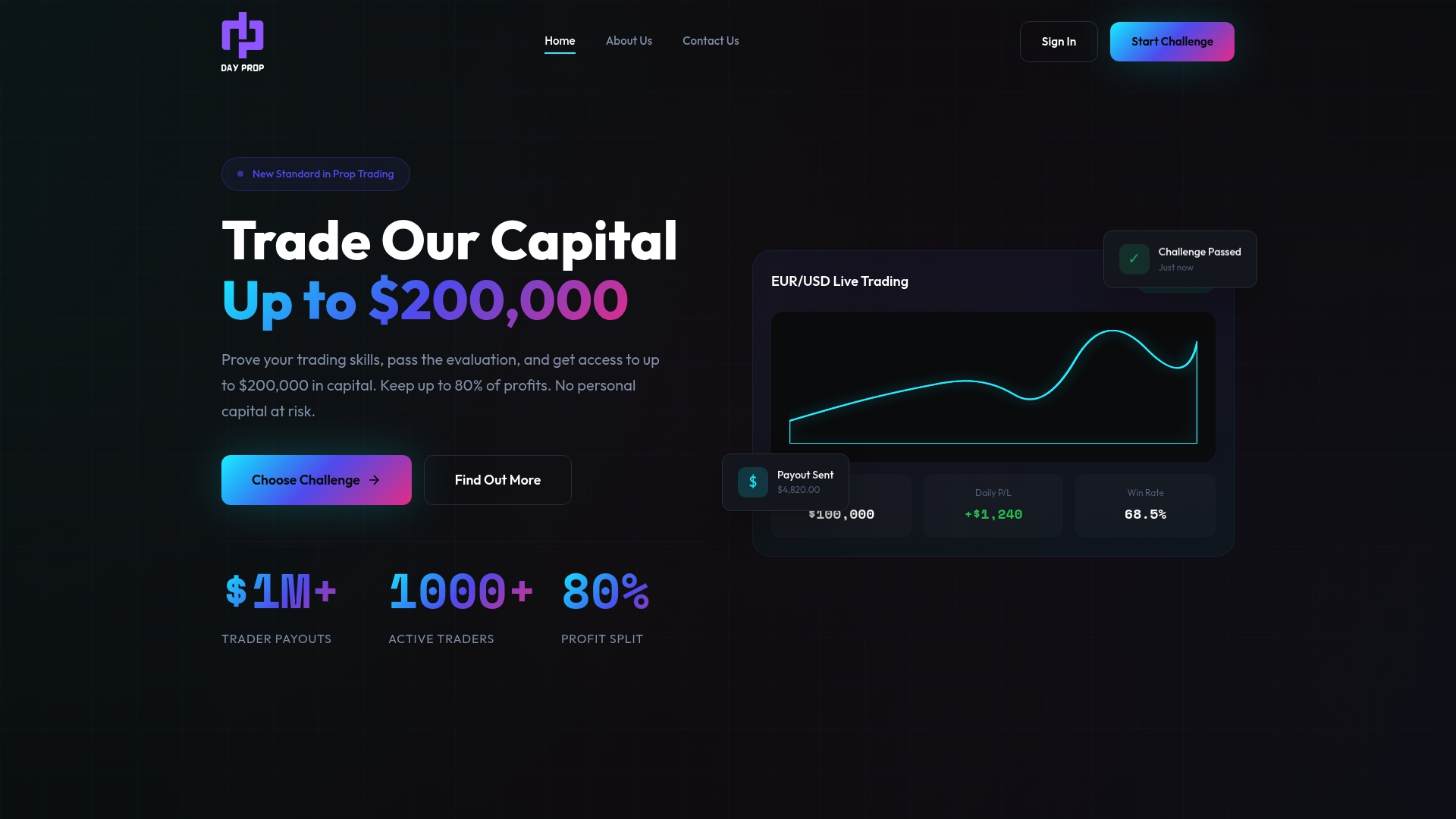
Access expert step-by-step guides detailing our performance-based evaluation process, including risk parameters, profit targets, and payout structures. DayProp’s risk-managed capital allocations feature professional oversight and transparent rules designed to support long-term trader development rather than short-term speculation. Explore comprehensive trading evaluation guides covering everything from challenge selection to scaling strategies.
Whether you trade forex, indices, or crypto, DayProp provides funding options matching your market expertise and risk management style. Our programs reward consistency and discipline, creating sustainable pathways to professional trading careers. Visit DayProp to explore current challenges, review detailed program rules, and begin your funded trading journey with confidence.
FAQ
What are the typical profit targets in evaluation-based funding challenges?
Profit targets in evaluation challenges typically range from 6% to 10% depending on program design and account size. Multi-phase challenges increase targets progressively, requiring 8% in phase one and 5% in phase two to test consistency rather than luck.
How do instant funding models differ in risk rules from challenges?
Instant funding models enforce stricter daily loss limits around 1% and maximum drawdown near 3% compared to evaluation challenges. This reduced tolerance creates shorter average tenure because traders have virtually no margin for error from day one.
What market types have specific funding model adjustments?
Crypto markets feature smaller capital allocations averaging $25,000 with higher volatility-adjusted drawdown limits around 6-8%. Forex and indices programs typically offer larger $100,000+ accounts with traditional 4-5% risk parameters matching lower volatility profiles.
Why is risk management critical in trader funding models?
Risk management through drawdown and daily loss limits protects firm capital while enforcing trader discipline. Proper adherence reduces emotionally driven errors, improves account longevity, and directly increases chances to scale capital and maintain long-term funding.
How do payout splits and scaling incentives work in funding programs?
Payout splits usually range from 60% to 80% based on firm structure and trader performance history. Scaling typically occurs after three or more consecutive profitable months with full rule compliance, increasing capital allocation by 25-50% per milestone with potential bonus accelerators for exceptional performers.
Recommended
- Top 7 daytraders.com Alternatives 2026 – DayProp Funding
- Why traders need professional risk management in 2026 – DayProp Funding
- Indices Trading Strategy Steps for Consistent Funding – DayProp Funding
- 6 Essential Trading Skills Every Funded Trader Needs – DayProp Funding
- Luxury Yacht Financing: 30-50% Down Payment Guide 2026
- Child care funding 2026: maximise your UK support