
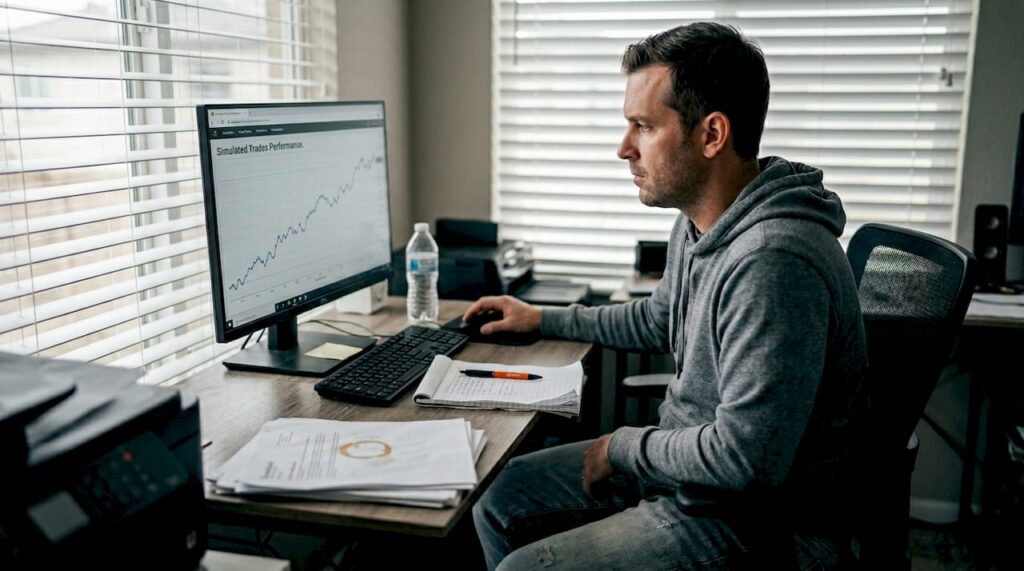
TL;DR:
- Trading simulators help build foundational platform skills and strategy testing without financial risk.
- They do not replicate emotional pressures, slippage, or liquidity gaps present in live trading.
- Successfully transitioning from simulation to live trading involves limited testing, disciplined logging, and small live positions.
Trading simulators are widely seen as a shortcut to trading success. The assumption is straightforward: practice in a risk-free environment, build a winning record, then go live. But the data challenges that belief. Simulated crypto trades across 305 sessions showed an average win rate of only 19% and a return on investment of -2.46%. That means most beginners struggle to profit even when there is no real money at stake. This guide examines what simulators genuinely offer, where they fall short, and how to use them as a structured bridge toward funded trading rather than a false finish line.
Table of Contents
- What trading simulators really do (and don’t do)
- Why risk-free trading matters: Learning, not just ‘winning’
- The double-edged sword: How simulators can build or destroy discipline
- Best practices: Maximizing skill growth and transitioning to live trading
- Most traders misunderstand simulators: Why the right balance is essential
- Take the next step: From simulator to funded trading
- Frequently asked questions
Key Takeaways
| Point | Details |
|---|---|
| Simulators lower risk | They let you practice strategies and trading basics without risking real money. |
| Discipline matters most | Using real-world rules in sim trading builds habits for long-term success. |
| Transition early | Switch to small live trades within 2-3 months to develop true trading psychology. |
| Emotions shape outcomes | Only live trading can teach you how to manage your reactions to profits and losses. |
What trading simulators really do (and don’t do)
Trading simulators give you access to real market data and order execution mechanics without putting actual capital at risk. That is a meaningful advantage, especially for traders who are still learning how platforms work, what order types to use, and how to read price action across FX, indices, and crypto markets. Simulators let you build foundational familiarity before any real money is involved.
What they do well:
- Platform mechanics: You can learn how to place, modify, and close orders without costly errors.
- Strategy testing: You can run a defined setup across dozens of trades to see if it produces consistent signals.
- Market exposure: You gain screen time across different sessions and asset classes.
- Risk parameter practice: You can rehearse position sizing and stop placement without financial consequences.
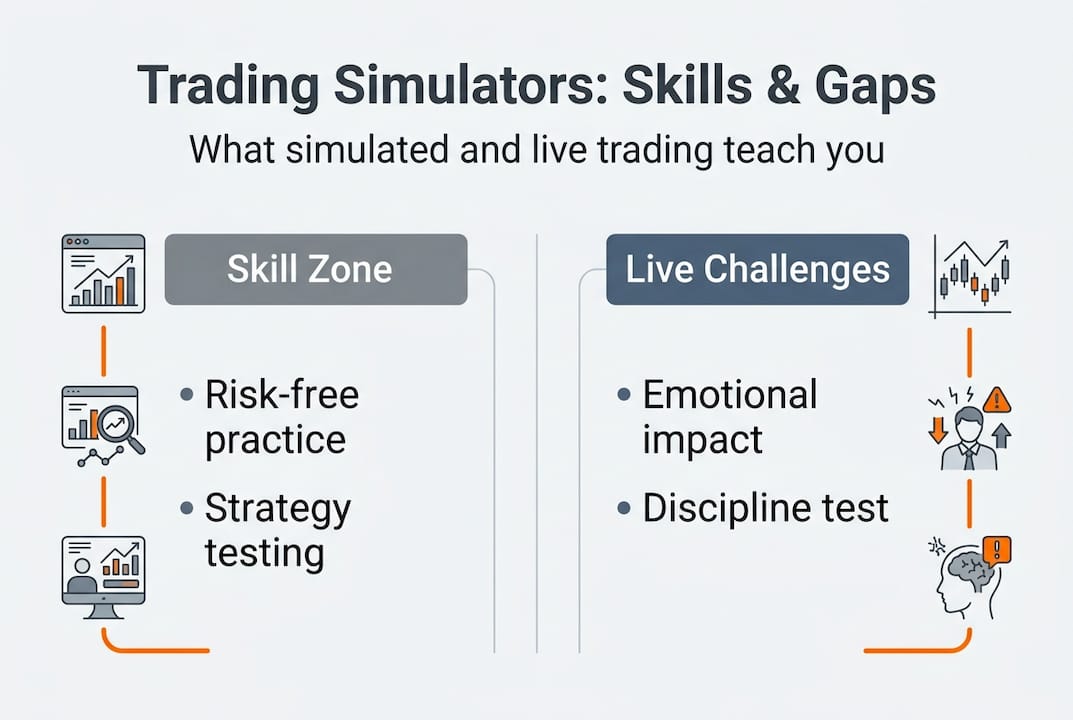
What they cannot replicate is equally important. Simulators do not reproduce the emotional weight of watching a real account drawdown. Slippage, which is the difference between the expected price and the actual fill price, is rarely modeled accurately. Liquidity gaps that occur during news events are often smoothed over in simulated environments. These gaps matter enormously in live trading, particularly in crypto markets where spreads widen sharply.
“Use sim for platform learning and strategy validation across 30 to 100 trades, but limit to 2-3 months before transitioning to live micro-trading.” This framing positions simulators as a starting point, not a destination.
Understanding proprietary trading models helps clarify why the gap between simulated and live performance exists. Institutional environments account for execution friction, emotional pressure, and capital constraints that simulators simply do not impose. The evaluation process guide at DayProp outlines exactly what live-condition performance looks like under structured rules.
Pro Tip: Record every simulated trade as if real capital were at risk. Log entry, exit, rationale, and emotional state. This habit builds the discipline that transfers to live markets.
Why risk-free trading matters: Learning, not just ‘winning’
The value of a simulator is not the profit it generates. It is the feedback it provides. When you trade without financial consequences, you can make mistakes that would otherwise cost you real money. That is the core benefit: accelerated learning through repetition without the penalty of loss.
For traders building foundational skills, simulators allow you to:
- Test a specific entry setup across a statistically meaningful sample of trades.
- Identify which market sessions align with your strategy’s edge.
- Measure your actual win rate and risk-to-reward ratio before committing capital.
- Develop pre-trade routines and post-trade review habits.
Even negative results carry value. The simulated crypto data showing a 19% win rate and -2.46% ROI across 305 trades is not a failure story. It is a readiness signal. If your simulated performance is poor, that is critical information to act on before going live.
The comparison between simulated and live trading environments clarifies what changes when real money enters the picture:
| Factor | Simulated trading | Live trading |
|---|---|---|
| Emotional impact | Minimal | High |
| Slippage | Rarely modeled | Frequent and variable |
| Execution speed | Consistent | Subject to latency |
| Discipline pressure | Low | Significant |
| Feedback quality | Structural only | Full, including psychological |
This table shows why sim results and live results often diverge. The structural mechanics may be similar, but the psychological layer is entirely different. Applying crypto risk management principles during simulation helps narrow that gap by building habits that hold under pressure.
The goal in simulation is not to win. It is to collect enough data to make an informed decision about whether your strategy has a real edge.
The double-edged sword: How simulators can build or destroy discipline
Simulators are not neutral tools. How you use them determines whether they build strong trading habits or quietly erode them. The risk-free environment that makes simulators useful is the same feature that makes them dangerous if misused.
False confidence is the most common outcome of poorly structured sim trading. A trader who achieves a 60% win rate in simulation may attribute that result to skill. In reality, it may reflect the absence of emotional pressure, perfect fills, and no slippage. When those conditions disappear in live markets, the strategy often underperforms.

Paper trading builds false confidence because strategies that succeed in simulation frequently fail live due to emotional friction and execution differences. The recommended approach is to transition gradually using small live positions rather than treating sim success as full readiness.
Numbered steps to bridge from sim to live trading safely:
- Complete a minimum of 30 to 100 simulated trades using a defined strategy with fixed rules.
- Review your sim log for consistency in execution, not just profitability.
- Identify the two or three setups that produced the most reliable results.
- Open a micro account and trade the smallest available position size with real capital.
- Apply the same drawdown limits and trade size rules you used in simulation.
- Track live results separately and compare them against your sim baseline.
Pro Tip: Set real-world constraints in your simulator from day one. Apply a maximum daily drawdown limit, a fixed position size, and a rule against revenge trading. If you cannot follow the rules in sim, you will not follow them live.
Understanding trading psychology is essential here. The mental shift from simulated to live trading is not gradual. It is immediate and often jarring. Preparing for that shift during simulation is the only way to reduce its impact.
Best practices: Maximizing skill growth and transitioning to live trading
Structured sim trading produces better outcomes than unstructured practice. The difference lies in how you define success, track results, and decide when to move on.
Progress benchmarks to guide your simulation phase:
| Benchmark | Target in simulation | Next step |
|---|---|---|
| Trade sample size | 30 to 100 trades | Begin micro-live testing |
| Win rate | Above 40% consistently | Validate with live micro positions |
| Risk-to-reward ratio | Minimum 1:1.5 | Scale position size gradually |
| Time in simulation | No more than 2 to 3 months | Transition regardless of sim results |
| Max drawdown adherence | 100% rule compliance | Proceed to evaluation challenge |
Experts consistently recommend limiting sim trading to 2 to 3 months or 30 to 100 trades before transitioning to micro-live trading. Staying longer than that rarely improves outcomes and often reinforces habits that only work in a consequence-free environment.
What to track in your sim log:
- Entry and exit price for every trade
- Rationale for entering the trade, tied to a specific setup
- Emotional state before, during, and after the trade
- Adherence to rules, including stop loss and position size
- Outcome vs. expectation, noting where the trade deviated from your plan
The transition to live trading should happen as soon as your core mechanics are proven, not when you feel ready. Feelings of readiness in simulation are unreliable. Data from your trade log is not. Managing risk consistently from the earliest live trades sets the behavioral standard that funded trading programs evaluate.
Most traders misunderstand simulators: Why the right balance is essential
Here is the honest perspective most trading guides avoid: simulators are most valuable in the first few weeks of practice, and their value diminishes quickly after that. High-performing traders who successfully enter funded programs do not spend months perfecting their simulated record. They extract what the simulator can teach, then move on.
The debate around sim trading is real. Proponents argue it allows risk-free iteration and strategy refinement. Critics argue it destroys discipline by removing the one thing that makes trading hard: the emotional cost of being wrong with real money. Both views have merit, but the balance matters.
Traders who linger in simulation often do so because they are searching for certainty before going live. That certainty does not exist. The only way to test whether your psychology holds under pressure is to trade with real stakes, even if those stakes are very small. The sooner you accept that reality, the faster your development accelerates.
The benefits of funded trading become accessible only when you are willing to perform under real conditions. Simulation is preparation. It is not performance.
Take the next step: From simulator to funded trading
Ready to translate simulated mastery into live performance? DayProp is built for traders who have done the foundational work and are ready to prove their edge under structured, real-world conditions.
DayProp’s evaluation framework is designed to reward consistency, disciplined risk management, and repeatable execution, not one-off wins. If you want to understand how different funding structures compare, compare trading funding models to find the structure that fits your strategy. For a step-by-step breakdown of what the process looks like, the trading evaluation guide walks you through exactly what funded performance requires. Your simulator work is the foundation. DayProp is where you build on it.
Frequently asked questions
How long should you use a trading simulator before going live?
Experts recommend 2 to 3 months or at least 30 to 100 trades, after which you should transition to live trading using the smallest available position sizes.
Can you become a consistently profitable trader using only simulators?
No. Simulators cannot reproduce the emotional reality of trading real capital, and false confidence developed in simulation is one of the most common reasons traders underperform when they go live.
What risks should you watch for in simulated trading?
The primary risks are developing overconfidence from unrealistic fills and building undisciplined habits. Discipline erosion happens when traders treat simulation as consequence-free rather than applying real-world rules throughout.
Do trading simulators work for FX, indices, and crypto strategies?
Yes, simulators are useful for testing strategies across all three asset classes, but live crypto and FX markets involve slippage and spread widening that simulators underrepresent. The 19% win rate and -2.46% ROI seen in simulated crypto trading highlights how even sim results can reveal significant readiness gaps.
Recommended
- Trader skill vs luck: What really drives trading success – DayProp Funding
- What Is Real Trading Skill? 60% Less Risk, 25% Higher Returns – DayProp Funding
- Understand real trading conditions: trade like a pro – DayProp Funding
- Why use trading rules: improve risk and gain funding in 2026 – DayProp Funding