

TL;DR:
- Payout cycles vary widely across platforms, influenced by timing, thresholds, and eligibility rules, affecting cash flow. Proper management requires understanding the specific cycle type, business day calculations, and threshold requirements to avoid delays and optimize capital. Traders who treat payout cycle management as a structured process enjoy more consistent cash flow and better overall trading stability.
Most traders assume payout cycles work the same way across all platforms. They don’t. Defining payout cycles correctly means understanding that timing, thresholds, business day rules, and platform-specific eligibility criteria all shape when funds actually reach your account. For retail and professional traders, this distinction directly affects cash flow planning, position sizing decisions, and how you structure your trading activity around expected payouts. This guide covers what payout cycles are, how they vary, and what you need to know to manage them effectively.
Table of Contents
- Key takeaways
- Defining payout cycles: what they are and how they work
- Payout thresholds and their effect on timing
- Payout cycle rules in prop trading firms
- Managing payout cycles for better cash flow
- My perspective on payout cycle mismanagement
- How Dayprop supports transparent payout management
- FAQ
Key takeaways
| Point | Details |
|---|---|
| Business days govern timing | Payout cycles run on business days, not calendar days, so weekends and holidays delay fund availability. |
| Thresholds and cycles are separate | Meeting a payout threshold only makes earnings eligible. The cycle schedule still controls when funds are released. |
| Prop firm rules add complexity | Firms like Apex Trader Funding require specific trading days and profitability conditions before any payout is processed. |
| Process definition reduces errors | Well-defined payout processes reduce disputes and improve accuracy across all payout cycle types. |
| Cycle frequency affects cash flow | Choosing the right payout frequency for your trading style directly impacts how efficiently you can manage capital. |
Defining payout cycles: what they are and how they work
A payout cycle is the defined interval at which accumulated earnings are calculated, validated, and disbursed to a recipient. In trading and payments contexts, this means the time period between when earnings are recognized and when those funds are transferred to your bank account or withdrawal destination.
Payout cycles are not simply “how often you get paid.” They include a settlement period, a validation phase, and the actual transfer. Understanding all three stages is the foundation of proper payout schedule management.
Common payout cycle types
Payout cycles generally fall into five categories: daily, weekly, bi-weekly, monthly, and custom or milestone-based. Each has a different effect on cash flow:
- Daily cycles process payouts every business day, maximizing liquidity but often carrying the highest processing overhead.
- Weekly cycles are common among retail platforms and prop trading firms, offering a balance between frequency and operational complexity.
- Bi-weekly cycles reduce administrative load but require traders to plan for longer gaps between fund receipt.
- Monthly cycles are typical in affiliate programs and some funded trading models, concentrating payouts into a single disbursement.
- Variable or milestone cycles tie payouts to specific performance conditions rather than fixed dates.
How business days affect your actual payout date
One of the most misunderstood elements of payout cycle explanation involves business day counting. Payout schedules use business days; weekends and public holidays do not count toward settlement time. This means a payout initiated on a Thursday may not arrive until the following Tuesday or Wednesday once the weekend and bank processing windows are factored in.
Even after a payout is issued, bank processing adds 1 to 3 business days beyond the processor’s timeline. That delay is outside the platform’s control. Traders who plan around calendar days consistently underestimate when funds will actually be available.
Pro Tip: Always count your expected payout date using business days, then add two additional days to account for bank processing. This prevents short-term cash flow gaps that catch traders off guard.
| Cycle type | Typical interval | Best suited for |
|---|---|---|
| Daily | Every business day | High-volume active traders |
| Weekly | 5 to 7 business days | Retail and prop traders |
| Bi-weekly | 10 to 14 business days | Traders with steady monthly income |
| Monthly | 20 to 22 business days | Long-term position traders |
| Milestone-based | Performance triggered | Prop firm funded accounts |
Payout thresholds and their effect on timing
A payout threshold is the minimum accumulated earnings amount required before a payout is released. It is a distinct concept from the payout cycle. The cycle governs timing. The threshold governs eligibility. Both must be satisfied before funds move.
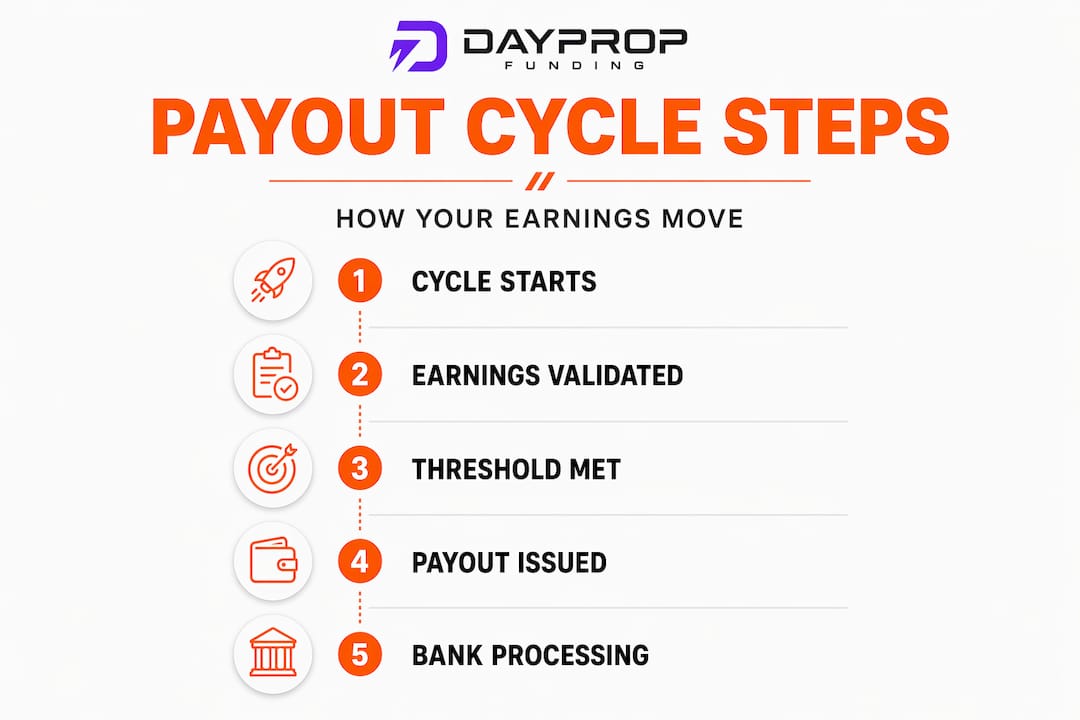
Earnings below the minimum threshold roll forward to the next payout cycle. This means a trader or affiliate who earns $45 in a cycle with a $50 minimum will carry that $45 into the following period. The cycle closes, but no disbursement occurs until the threshold is cleared.
This mechanic creates an important planning consideration. If your payout cycle is monthly and your earnings are close to but consistently below the threshold, you could go multiple months without receiving funds, even though you are technically generating income.
What traders need to monitor
- Know your platform’s minimum payout amount before you start trading or earning.
- Track earnings within the current cycle to forecast whether you will clear the threshold.
- Understand that meeting the payout threshold only makes earnings eligible. The scheduled cycle date still controls when the transfer occurs.
- Request a settlement report rather than relying on individual transaction views, since fees, refunds, and adjustments affect your net payout figure.
- Account for potential reversals. Post-period recalculations for refunds or disputes can adjust your final payout amount even after a cycle closes.
Pro Tip: If you are operating across multiple platforms with different thresholds, keep a single consolidated tracker that shows your position relative to each threshold at any given time. This prevents situations where you assume earnings are available when they are still in a pending or sub-threshold state.
The threshold and cycle relationship is also why some platforms offer “instant” or accelerated payout options at a fee. In those cases, the platform advances funds outside the standard cycle, effectively removing the timing constraint at a cost to the trader.
Payout cycle rules in prop trading firms
Prop trading firms apply some of the most structured payout cycle rules in the industry. Understanding these rules is not optional; they directly determine when and whether you receive a withdrawal from your funded account.
Apex Trader Funding uses a fixed 8-trading-day payout cycle with specific conditions that must be met before a payout request can be submitted. A trading day in this context runs from 6 PM ET to 5 PM ET the following day. Within the 8-day cycle, traders must log at least 5 days that are both active and profitable, meeting minimum profit requirements on each qualifying day.
This structure reflects a broader principle across prop firms: consistent profitability and defined trading day criteria are required to unlock payouts. A trader who takes one highly profitable day and six flat days will not satisfy the consistency conditions, regardless of net profit.
Why gating conditions exist
Prop firms use these conditions to separate disciplined traders from those relying on single-event gains. The conditions also protect the firm from large, unsustainable drawdowns immediately following a payout. For you as a trader, this means your trading activity must be structured around the payout cycle, not just around market opportunities.
If you are working toward a payout on a defined cycle, knowing the cycle’s start date, the required active days, and the minimum daily profit target lets you reverse-engineer your trading plan for that period.
| Firm model | Cycle length | Key conditions |
|---|---|---|
| 8-day trading cycle | 8 trading days | 5 profitable days, minimum daily profit met |
| Weekly fixed | 7 calendar days | Minimum balance above drawdown limit |
| Monthly milestone | 30 days | Net profit target reached, no rule violations |
| On-demand request | Trader-initiated | Account balance and eligibility criteria met |
Learning to compare trader funding models is one of the most practical steps a retail trader can take when choosing between platforms, particularly when payout cycle structures differ significantly between them.
Managing payout cycles for better cash flow
Operational control of payout cycles goes beyond knowing when you will be paid. It involves building a process around your trading that accounts for timing delays, eligibility conditions, and potential disruptions.

Most payout cycle problems stem from poorly defined processes rather than technical failures. When eligibility rules, calculation methods, and disbursement timelines are not clearly mapped, errors and disputes follow. For traders, this means understanding how your platform defines each stage of its payout cycle before you rely on it for cash flow.
Here is a practical approach to payout schedule management:
- Document your platform’s payout cycle terms. Record the cycle length, business day rules, minimum thresholds, and any gating conditions in one place before you start trading.
- Map your expected payout dates on a calendar. Account for business days only and add a buffer for bank processing. Flag weekends, public holidays, and any platform-specific blackout periods.
- Monitor your threshold position weekly. Do not wait until a cycle closes to discover your earnings fell short. Track the running total actively.
- Build a cash reserve for cycle gaps. Even on a weekly payout cycle, a single delayed payout due to a holiday or account review can disrupt short-term operations. A minimum two-week cash buffer removes most of this risk.
- Review settlement reports, not just transaction histories. Reconciliation depends on detailed settlement reports, since individual order views do not reflect net payout after fees and adjustments.
Payout disruptions also occur for administrative reasons. Changing your payout destination can pause disbursements for up to 4 calendar days on some platforms while the change is verified. If you are planning to update bank details, do it immediately after a payout clears, not before one is due.
Pro Tip: Align your payout cycle selection with your actual trading frequency. If you trade actively every day, a weekly cycle keeps capital moving efficiently. If you hold positions for weeks at a time, a monthly cycle may reduce administrative overhead without sacrificing meaningful liquidity.
Defining payment intervals that match your trading style is one of the clearest examples of how payout cycle best practices translate directly into better financial outcomes. Optimizing payout cycles is not about gaming the system. It is about removing preventable delays and making informed decisions about when and how funds flow.
My perspective on payout cycle mismanagement
In my experience, the traders who struggle most with payout timing are not the ones who misunderstand markets. They are the ones who treat payout cycles as an afterthought. I have seen traders with genuinely strong performance records run into cash flow problems simply because they planned around calendar days and ignored business day rules, or because they assumed crossing a profit target automatically triggered a payout.
What I have found is that the most financially stable traders treat their payout cycle the same way they treat their trading workflow: as a structured process with defined inputs, timing, and outputs. They know when their cycle starts, what conditions trigger eligibility, and what delays are possible. They do not guess.
The other issue I see repeatedly is traders conflating thresholds with cycles. They hit their minimum earnings target and expect funds immediately, without understanding that the cycle schedule still applies. That gap in understanding creates frustration and, more practically, forces poor decisions around position sizing because traders believe capital is available when it is not.
My advice is direct: read your platform’s payout documentation in detail, build a simple tracking system, and treat payout cycle management as part of your capital allocation practice, not separate from it. The traders who do this consistently face fewer surprises and make better decisions across the board.
— Nikola
How Dayprop supports transparent payout management
Dayprop is built on the principle that traders deserve clarity at every stage of the evaluation and payout process. If you are working to understand how your performance translates into funded capital and consistent withdrawals, Dayprop’s performance-based evaluation process provides a transparent framework that connects trading discipline directly to payout outcomes.

Dayprop’s structured evaluation model gives traders defined payout conditions, clear cycle terms, and a performance-linked progression path. Rather than encountering ambiguous payout rules after committing to a challenge, traders access the full terms upfront. For traders serious about managing cash flow alongside trading performance, the prop funding evaluation guide outlines exactly how Dayprop aligns payout scheduling with real-world trading conditions.
FAQ
What is a payout cycle in trading?
A payout cycle is the defined interval at which a platform calculates, validates, and transfers earned funds to a trader’s account. It covers the full process from period close through settlement and disbursement.
How do business days affect payout timing?
Business days exclude weekends and public holidays, which means a payout initiated Friday may not arrive until Wednesday of the following week once settlement and bank processing are factored in.
What is the difference between a payout threshold and a payout cycle?
A payout threshold is the minimum earnings required before a payout is released. A payout cycle is the scheduled interval for disbursement. Both must be satisfied independently for a payout to occur.
How does Apex Trader Funding’s payout cycle work?
Apex Trader Funding uses an 8-trading-day cycle requiring at least 5 profitable trading days that meet minimum profit conditions. A trading day runs from 6 PM ET to 5 PM ET the following day.
How can traders optimize their payout cycles?
Traders can optimize payout cycles by selecting a cycle frequency that matches their trading activity, tracking earnings against thresholds actively, and building a cash reserve to cover delays from holidays or account reviews.
Recommended