

TL;DR:
- Most traders assume funding a trading account is as simple as making a bank transfer, but it involves specific transaction types, verification steps, and timelines that can cause delays. Understanding Account Funding Transactions (AFTs), which pull funds directly with your authorization, is essential for faster, more cost-effective deposits, especially when choosing methods like ACH, wire, card payments, or crypto transfers. Proper preparation—such as completing KYC early and selecting suitable funding options—helps traders avoid common pitfalls and ensures they are ready to trade without unnecessary delays.
Most traders assume funding a trading account is as straightforward as a standard bank transfer. In practice, the account funding process involves specific transaction types, verification requirements, and method-dependent timelines that catch many traders off guard. Understanding what the account funding process actually entails, from identity checks to fund availability, separates traders who move fast from those stuck waiting on delayed deposits. This guide covers account funding explained from start to finish, including the most practical methods, the step-by-step process, and the challenges you need to anticipate before they slow you down.
Table of Contents
- Key Takeaways
- What is the account funding process and how does it work?
- Common account funding methods and their trade-offs
- Steps to fund a trading account
- Potential challenges and how to troubleshoot them
- My perspective on getting account funding right
- Start trading with the right funding foundation
- FAQ
Key Takeaways
| Point | Details |
|---|---|
| AFTs are pull transactions | Account Funding Transactions debit funds directly from your card or bank to your trading account, enabling faster processing. |
| KYC verification takes time | Identity verification typically takes 24 to 48 hours, so complete it before you need immediate access to capital. |
| Method selection matters | Each funding method carries different fees, processing speeds, and daily limits that directly affect your trading workflow. |
| Crypto deposits carry risk | Sending funds on unsupported networks or to incorrect addresses can result in permanent, unrecoverable loss. |
| Modern options improve speed | Apple Pay and purpose-built business accounts now offer faster and lower-cost funding alternatives to traditional wire transfers. |
What is the account funding process and how does it work?
At its core, the account funding process refers to the sequence of steps that move money from your personal bank or card into a trading account. But there is a specific mechanism powering most modern funding transactions that most traders never think about: the Account Funding Transaction, or AFT.
AFTs are pull transactions authorized by the account holder that debit funds directly from a card or bank account into a target account. This differs from a standard purchase transaction, which pays a merchant for goods or services. It also differs from a push transaction, where you initiate a transfer from your own account outward. In an AFT, the receiving platform pulls the funds toward itself, with your authorization.
This distinction matters because it affects processing speed, fee structures, and how your bank categorizes the transaction. AFTs reduce intermediaries in the payment chain, which speeds up money movement and often lowers costs compared to traditional bank wire transfers. Common use cases include funding digital wallets, prepaid cards, and brokerage or proprietary trading accounts.
Pro Tip: When you see a funding option labeled as “card deposit” on a trading platform, you are almost certainly initiating an AFT. Treat it differently from a regular purchase. Your bank may apply different limits or review criteria.
Understanding AFTs is the foundation of understanding account funding options more broadly. Once you know the transaction type involved, the rest of the process, including method selection, documentation, and troubleshooting, becomes far easier to navigate.
Common account funding methods and their trade-offs
Knowing how to fund an account is only useful if you understand what each method actually costs you in time, fees, and flexibility. Traders generally have four primary account funding methods available to them.
Method comparison at a glance
| Method | Processing Time | Typical Fees | Daily Limits | Best For |
|---|---|---|---|---|
| ACH Transfer | 1 to 3 business days | Low to none | Varies by bank | Regular, recurring deposits |
| Wire Transfer | Same day to 24 hours | $15 to $50 outgoing | High | Large, urgent transfers |
| Card / Apple Pay | Near instant | Low to none | Up to $50,000 | Fast deposits with daily cap |
| Crypto (e.g., USDC) | Minutes onchain | Network fees vary | Platform dependent | Fast settlement, tech-savvy users |
ACH transfers are the most common bank-to-bank method, but the clearing time works against you when markets move fast. Wire transfers are faster but carry outgoing fees from your bank, typically between $15 and $50 per transfer, which erodes smaller deposits significantly.
Card and mobile payment options have improved substantially. Apple Pay supports daily deposits up to $50,000 for US users and processes faster than traditional transfers, making it a practical alternative when speed matters. For traders comfortable with digital assets, USDC and similar stablecoins settle onchain in minutes, though converting back to fiat through your bank can introduce its own delays.
Purpose-built business accounts represent a newer development worth noting. These accounts can be set up digitally in one business day, carry zero ACH fees, and include automated reconciliation features. For traders funding accounts regularly or at scale, this infrastructure reduces friction and administrative overhead considerably.
Key factors to weigh when selecting your funding method:
- Speed vs. cost trade-off. Faster methods like wires cost more. ACH is cheaper but slower.
- Platform compatibility. Not every trading platform accepts every payment network.
- Security. Card-based and regulated banking transfers carry fraud protections that crypto transfers do not.
- Reversibility. ACH and card deposits can sometimes be reversed. Crypto transfers cannot.
Steps to fund a trading account
Understanding account funding explained in theory is one thing. Walking through the actual steps to fund an account prevents costly mistakes and delays when it counts.

Step 1: Complete identity verification (KYC)
Before you deposit a single dollar, regulated platforms require you to pass Know Your Customer checks. KYC verification typically takes 24 to 48 hours and requires a government-issued ID, proof of address, and in some cases a live selfie or video confirmation. Platforms must comply with Anti-Money Laundering regulations, so this step is non-negotiable. Start verification well before you plan to trade.
Step 2: Navigate to the deposit or funding section
Once verified, log into your trading platform and locate the deposit or wallet funding area. This is usually found under “Account,” “Wallet,” or “Funds.” Confirm which payment methods the platform supports before proceeding.
Step 3: Select your funding method and enter the amount
Choose the most appropriate method based on your speed and cost priorities. Enter the deposit amount and double-check the currency. Some platforms display limits per method at this stage. Review them before confirming.
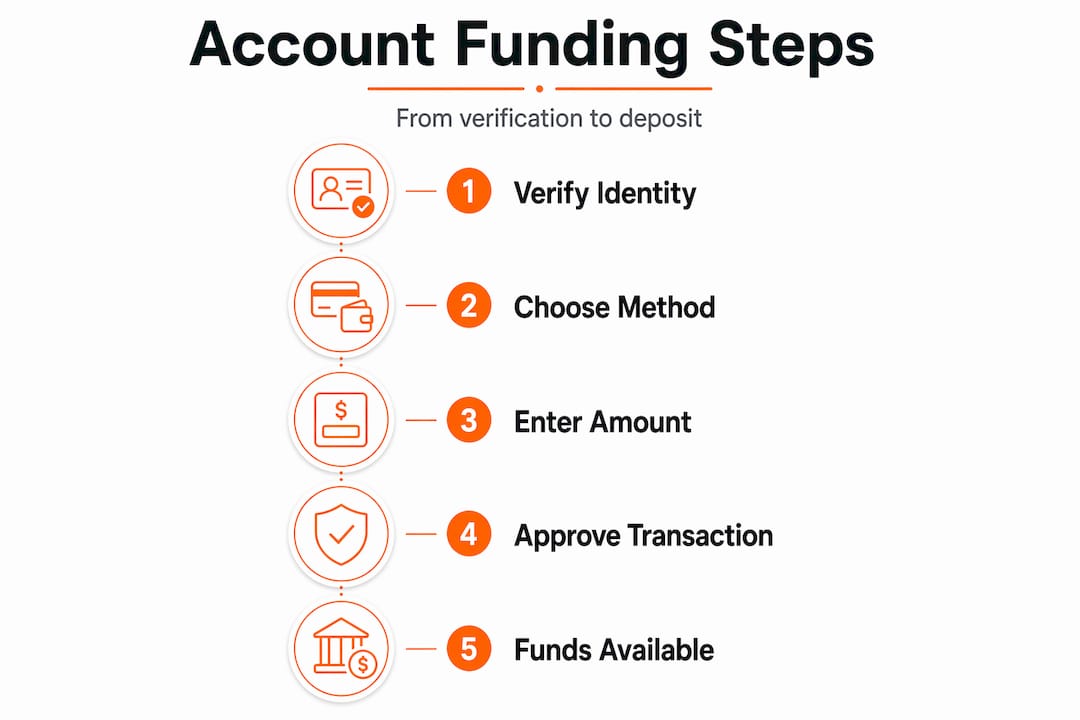
Step 4: Authenticate the transaction
Depending on your method, you will either approve an AFT pull via your card details, authorize an ACH link, initiate a wire from your bank, or confirm a crypto send from your wallet. Multi-factor authentication may be required.
Step 5: Wait for confirmation and fund availability
After initiating the transfer, you will receive a confirmation email or in-platform notification. Card and Apple Pay deposits typically reflect within minutes. ACH transfers may take one to three business days. Wire transfers often clear the same day if sent before your bank’s cutoff time.
Pro Tip: Take a screenshot of your transfer confirmation, including the transaction reference number. If there is a delay or dispute, this documentation significantly speeds up resolution with platform support.
You can also review the full funded trading account workflow to understand how account funding fits within the broader process of getting capital allocated and trading live.
Potential challenges and how to troubleshoot them
Even experienced traders run into problems with account funding procedures. Most issues fall into predictable categories, and knowing them in advance lets you resolve them faster.
Bank flags on crypto-related transfers
Many US banks flag inbound transfers associated with crypto-related platforms, causing delays even when the transaction itself is legitimate. The funds may settle onchain quickly but get held on the banking side. Using exchanges with established US banking relationships helps smooth the fiat conversion and reduces the chance of flagging.
Crypto sent to wrong address or network
This is the most consequential error in the funding process. Sending crypto on an unsupported network or to an incorrect wallet address can result in permanent fund loss. Recovery is not guaranteed and in many cases is not possible. Always copy and paste addresses rather than typing them manually. Confirm the network (e.g., Ethereum, Polygon, Solana) matches what the platform specifies before sending.
ACH declines and unsupported networks
Some platforms do not accept all card networks or ACH configurations. If your card is declined, check whether the platform supports your card type, or whether your bank has restrictions on funding-related transactions. A different payment method often resolves this quickly.
Cash deposit restrictions
Major banks prohibit non-account owners from depositing cash into consumer accounts to prevent fraud and money laundering. If you are trying to assist someone else in funding their trading account with cash, you will encounter this restriction at most major US banks. Electronic transfers from your own account remain the reliable path forward.
Delayed or missing funds
If funds do not appear within the expected window, gather your transaction reference number, timestamp, and the sending account details before contacting support. Platform support teams can trace transfers far more efficiently with complete documentation than with vague descriptions of the transaction.
My perspective on getting account funding right
I’ve watched traders lose hours, and sometimes real money, over funding errors that were entirely preventable. The most common pattern I see is traders treating account funding as an afterthought. They pass an evaluation, they are ready to trade, and then they spend two days sorting out a failed deposit or an unverified account.
What I’ve learned from watching this play out repeatedly is that the best traders approach funding the same way they approach their trade setups: with preparation and zero shortcuts. They complete KYC before they need it. They test smaller deposits with a new platform before sending large sums. They choose their funding method based on actual platform compatibility, not just personal preference.
The improvements in payment infrastructure over the past few years have genuinely changed what is possible. Apple Pay integration and digitally established business accounts have removed friction that used to take days. But these tools only help if you understand what you are working with. Sending a crypto deposit without confirming the supported network first is still one of the most avoidable and costly mistakes in trading.
My view on the future is straightforward. Payment rails for traders will continue improving. The gap between initiating a deposit and trading live is narrowing. But no infrastructure improvement replaces knowing the account funding process steps cold before you execute them.
— Nikola
Start trading with the right funding foundation
Dayprop is built specifically for traders who take the funding process seriously. If you have clarity on how to fund an account but are still working toward your first allocation of live capital, the evaluation path matters as much as the deposit itself.
Dayprop’s performance-based evaluation process walks you through exactly how to qualify for funded capital in FX, indices, and crypto. For traders who want to compare their options before committing, the trader funding model comparison for 2026 breaks down the trade-offs across funding structures in plain terms. Dayprop’s platform is designed to reward disciplined trading, not speculation, and the path from evaluation to live funding is transparent from day one.
FAQ
What is the account funding process in trading?
The account funding process refers to the steps required to move money from your personal bank or card into a trading account. It typically includes identity verification, method selection, transfer initiation, and waiting for fund availability.
How long does account funding take?
Processing time depends on the method. Card and Apple Pay deposits often reflect within minutes, ACH transfers take one to three business days, and wire transfers usually clear the same business day if submitted before your bank’s cutoff.
What are the most common account funding methods?
The most widely used account funding methods are ACH bank transfers, wire transfers, card payments including Apple Pay, and crypto transfers using stablecoins like USDC. Each carries different fees, speed, and security characteristics.
Is account funding necessary before trading?
Yes. Regulated trading platforms require both identity verification and a completed deposit before granting access to live trading. KYC must be approved and funds must be confirmed in your account before orders can be placed.
What should I do if my deposit does not show up?
Collect your transaction reference number, the sending account details, and the timestamp of the transfer. Contact the platform’s support team with this information. Incomplete or vague inquiries significantly slow down resolution.
Recommended